Week 1 Leadership
 Call Kai
 Learn
Learn Practice Test
 Spaced Repetition
 Match
Match Flashcards
 Knowt Play
1/66

There's no tags or description
Looks like no tags are added yet.
Name | Mastery | Learn | Test | Matching | Spaced | Call with Kai |
|---|
No analytics yet
Send a link to your students to track their progress
67 Terms
360-degree feedback
receiving feedback on performance from those you supervise, peers, and supervisors or those higher in an organization structure
Charisma
Personal quality that instills pride, faith, and respect in subordinates by transmitting a sense of mission that is effectively articulated
contingent rewards
rewards and recognition exchanged for accomplishment of assigned work duties or reaching organizational objectives
individualized consideration
delegates projects to stimulate the learning and growth of employees, coaches, and teaches employees, and treats each employee and respect
intellectual stimulation
arousing followers to think in new ways and emphasizing problem-solving and the use of reason before acting
leadership
a process of creating structural change wherein the values, vision, and ethics of change wherein the values, vision, and ethics of individuals are integrated into the culture of a community as a means of achieving sustainable change
Supervisory theories of leadership
path-goal, transactional
Path-Goal Leadership
Leaders increase personal payoffs for subordinates for goal attainment and make the path to these payoffs easier to travel by reducing obstacles, thereby improving performance
Transactional Leadership
Leaders promise rewards and benefits to subordinates for meeting work goals, and leaders and subordinates agree through transactions on what will lead to reward and how to avoid punishment
Strategic theories of leadership
Transformational, situational leadership
Transformational leadership
leaders achieve change by expressing the value associated with outcomes and by articulating a vision of the future resulting in commitment, effort, and improved performance on the part of subordinates
Situational leadership
leader should adopt a leadership style that best fits the developmental level of their subordinates competence and commitment
Servant leadership
leaders are attentive to the concerns of followers and empathize and nurture them by first empowering them and helping them to develop their personal capacities
One often-cited difference in leadership and management mentioned in this chapter is…
Leaders focus on strategic change, whereas managers focus on the status quo
Which of the following would be most accurate in regard to current thinking about the relationships between human traits and leadership effectiveness?
Traits may help us understand how a particular leader might be perceived, but there is little recent research to validate Trait Theory as effective in linking leaders with leadership outcomes.
Which of the following pairs includes two theories of leadership that could both be categorized as supervisory theories of leadership?
Path-Goal Theory of Leadership and Transactional Leadership Theory
A theory of leadership that focuses on identifying the relationship between task characteristics and employee readiness and matching a supervisory response is best called:
Situational Leadership Theory
Two leadership theories that were developed separately but are recognized as most effective when they are combined are:
Transactional Leadership Theory and Transformational Leadership Theory.
In regard to the additive effect of transformational leadership and transactional leadership, which of the following is generally accepted as true?
Transactional leadership and transformational leadership are not contradictory styles but instead are complementary and can be used together.
When comparing Servant Leadership Theory and Transformational Leadership Theory, which of the following best describes the motivation of the leaders?
Servant leaders tend to see all persons as equal and valued, whereas transformational leaders value individuals but more in relation to helping the organization succeed.
One accurate summary statement about what we know about the evidence on gender and leadership would be:
Men and women are perceived as more effective as leaders when the approaches they use match their presentation as more "masculine" or "feminine" as perceived by followers.
Authority-compliance management
heavy emphasis on task, low emphasis on people, results driven, lack of emphasis on communication
Social club management
low concern for task, high concern for people, low emphasis on production, emphasis on social needs, helpful and comforting climate
deprived management
lack of concern with people and tasks, uninvolved leadership, indifferent and apathetic
fence management
compromising, some emphasis on task, some emphasis on people, avoidance of conflict
team management
strong emphasis on tasks and on interaction, participatory and engaged, clear about priorities, open-minded, enjoyable work environment
How does the path-goal theory relate to occupational therapy?
The PEO model describes how the person, environment, and occupation relate to each other to achieve occupational performance. The path is parallel to occupational performance. The tasks are related to occupations. The plan is related to the treatment plan.
Theory U
When intentional efforts to identify issues and improve conditions are made, positive things can take place. This is done with an open mind, open heart, and open will.
What are the 5 movement processes in Theory U?
1) co-initiating
2) co-sensing
3) co-presencing
4) co-creating
5) co-evolving
Directive behavior
set guidelines, clarify expectations, and give guidance on the tasks to be accomplished
Supportive behavior
show concern and respect for followers’ needs and preferences and create a friendly, supportive environment
participative behavior
collaborate with clients to make decisions
achievement-oriented behavior
set challenging but realistic goals to push clients to excel and have confidence they can attain goals
Attributional theory of leadership
attributions are cognitive processes individuals use to understand cause and effect in problem-solving situations.
Situational leadership
based on the leader’s ability to read the multiple factors involved in any given situation and determine the best direction to take to get the job done.
task behavior
the extent to which the leader engages in spelling out the duties and responsibilities of an individual or group
Flow of situational leadership
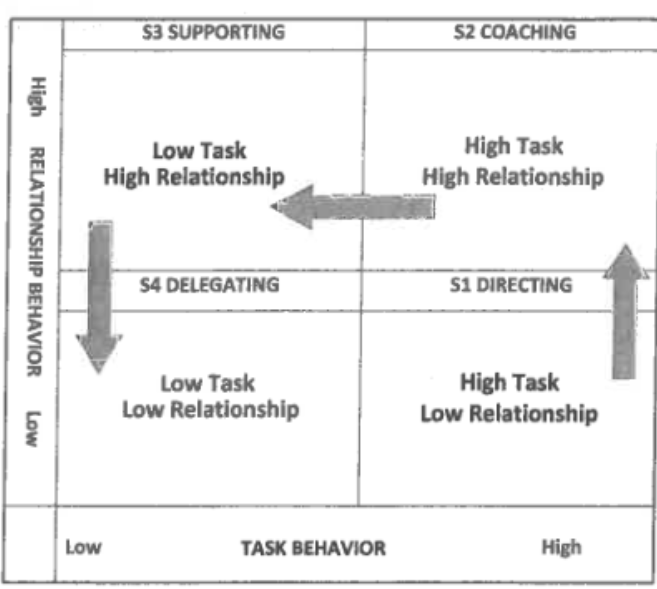
Stages of situational leadership
1) directing
2) coaching
3) supporting
4) delegating
What OT model are transformational leadership and transactional leadership related to?
MOHO
Quantum leadership
views constant change as inevitable
Quantum seeing
the ability to see intentionally
quantum thinking
the ability to think paradoxically
quantum feeling
the ability to feel vitally alive
quantum knowing
the ability to know intuitively
quantum acting
the ability to act responsibility
quantum trusting
the ability to trust life’s process
quantum being
the ability to be in a relationship
Principle 1 of Quantum Theory
Wholes are made up of parts
Principle 2 of quantum theory
all health care is local (all decision are made on a one-on-one level)
Principle 3 of quantum theory
adding value to a part adds value to the whole
principle 4 of quantum theory
simple systems make up complex systems
principle 5 of quantum theory
diversity is a necessity of life
principle 6 of quantum theory
error is essential to creation
principle 7 of quantum theory
systems thrive when all their functions intersect and interact
principle 8 of quantum theory
equilibrium and disequilibrium are in constant tension
principle 9 of quantum theory
change is generated from the center outward
principle 10 of quantum theory
revolution results from the aggregation of local changes
Authentic leadership
focuses on whether leadership is genuine and real, strong connections to others
Leader-member exchange theory
centered on interactions between leaders and followers
what are the three phases of LMX theory?
1) stranger
2) acquaintance
3) mature partnership
authoritarian leadership
theory x, perceive that followers need direction
democratic leadership
theory y, treat followers as fully capable of doing work on their own
Laissez-Faire leadership
non-leadership, hands off approach
Adaptive leadership
prepare and encourage people to deal with change
Inclusive leadership
create environment in which difference are valued and can be incorporated into main work of an organization to enhance strategies, processes, and overall effectiveness
Collective leadership
a group of people with diverse skills and experience working toward shared goals while sharing decision making and working collaboratively
Ethical leadership
concerns with kinds of values and morals an individual or a society finds desirable or appropriate