Section 3: Parts of the muscle fiber (cell)
 Call Kai
 Learn
Learn Practice Test
 Spaced Repetition
 Match
Match Flashcards
 Knowt Play
1/18

There's no tags or description
Looks like no tags are added yet.
Name | Mastery | Learn | Test | Matching | Spaced | Call with Kai |
|---|
No analytics yet
Send a link to your students to track their progress
19 Terms
Microfibrils
Densely packed, rodlike elements in a muscle fiber
80% of cell volume
sarcomeres
contractile units containing myofilaments (myosin and actin)
What do sarcomeres exhibit
striations - perfectly aligned repeating series of dark a bands and light i bands
What are the two filaments inside of a sarcomere
thick myosin filament and thin actin filament
“A” band
dark region
Entire myosin filament with overlapping actin filament
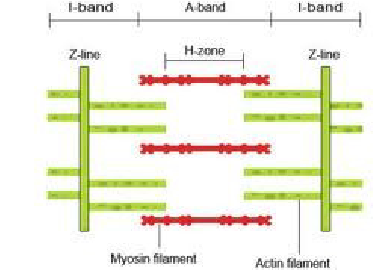
“i” band
light region
actin filament only → not including actin that overlaps with myosin (so basically no myosin)
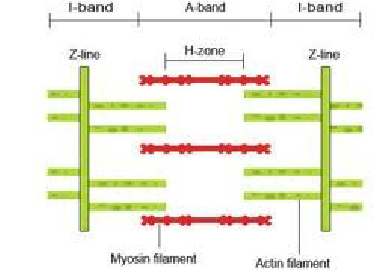
H zone
light region with only myosin → disregard mysoin that overlapps with actin (so basically no actin)
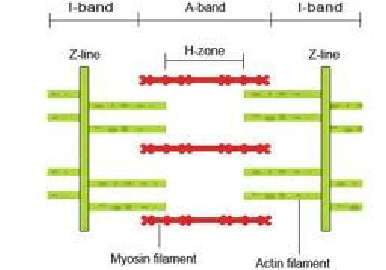
Z line / Z disc
coin shaped sheet of proteins on the midline of light I bands → anchors thin filaments
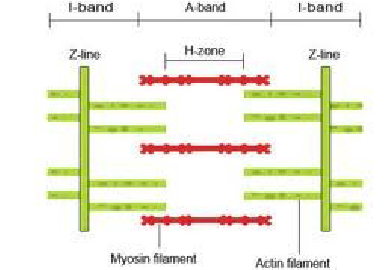
What connects microfibrils to each other
Z - line / z disc
Sarcomere runs from ____ to ____
z-line to z-line
Sliding Filament Theory of
Muscle Contraction
when skeleton muscle fibers contract, myosin heads binds to actin to begin sliding
sliding → cross bridges between actin and myosin form and break to pull actin (thin filament) towards sarcomere center
Does the myosin or actin shrink during contraction
No
4 steps of the Sliding Filament Theory of
Muscle Contraction
what happens to each → h zone , i band, z line , a band
H band and i band get smaller
Overlapping zones get smaller → more overlapping
Z line gets closer together
A band stays constant
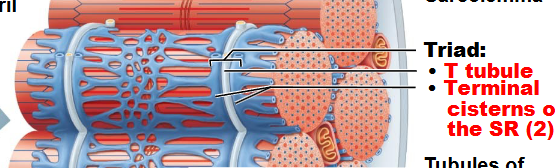
Sarcoplasmic reticulum
ER of the muscle fiber (cell) → surrounds each microfibril → stores and release Ca2+
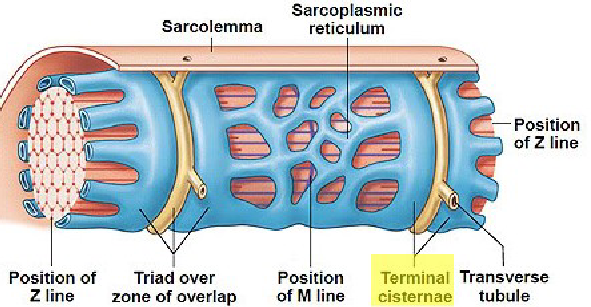
What does the sarcoplasmic reticulum contain
pairs of terminal cisternae forming perpendicular cross channels
sacs that store Ca2+
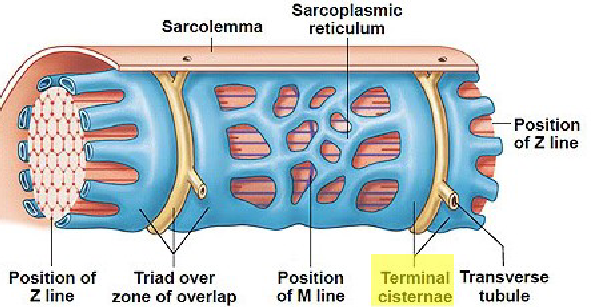
Transverse (T) tubules
continuation of sarcolemma (plasma membrane) that penetrates the cell’s interior
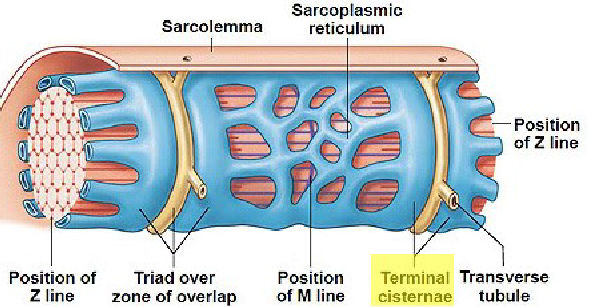
Triad
encircles each sarcomere
t tubules + 2 terminal cisternae of the Sarcoplasmic reticulum
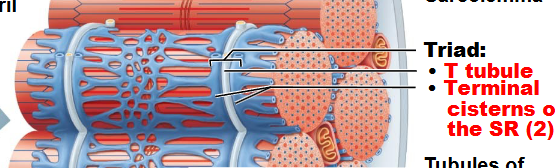
Function of t tubules
conduct electrical impulses deep into the muscle fiber → in each sarcomere
Function of the triad
Convert action potential to release Ca2+ for contraction
Motor neuron
↓
Muscle membrane (sarcolemma)
↓
T tubule
↓
SR
↓
Calcium released
↓
Contraction