Material exchange at capillaries
 Call Kai
 Learn
Learn Practice Test
 Spaced Repetition
 Match
Match Flashcards
 Knowt Play
1/15

There's no tags or description
Looks like no tags are added yet.
Name | Mastery | Learn | Test | Matching | Spaced | Call with Kai |
|---|
No analytics yet
Send a link to your students to track their progress
16 Terms
Movement of biomolecules (nutrients and wastes) across thin capillary wall
From plasma to interstitial fluid (then into cells) and vise versa
Capillary density is related to the metabolic demands of the tissue
Measured by the number of capillaries per unit of surface area
Can be increased by growing new ones (angiogenesis)
Capillaries have the thinnest walls
single layer of flattened endothelial cells that are “leaky”
Supported by the basal lamina (basement membrane) of fibrous proteins
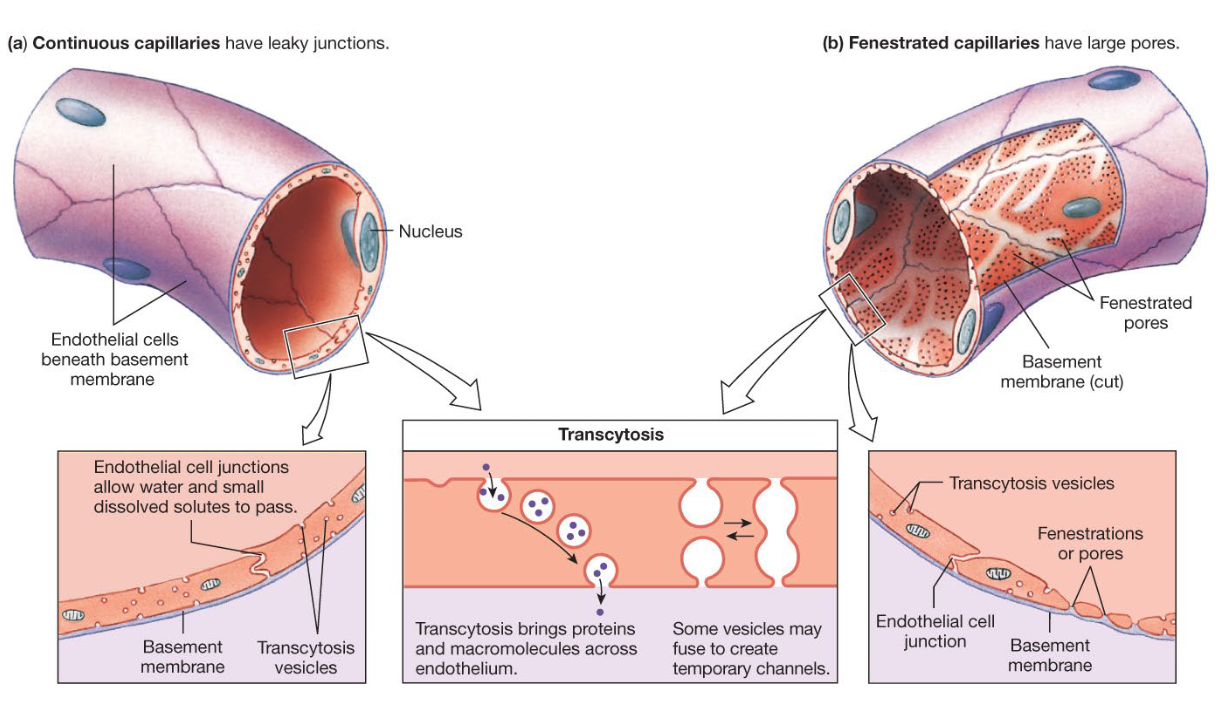
Two types of capillaries
Continuous capillaries: have leaky junctions
Fenestrated capillaries: have large pores
Types of transport across capillary endothelial cells
Transcytosis
Diffusion
Water movement
Transcytosis
a type of transcellular transport where macromolecules are captured in vesicles on one side of a cell, transported across the interior, and released on the opposite side
For large proteins and other solutes too big to fit through fenestrations or junctions between cells
Diffusion for small molecules (gases, ions, glucose, amino acids, etc)
through between-cell (paracellular) junctions and channels or fenestrations
Direction of movement is determined by concentration or pressure gradients
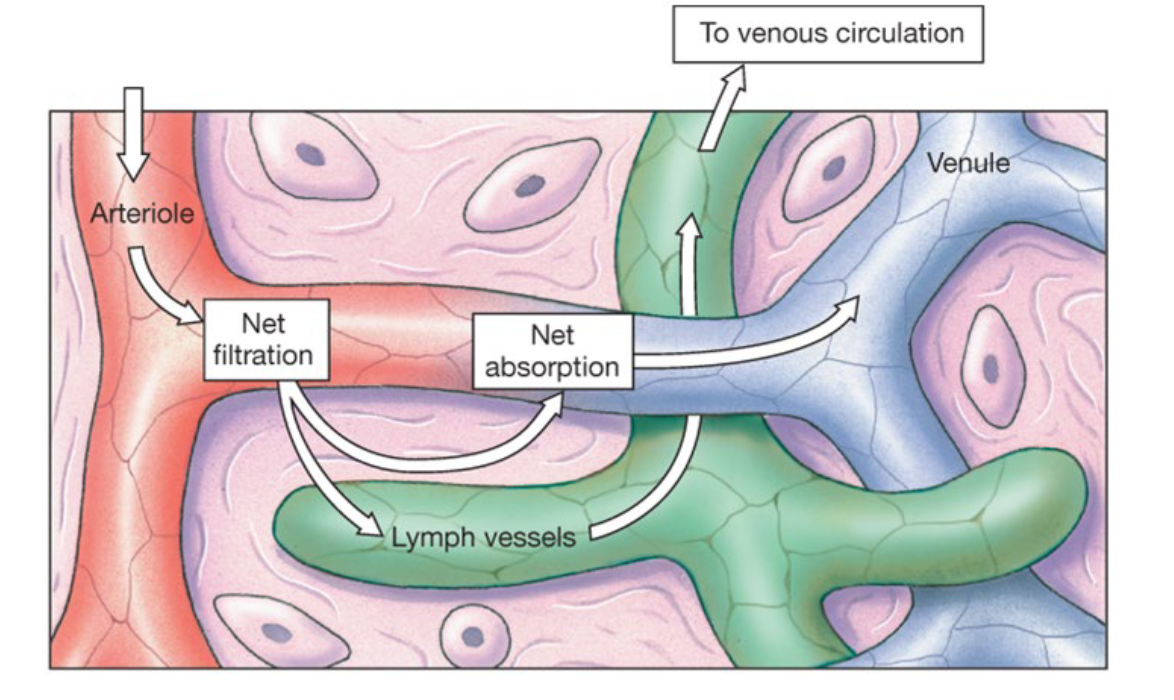
Water moves by “bulk flow” and is driven by hydrostatic and osmotic pressures
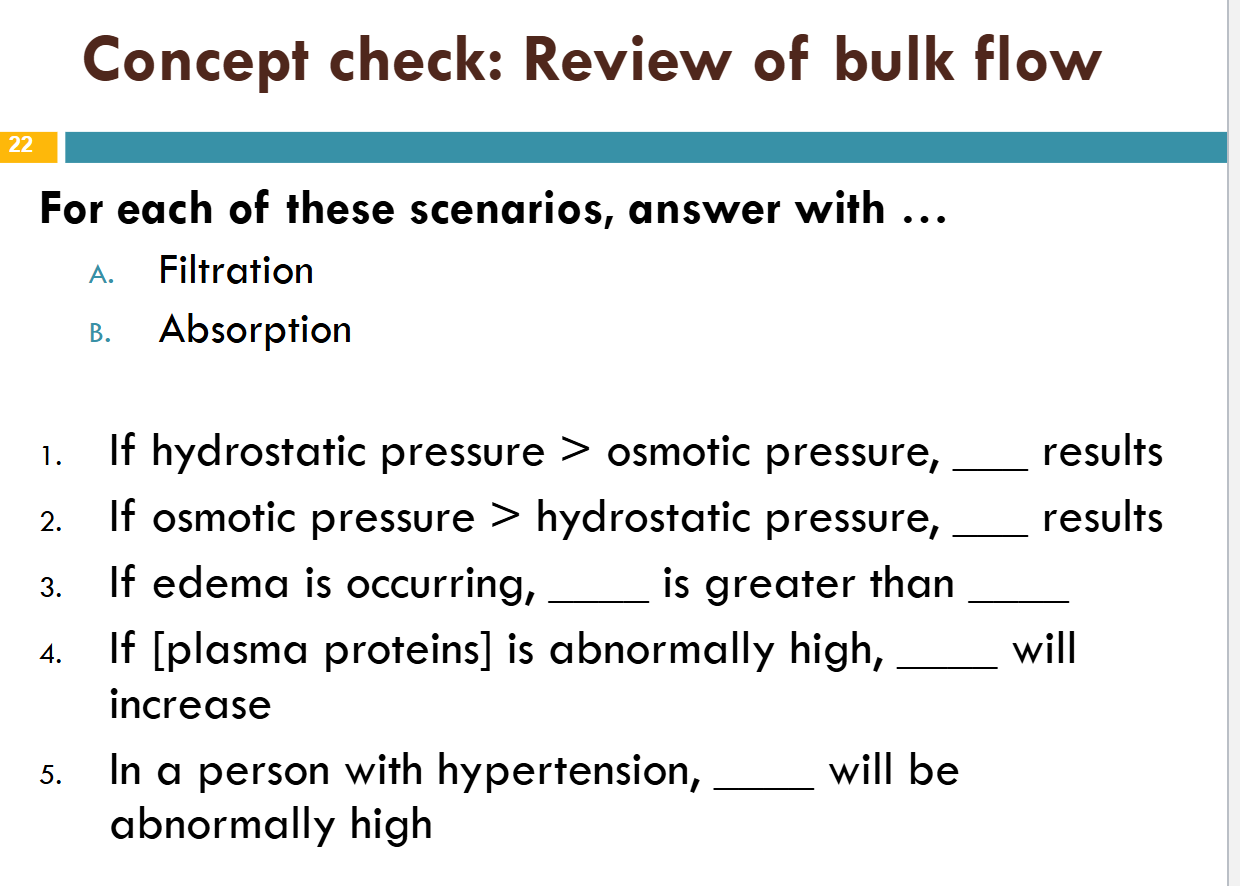
Filtration: water movement OUT OF capillaries
→ driven by capillary’s hydrostatic pressure
→ net filtration occurs at the arteriole end of a capillary bed
Absorption: water movement INTO capillaries
→ driven by colloid osmotic pressure in the capillary
→ net absorption at the venous end of a capillary bed
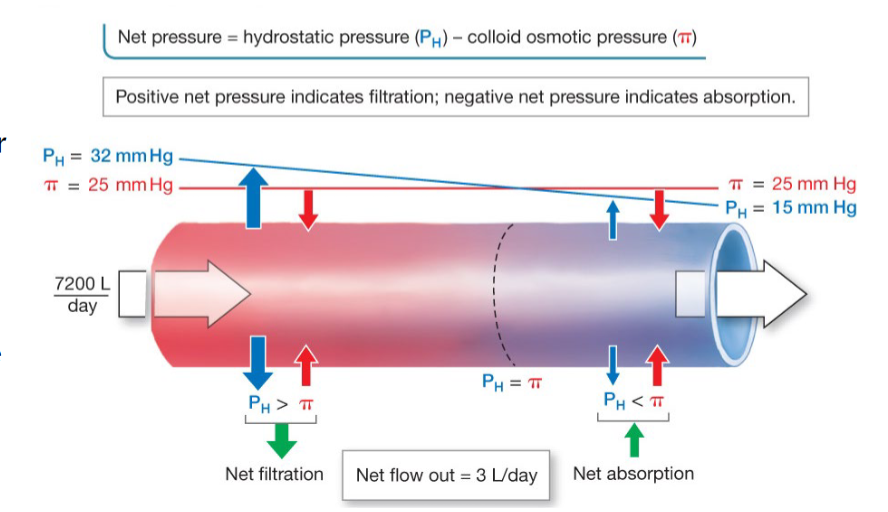
The balance between hydrostatic pressure and osmotic pressure regulates bulk flow of fluid at a capillary!
The net pressure at any point determines the direction of fluid movement
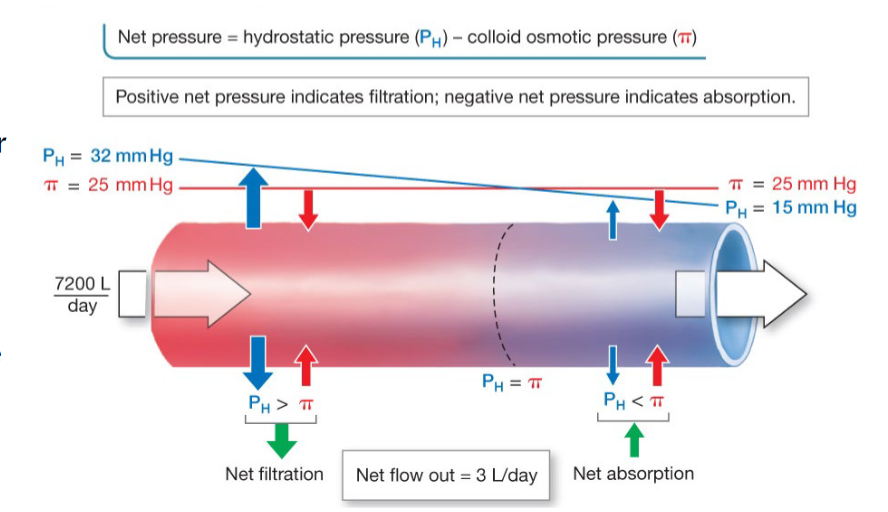
Arteriole end
hydrostatic pressure is higher and forces fluid out of capillary
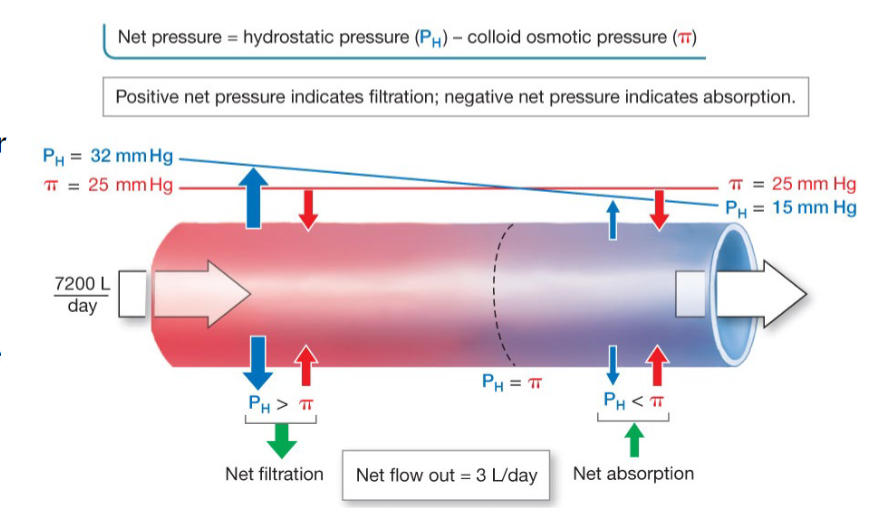
Venous end
osmotic pressure is higher and draws fluid back into capillary
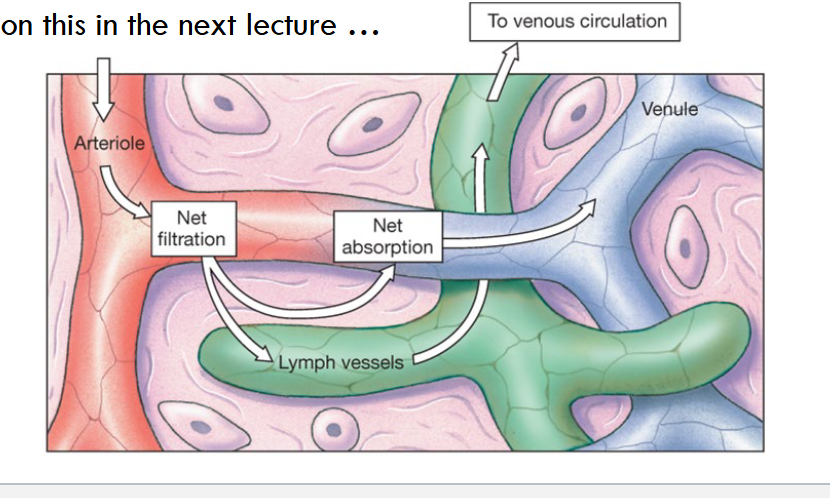
Lymphatic system
collects excess interstitial fluid and proteins and returns them to the circulatory sys
picks up fat absorbed by the digestive sys and transfers it to CVS
also serves as a filter for pathogens
Edema
Fluid accumulation in tissue
What causes edema?
filtration rate is far greater than absorption rate
inadequate drainage of lymph
Edema due to disruption of balance between filtration and absorption can occur when there is an…
increase in hydrostatic pressure in vessels
decrease in plasma protein concentration
→ what will this affect?
increase in interstitial proteins
→ what will this do?