APUSH Unit 1
0.0(0)
Studied by 8 people Note
 Call Kai
 Learn
 Practice Test
 Spaced Repetition
 Match
 Flashcards
 Knowt Play
Card Sorting
1/110

Earn XP
Description and Tags
111 Terms
1
New cards
Radicals
those who favor extreme change
2
New cards
will become incredibly violent to achieve change
radicals, reactionaries
3
New cards
liberals
favor government action
4
New cards
moderates
in between, both sides, middle people
5
New cards
conservatives
Stick to the traditional ways of government and tend to oppose change
6
New cards
reactionaries
want to go back to how things were
7
New cards
maize
corn, amazing, easy to grow, feed lots of people, can support large cities
8
New cards
three-sister farming
corn, beans, squash
9
New cards
"New World" prior to Europeans
Native populations in North America had a wide variety of social, political, and economic structures based on interactions w/ environment and each other
10
New cards
Northwest tribe
Chinook
11
New cards
3 most dominant and advanced civilizations in the Americas
Aztecs, Maya, and Inca
12
New cards
Inca Empire
Empire in Peru
13
New cards
Aztec Empire
Empire in Mexico, flourished due to maize
14
New cards
Reasoning for Europeans to get to Asia
For trade; silk, drugs, perfume, sugar
15
New cards
Moors
Muslims of Spain
16
New cards
issues in european routes to asia
expensive, moors forced very high prices
17
New cards
Marco Polo
Italian explorer who wrote about his travels to Central Asia and China.
18
New cards
Portuguese exploration
Due to advancements in sailing technology, able to sail down the coast of Africa and open trade of gold and slaves
19
New cards
caravel
Portuguese ship
20
New cards
Portuguese in Africa
created trading posts for the purchases of gold and slaves
21
New cards
Bartolomeo Dias
rounds the Cape of Good Hope- the tip of South Africa
22
New cards
Vasco da Gama
the first to reach India by sea sailing around the tip of Africa, made portugal rich, brought back spices
23
New cards
Ferdinand and Isabella
united Spain, drove out the Moors out of southern Spain
24
New cards
Christopher Columbus
Italian navigator, funded by the Spanish Government to find a passage to the Far East. given credit for discovering the "New World," made four voyages to the "New World."
25
New cards
Treaty of Tordesillas
Divided the New World between Spain and Portugal
26
New cards
Columbian Exchange
The exchange of plants, animals, diseases, and technologies between the Americas and the rest of the world following Columbus's voyages.
27
New cards
New Spain
Mexico, Caribbean, Central and Southwest of present-day USA, Florida, Central America; started to create armed outposts to protect them from other Europeans and Natives
28
New cards
Ecomienda
allows government to "command" or give Indians to colonists in promise to Christianize them, basically slavery
29
New cards
Hernan Cortes
Spanish conquistador who defeated the Aztecs and conquered Mexico
30
New cards
Francisco Pizarro
Spanish explorer who conquered the Incas
31
New cards
Montezuma
Powerful Aztec monarch who fell to Spanish conquerors (Cortes)
32
New cards
economic condition changes in Europe
capitalist system, due to the influx of money; spread commerce and manufacturing
33
New cards
merchants in France and Holland
start making money
34
New cards
Conquistadors
Spanish soldiers and explorers who led military expeditions in the Americas and captured land for Spain
35
New cards
Vasco Nunez Balboa
discovered the Pacific Ocean
36
New cards
Ferdinand Magellan
first around the tip of South America, his ship was the first to circumnavigate the globe
37
New cards
Ponce de Leon
Discovered Florida
38
New cards
Francisco Coronado
Spanish explorer, in search of golden cities, went through Arizona and New Mexico and saw the Grand Canyon and buffalo (animal)
39
New cards
Hernando de Soto
Spanish explorer who discovered and claimed the Mississippi River for Spain
40
New cards
European nations response to Spain's new power
everyone felt threatened by them, wanted to be better,
41
New cards
John Cabot
English explorer who claimed Newfoundland for England while looking for Northwest Passage
42
New cards
Giovanni Verrazano
French explorer who sailed from Nova Scotia to the Carolinas
43
New cards
Jacques Cartier
discovered the St. Lawrence River
44
New cards
West African Slavery
spanish imported enslaved africans to labor in plantation agriculture and mining
45
New cards
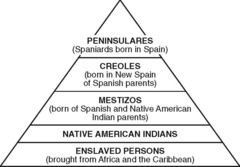
Spanish Caste System
defined the status of the diverse populations of Europeans, Africans, and Native Americans in their empire
46
New cards
creoles
Spaniards born in Latin America
47
New cards
Mulattos
Persons of mixed European and African ancestry
48
New cards
Mesitzo
a person of mixed European and native American Indian descent
49
New cards
Sea Dogs
English sea captains and pirates
50
New cards
Anglican Church
King Henry VIII of England creates so that he can marry and divorce as he pleases
51
New cards
Elizabeth I
wanted to spread protestantism and steal Spanish Ships
52
New cards
Sir Walter Raleigh
An English adventurer and writer, became an explorer of the Americas. In 1585, Raleigh sponsored the first English colony in America on Roanoke Island in present-day North Carolina. It failed and is known as " The Lost Colony."
53
New cards
The Lost Colony of Roanoke
Failed attempt to establish a permanent English settlement in on Roanoke Island
54
New cards
Spanish Armada
"Invincible" group of ships sent by King Philip II of Spain to invade England, Armada was defeated by English "sea dogs" marked the beginning of English naval dominance and fall of Spanish dominance.
55
New cards
Results of the Spanish Armada for Spain
Spain will go into decline, begin to lose a lot of its North american Empire, lose their fighting spirit
56
New cards
Results of the Spanish Armada for England
has all the traits needed for colonization to begin; unified state, popular ruler, nation unified by religion, good navy; and had a growing population, enclosure movement, primogeniture
57
New cards
primogeniture
A system of inheritance which the eldest son in a family received all of his father's land. Many of the other kids turned to the New World for their financial purposes and individual wealth.
58
New cards
Puritans
Protestant sect in England hoping to "purify" the Anglican church of Roman Catholic traces in practice and organization,
59
New cards
Joint-Stock Company
A company made up of a group of shareholders. Each shareholder contributes some money to the company and receives some share of the company's profits and debts
60
New cards
The Virginia Company of London
charter from King James I of England for settlement in the New World, also granted the overseas settlers the same rights as Englishmen
61
New cards
Founding of Jamestown
King James I and the charter guaranteed the settlers that they would have the same rights as all englishmen
62
New cards
Jamestown
First permanent English settlement in North America
63
New cards
John Smith take over
no work, no food- leads to cannibalism
64
New cards
starving time
Most of the colonists of Virginia died of starvation because they did not possess the skills that were necessary to obtain food in the new world.
65
New cards
Lord De La Warr
New governor of Jamestown imposing a strict military rule, and declaring war against the Powhatan Indians
66
New cards
Powhatan Indians
Original inhabitants of the James River area
67
New cards
Anglo-Powhatan wars
defeated because of the three D's;
1. Disease 2. disorganization 3. disposability
they serve no economic function(slaves)so they can be disposed of
1. Disease 2. disorganization 3. disposability
they serve no economic function(slaves)so they can be disposed of
68
New cards
tobacco
Cash crop that made a profit and saved Jamestown
69
New cards
Slave Kingdoms of Africa
Kingdoms that were enslaving Africans and sending them over to the United States
70
New cards
Indentured Servants
Colonists who came over from Europe under the promise they would be servants but in time would be given their freedom
71
New cards
Chattel Slavery
Absolute legal ownership of another person, including the right to buy or sell that person.
72
New cards
House of Burgesses
The first official legislative assembly in the Colonies (mini parliament)
73
New cards
Bacon's Rebellion
Uprising by poor colonists of Virginia against wealthy, attack the indians to get the land, resulted in the burning of Jamestown, very wealthy colonists realized they cant have indentured servants they needed slaves
74
New cards
Governor William Berkeley
corrupt and wealthy, government favored the wealthy,
75
New cards
Nathaniel Bacon
led the rebellion, but ended up getting sick and dying
76
New cards
Results of Bacon's Rebellion
new lands opened for the colonists, wealthy became more cooperative with the colonists, wealthy whites felt they would be better served by bringing in more slaves, racial exploitation, expulsion of more Indians
77
New cards
Sugar
required african slaves to get it, can't get enough because of rum, really labor intensive
78
New cards
Maryland
founded as a catholic paradise by Baltimore
79
New cards
Lord Baltimore
Founded the colony of Maryland and offered religious freedom to all Christian colonists, allowed anyone to come in as long as they believed in the trinity
80
New cards
New England
New Hampshire, Massachusetts, Rhode Island, Connecticut- founded for religious purposes
81
New cards
pilgrims
English Puritans who founded Plymouth colony
82
New cards
Mayflower Compact
First agreement for self-government in America. conset to be ruled by majority
83
New cards
Massachusetts Bay Company
joint-stock company chartered by Charles I, first one that has a home-office not in England, self-governing, local control in colony
84
New cards
City Upon a Hill
Christian community based on God's will, model christian society
85
New cards
John Winthrop
Puritan governor of Massachusetts Bay Colony, made idea of "City upon a hill"
86
New cards
Roger Williams
He founded Rhode Island for separation of Church and State. "we don't need churches if we believe in God"
87
New cards
Rhode Island
Founded by Roger Williams, promoted religious freedom, outlawed slavery
88
New cards
Anne Hutchinson
A Puritan woman who disagreed with the Puritan Church in Massachusetts Bay Colony. Took part in the formation of Rhode Island. She displayed the importance of questioning authority
89
New cards
Half-way Covenant
recognition that the puritans aren't as religious as they used to be, indication of puritans losing power, eased requirements for church membership, no more "elect"
90
New cards
Salem Witch trials
Outbreak of witchcraft accusations in a puritan village marked by an atmosphere of fear, hysteria and stress
91
New cards
New Amsterdam/New York
Dutch colony purposely lost to England, becoming New York- named after Duke of York
92
New cards
William Penn
Quaker that founded Pennsylvania to establish a place where his people and others could live in peace and be free from persecution "religious society of Friends"
93
New cards
Religious society of friends
official name for the Quakers
94
New cards
Pennsylvania
founded by William Penn, to have his Quakers live in peace, religiously tolerant
95
New cards
Southern Colonies
Maryland, Virginia, North Carolina, South Carolina, Georgia
96
New cards
Middle Colonies
New York, New Jersey, Pennsylvania, Delaware
97
New cards
Mercantilism
government needs to control foreign trade, export more than import, as much silver and gold as possible, favorable balance of trade, acquire as many overseas colonies as possible, colonies exist for the good of the mother country, cannot trade with other nations
98
New cards
Salutary Neglect
unwritten British policy of liberal laws, specifically for trade, used to govern and administer the American colonies
99
New cards
Robert Walpole
Prime minister of Great Britain ,position towards the colonies was salutary neglect.
100
New cards
Navigation Acts
rules that you are not supposed to trade with other nations, or smuggle anything, only trade with the mother country