Acid-Base Balance
 Call Kai
 Learn
Learn Practice Test
 Spaced Repetition
 Match
Match Flashcards
 Knowt Play
1/46

There's no tags or description
Looks like no tags are added yet.
Name | Mastery | Learn | Test | Matching | Spaced | Call with Kai | Chat |
|---|
No analytics yet
Send a link to your students to track their progress
47 Terms
Acid
A substance that can yield hydrogen or hydronium ions when dissolved in water.
Base
A substance that can yield hydroxyl ions when dissolved in water.
lower than 6.8 pH
Greater than 8.0 pH
Arterial blood pH that is incompatible to life?
Acid taken with food (exogenous sources)
Carbonic acid formation taking place in the
cell and plasma (constant)
Inorganic acids produced during the
breakdown of nutrients
Organic acids resulting from intermediary
metabolism
Sources of Hydrogen ion in the body
Chemical buffers
First line of defense against pH changes, including the bicarbonate carbonic acid system as the major chemical buffer in the blood.
only takes second to minute after abnormality to react.
Respiratory mechanism
Second line of defense against pH changes and second to respond, involving respiratory mechanism and ventilation.
Takes minutes to hours after pH change occurs.
Renal mechanism
Third line of defense against pH changes, involving the kidneys through reabsorption.
Takes hours to days after pH change to activate.
CO2
Regulated by the lungs thru ventilation (respiration).
Bicarbonate
controlled by the kidneys
Carbonic Anhydrase
An enzyme that catalyze and produce H2CO3.
TRUE
True or False
CO2 and Hydrogen ions are directly proportional in the Lungs?
Level of hydrogen ion determination in the body.
the rate of removal of carbon dioxide would determine the what?
CO2 would accumulate in the plasma and more carbonic acid will be produced as well as hydrogen ion concentration.
Hypoventilation or Slow removal of CO2 of Lungs / no removal will result to
Decrease Hydrogen ion concentration and fast removal of CO2 leading to decrease H+
Hyperventilation or Rapid/fast elimination of CO2 by the lungs will result to
FALSE
TRUE OR FALSE
pH and H+ are directly proportional.
Kidneys
Excrete Considerable Amounts of Acid and Base for Acid-Base Regulation.
Reclaim bicarbonate from the glomerular filtrate
Responsible for excreting excess acid or excess base
50-100 mmol/L
Kidneys excrete _________ of Acid per day.
26-30 mmol/L
Kidneys reabsorb ________ of HCO3
IV infusion (Lactate, Acetate, and HCO3)
When lactate and acetate are infused intravenously, they are transformed into HCO3.
Increase HCO3 in
Diuretics
Reduced Reabsorption
Chronic neophritis
Decrease HCO3 in
Henderson-Hasselbach Equation
Expresses acid-base balance relationship and relates pH to the dissociation properties of weak acids.
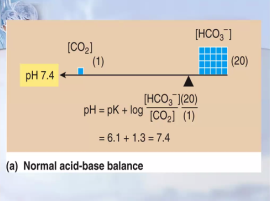
20:1
What ratio should be maintained to determine if there is disturbance in 7.4 pH?
pH, pCO2, HCO3, pO2 - key factors in evaluating acid-base balance.
Parameters of Interest
Bicarbonate and carbonic acid, plasma proteins, hemoglobin, and inorganic phosphate - involved in maintaining pH balance.
Blood buffers
7.40 pH
Optimum Value For Arterial Blood
7.35 - 7.45 pH
normal value of pH
35-45 mmHg
Normal pCO2
<35 mmHg pCO2
Respiratory Alkalosis is seen in
>45 mmHg pCO2
Respiratory Acidosis is seen in
pCO2 (partial CO2)
Index or efficiency of gas exchange.
Heparin, Barbiturates, Morphine Or Alcohol
It can Have An Increasingly Marked Effect On Measured pCO2.
19- 24 mmol/L
Arterial blood total CO2
22-26 mmol/L
Venous blood total CO2
21-28 mEq/L
Normal HCO3
<21 mEq/L HCO3
Metabolic Acidosis is seen in
>28 mEq/L HCO3
Metabolic Alkalosis is seen in
pO2
Reflect the availability of the gas in the blood.
The degree of association or dissociation of oxygen with hemoglobin is determined.
81-100 mmHg
Normal pO2
< 81 mmHg
Hypoxemia is seen in
Mild Hypoxemia
61-80 mmHg pO2
Moderate Hypoxemia
41-60 mmHg pO2
Severe Hypoxemia
40 mmHg or Less pO2
TRUE
TRUE OR FALSE
Healthy persons living at high altitudes will show a lower range of arterial pressure.
Metabolic Acidosis
A condition marked by marked Low pH, Low pCO2, and Low HCO3-
caused by Bicarbonate Deficiency
Production Of Excess Amount Of Acid
DKA - Diabetic Ketoacidosis
Lactic Acidosis
Renal Failure
Diarrhea
(+) Hyperkalemia And
Hyperchloremia
Increase breathing rate
Metabolic Alkalosis
A condition marked by high pH, high pCO2, and high HCO3- levels in the blood
typically caused by an excess of bicarbonate due to factors like vomiting or hypokalemia & hypochloridemia.
seen in decrease Breathing rate.
Respiratory Acidosis
A state where there are Low pH, high HCO3-, and high pCO2 levels in the blood.
Usually resulting from excessive carbon dioxide accumulation seen in conditions of
COPD
Druug overdose
Myasthenia Gravis
CNS Dse
Pneumonia
Kidneys retain HCO3 because of increased pCO2
Respiratory Alkalosis
An abnormal condition characterized by high pH, low pCO2, and low HCO3- levels in the blood
Often due to excessive carbon dioxide loss seen in situations of
Anxiety
Severe pain
Aspirin Overdose
Hepatic Cirrhosis
Gram-Negative Sepsis
Decreased Reabsorption of HCO3 causing Acidification and Hypokalemia.