Production, Costs, and Supply
 Call Kai
 Learn
Learn Practice Test
 Spaced Repetition
 Match
Match Flashcards
 Knowt Play
1/10

There's no tags or description
Looks like no tags are added yet.
Name | Mastery | Learn | Test | Matching | Spaced | Call with Kai |
|---|
No analytics yet
Send a link to your students to track their progress
11 Terms
Cristiano Ronaldo scores two goals per game for the first five goals of the season.
Calculate his average number of goals per game.
2 goals × 5 games / 5 games
= 2 goals per game
Cristiano Ronaldo scores two goals per game for the first five goals of the season
In the next game he scores a hat-trick. What happens to his average goals per game?
Hat-trick - the scoring of three goals in a game by one player
10 previous goals + 3 new goals / 6 games
= 2,17
His average goals increase
Cristiano Ronaldo scores two goals per game for the first five goals of the season.
If instead of scoring a hat-trick he had failed to score, what would have happened to his average number of goals per game?
10 previous goals + 0 goals / 6 games
= 1,67
His average goals decrease
Cristiano Ronaldo scores two goals per game for the first five goals of the season.
Based on the two possible outcomes, as per (b) and (c), explain the relationship between his marginal and average number of goals per game.
There is a direct relationship between marginal and new average number of goals
If marginal > original average - New average increases
If marginal < original average - New average decreases
If marginal = original average - New average remains constant
| Column 1 | Column 2 | Column 3 | Column 4 | Column 5 | Column 6 |
Capital input | 4 | 2 | 7 | 4 | 11 | 8 |
Labour input | 5 | 6 | 10 | 12 | 15 | 16 |
Output | 4 | 4 | 8 | 8 | 12 | 12 |
Suppose the rental rate of capital in table above is R3 and the wage rate is R5.
Suppose the firm is currently using the production techniques shown in columns 1, 3 and 5 for output levels 4, 8 and 12 respectively. Would the firm switch to columns 2, 4 or 6 respectively for any levels of output?
1: TC = (5×5) + (3×4) = 37
2: TC = (5x6) + (3×2) = 36 — cheaper therefore switch to Column 2 Production technique
3: TC = (5×10) + (3×7) = 71
4: TC = (5×12) + (3×4) = 72 — expensive therefore stay at Column 3 Production technique
5: TC = (5×15) + (3×11) = 108
6: TC = (5×16) + (3×8) = 104 — cheaper therefore switch to Column 5 Production technique
How do the firm’s total and average costs change when the rental rate of capital rises?
Total cost increases thus increasing the Average cost — A s the total cost is in the numerator of AC=OutputTC
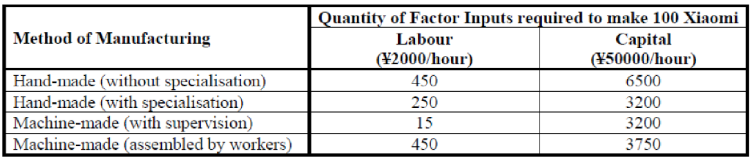
There are four methods of manufacturing a Xiaomi, each using different quantities of factor inputs (capital and labour). According to the following table, which statement is correct regarding the efficiency in the Xiaomi market?
A. Making Xiaomi by hand (without specialization) is not a technically efficient production technique, since the capital expense is larger than the labour expense when manufacturing Xiaomi.
B. Making Xiaomi by hand (with specialization) is a technically efficient production technique, since fewer labourers are required compared to making Xiaomi by hand (without specialization).
C. Making Xiaomi by machine (with supervision) is a technically efficient production technique since fewer labourers are required compared to making Xiaomi by hand (with specialization).
D. Making Xiaomi by machine (assembled by workers) represents production efficiency, as in order to increase production of Xiaomi the production of iPhones must decrease.
E. Each of the above-mentioned production techniques would represent a point on the same production function, as they all pertain to the production of Xiaomi.
C
When the marginal product is increasing:
i. Average product is also increasing.
ii. The total cost curve is increasing at a decreasing rate.
iii. The law of diminishing returns is not yet in operation.
iv. Average variable is decreasing.
A. Only (i) and (ii) are correct.
B. Only (ii) and (iii) are correct.
C. Only (i), (ii), and (iii) are correct.
D. Only (i), (iii), and (iv) are correct.
E. All of the above options are correct.
E
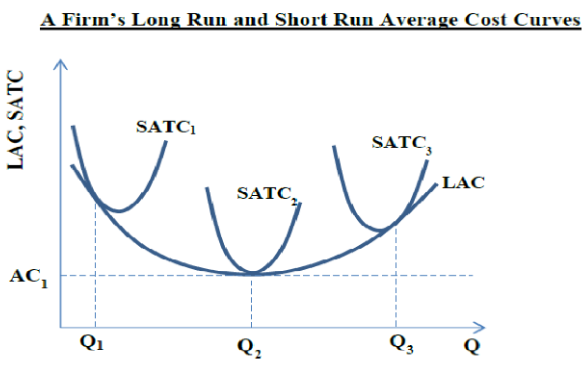
Consider the Figure below.
According to the figure, which of the following is/are correct?
i. All points on the LAC curve show the firm’s minimum average cost of producing a given output when all factor inputs can be varied.
ii. All points on the LAC curve show the firm’s minimum average cost of producing a given output when only one factor inputs can be varied.
iii.Economies of scale exist on all points on the LAC curve between Q1 and Q2, and the minimum efficiency scale exists on all points on the LAC curve between Q2 and Q3.
A. Only (i) is correct.
B. Only (ii) is correct.
C. Only (iii) is correct.
D. Only (i) and (ii) are correct.
E. Only (ii) and (iii) are correct.
A
All of the following would be short run decisions faced by a firm except:
A. Whether to work labour overtime if output sales increase.
B. Whether to construct a new plant if sales increase.
C. Whether to shut the plant down if sales fall.
D. Whether to lay off labour if the demand for the firm’s output declines.
E. A, B and D.
B
A firm’s total curve shows:
A. the only levels of output that the firm may produce.
B. the minimum average cost of producing each level of output.
C. that as output increases, the total cost of production rises.
D. that as output increases, the cost of producing each level of output remains constant.
E. None of the above.
C