MCB 2210 L22: Microtubules
 Call Kai
 Learn
Learn Practice Test
 Spaced Repetition
 Match
Match Flashcards
 Knowt Play
1/23

There's no tags or description
Looks like no tags are added yet.
Name | Mastery | Learn | Test | Matching | Spaced | Call with Kai |
|---|
No analytics yet
Send a link to your students to track their progress
24 Terms
Microtubule assembly
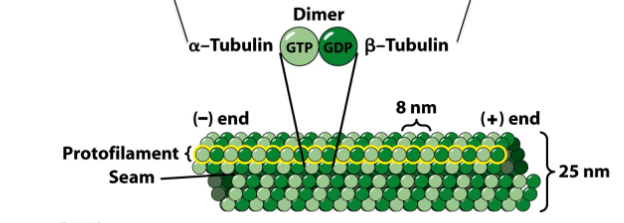
Tubulin heterodimer = subunit
α-tubulin
β-tubulin
Microtubule = polymer
~ 24 nm in diameter
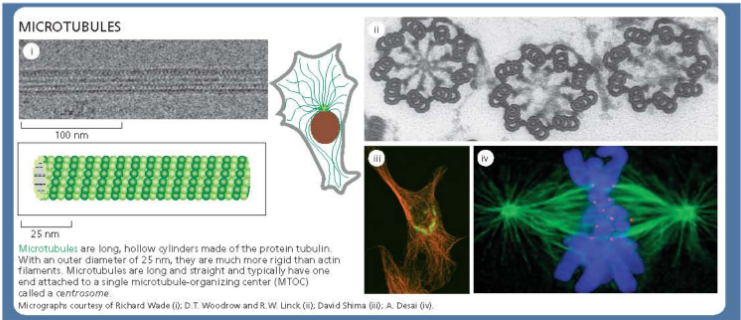
Structure of Microtubules
Microtubules = tubes = tubular polymers
αβ tubulin heterodimers (encoded by 2 genes) = ALWAYS STUCK TOGETHER (under normal conditions)
α-tubulin = DOES NOT hydrolyze GTP (binds irreversibly)
β-tubulin = DOES hydrolyze GTP
Tube forms form from base (vertically)
Protofilament = single linear chain of tubulin heterodimers (lateral interactions = cylinder)
13 protofilaments = 1 microtubule
Polar → MT = polar
(-) end = slow growing = ringed with α-tubulin
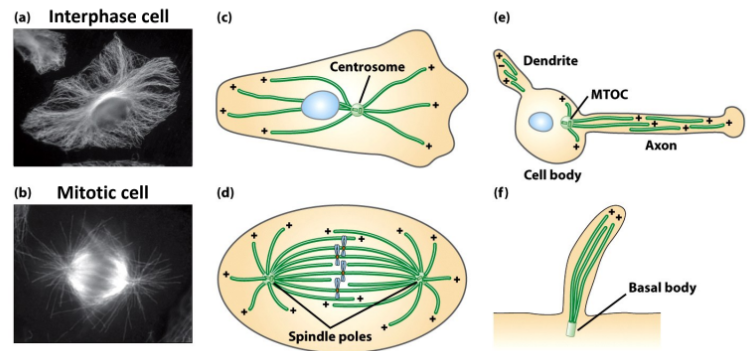
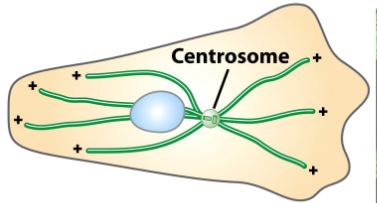
IN VIVO = Usually capped + embedded in MTOC/centrosome
(+) end = fast growing = ringed with β-tubulin
Dynamics primarily @ (+) end
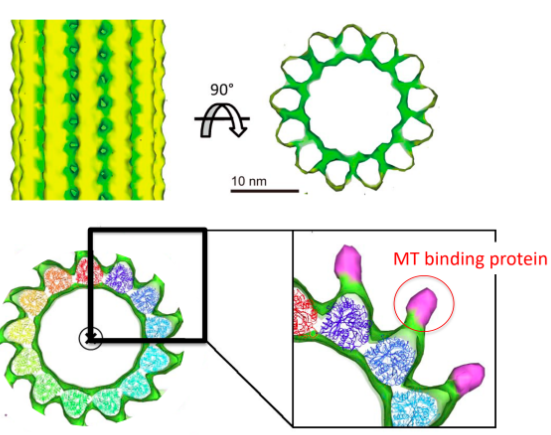
What type of imaging is used to image microtubules?
Cryo-EM: proteins = frozen in liquid nitrogen vapor
2D snapshots in electron microscope
What is a common source of pure tubulin?
Pig brains (high concentration of MTs → tubulin in nervous tissue)
How can MT dynamics be controlled in vitro?
What are the 2 methods to study microtubule dynamics?
IN VITRO → Δ Temperature
Polymerization @ 37°C
Depolymerization @ 4°C
Scattering of light
Polymer = scatters more light than heterodimer (larger)
Fluorescent tag (rhodamine/fluorescein) → tubulin → visualize MT incorporation
Describe the 3 steps of MT assembly kinetics (IN VITRO)
Nucleation
Oligomers = stable seed/nucleus → used to initiate
Slow lag phase
Elongation = fast addition of heterodimers
Steady state = when [tubulin heterodimer] = Cc
Rate of elongation = rate of shrinkage → TREADMILLS
![<ol><li><p><strong>Nucleation </strong></p><ol><li><p><u>Oligomers</u> = stable seed/nucleus → used to initiate </p><ol><li><p>Slow lag phase </p></li></ol></li></ol></li><li><p><strong>Elongation</strong> = fast addition of heterodimers </p></li><li><p><strong>Steady state</strong> = when [tubulin heterodimer] = Cc </p><ol><li><p>Rate of elongation = rate of shrinkage → TREADMILLS</p></li></ol></li></ol><p></p>](https://assets.knowt.com/user-attachments/222e9ddc-2919-401d-986f-a3110fe4ef29.png)
Critical concentration concept on a graph
Critical concentration = [free tubulin] in equilibrium w/ [MT] = TREADMILLINg
[Tubulin] < Cc → no polymerization
[Tubulin] > Cc → polymerization
UNTIL [Tubulin] = Cc → steady state = TREADMILLING
![<p>Critical concentration = [free tubulin] in equilibrium w/ [MT] = TREADMILLINg</p><p>[Tubulin] < Cc → no polymerization</p><p>[Tubulin] > Cc → polymerization </p><p>UNTIL [Tubulin] = Cc → steady state = TREADMILLING</p>](https://assets.knowt.com/user-attachments/3c284547-d17a-48ad-8f29-284d9ff7b281.png)
Explain the 2 differences between the (+) and (-) ends of MTs
Polymerization rate + Critical concentration
(+) end = grows faster, ↓ Cc
(-) end = grows slower, ↑ Cc
Treadmilling
Constant length
(+) end = growing
(-) end = shrinking
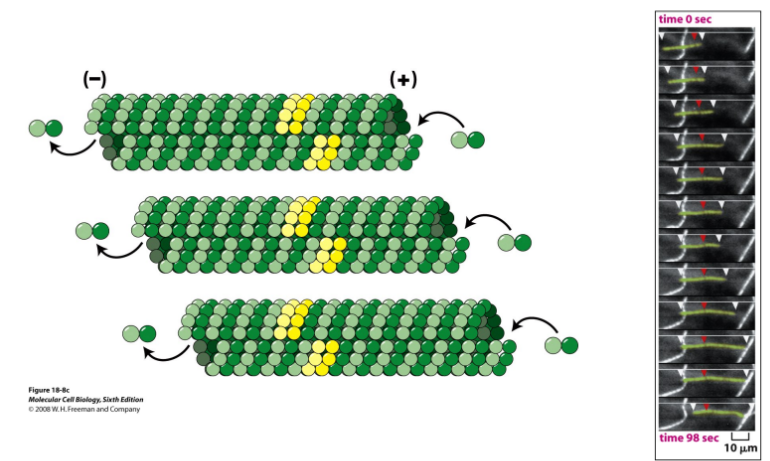
Describe the role of nucleotides in MT dynamics
GTP-bound αβ tubulin heterodimers add @ (+) end
Tubulin dimer incorporates into MT
β-tubulin hydrolyzes GTP → GDP
GTP Cap @ (+) end of MT w/ GTP-β-tubulin
Rest of MT = GDP-β-tubulin
At what concentrations of free tubulin will GTP cap be lost?
[Tubulin] ~ Cc → rate of polymerization slows → GTP cap lost → exposes GDP-tubulin @ end
GTP hydrolysis
GTP dissociation from MT (+) end
Explain the role of nucleotides and GTP cap in MT disassembly
GTP cap → MTs elongate
GTP-tubulin = makes lateral interactions w/ protofilaments (maintain cylindrical structure)
Loss of GTP cap → GDP cap → MTs = destabilized
GDP-tubulin = weakens lateral interactions w/ protofilaments →
Protofilament splaying = lateral interactions BREAK → curl outward → rapid depolymerization + shrinkage
Can be completely disassembled
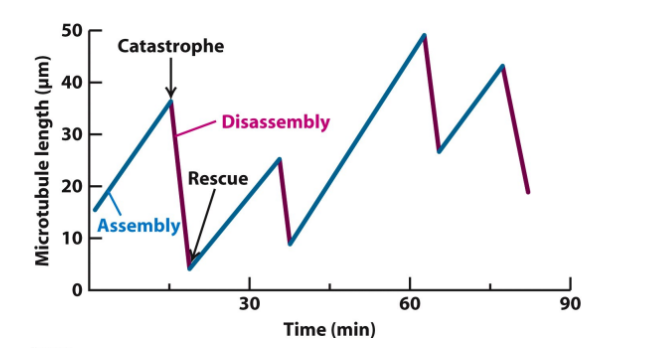
Catastrophe = MT disassembly
Rescue = MT regrowth
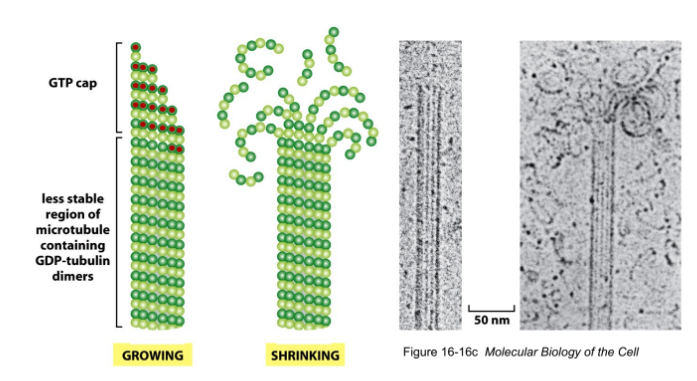
Explain the formation of a GTP cap
GTP cap = rate of polymerization > rate of hydrolysis
Loss of GTP cap = rate of polymerization < rate of hydrolysis
Rate of addition of GTP = too slow → GDP-β-tubulin → weakened lateral interactions → protofilament splaying → catastrophe
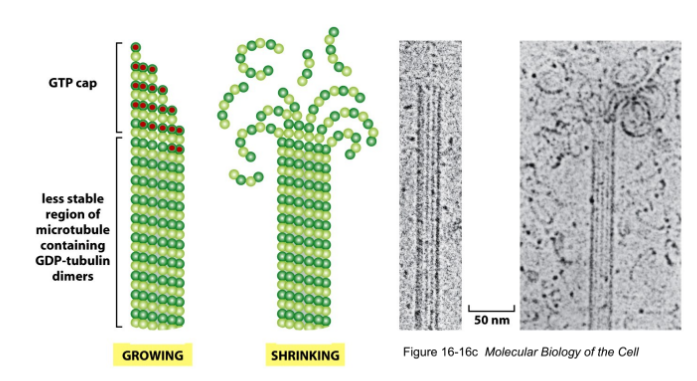
Explain how protofilament splaying works with tubulin heterodimers as GTP-β-tubulin is hydrolyzed to GDP-β-tubulin.
GTP → GDP = Δ conformation → protofilament curves → stress → catastrophe
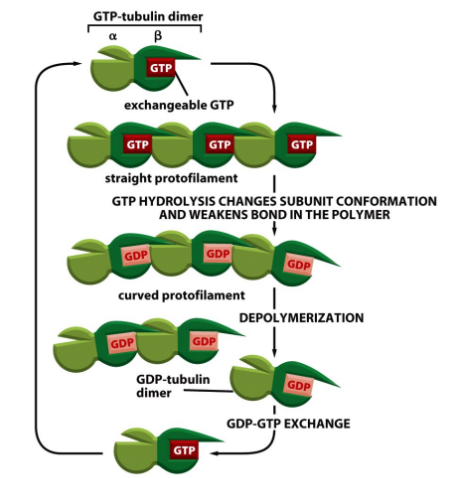
Explain the steps of dynamic instability
Individual MTs = dynamic instability
Dynamic instability = individual MTs = rapidly Δ length
[Tubulin] ~ Cc → some MTs grow, others shrink
Rapid growth w/ GTP-capped (+) end
Rate of polymerization > rate of hydrolysis
Catastrophe = loss of GTP cap → rapid shrinkage
Rate of polymerization < rate of hydrolysis
Rescue = regain of GTP cap → rapid growth
Rate of polymerization > rate of hydrolysis
Cycle repeats
CHANGE IS RANDOM result of conversions b/w GTP→ GDP @ (+) end
Steady state = total amount of polymer = constant, any individual MT can be elongating/shortening
Describe how a graph of microtubule length of an individual MT vs Time can demonstrate dynamic instability
Curve increasing = MT Assembly
Peak = Catastrophe
Curve decreasing = MT disassembly
Valley = Rescue
What two types of protiens is commonly used to visualize dynamic instability IN VITRO?
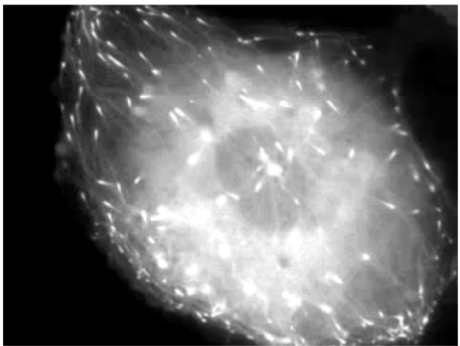
EB1 = (+) end tracking protein (+TIPs) → binds to GTP cap of MTs
Detects presence/absence of GTP cap
Tagged with GFP/fluorescent marker to visualize
Microtubule-Associated Proteins (MAPs) = interact w/ MT ends
Tagged w/ fluorescent markers to visualize MT dynamics
What are 3 ways that cells regulate MT dynamics?
Generally: [Tubulin] > Cc → MT polymerization = favored
MT DO NOT form randomly in cells
Kinetic barrier to nucleation = Unfavorable process of oligomeric “seed”/nucleus” formation from tubulin heterodimers
Microtubule Associated Proteins (MAPs)
Regulate MT assembly in cells
Special Nucleation Sites = allow immediate MT polymerization (eliminate lag phase)
Cell regulates where + when MT polymerizes
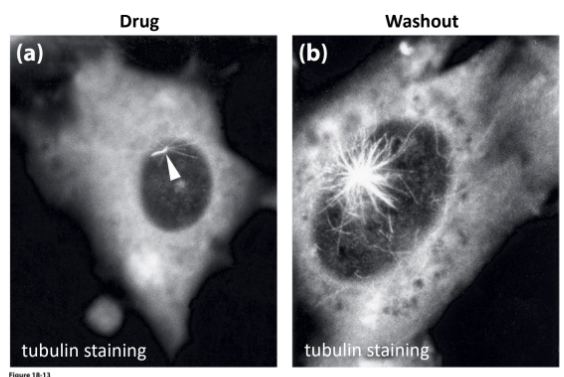
Explain 2 methods of how localization of (+) and (-) ends of MTOC can be proven in an experiment
Δ temperature
Depolymerization @ 4°C
Polymerization @ 37°C
Observe new MTS growing from centrosome → return of normal MT distribution
Adding/washing away drug
MT destabilizing drug = depolymerization
Washing drug away = polymerization
Observe new MTS growing from centrosome → return of normal MT distribution
Describe 3 types of drugs that affect MT polymerization
Taxol = MT stabilizing drug → prevents disassembly
Blocks mitotic spindle assembly
Antineoplastic (anti-cancer) drug
Colchicine = caps (+) end of microtubules → prevent elongation → GTP cap lost → MT depolymerization
REVERSIBLE
Nocodazole = binds to β-tubulin → MT depolymerization
REVERSIBLE
Antineoplastic (anti-cancer) drug
What happens to MTs when nocodazole or colchicine is removed?
MT regrowth from MTOC
Explain parts of the centrosome
Centrosome = 2 centrioles + Pericentriolar Material (PCM)
PCM holds γ-TuRC → MT (-) ends embedded in PCM → (+) ends face outward into cytoplasm
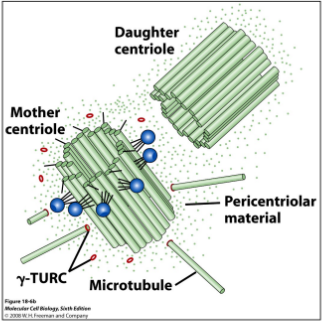
What protein anchors MTs @ the MTOC/centrosome?
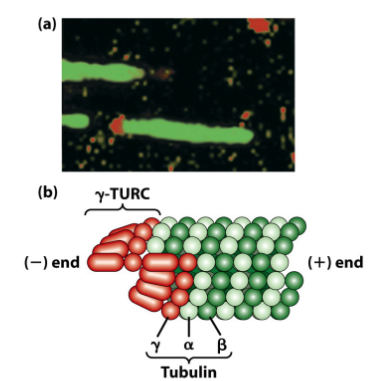
γ-TuRC = cone-shaped protein complex = nucleation template for MT growth @ PCM of centrosome/MTOC
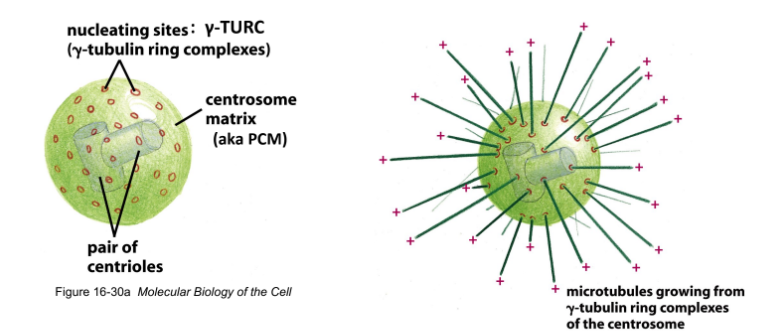
What is the microtubule nucleator used in cells?
γ-tubulin = microtubule nucleator
Part of γ-tubulin ring complex (γ-TuRC)
Purified γ-TuRC nucleates assembly of pure tubulin
Mechanism not well understood
MTs NOT treadmilling in interphase cells
(-) ends bound to MTOCs/centrosomes
Dynamic instability
Describe major functions of microtubules
Cell polarity
Membrane trafficking
Mitosis
Special functions in flagella + nerve axons
Drugs → Δ MT assembly → treat diseases (Ex. cancer)