LESSON 14: INFLUENCES ON CONSUMER BEHAVIOR iops
 Call Kai
 Learn
Learn Practice Test
 Spaced Repetition
 Match
Match Flashcards
 Knowt Play
1/24

There's no tags or description
Looks like no tags are added yet.
Name | Mastery | Learn | Test | Matching | Spaced | Call with Kai |
|---|
No analytics yet
Send a link to your students to track their progress
25 Terms
CONSUMER BEHAVIOR
➢ Refers to the study of customers and how they behave while deciding to buy a product that satisfies their needs.
➢ A study of the actions of the consumers that drive them to buy and use certain products.
Consumers
Refer to people who avail services and buy products in the market.
Psychological Factors
nclude a person’s attitude, perceptions about a situation, their ability to understand information, what motivates them, their personality and beliefs.
Psychological Factors
e.x.: A person who is actively reducing their plastic consumption will buy differently to someone who doesn’t believe in climate change.
Personal Factors
Include age, gender, financial situation, buying power, occupation, background, culture and location.
Personal Factors
e.x.: An older person will probably shop in a different way to a younger person, for example with a preference for bricks-and-motor stores rather than online shopping.
Social Factors
Include a person’s friends, family, community, work or school community, or groups they associate with such as a local church or hobby group.
Social Factors
e.x.: A shopper who is at a school where a certain style of trainers is in fashion might search out similar shoes to fit in with their peers.
Routine Response
○ Brand recognition and repetition plays a large part in this type of buying behavior.
○ People will purchase a brand they recognize, have tried before, or like the best.
○ This type of buying doesn’t require much thought.
Routine Response
e.x.: When choosing a loaf of sliced bread, you’ll probably have a favorite that you reach for most often.
Limited Decision-Making
○ Often mid-level, occasional buying decisions fall into this category.
○ They require some research and little amount of thought before making a choice.
Limited Decision-Making
e.x.: Picking where restaurant to eat in an unfamiliar area (Budget or number of people eating in a restaurant).
Extensive Decision-Making
○ Buying decisions that involve a big financial investment or personal impact fall in this category.
○ Most buyers will spend an extensive amount of time researching.
Extensive Decision-Making
e.x.: Buying a house. Many in the market for a new home will research thoroughly, view numerous properties, weigh up different options, visit local areas, check nearby schools and facilities etc. before a purchase is made.
Impulsive Buying
○ An impulse buy has no prior planning. It is a purchase made on a whim and with little thought.
○ It ‘s often irrational and in the moment.
Impulsive Buying
e.x.: If you’re waiting in a line to buy your lunch and see a magazine within easy reach with an eye-catching front cover, then…
8 CONSUMER CHARACTERISTICS
1. Perfectionist
2. Brand-aware
3. Hedonist
4. Price-aware
5. Fashion-aware
6. Impulsive
7. Confused
8. Habitual
IMPORTANCE OF STUDYING CONSUMER BEHAVIOR
1. Consumer Differentiation
2. Consumer Retention
3. Design Relevant Marketing Program
4. Predict Market Trend
5. Competition
6. Innovation
7. Improve Customer Service
Engel-Kollat-Blackwell (EKB) Model
○ This model of consumer behavior outlines a five-stage decision process that consumers go through before purchasing a product or service.
Engel-Kollat-Blackwell (EKB) Model
Awareness → Information Processing → Evaluation → Purchasing Decision → Outcome Analysis
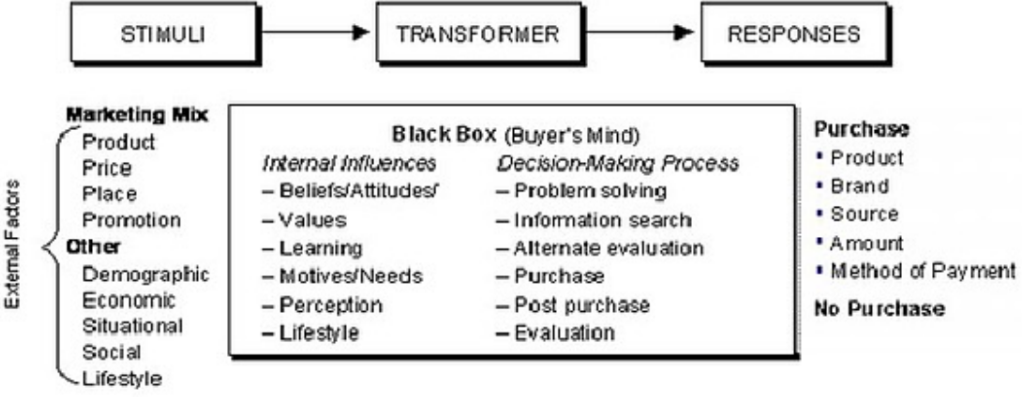
Black Box Model
Sometimes called the Stimulus-Response Model, says that customers are individual thinkers that process internal and external stimuli to make purchase decisions.
Black Box Model
Hawkins Stern Impulse Buying
When we think of impulse buying, we typically imagine picking up a candy bar or a pack of gum before checking out.
Hawkins Stern Impulse Buying
The Impulse Buying theory is an alternative to EKB, as it claims that purchases aren’t always a result of rational thought.
Hawkins Stern Impulse Buying
These are certainly impulse purchases, but Hawkins Stern categorizes them into four different types:
a. Escape Purchase
b. Reminder Purchase
c. Suggested Purchase
d. Planned Purchase