GW 4.1 One-Layer Model: Derivation
 Call Kai
 Learn
Learn Practice Test
 Spaced Repetition
 Match
Match Flashcards
 Knowt Play
1/11

There's no tags or description
Looks like no tags are added yet.
Name | Mastery | Learn | Test | Matching | Spaced | Call with Kai |
|---|
No analytics yet
Send a link to your students to track their progress
12 Terms
What does the One-Layer model show?
Sunlight that is not absorbed or reflected by the atmosphere, but partially reflected by the surface
Infrared radiation that is emitted and absorbed by the atmosphere and the surface
Why is sunlight also called shortwave radiation?
The sun emits shorter wavelength than the Earth
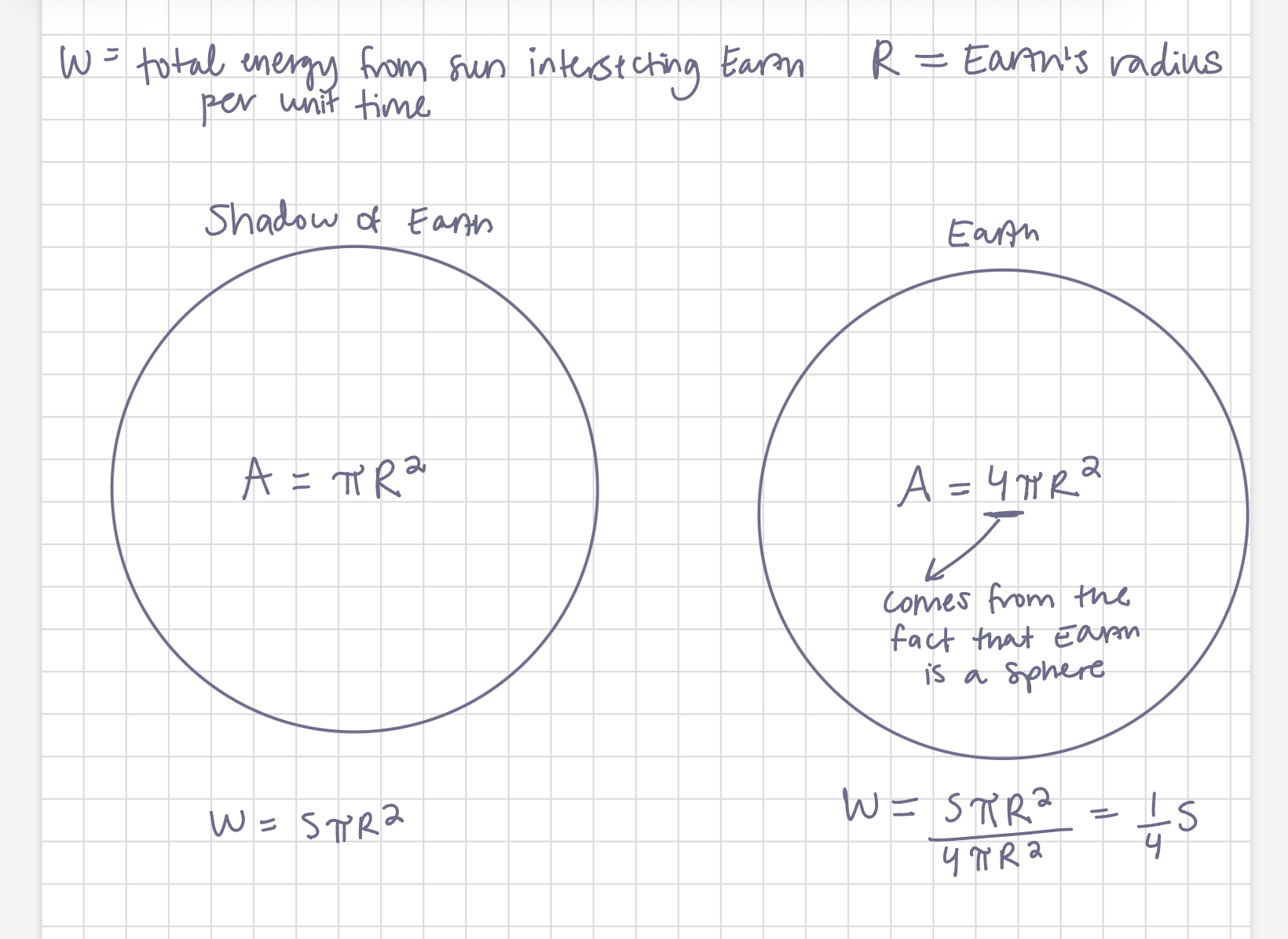
Why does the factor of ¼ appear in front of the solar radiation flux in the one-layer model?
The factor of ¼ represents the incoming sunlight or insolation measured in W m-2
Where does this come from?
Refer to attached image!
What is albedo?
For the One-Layer Model, we assume that sunlight passes directly through the atmosphere
When it hits Earth’s surface, some fraction is absorbed and some fraction is reflected
The fraction reflected is called the albedo (α)
What is the solar energy flux absorbed by the surface?
¼ (1-α)S
What is the solar energy flux reflected back to space?
¼αS
What do we assume to be the emissivity of the surface?
1 b/c solids and liquids have emissivities close to 1
This means that the surface will absorb all of the downward infrared radiation that the atmosphere emits toward it
Does the surface also emit its own radiation upward?
Yes!
Stefan-Boltzmann Law
It will emit a radiative flux of σTs4 where Ts is the surface temperature
What factors impact atmospheric emissivity (ε)?
CO2 concentration
H2O concentration
The amount and type of clouds
What is the atmosphere’s emitted radiative flux both upward and downward? And why?
εσTa4 where Ta is the atmospheric temperature
Why is this?
Stefan-Boltzmann law tells us how much energy a blackbody will radiate per area per time
A layer of atmosphere has area that can emit both on its top and its bottom
According to Kirchoff’s Law, the atmosphere has to also do what?
The atmosphere also has to absorb a fraction of ε of the infrared radiation that hits it
In this case, the emission from the surface is what hits it
It absorbs a radiative flux of εσTs4 from the surface passes through the atmosphere and up into space
What is the effect of CO2 in the one-layer model?
By increasing CO2:
(1) the atmosphere better absorbs long-wave radiation emitted by the Earth
(2) the Earth re-emits that radiation back to the surface, leading to the warming of the surface
Things to notice here:
(1) The atmosphere absorbs and re-emits the long-wave radiation, it does not reflect it
(2) Changing the CO2 does not affect the amount of solar radiation absorbed by the atmosphere in the one-layer model
(3) This is a good approximation of the effect of CO2 in the real world
(3a) Increasing CO2 leads to surface warming by increasing the amount of surface long-wave radiation absorbed by the atmosphere then re-emitted back down to the surface