Pharm Chapter 26: Dental Disorders & Hygiene Terms Study Set
 Call Kai
 Learn
Learn Practice Test
 Spaced Repetition
 Match
Match Flashcards
 Knowt Play
1/45

There's no tags or description
Looks like no tags are added yet.
Name | Mastery | Learn | Test | Matching | Spaced | Call with Kai |
|---|
No analytics yet
Send a link to your students to track their progress
46 Terms
1. What percentage of children ages 12 to 17 years in the United States have experienced tooth decay?
a. 28%
b. 48%
c. 68%
d. 88%
c. 68%
2. The incidence of dental caries in children has decreased over the past decades. This decrease has been attributed to improved oral hygiene.
a. Both statements are true.
b. Both statements are false.
c. The first statement is true, the second statement is false.
d. The first statement is false, the second statement is true.
c. The first statement is true, the second statement is false.
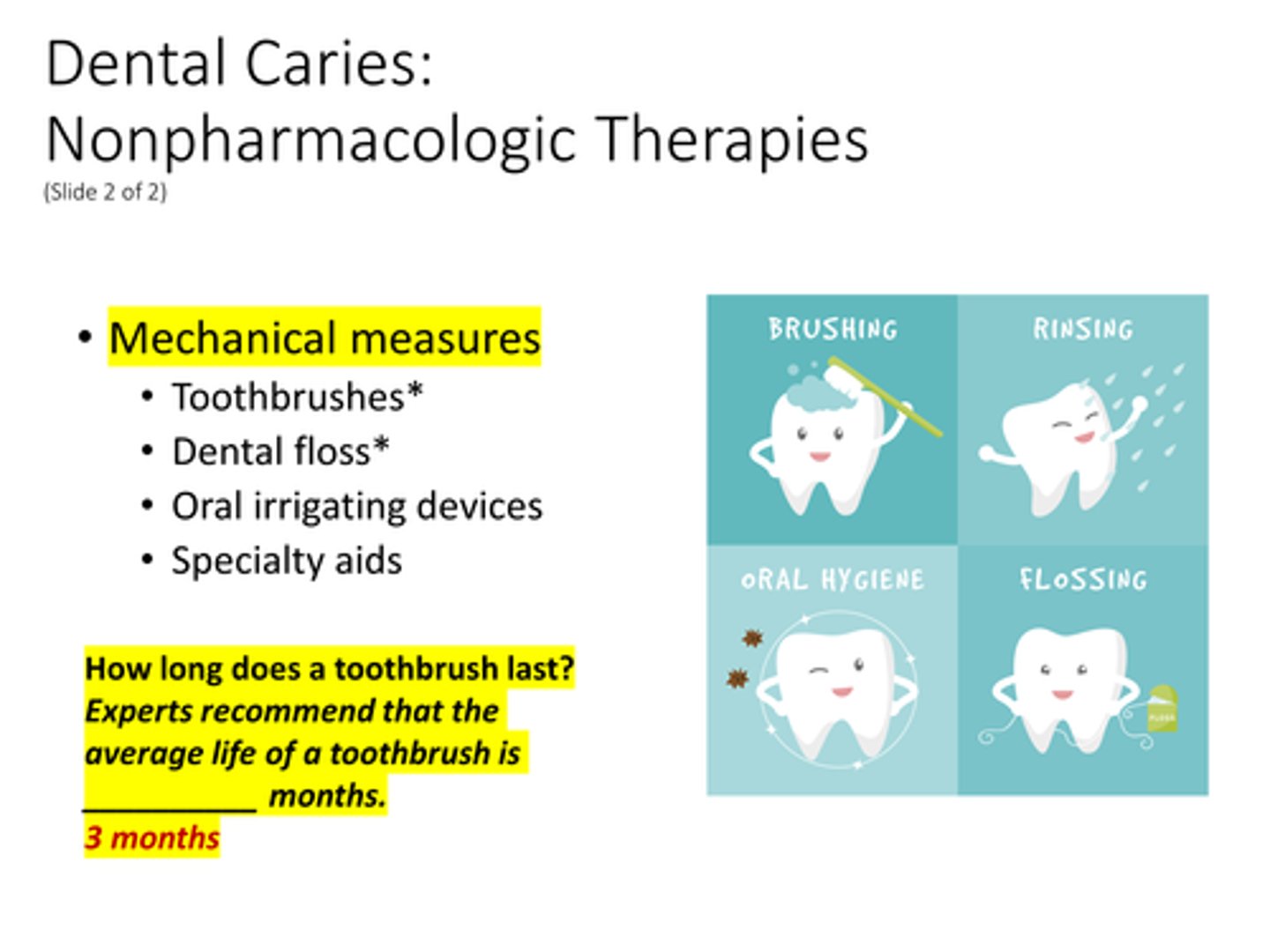
TRUE - Dental caries in children has decreased over the past decades
FALSE - However, the decrease is attributed to fluoridation of public water supplies, dentifrices, and mouth rinses, not improved oral hygiene.
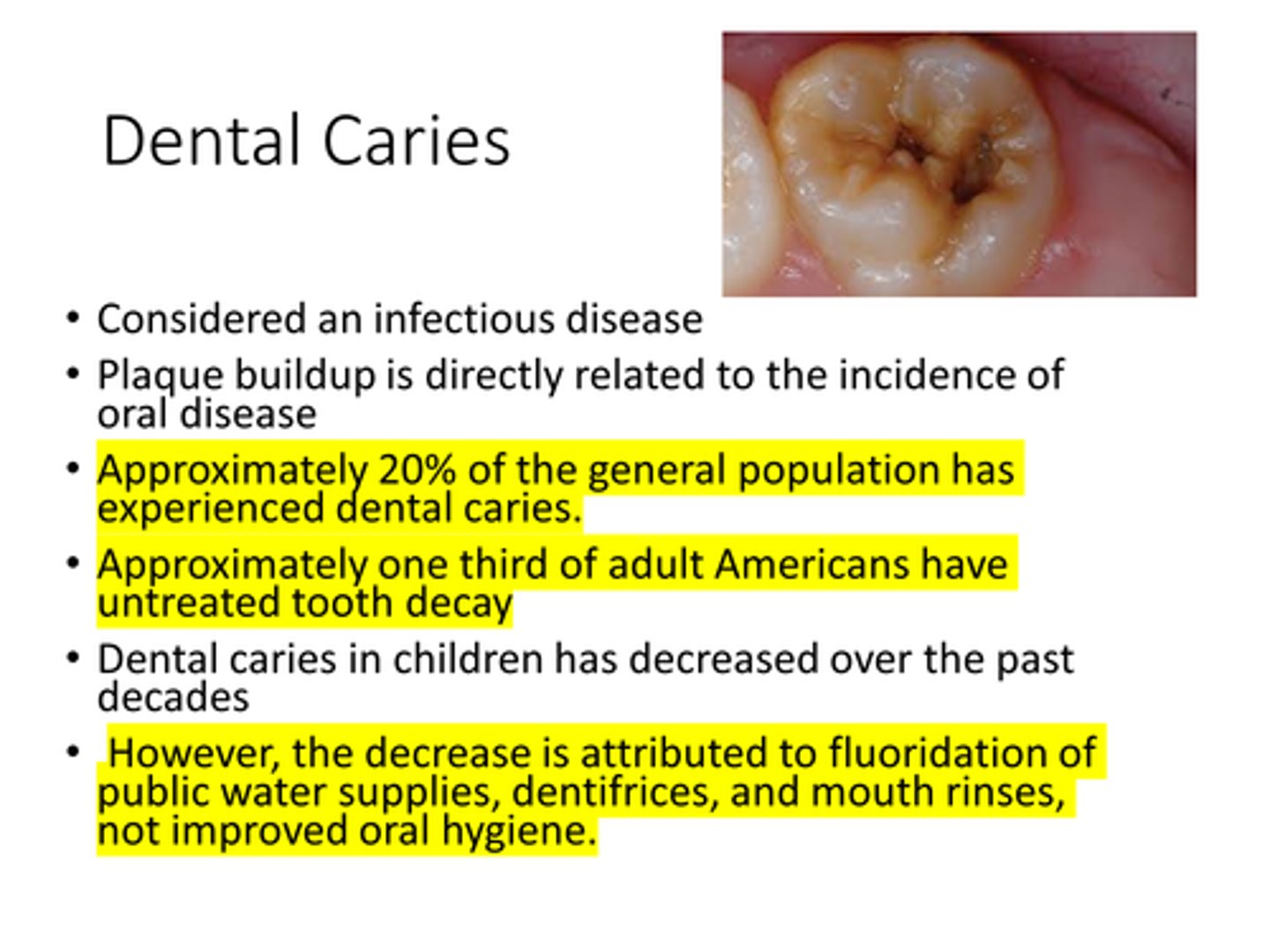
3. The dental hygienist should teach the patient that the best way to ensure healthy teeth and gingival tissues is to remove plaque mechanically by brushing at least twice daily and by __________ at least once a day.
a. Rinsing with mouthwash
b. Flossing
c. Massaging the tissue
d. Using a toothpick
b. Flossing
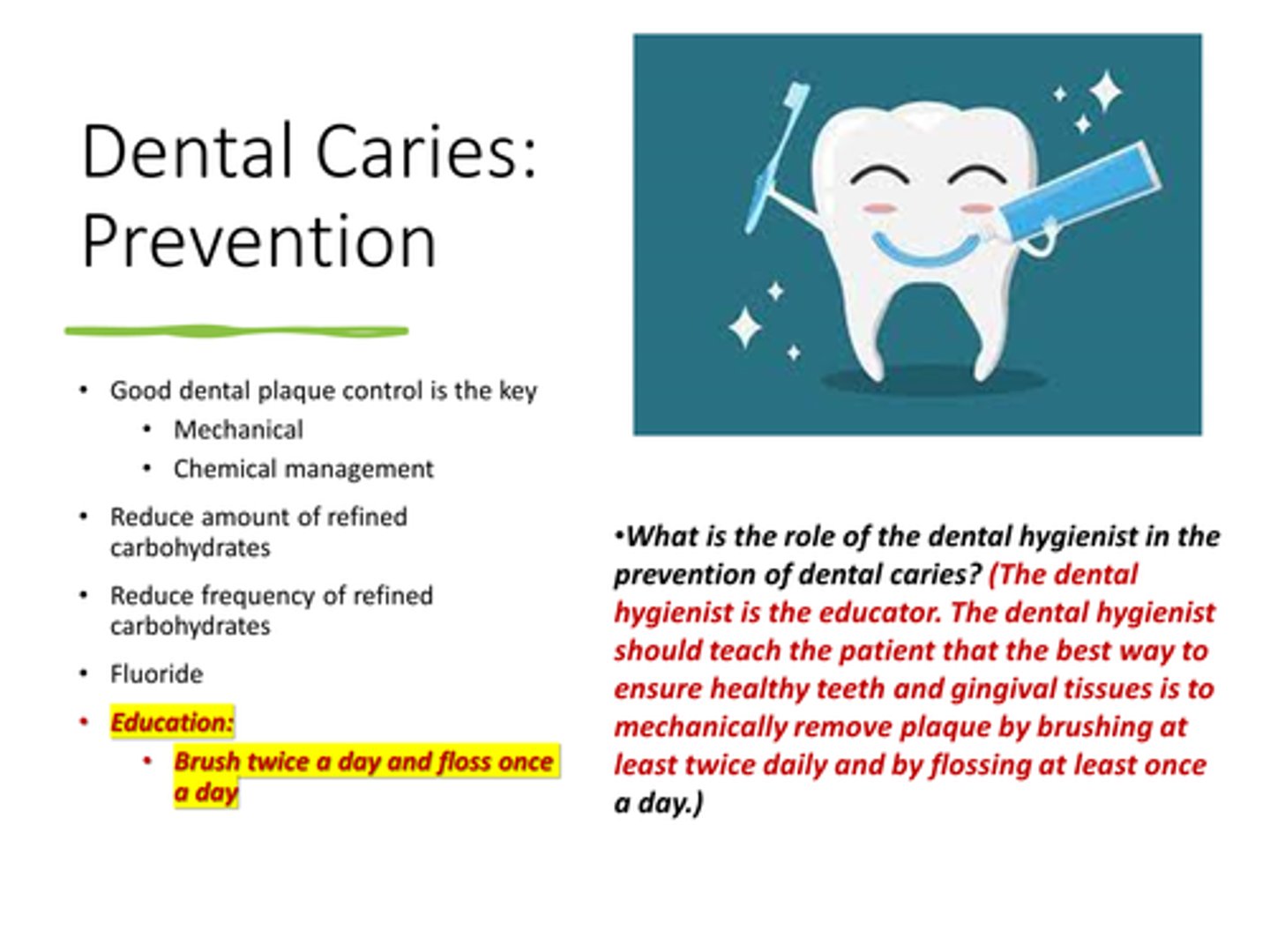
4. Food __________ are less cariogenic.
a. With lower water content
b. That stimulates saliva flow
c. High in protein
d. Both a and b
e. Both b and c
e. Both b and c
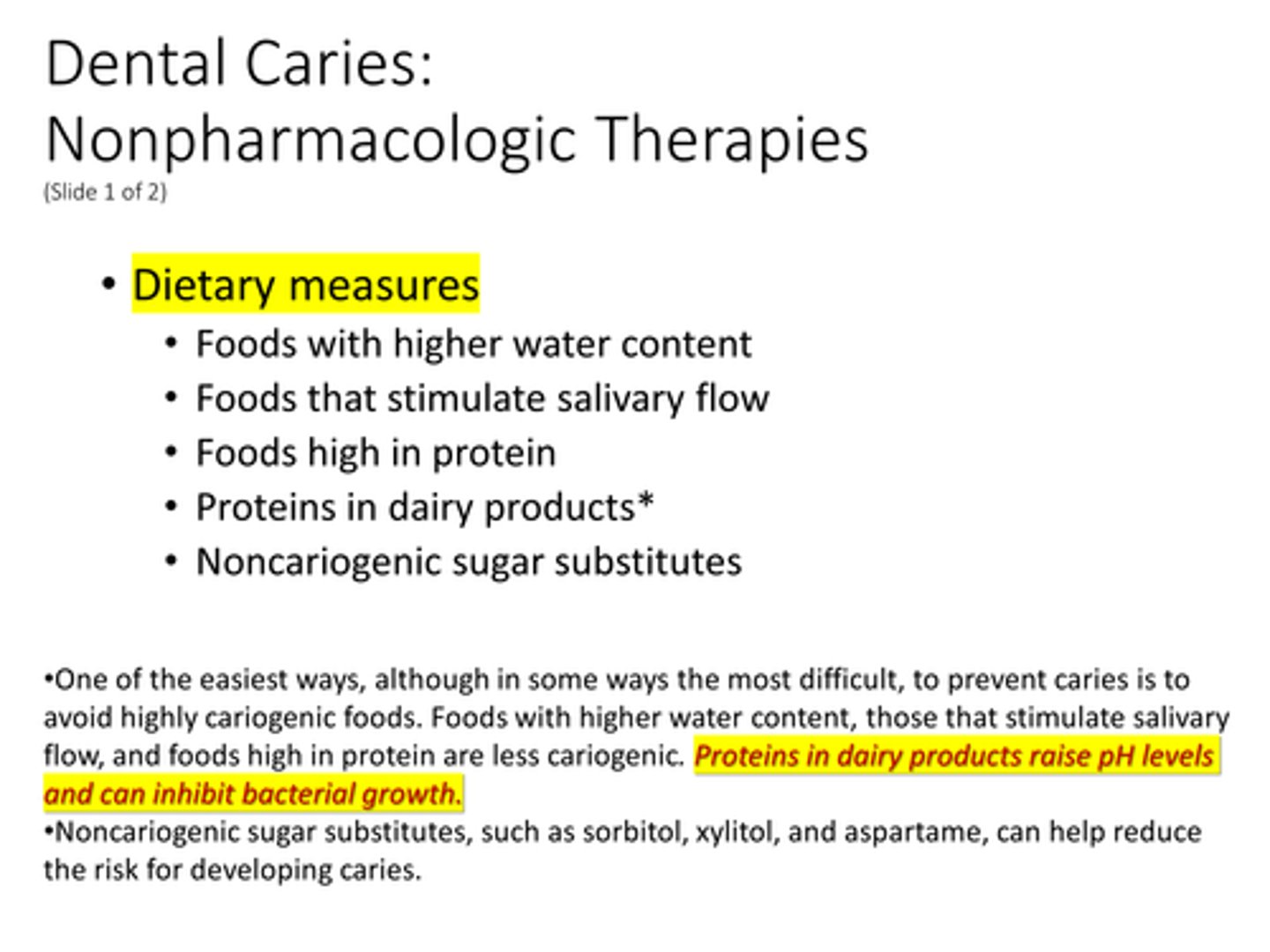
•Foods with
- higher water content, those that
- stimulate salivary flow, and
- foods high in protein are
LESS cariogenic.
- Proteins in dairy products
- Noncariogenic sugar substitutes
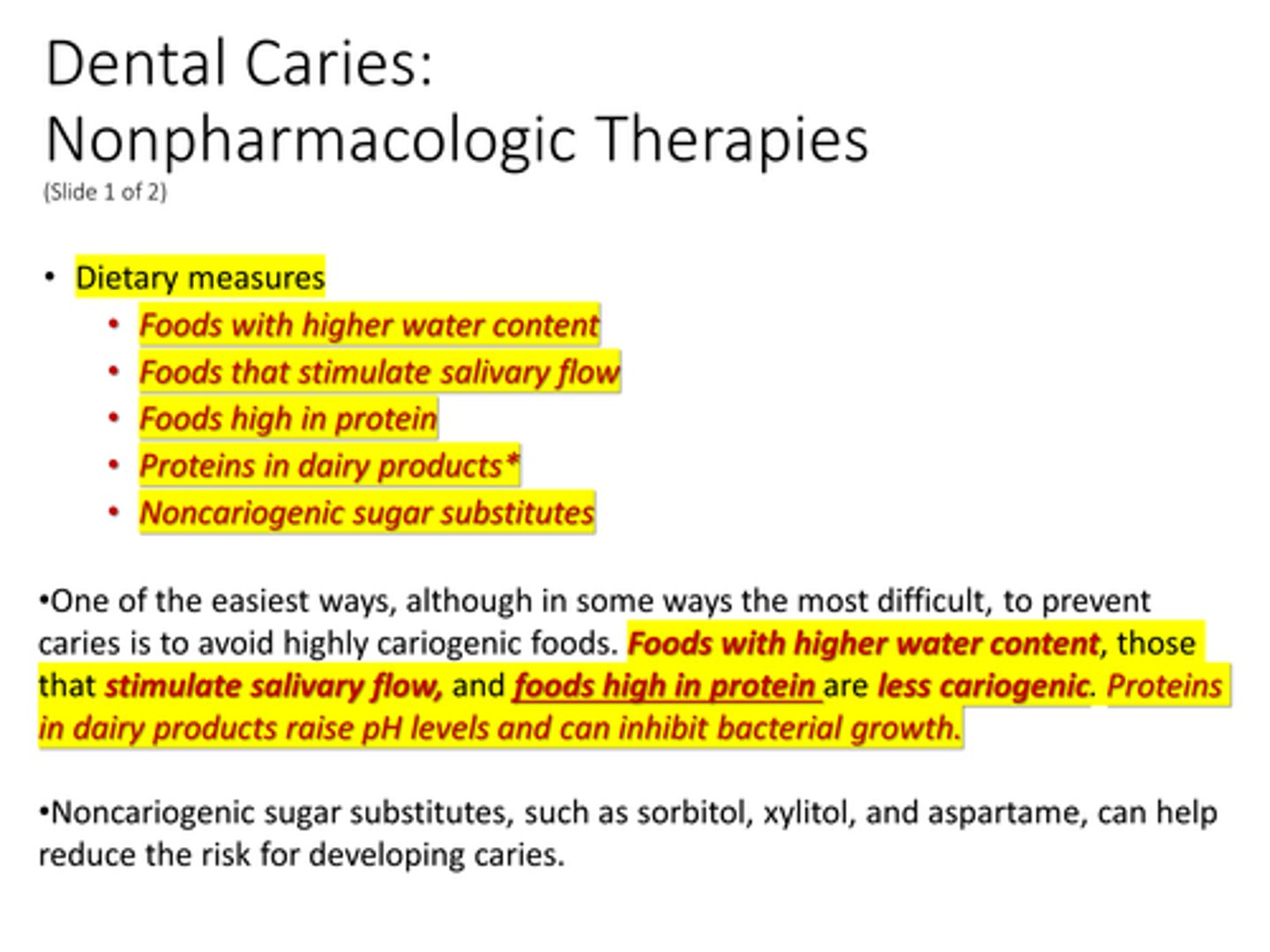
5. Experts recommend that the average life of a toothbrush is __________ months.
a. 3
b. 6
c. 12
d. 24
a. 3
How long does a toothbrush last? 3 months
6. Which of the following statements is true concerning guidelines for the proper use of dental floss?
a. The patient should pull out approximately 8 inches of floss from its container.
b. Most of the floss should be wrapped around the middle fingers until approximately 1 inch of floss remains visible.
c. Use a gentle gliding motion and place the floss between two teeth but do not encroach on the gum line.
d. Keep the floss taut and do not let it curve into a C-shaped curve against either tooth that forms the contact
b. Most of the floss should be wrapped around the middle fingers until approximately 1 inch of floss remains visible.
Review Box 26.2
7. According to the American Dental Association (ADA), which of the following groups of adults should receive professionally applied fluoride products?
a. All adults
b. Only adults with active caries in the last 3 years with risk factors for caries
c. Only adults with active caries in the last 3 years without risk factors for caries
d. Only adults without active caries in the last 3 years without risk factors for caries
e. No adults
b. Only adults with active caries in the last 3 years with risk factors for caries
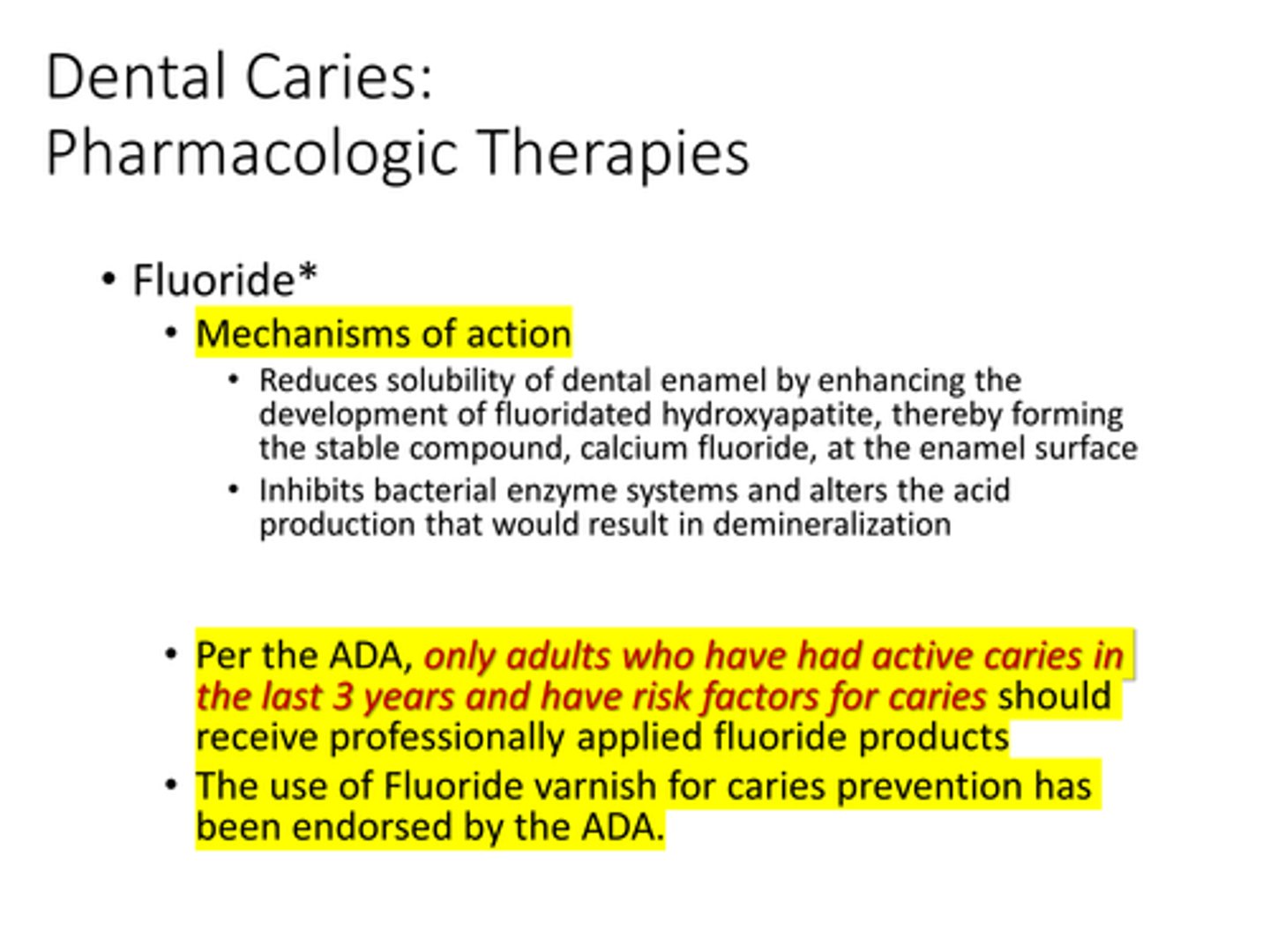
8. Fluoride is thought to work by:
a. Interacting with mineralized tissue, including bones and teeth
b. Acting on individual microorganisms in biofilm
c. Functioning as an antibiotic
d. Both a and b
e. Both b and c
d. Both a and b
9. Which of the following statements is true concerning fluoride toxicity?
a. Both acute and chronic toxicity can occur with fluoride use.
b. Acute but not chronic toxicity can occur with fluoride use.
c. Chronic but not acute toxicity can occur with fluoride use.
d. Neither acute nor chronic toxicity can occur with fluoride use.
Both acute and chronic toxicity can occur with fluoride use.
10. Which of the following liquids may be used during management of acute fluoride toxicity?
a. Apple juice
b. Lemonade
c. Milk
d. Coffee
c. Milk
11. Which of the following statements is true concerning chronic fluoride toxicity?
a. Drinking water with more than 2 ppm of fluoride can lead to fluorosis of tooth enamel during the age of tooth mineralization.
b. Dentinal hypoplasia is the most common sign of chronic fluoride toxicity during tooth development.
c. Color changes in tooth enamel caused by chronic fluoride toxicity are a result of hypermineralization of the outer one third of tooth enamel.
d. Children that drink water with at least 0.6 ppm of fluoride and ingest fluoride supplements are at risk for developing chronic toxicity.
Drinking water with more than 2 ppm of fluoride can lead to fluorosis of tooth enamel during the age of tooth mineralization.
12. Which of the following types of topically applied fluoride is recommended when porcelain or composite restorations are present?
a. Sodium fluoride (NaF)
b. Acidulated phosphate fluoride (APF)
c. SnF
d. Both a and b
e. Both b and c
a. Sodium fluoride (NaF)
13. Experts recommend that fluoride applications remain in place for:
a. 30 seconds
b. 1 minute
c. 2 minutes
d. 4 minutes
d. 4 minutes
14. The patient is instructed to refrain from eating or drinking for __________ minutes after professionally applied fluoride applications.
a. 4
b. 14
c. 30
d. 60
c. 30
15. Professionally applied fluoride topical agents last for approximately:
a. 5 to 8 weeks
b. 12 weeks or 3 months
c. 26 weeks or 6 months
d. 52 weeks or 1 year
a. 5 to 8 weeks
16. Annual 4-minute in-office topical fluoride applications reduce tooth decay in permanent teeth of children living in nonfluoridated areas by __________.
a. 6%
b. 16%
c. 26%
d. 36%
c. 26%
17. Some topical fluoride products are marketed as 1-minute in-office applications. Clinical trials have proved that they are as effective as the 4-minute applications.
a. Both statements are true.
b. Both statements are false.
c. The first statement is true, the second statement is false.
d. The first statement is false, the second statement is true.
c. The first statement is true, the second statement is false.
18. Which of the following professionally applied preparations for in-office application has the highest fluoride concentration (ppm)?
a. Sodium 2%
b. Sodium varnish 5%
c. APF 1.23%
d. 0.4% SnF and 1.1% NaF in APF
b. Sodium varnish 5%
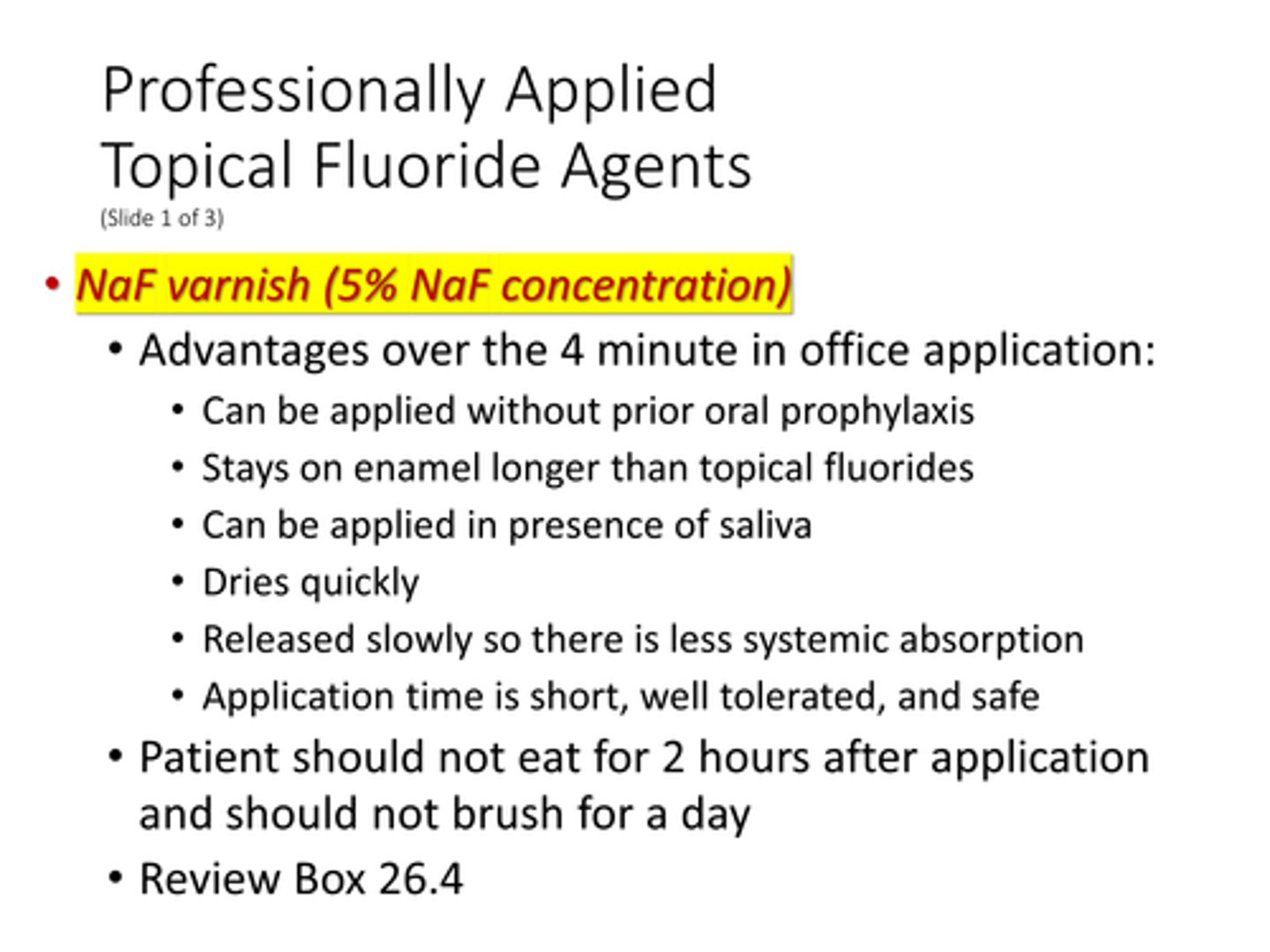
19. Which of the following statements is true of professionally applied NaF varnish?
a. NaF varnish is available in Europe but is not currently available in the United States as a dentin-desensitizing agent and as a cavity liner.
b. The U.S. Food and Drug Administration (FDA) has approved the varnish for its anticaries effect.
c. The use of fluoride varnish for caries prevention has been endorsed by the ADA.
d. NaF varnish is available as a 5% solution.
c. The use of fluoride varnish for caries prevention has been endorsed by the ADA.
20. Which of the following statements is true of NaF varnish as a professionally applied topical agent?
a. The varnish requires prior oral prophylaxis.
b. The varnish stays on the enamel longer than topical fluoride.
c. The varnish can be applied if saliva is present.
d. Both a and b are true.
e. Both b and c are true.
e. Both b and c are true.
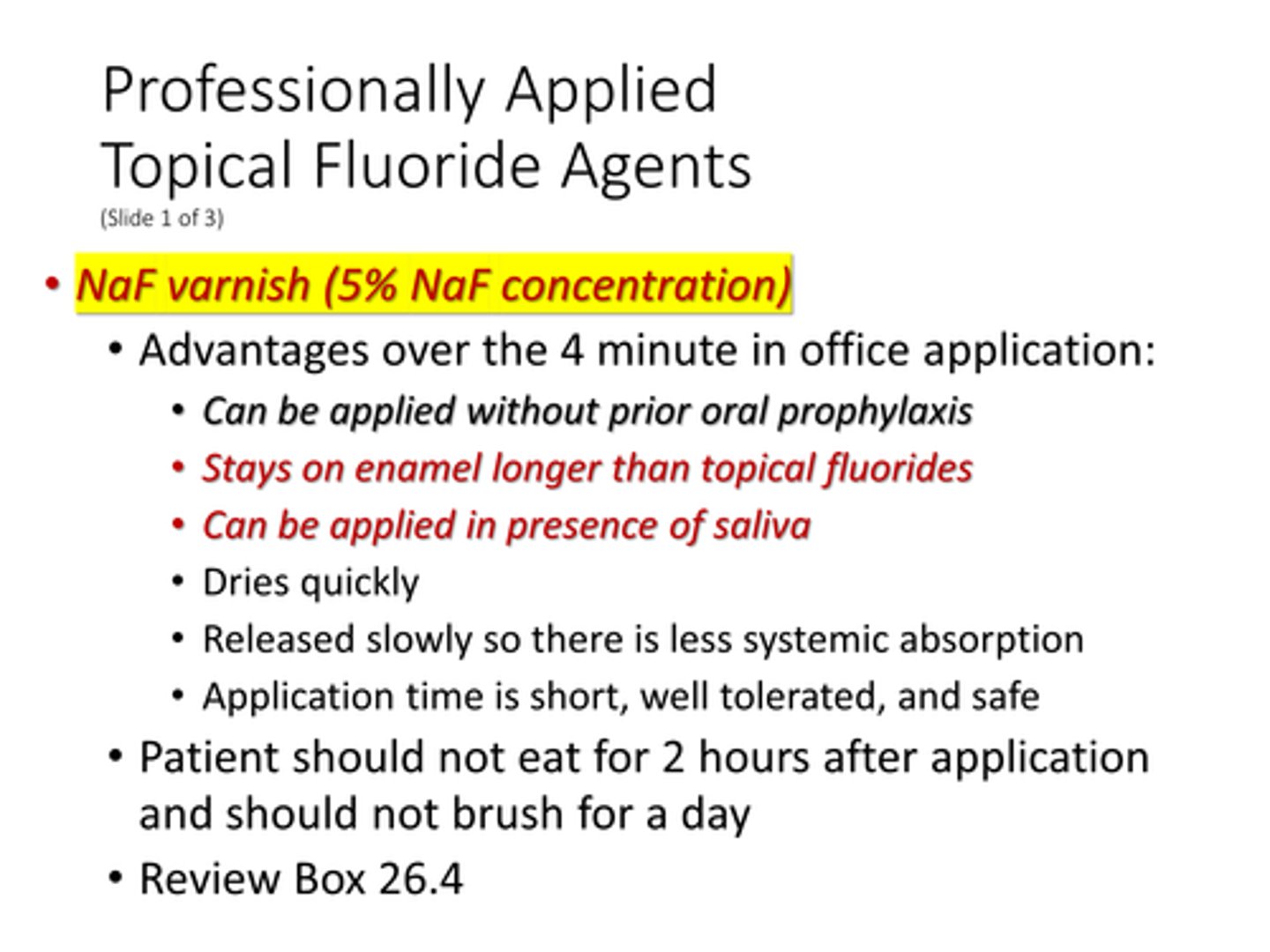
•Advantages over the 4 minute in office application:
•Can be applied without prior oral prophylaxis
•Stays on enamel longer than topical fluorides
•Can be applied in presence of saliva
•Dries quickly
•Released slowly so there is less systemic absorption
•Application time is short, well tolerated, and safe
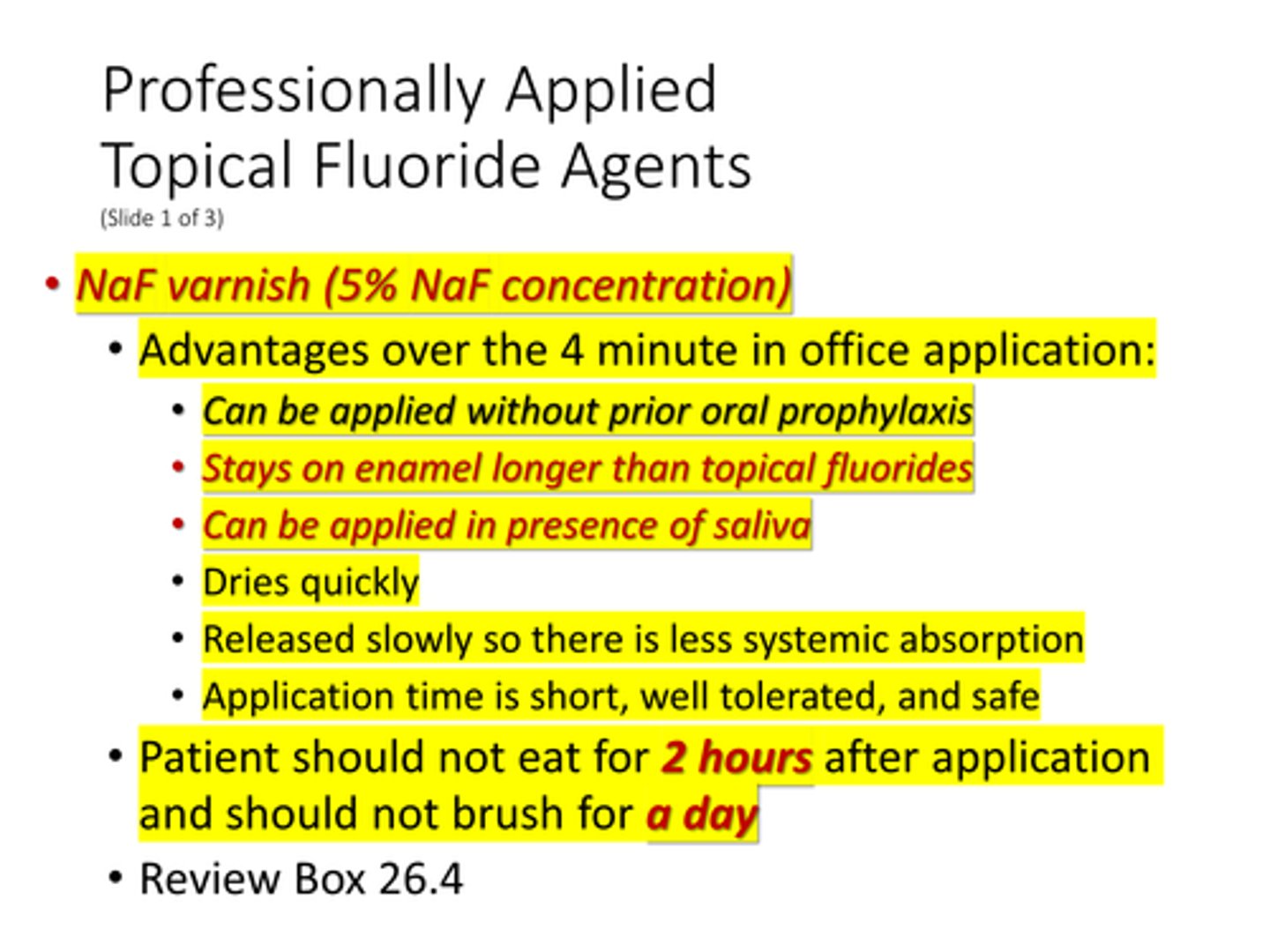
21. The patient should not eat for __________ after the application of NaF varnish and should not brush his teeth for __________.
a. 30 minutes, 30 minutes
b. 30 minutes, 60 minutes
c. 1 hour, 2 hours
d. 2 hours, 1 day
e. 2 hours, 2 days
2 hours, 1 day
22. Which of the following statements is true regarding use of dentifrices in the United States?
a. Nearly 75% of all dentifrices or toothpastes available in the United States contain some form of fluoride, but the remaining 25% of these products do not.
b. Some products contain triclosan 0.3%, as well as fluoride, but these products do not carry ADA approval for claimed effects against gingivitis.
c. Studies have shown that children between the ages of 10 and 15 years who brush three times daily with a fluoride dentifrice showed no reduction in the decayed-missing-filled rate compared with those that only brush once a day.
d. Children should use a pea-sized amount of toothpaste to minimize fluoride ingestion.
Children should use a pea-sized amount of toothpaste to minimize fluoride ingestion.
23. Which of the following agents is added to mouth rinses to function as a foaming agent that helps remove debris?
a. Alcohol
b. Surfactants
c. Glycerin
d. Benzoic acid
b. Surfactants
24. Guidelines for using at-home topical fluoride preparations include:
a. Topical fluoride rinses should be used no more than four times per day.
b. Brush teeth with a fluoride dentifrice after rinsing with the at-home topical fluoride preparation.
c. Swallow the fluoride rinse for a systemic effect.
d. Rinse vigorously for approximately 60 seconds.
d. Rinse vigorously for approximately 60 seconds.
25. Which of the following statements is true of Xylitol?
a. Xylitol has been found to reduce the levels of Streptococcus mutans in saliva but not plaque.
b. Xylitol has been found to inhibit the attachment of biofilm to teeth.
c. Xylitol can prevent the transmission of oral bacteria from mother to child.
d. Both a and b are true.
e. Both b and c are true.
e. Both b and c are true.
26. Which of the following statements is true of the use of chlorhexidine rinse for the treatment of gingivitis?
a. Chlorhexidine is active against gram-positive but not gram-negative bacteria.
b. Chlorhexidine is subject to bacterial resistance.
c. Chlorhexidine binds to the bacterial cell membrane and increases its permeability.
d. Chlorhexidine is used prophylactically.
c. Chlorhexidine binds to the bacterial cell membrane and increases its permeability.
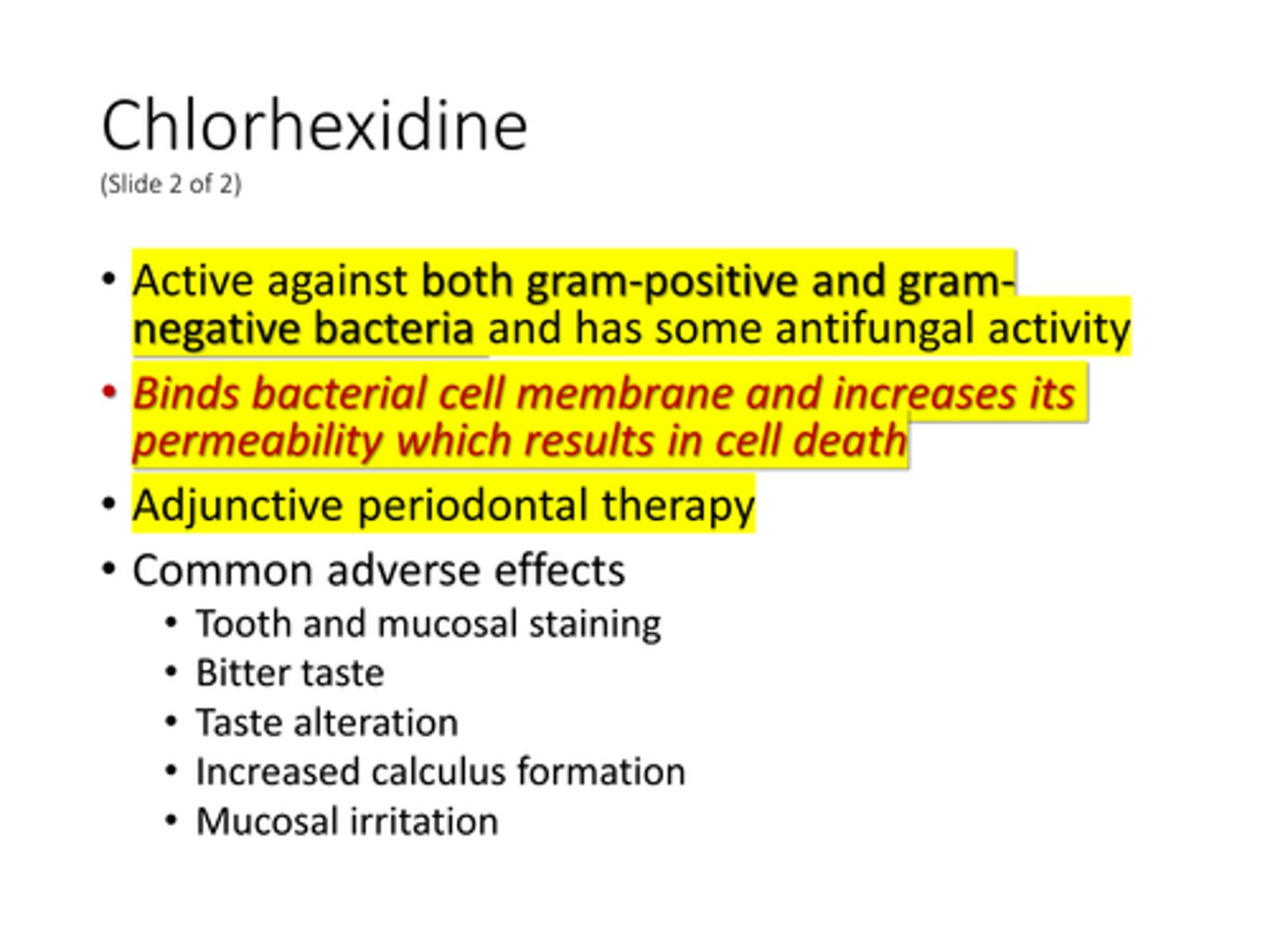
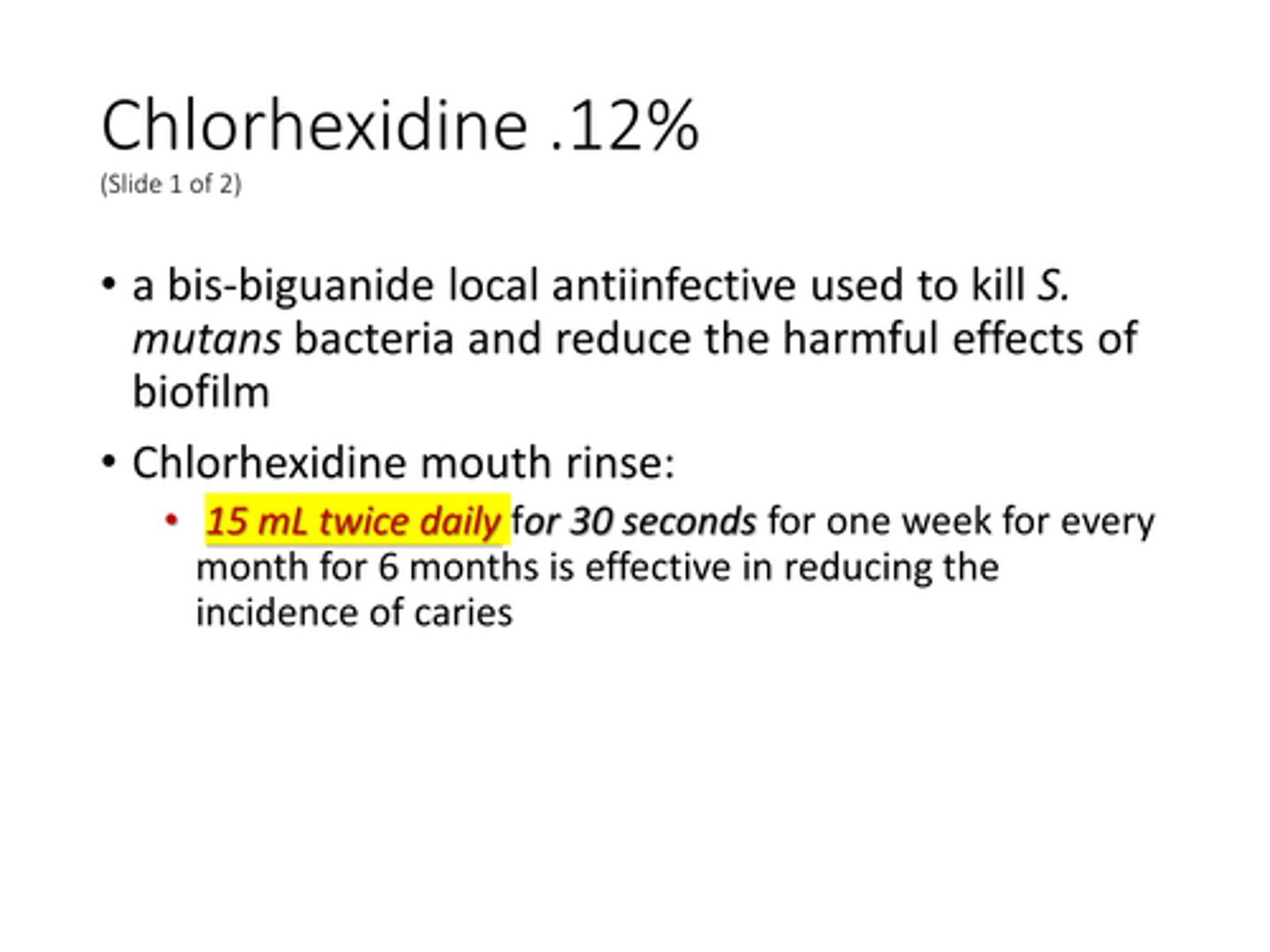
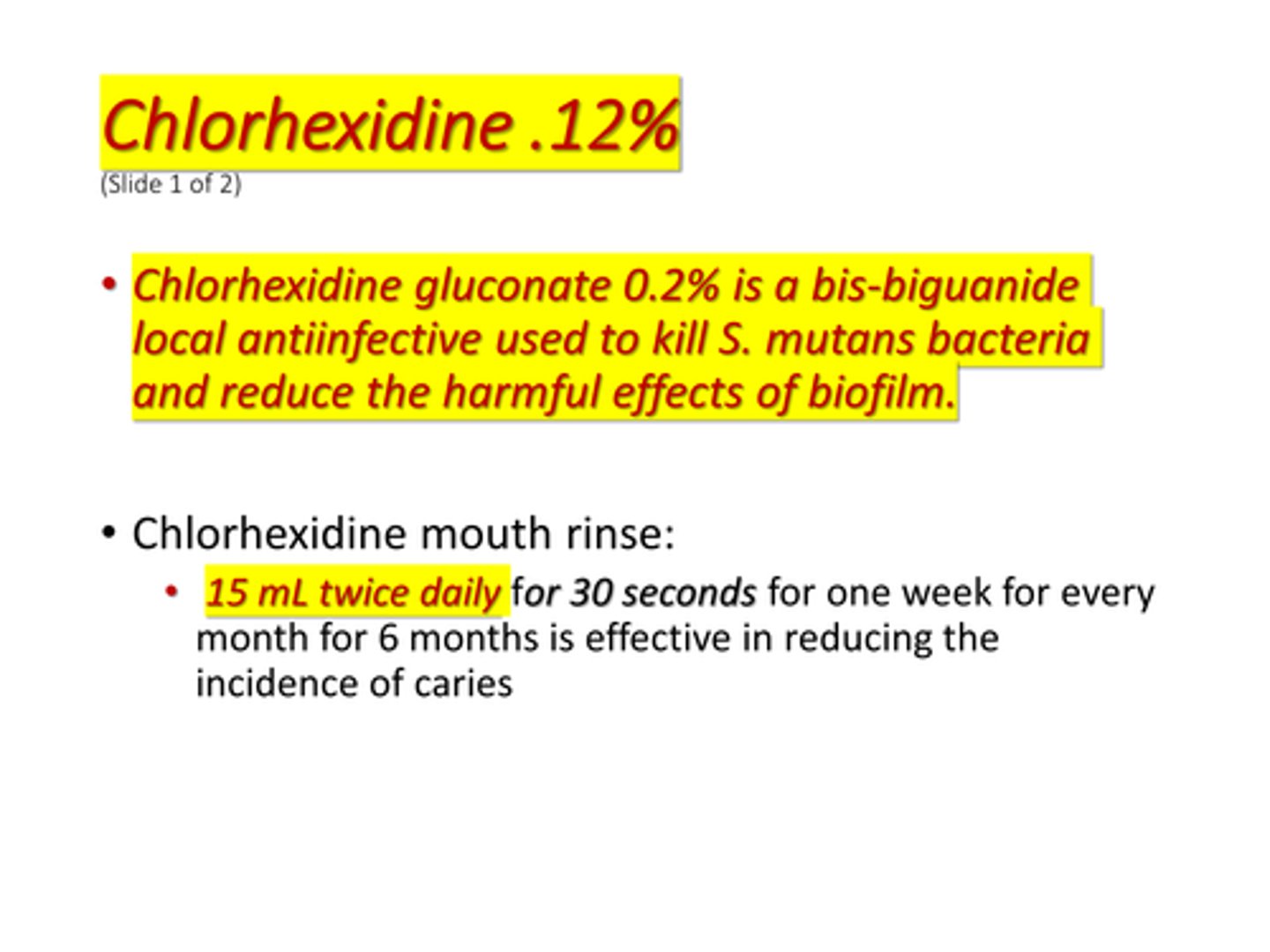
27. Patients should rinse with chlorhexidine for 30 seconds with 15 ml of chlorhexidine __________ a day.
a. Once
b. Twice
c. Three times
d. Four times
b. Twice
28. In a recent clinical trial, an essential oil mouth rinse plus brushing and flossing was:
a. Not found to be effective in reducing interproximal bleeding
b. Found to be effective in reducing interproximal pocket depths
c. Found to produce similar results to chlorhexidine at the end of 3 months of therapy
d. Found to produce similar results to chlorhexidine at the end of 6 months of therapy
Found to produce similar results to chlorhexidine at the end of 6 months of therapy
29. Which of the following treatments is the most effective in reducing gingivitis?
a. Sodium 2% fluoride
b. APF 1.23%
c. 0.4% SnF and 1.1% NaF in APF
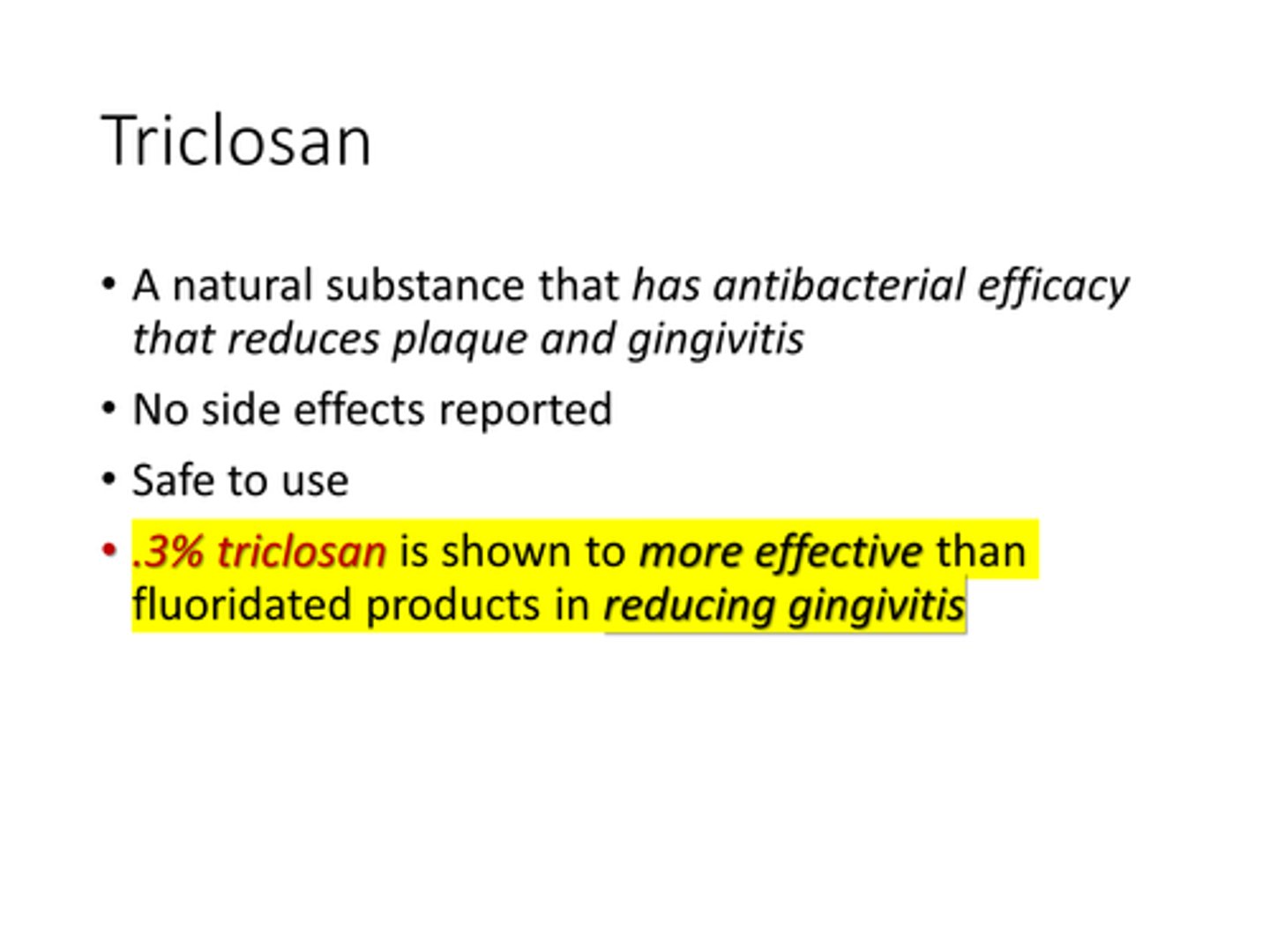
d. 0.3% triclosan
d. 0.3% triclosan
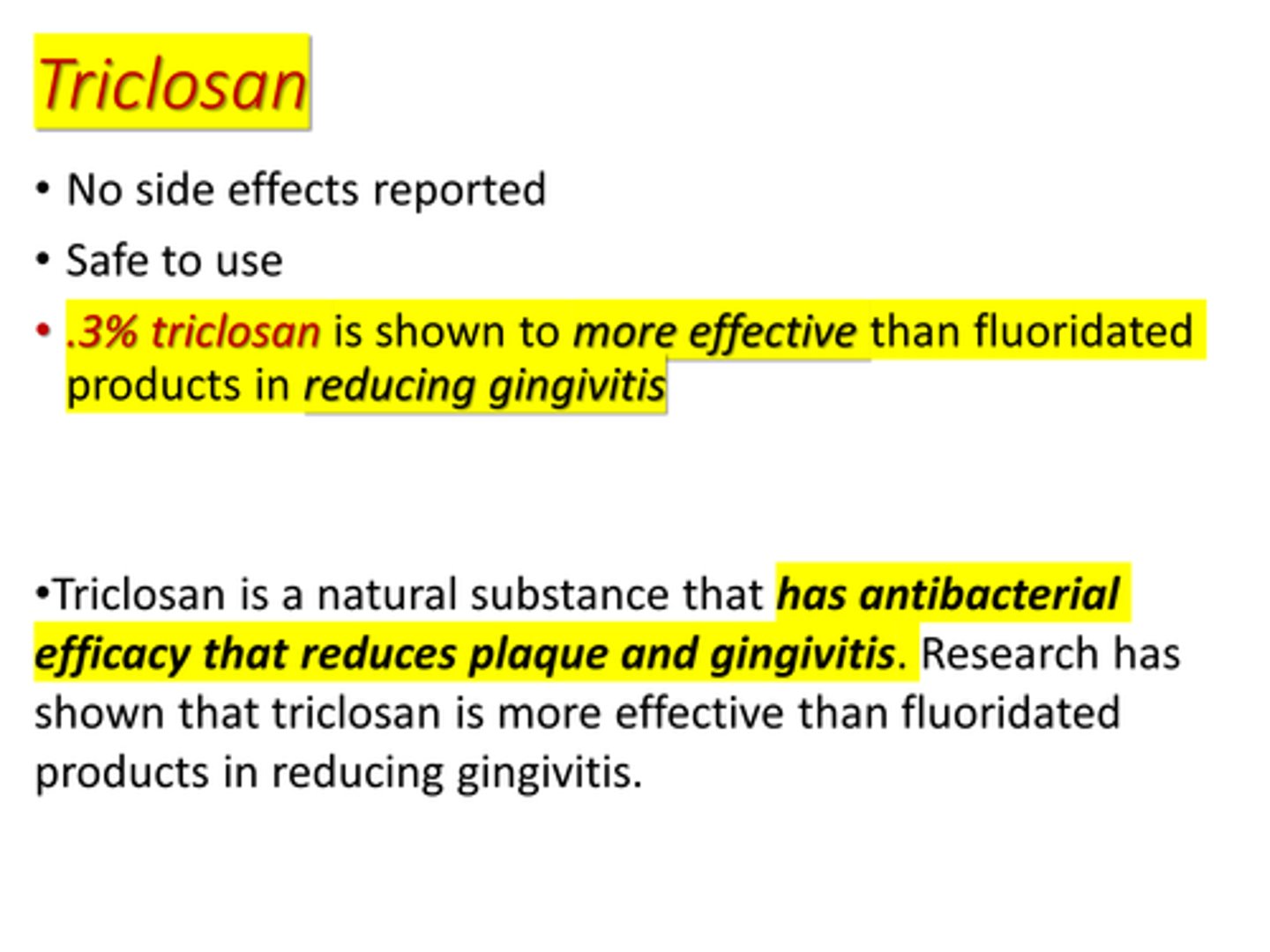
0.3% triclosan is shown to more effective than fluoridated products in reducing gingivitis
30. For dentinal hyperalgesia (DH) to develop, the dentin must become exposed through the loss of gingival recession or enamel, and:
a. The dentin tubules must be open to the oral cavity and the pulp.
b. The tooth must be in hyperocclusion.
c. Erosion at the cervical must be present.
d. A carious exposure of the tooth pulp must be present.
The dentin tubules must be open to the oral cavity and the pulp.
31. Which of the following choices is the most common cause of intrinsic acid production?
a. Medication
b. Gastric reflux
c. Wine
d. Ciders
b. Gastric reflux
32. The vast majority of desensitizing toothpastes contain:
NaF
Oxalates
Adhesives and resins
5% potassium nitrate
d. 5% potassium nitrate
33. T/F: Dental disorders result in 7 million days of lost work each year.
True
False
True
34. T/F: Approximately 40% of the general population has experienced dental caries.
True
False
False
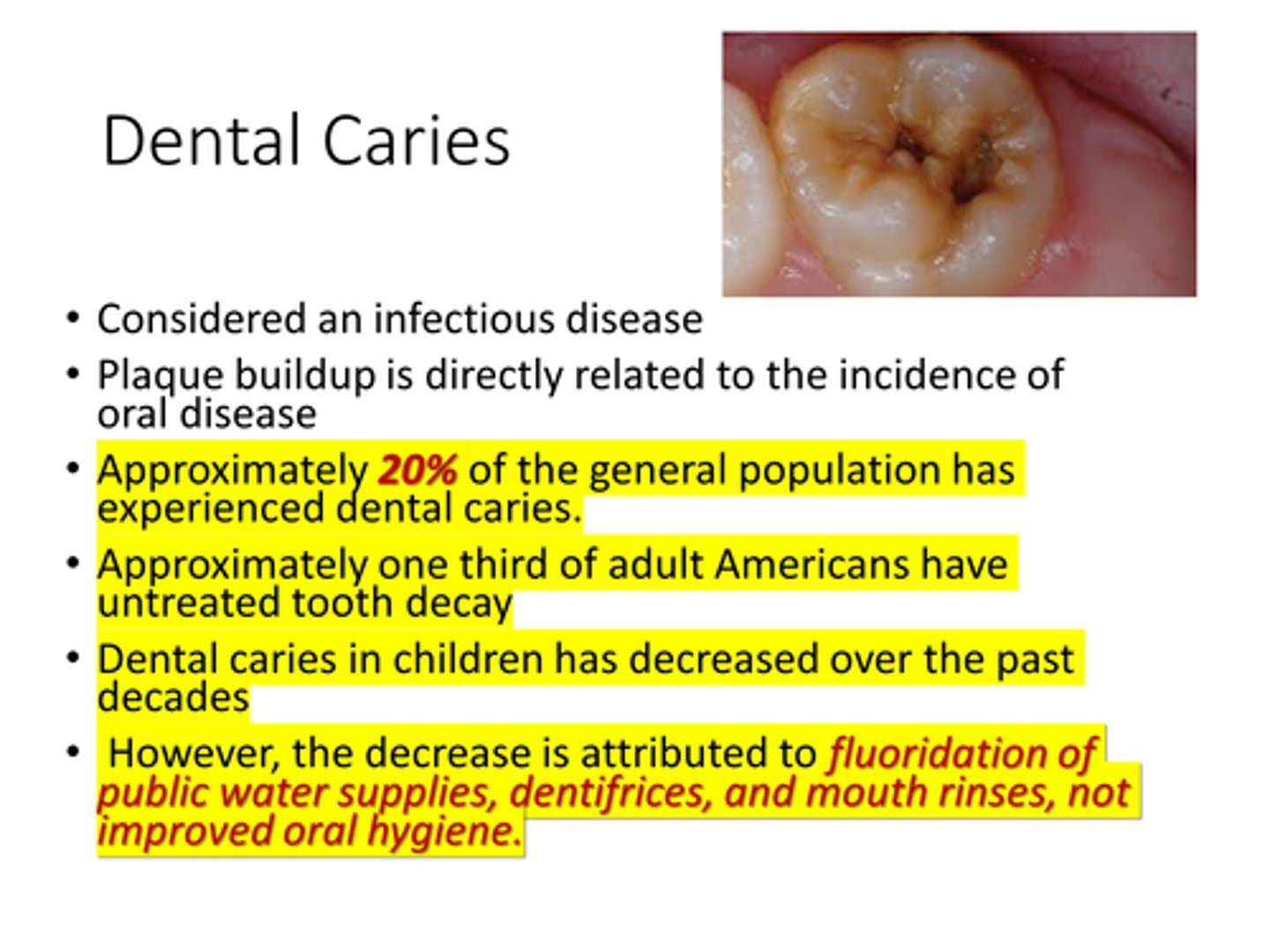
Approximately 20% of the general population has experienced dental caries.
35. T/F: Proteins in dairy products raise pH levels and can inhibit bacterial growth.
True
False
True
36. T/F: Patients considered as having a low risk for caries benefit from professionally applied fluoride products.
True
False
False
37. T/F: Children that drink water with at least 1 ppm of fluoride and ingest fluoride supplements are at risk for developing chronic fluoride toxicity.
True
False
True
38. T/F: Tooth bleaching can increase the risk for sensitivity.
True
False
True
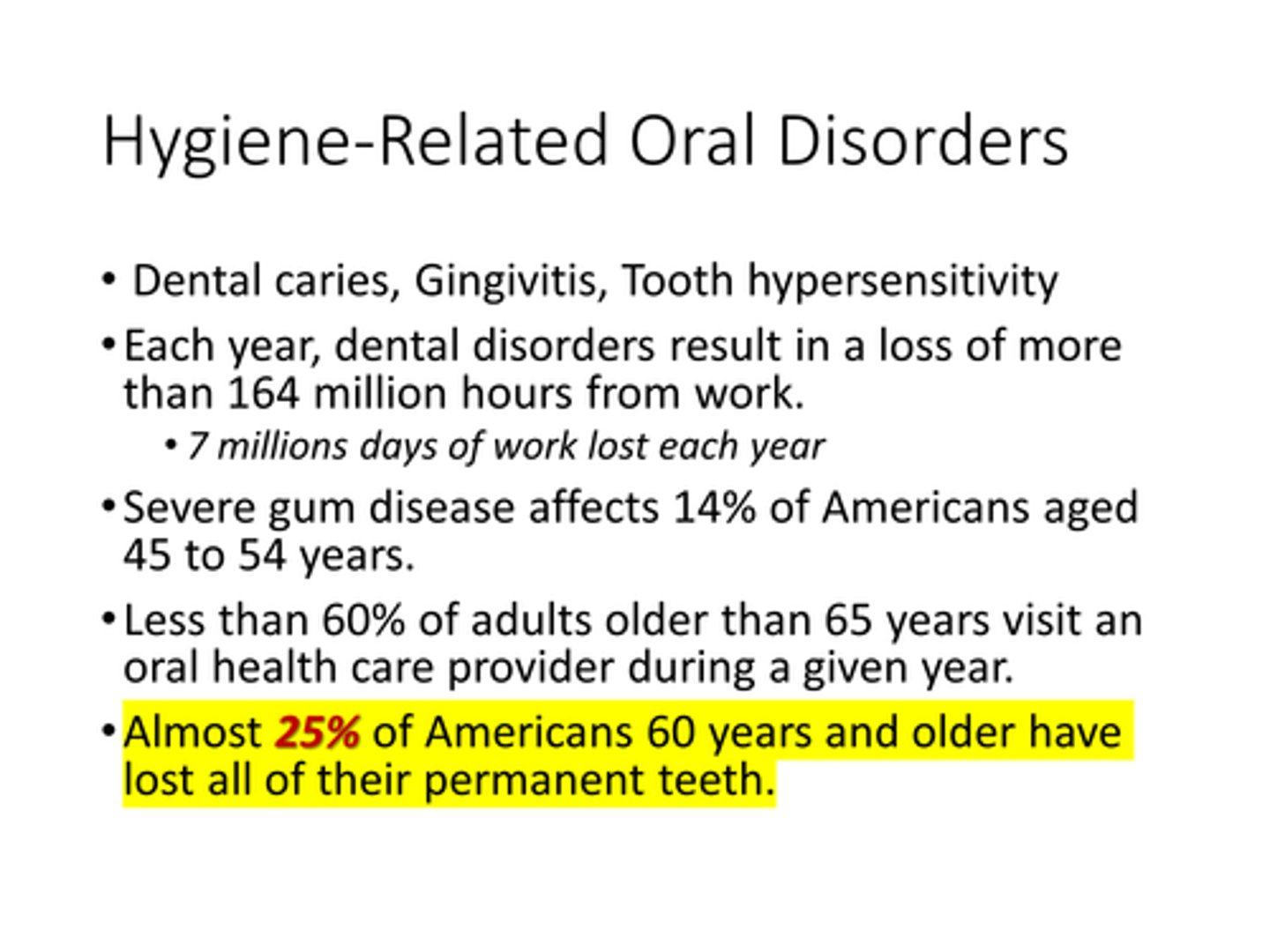
39. Almost which percentage of Americans 60 years and older have lost all their teeth?
25%
40. Professionally applied NaF varnish is available with a sodium fluoride concentration of
5%
41. Topical NaF 2% is recommended for patients with porcelain or composite restorations. APF 1.23% is not recommended for patients with porcelain or composite restorations.
a. Both statements are true.
b. Both statements are false.
c. The first statement is true, the second statement is false.
d. The first statement is false, the second statement is true.
a. Both statements are true.
42. Each of the following is true of xylitol EXCEPT one. Which is the EXCEPTION?
Decreases periodontal disease
43. Which is a bisbiguanide local antiinfective available in a 0.2% mouthrinse?
Chlorhexidine
44. The FDA has stated that triclosan is effective against
gingivitis
45. Which in-office therapy for tooth hypersensitivity lasts longest?
Adhesives and resins (cavity varnishes, bonding agents and restorative resin materials
What is the role of the dental hygienist in the prevention of dental caries?
The dental hygienist is the educator.
The dental hygienist should teach the patient that the best way to ensure healthy teeth and gingival tissues is to mechanically remove plaque by brushing at least twice daily and by flossing at least once a day