Geology Exam 3
 Call Kai
 Learn
Learn Practice Test
 Spaced Repetition
 Match
Match Flashcards
 Knowt Play
1/60

There's no tags or description
Looks like no tags are added yet.
Name | Mastery | Learn | Test | Matching | Spaced | Call with Kai |
|---|
No analytics yet
Send a link to your students to track their progress
61 Terms
Identify the false statement:
Natural gas is a short-chain hydrocarbon.
Oil and natural gas have a high energy density.
Oil is derived from the carcasses of dinosaurs.
Natural gas is less dense than oil.
Long-chain hydrocarbons are viscous.
Oil is derived from the carcasses of dinosaurs → No, from remains of microscopic marine organisms
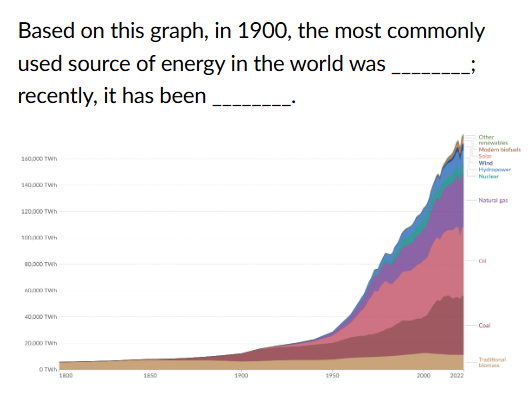
coal; oil
Source rocks are always __________.
Sedimentary
Which temperature is within the "oil window" where kerogens are cracked to make oil?
100 Celsius → Window is 60-120 Celsius
All of these geologic features can potentially help form a trap for hydrocarbons, except one. Which is the exception?
fault
syncline
sand bar
salt dome
syncline
In the context of conventional oil reservoirs, an impermeable rock, regardless of lithology, is a good candidate to serve as a ________.
seal rock
Approximately how much oil is left behind, still in the ground, after "primary recovery" (i.e. drilling a new well and pumping out whatever will come)?
90%
10-30% Extracted
Permeability is a measure of ________.
how well the pores within rock are connected
Which type of mineral deposit was formed as a result of the oxygenation of the Earth's atmosphere?
banded iron formation (BIF)
What is an ore?
Any rock that can be mined and processed to extract metal for a profit.
Which of the following is NOT a factor used in classification of types of mass movement?
Type of material
Immediate cause (earthquake, rain event)
Rate of movement
Nature of moving mass (cloud, slurry or block)
Environment (subaerial or submarine
Immediate cause (earthquake, rain event)
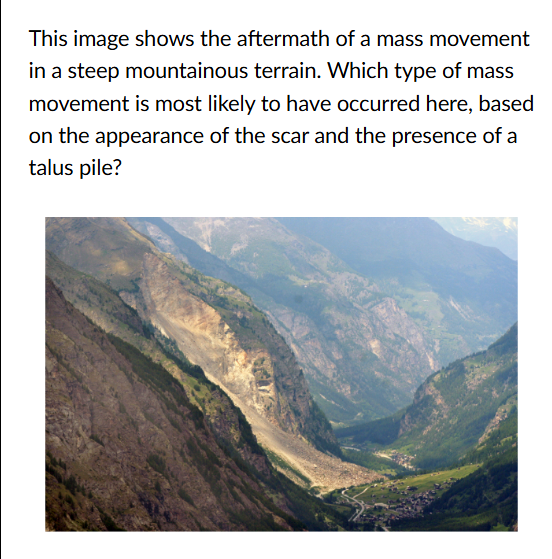
Rockfall
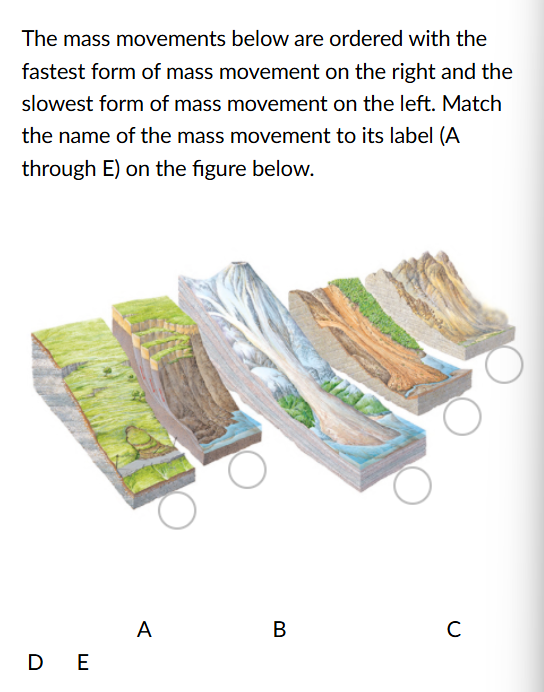
Solifluction or creep
Slumping
Lahar
Debris flow
Rockfall/slide
Which of the following phenomena may cause a stable slope to become so unstable that it fails? Choose all that are correct.
Decreased slope
Increased vegetation
Increased load
Excavation of base of slope
Vibration
Water saturation
Increased load
Excavation of base of slope
Vibration
Water saturation
Which of the following contribute to mass movement? Select all that apply.
retaining walls
saturated soil
oversteepened slopes
hillsides with little vegetation
terraces
abundant vegetation
earthquakes
saturated soil
oversteepened slopes
hillsides with little vegetation
earthquakes
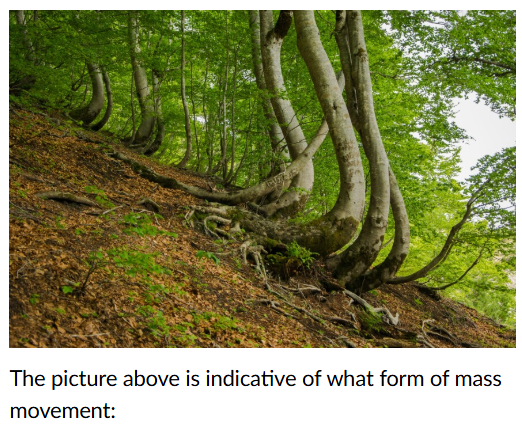
Creep
Which of the following types of mass wasting can occur in the absence of water?
Rockslide
Which of the following is NOT a likely trigger for a rockfall?
Heavy rain
Undercutting of a slope
Earthquake
Weathering
Heavy Rain
Which of the below interventions is a viable way of stabilizing a slope?
Watering the slope heavily to grow more vegetation
Digging out the base of the slope so there is less material to slide
Building structures on the slope so that their weight compresses the slope downwards
Planting vegetation with deep roots on the slope
Planting vegetation with deep roots on the slope
Which of the following materials will have the steepest angle of repose?
Silt
Fine sand
Coarse sand
Angular pebbles
Angular pebbles
The Width x Depth x Velocity of a stream describes which of the below?
discharge
evaporation
area
loading
discharge
Channels form along pre-existing fractures, and streams join one another at right angles, creating a __________________.
radial drainage network
dendritic drainage network
rectangular drainage network
parallel drainage network
rectangular drainage network
Permanent streams have water flowing year-round, while ephemeral streams only have water flowing part of the year. What can be said about the elevation of the water table relative to the stream elevation?
In permanent streams, the water table is consistently higher than the stream elevation.
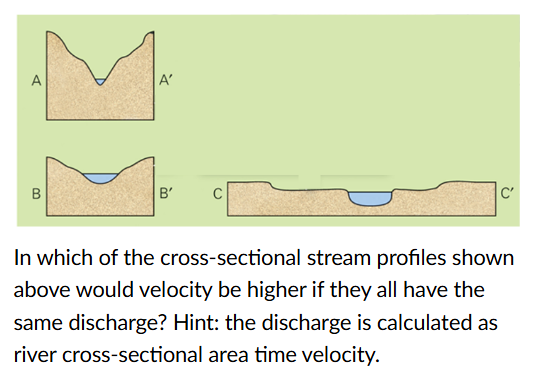
A
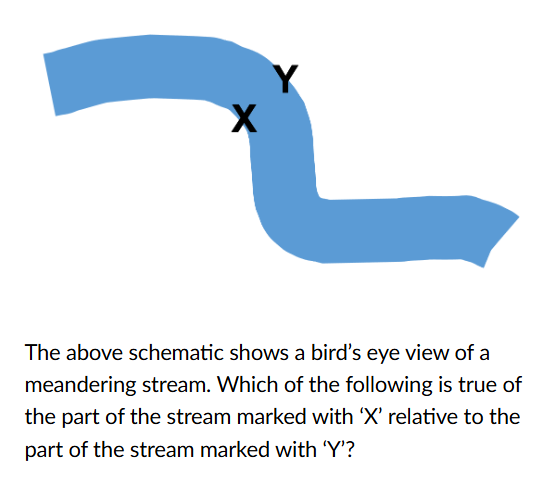
The velocity at X is lower than the velocity at Y
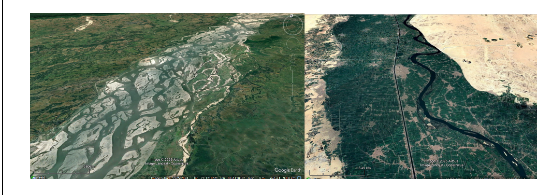
The Gange River has a braided stream while Nile River has a meandering stream.
Which of the following is true of the base level of a stream?
It is the lowest point to which a stream can erode.
It is the location where a stream loses energy and deposits sediments.
When the base level of a stream is lowered, stream erosion increases and vice versa.
All of these statements are true.
All of these statements are true.
River discharge vary through time. What is the meaning of flood recurrence interval (or return period) ?
Flood recurrence interval represent the number of years between floods of a certain size.
Why is the Earth warmer at the equator than at the poles?
Because the equator area has more continent surface than ocean surface.
Because the atmospheric circulation brings energy toward the equator.
Because the angle of sunlight at the poles reduces the amount of energy per unit area reaching the poles relative to the equator.
Because there are more volcanoes in the Tropics than at high latitudes.
Because the angle of sunlight at the poles reduces the amount of energy per unit area reaching the poles relative to the equator.
Why is seawater salty?
There are large deposits of halite underwater.
Rivers deliver dissolved solutes from land and these accumulate in the ocean through evaporation.
Volcanoes from mid-ocean ridges release dissolved chemicals.
Melting sea ice and glaciers deliver salt.
Rivers deliver dissolved solutes from land and these accumulate in the ocean through evaporation.
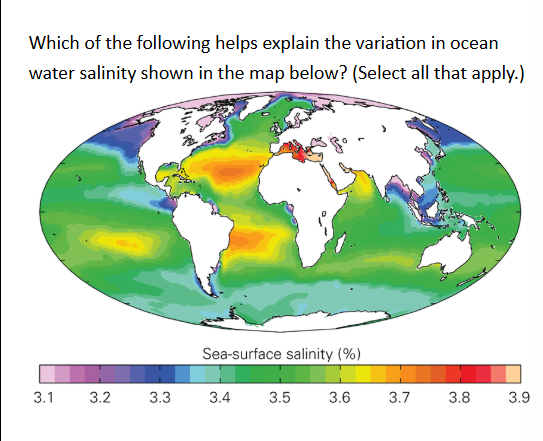
Freshwater input from wet areas.
Cold areas (high latitudes) have lower evaporation
Warm areas have higher evaporation.
What is the Coriolis Effect?
The deflection of motion in the atmosphere and ocean to the right in the Northern Hemisphere and left in the Southern Hemisphere due to the Earth's rotation
Which of the following is not responsible for or does not affect ocean tides?
Long-term sea-level change
Gravitational attraction by the Moon
Gravitational attraction by the Sun
Centrifugal force from Earth's spin
Long-term sea-level change
What phenomenon produces the global-scale conveyor belt that circulates water through the entire ocean system over a period of 1500 years?
Thermohaline circulation
Which of the following is true about why ocean basins are present? (Select all that apply.)
Oceanic lithosphere “floats deeper” in the mantle.
Continental lithosphere “floats higher” on the mantle.
Extension zones result in ocean trenches.
Volcanic hotspots produce continents which rise above the ocean.
Oceanic lithosphere “floats deeper” in the mantle.
Continental lithosphere “floats higher” on the mantle.
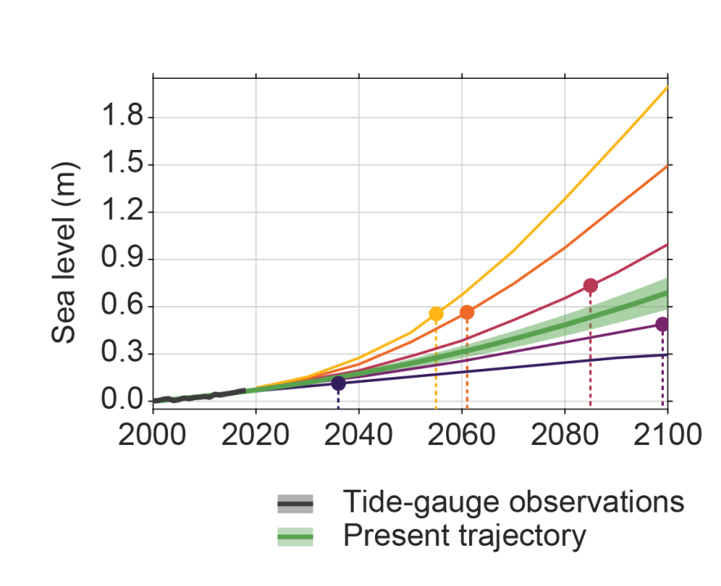
Based on current trajectory, global sea-level will be how much higher by 2080 (the end of a current college student's life expectancy) relative to where it was in 2000?
They would be the same
1.8 m
1 m
1.5 ft
1.5 ft
In beach environments, sediment transport tends to be parallel to (along) the beach. This is caused by ________.
longshore drift
What process causes waves to break as the approach a beach?
Frictional interaction between the wave base and the ocean floor as it shallows causes the wave to slow more at depth, steepen, and tip over.
Accelerating offshore winds destabilize the waves.
Waves intersect with undersea topography which causes them to "jump" and tip over.
Tidal wave interactions are maximized in shallower water near the beach resulting in wave instability.
Frictional interaction between the wave base and the ocean floor as it shallows causes the wave to slow more at depth, steepen, and tip over.
How does the rate of groundwater flow compare with that of ocean currents or river currents?
The rate of groundwater flow is slower than that of surface-water currents.
What best described the Edwards Aquifer in Texas especially in its eastern section?
confined, karst aquifer
A perrenial river in a low-lying area, such as the bayous in East Texas, is likely to be:
gaining groundwater
Where does the capillary fringe occur?
Between the saturated zone and unsaturated zone
Which of the following is true of the groundwater table?
It is the depth at which the saturated zone begins
Which of the following is true of porosity and permeability?
Porosity is a measure of the amount of a substance composed of empty space, and permeability is a measure of how well the pores are connected
What is the difference between a confined aquifer and an unconfined aquifer?
A confined aquifer lies beneath an aquitard, while an unconfined aquifer does not
Which of these are true of an artesian well?
Penetrates an unconfined and does not require pumping
Penetrates an unconfined aquifer and requires pumping
Penetrates a confined aquifer and does not require pumping
Penetrates a confined aquifer and requires pumping
Penetrates a confined aquifer and does not require pumping
Why is the Earth warmer at the equator than at the poles?
Because the angle of sunlight at the poles reduces the amount of energy per unit area reaching the poles relative to the equator.
Which of the following is true of the relationship between temperature, pressure, and atmospheric motion? (Select all that apply.)
Atmospheric circulation works to redistribute heat from colder areas toward warmer areas.
At a given altitude in the atmosphere, a warmer column of air will have more mass above it than a colder column of air, producing a pressure gradient force
Wind tends to blow from areas of high pressure to areas of low pressure
Temperature, pressure, and atmospheric motion are completely independent
At a given altitude in the atmosphere, a warmer column of air will have more mass above it than a colder column of air, producing a pressure gradient force
Wind tends to blow from areas of high pressure to areas of low pressure
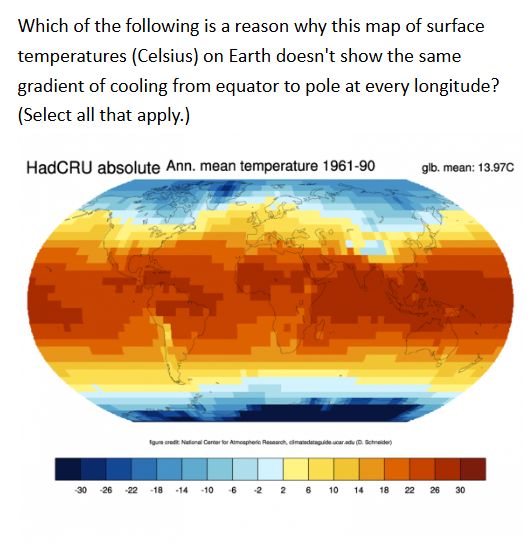
Areas where ocean currents bring heat northward are warmer than areas to their east or west
What is the Coriolis Effect?
The deflection of motion in the atmosphere and ocean to the right in the Northern Hemisphere and left in the Southern Hemisphere due to the Earth's rotation
Which of the following does the Coriolis Effect contribute to? (Select all that apply.)
Sometimes poor and unreliable winds at the Horse Latitudes
The presence of gyres in the Earth's surface ocean currents
The separation of Earth's atmospheric circulation into three "cells" from equator to pole
The rotation of hurricanes
Sometimes poor and unreliable winds at the Horse Latitudes
The presence of gyres in the Earth's surface ocean currents
The separation of Earth's atmospheric circulation into three "cells" from equator to pole
The rotation of hurricanes
Which of the following statements about air density is false?
Cool air is more dense than warm air
Air temperature, density, and relative humidity are not related
Air is comprised of molecules and therefore has mass and can exert a pressure
Warm air holds more moisture and is less dense than cool air
Air temperature, density, and relative humidity are not related
All of these are characteristics of glacial till except one. Which is NOT a characteristic of glacial till?
All particles are rounded due to extensive transport
Deposited where a melting glacier dumps the sediment it has been carrying.
Extremely poor sorting, with particles sizes from clays to boulders
Can contain large rocks that have been transported very far from the bedrock they were eroded from
All particles are rounded due to extensive transport
What formed the huge ripples in the Columbia River valley in eastern Washington state, an area known as the scablands?
Huge floods caused by the sudden emptying of a giant glacial lake when its ice dam was breached.
Carbon-14 (14C) is a radioactive isotope created by cosmic rays hitting nitrogen atoms in the upper atmosphere, and all living things have some 14C in them. Which of these would have the lowest concentration of 14C (i.e. fewest 14C atoms per total carbon)?
An Egyptian mummy
Which of these statements about the fractionation of oxygen isotopes is true?
A water molecule containing heavier 18O is less likely to evaporate, and more likely to condense, than water with only lighter 16O.
Which of these terms does NOT denote an orbital variation that’s part of a Milankovitch cycle?
Polarity
What are some ways that plate tectonic processes can change global climate on millions-of-year time scales? Check all that apply:
Subduction rates can affect the extent of arc volcanism, which can send CO2 into the air.
Fast subduction leads to younger oceanic crust on average, raising sea level
Subduction of carbon-rich sediment can sequester it away from the atmosphere.
Continents positioned in polar regions make it easier for ice sheets to grow
Subduction rates can affect the extent of arc volcanism, which can send CO2 into the air.
Fast subduction leads to younger oceanic crust on average, raising sea level
Subduction of carbon-rich sediment can sequester it away from the atmosphere.
Continents positioned in polar regions make it easier for ice sheets to grow
What is the observed relationship between temperature (estimated from oxygen isotopes in the ice), and the amount of CO2 in trapped air bubbles, in Antarctic ice cores?
Higher CO2 content correlates with higher temperature
What is the principal way increasing the Earth’s albedo affects climate?
It cools the climate by reflecting more sunlight back into space
A glacial erratic is:
A large rock or boulder dropped by a glacier, seemingly randomly and often very far from the rock formation it eroded from