Exam 3: Short Answer
 Call Kai
 Learn
Learn Practice Test
 Spaced Repetition
 Match
Match Flashcards
 Knowt Play
1/64

There's no tags or description
Looks like no tags are added yet.
Name | Mastery | Learn | Test | Matching | Spaced | Call with Kai |
|---|
No analytics yet
Send a link to your students to track their progress
65 Terms
What is label 1?
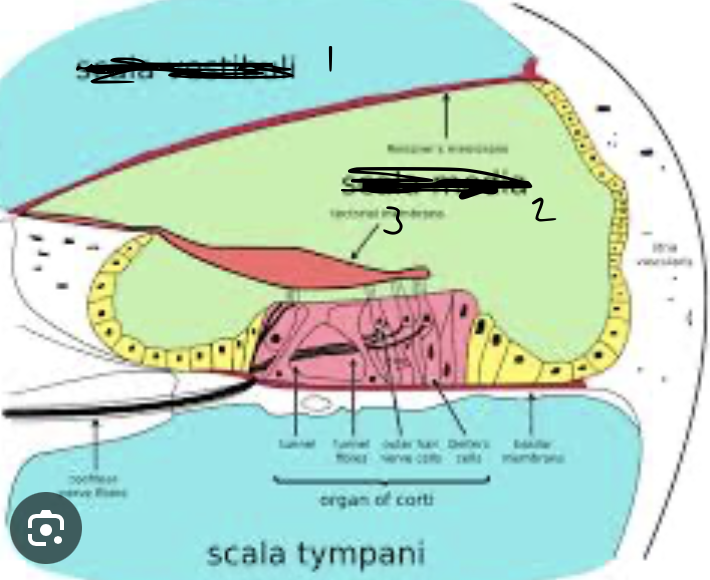
Scala Vestiboli
What is label 2?
Scala Media
What is label 3?
Tectorial membrane
What is label 3?
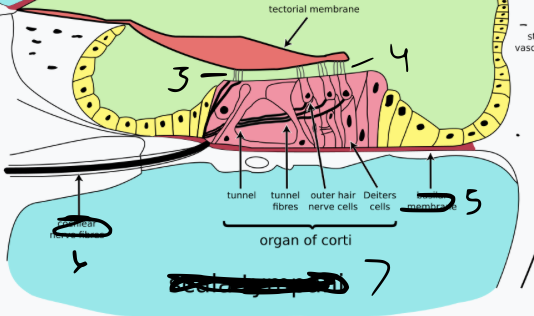
Inner hair cell
What is label 4?
Outer hair cells
What is label 5?
Basila membrane
What is label 6?
Cochlear nerve fibers
What is label 7?
Scala tympani
What is the 1st layer of the retina?
Internal limiting membrane
What is the 2nd layer of the retina?
Nerve fiber layer
What is the 3rd layer of the retina?
Ganglion cell layer
What is the 4th layer of the retina?
Inner plexiform layer
What is the 5th layer of the retina?
Inner nuclear layer
What is the 6th layer of the retina?
Outer plexiform layer
What is the 7th layer of the retina?
Outer nuclear layer
What is the 8th layer of the retina?
External limiting membrane
What is the 9th layer of the retina?
Photoreceptor outer segments
What is the 10th layer of the retina?
Retinal pigment epithelium
What type of cell is label 1?
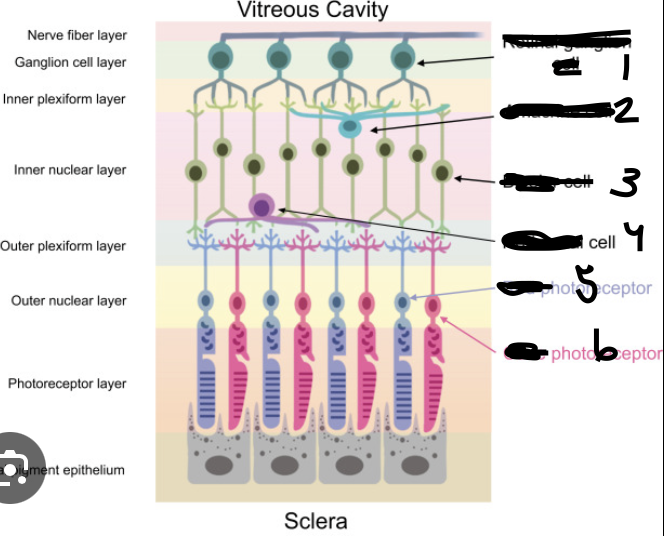
Retinal ganglion cell
What type of cell is label 2?
amacrine cell
What type of cell is label 3?
Bipolar cell
What type of cell is label 4?
Horizontal cell
What type of cell is label 5?
Rods photoreceptor
What type of cell is label 6?
Cones photoreceptor
What is label 1?
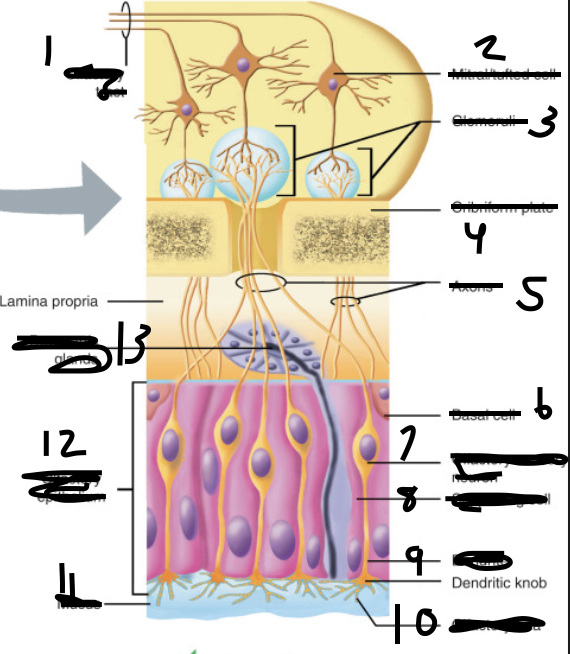
Olfactory tract
What is label 2?
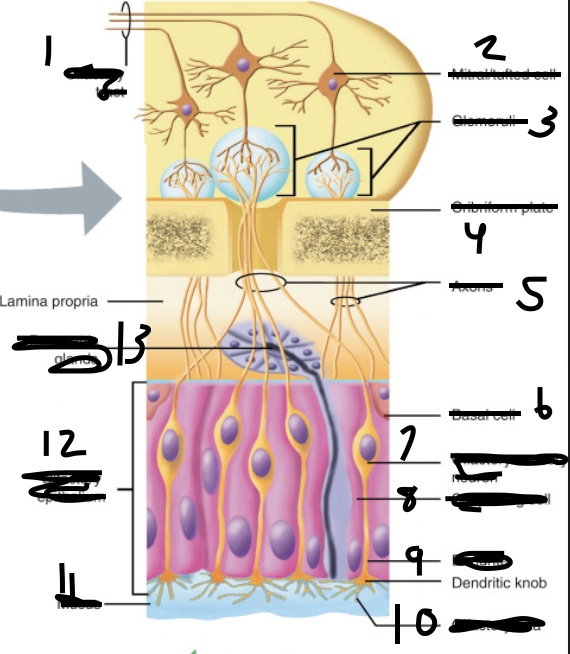
Mitral/tufted cell
What is label 3?
Glomeruli
What is label 4?
Cribriform plate
What is label 5?
Axons
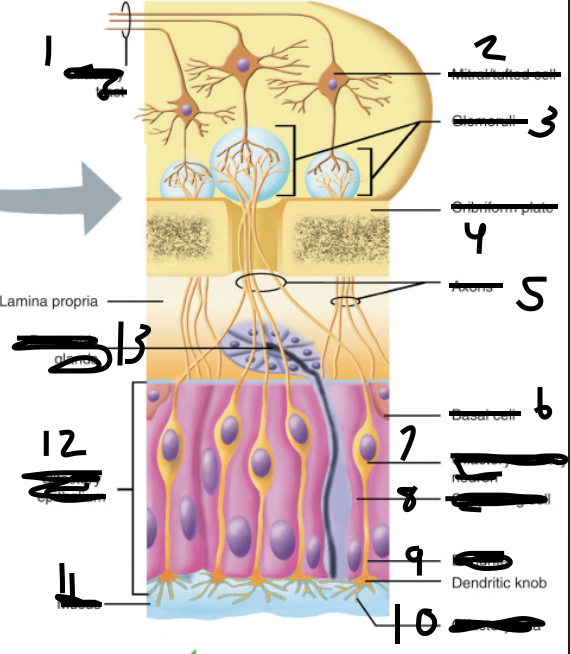
What is label 6?
Basal cell
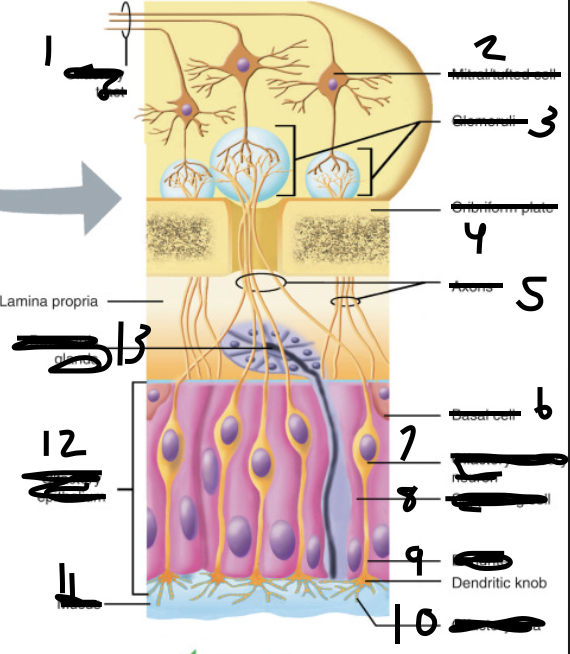
What is label 7?
Olfactory sensory neuron
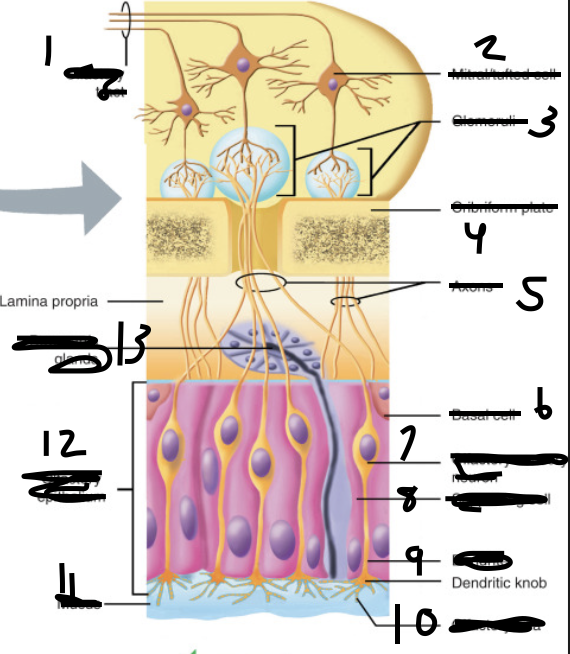
What is label 8?
Supporting cell
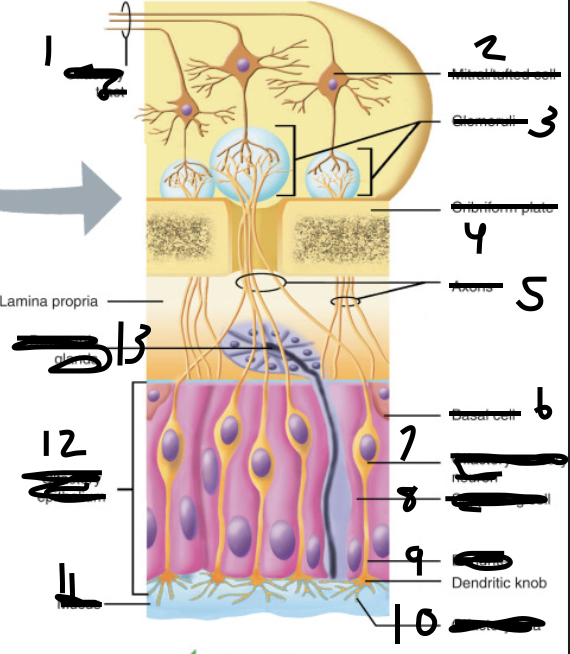
What is label 9?
Dendrite
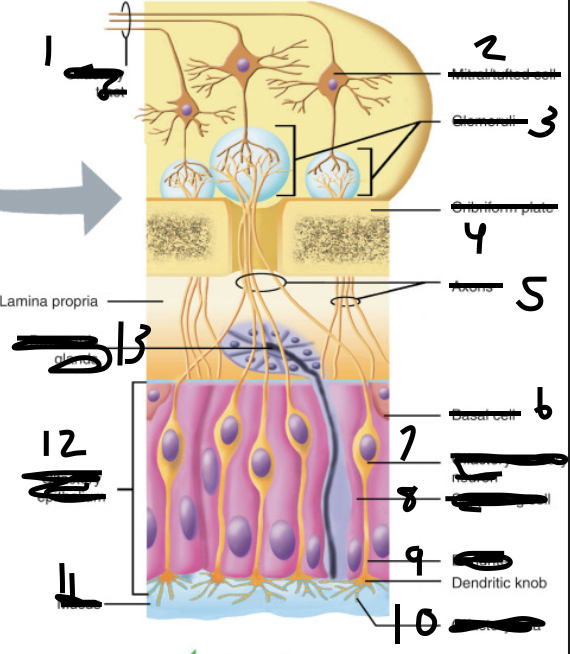
What is label 10?
Olfactory cilia
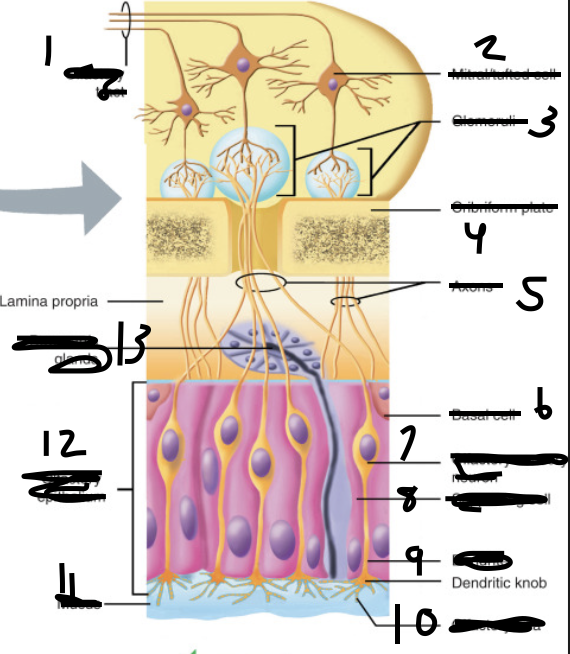
What is label 11?
Mucus
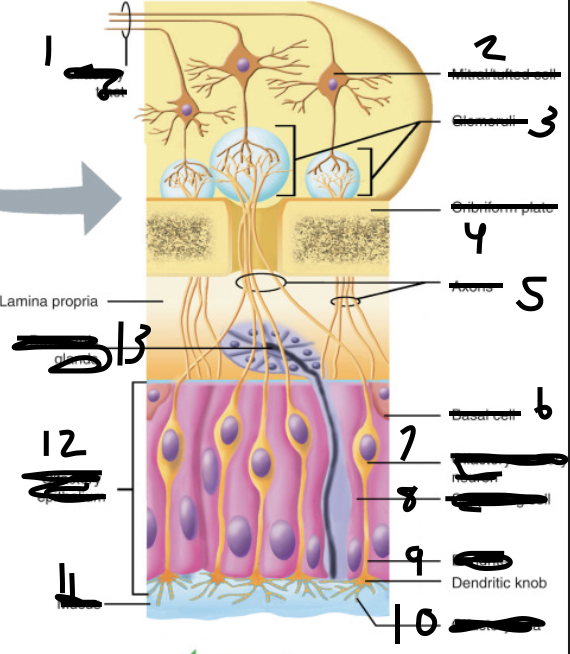
What is label 12?
Olfactory epithelium
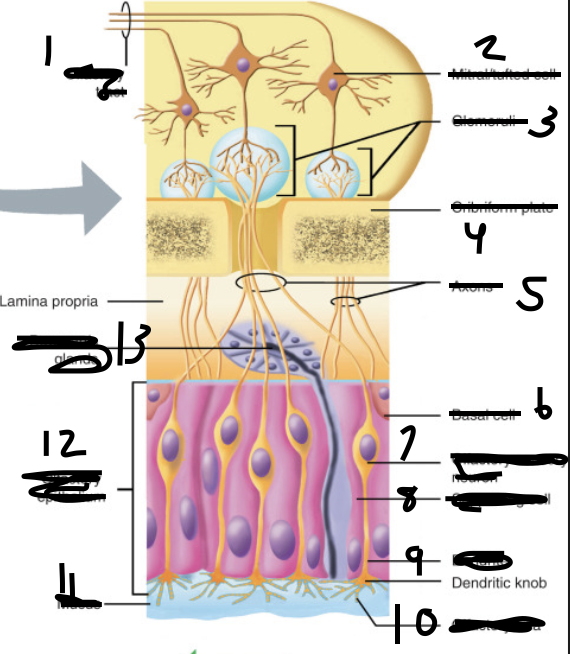
What is label 13?
Bowman’s glands
What is step 1 in phototransduction?
Conformational change of rhodopsin (11-cis-retinal to all-trans-retinal)
What is step 2 of phototransduction?
Activates transduction
What is step 3 of phototransduction?
Activates PDE
What is step 4 of phototransduction?
Leads to cGMP breakdown
What is step 5 of phototransduction?
Less cGMP causes closure of CNG channels
What is step 6 of phototransduction?
Leading to less cation influx
What is step 7 of phototransduction?
Causing hyperpolarization
What is step 8 of phototransduction?
So less neurotransmitters (glutamate release)
What is the 1st step of hearing?
Vibrations of the tympanic membrane create a wave in the fluid in the cochlea
What is the 2nd step in hearing?
Displaces the cochlear duct and basilar membrane
What is step 3 in hearing?
Displacement can be detected by special cells in cochlea
Describe the 1st step of central processing.
Spiral ganglion neurons terminate in the dorsal and ventral cochlear nuclei in the brain stem
What is the 2nd step for dorsal cochlear nuclei in central processing?
Contralateral inferior follicles in the midbrain (direct or indirect through the lateral meniscus)
What is the 2nd step for ventral cochlear nuclei in central processing?
Superior olivary nuclei send to where info from right and left sides integrated together
Describe the 3rd step in central processing.
Auditory goes through the medial geniculate nucleus to the auditory cortex
What is the 1st step in the gustatory system?
Chemical binds tip of taste receptor cell on surface of tongue or oral cavity
What is the 2nd step in the gustatory system?
Causes depolarization of the TRC
What is the 3rd step in the gustatory system?
TRCs synapse into gustatory nerve
What is the 4th step in the gustatory system?
Sent to nucleus of solitary tract in the brain stem > thalamus > eventually to insular cortex (for taste sensation
Which taste receptors go with sweet?
T1R2 and T1R3
Which taste receptors go with umami?
T1R1 and T1R3
Which taste receptors go with bitter?
T2R
Which taste receptor goes with salty?
ENaC
Which taste receptors go with sour?
TRP or TRP-like ion channel
What is the 1st step in the olfactory system?
Odorant binds to ORN
What is the 2nd step in the olfactory system?
Activates a special Ga-olf and adenyl cyclase > production of cAMP
What is the 3rd step in the olfactory system?
cAMP then open CNG channels that let in Na+ and Ca2+ which depolarizes the ORN
What is the 4th step in the olfactory system?
Ca2+ can amplify signal by opening Cl- channels