Particles and Radiation
 Call Kai
 Learn
Learn Practice Test
 Spaced Repetition
 Match
Match Flashcards
 Knowt Play
1/13

There's no tags or description
Looks like no tags are added yet.
Name | Mastery | Learn | Test | Matching | Spaced | Call with Kai |
|---|
No analytics yet
Send a link to your students to track their progress
14 Terms
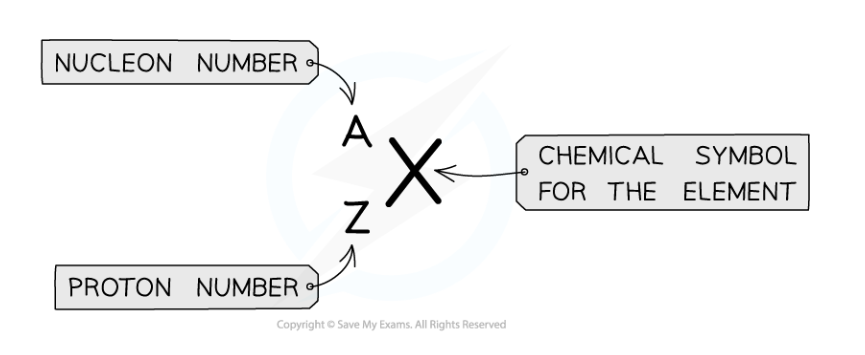
Atomic Structure and notation
The relative mass of an electron is 1/___
Specific charge refers to the ratio of charge over ___, and has units coulombs per kilogram
A represents the ______ number
2000, mass, nucleon
Isotopes
An isotope is defined as nuclei that have the same number of protons but different numbers of neutrons
Isotopic data is defined as the relative amounts of different isotopes of an element present within a substance
The mass of an element is often given as relative atomic mass
The relative atomic mass of an element can be calculated using the relative _______ values
The percentage abundance of different isotopes in a sample can be obtained using a mass _________.
One use of isotopic data is _______ _____.
abundance, spectrometer, carbon dating
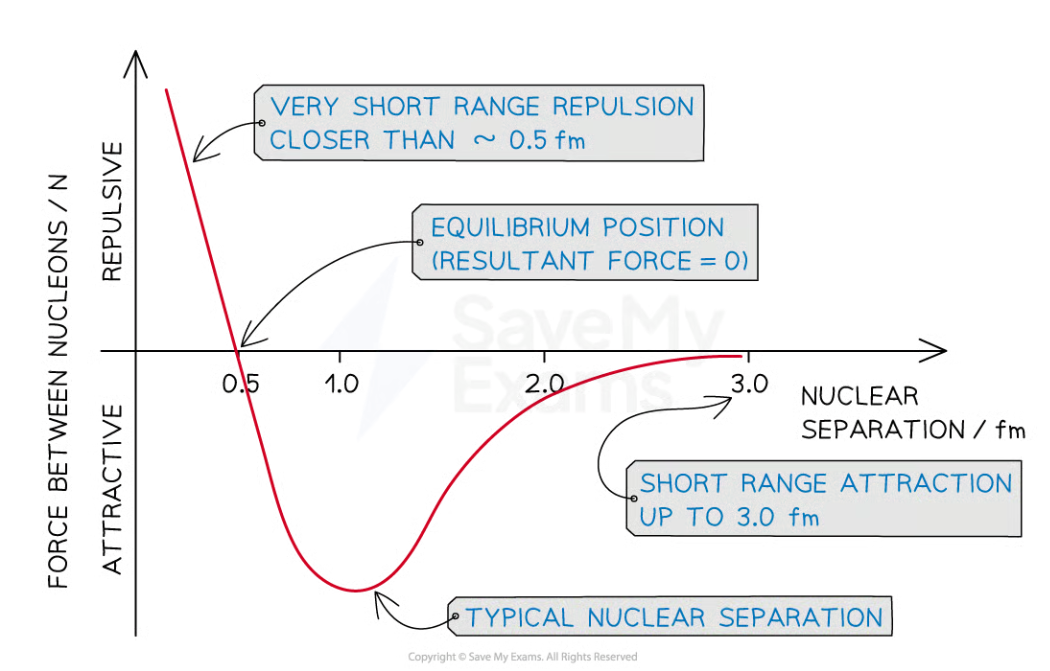
The Strong Force
Inside the atom, nucleons exert an attractive gravitational force on each other. But gravity is the weakest force, so it has ______ effect compared with the electromagnetic and strong forces
The strong nuclear force acts between ______
The strength of the strong nuclear force between two ______ varies with the _______ between them
1__ is the typical nuclear separation, i.e., how far apart nucleons typically are
The equilibrium position, where the resultant force is zero, occurs at a separation of about 0.5 fm
negligible, quark, nucleons, separation, fm,
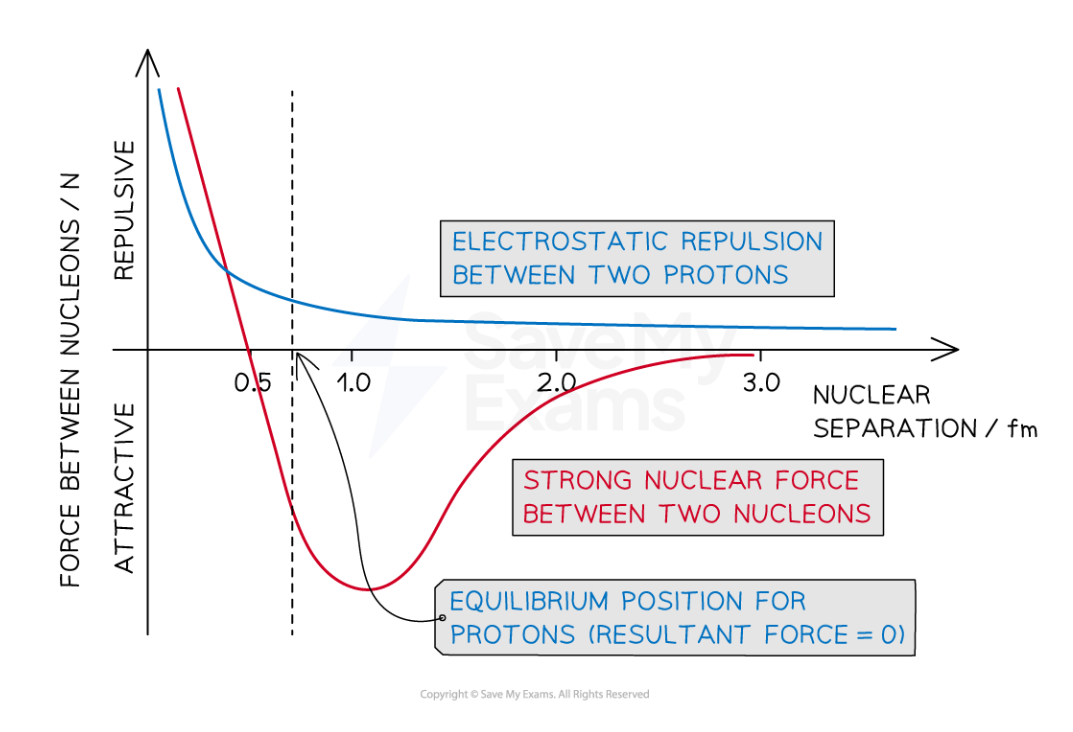
Comparing the Strong and Electromagnetic Forces
The electrostatic force is influenced by charge, whereas the strong nuclear force is not. This means the strength of the strong nuclear force is roughly the same between all types of _______ (i.e. proton-proton, neutron-neutron and proton-neutron)
The __________ _____ for protons, where the electrostatic repulsive and strong attractive forces are equal, occurs at a separation of around 0.7 fm
Nucleon, equilibrium position
Antimatter
Antimatter particles are identical to their matter counterpart but have an opposite _____, _______ number, ______ number, and magnetic moment direction. Every other property is identical
Annihilation is defined as: The _________ of a particle-antiparticle pair when they collide and convert their _____ into two _______
Pair production is the opposite of annihilation, it is defined as: the ______ of a particle-antiparticle pair when a ____________ photon _________ converts its energy into mass
Charge, lepton, baryon, destruction, mass, photons, creation, high-energy, spontaneously
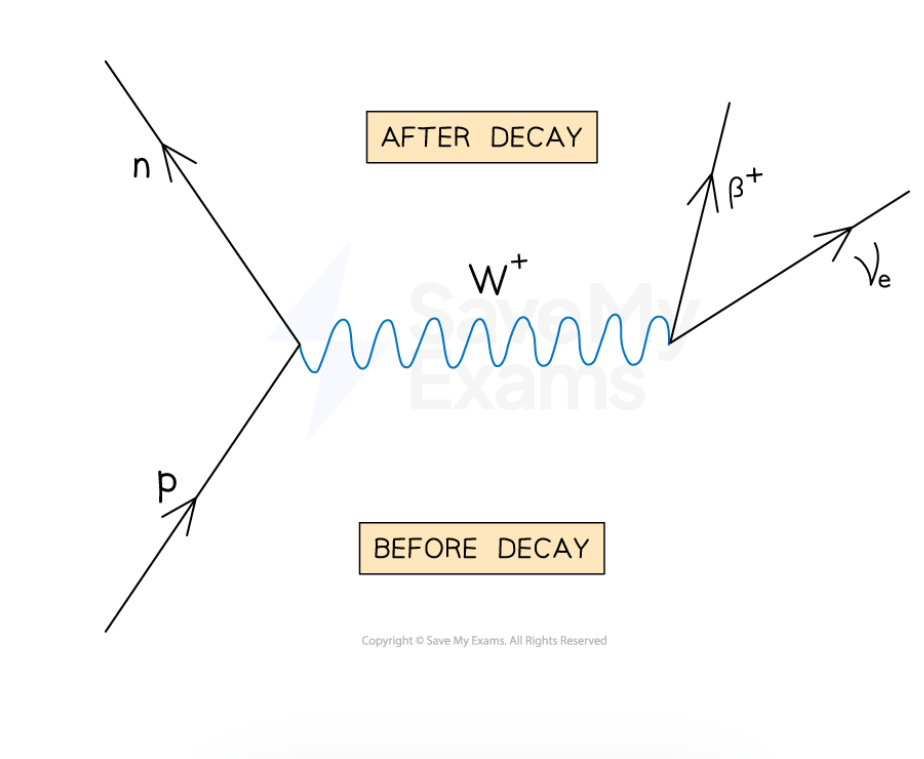
Nuclear Decay
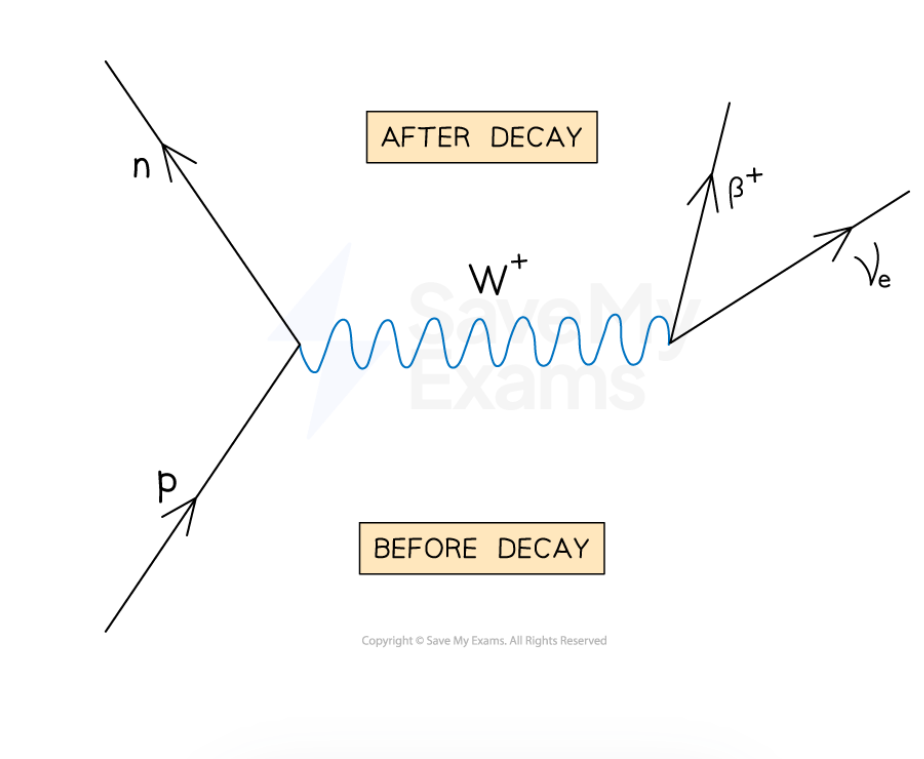
Beta minus decay occurs when ______ turns into a _______ and emits an electron and ______________ ________. Beta plus decay releases an electron neutrino
In beta decay, the nucleus loses a _______ amount of energy each time to make the beta particles. This should have resulted in beta particles having a specific _______ ______, but they showed a _______ ____ of energies. This provided evidence that the neutrino was also being produced using the ________ energy.
The proton is the only _____ baryon into which other baryons eventually decay
neutron, proton, anti-electron neutrino, specific, kinetic energy, continuous range, remaining
Classification
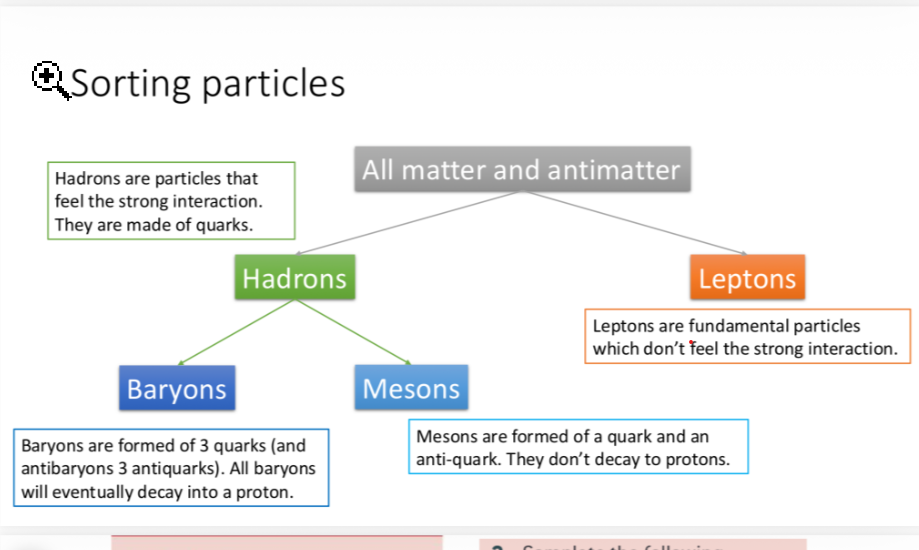
All baryons decay into protons
Fundamental interactions are mediated by exchange particles. _____ mediate the strong nuclear force.
Kaons always decay into ______; ______ into electrons
______ are quark anti-quark pairs
pions, pions, muons, mesons
Leptons and Strangeness
Leptons have a lepton number of L=+1
Particles that are non leptons have a lepton number of L=0
Strange particles are always produced through the ______ interaction and decay through the ______ interaction. Strangeness can only change by + or - 1 in the weak interaction
Particles with a strange quark have S= ___
Particles with anti-strange quarks have S=1
Particles with no strange quarks have S=0
Strong, weak, -1
The Four Interactions
The electromagnetic force has the longest range out of the four fundamental interactions as photons have an infinite range, because they have __ _____.
Each force has its own exchange particle known as a boson. This is a virtual particle that is only in existence during the interaction, then pops out of existence.
Bosons are known as virtual because we don’t _______ them ________.
If we did intercept a boson passing between two particles, we would stop the force from acting.
No mass, observe, directly
Bosons
Pions are the gauge bosons that mediate the strong force between nucleons; gluons mediate the strong force between quarks
The Z0 boson can also mediate the weak force
A photon is defined as a massless “packet” or a “quantum” of _________ _____
This means that energy is not transferred continuously but as _______ packets of energy
electromagnetic energy, discrete
Feynman Diagrams
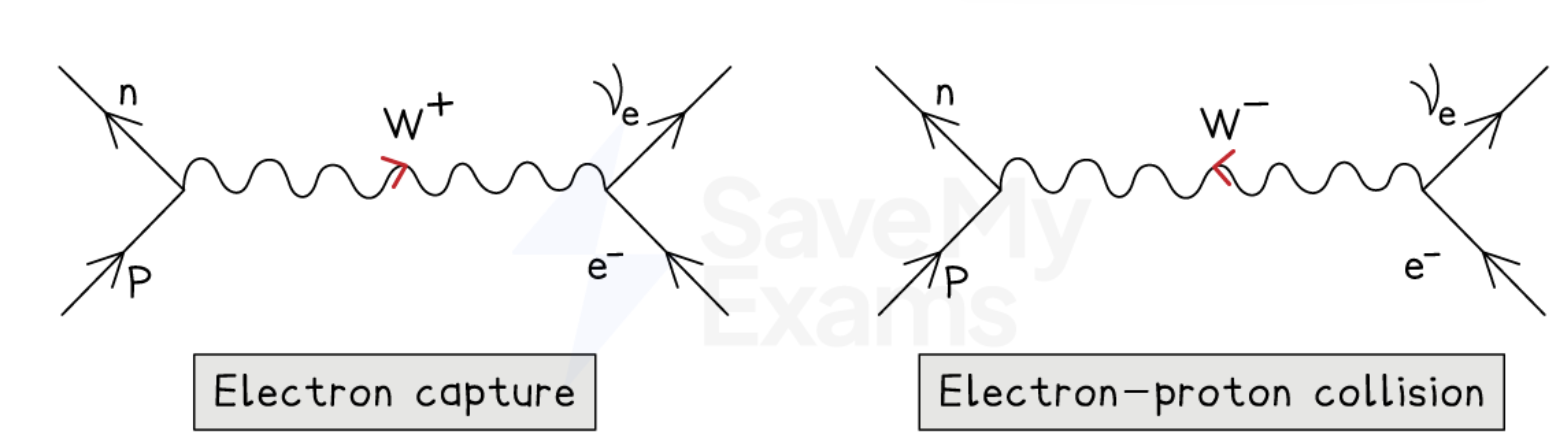
Electrons and protons are attracted to each other via the electromagnetic interaction. However, when they interact with each other, it is the weak interaction that facilitates the collision
They have the same equation
The transfer of exchange particles is from left to right, unless indicated by an arrow above the wavy line
Hadrons/quarks are present on the ____ and leptons on the right, they must never meet at a vertex
Charge, baryon number and lepton number must be conserved at each vertex
The photoelectric effect problem I
As photons are particle-like, they interact with electrons in the metal in a 1:1 fashion
Each photon interacts with only 1 electron and delivers its entire energy to that one electron. This is why the photo-emission of electrons happens instantaneously.
The photoelectric effect problem II
The emission of electrons does not happen below a certain threshold frequency, regardless of intensity.
This is because E=hf means that photon energy is dependent on frequency, and it takes a minimum amount of energy for an electron to be able to leave the metal.
This is the work function, phi.
The Photoelectric Effect—Problem III
Once the threshold frequency is reached, the number of photo-electrons emitted increases with increased intensity of radiation.
This is because, at any frequency, the intensity of light depends on the number of photons.
Once the threshold frequency has been reached, each photon is able to cause a photoemission, so more intense light causes more electrons to be released.