Materials
 Call Kai
 Learn
Learn Practice Test
 Spaced Repetition
 Match
Match Flashcards
 Knowt Play
1/32

Earn XP
Description and Tags
33 Terms
Define density and its unit
A measure of the ‘compactness’ of a substance. The mass per unit volume
Unit: kgm−3
State the equation of density
ρ=vm = mass/volume
Describe the method to find the density of an object.
• Use a mass balance to measure the objects mass
Use a ruler to measure dimensions of regular object
Or for irregular objects: Use water displacement method with eureka can and measuring cylinder
State Archimedes principle
The upthrust force is equal to the weight of the fluid displaced. If the upthrust equals the weight of the object, the object will float.
Explain how (heavy cargo) ships float
They are large, so displace large volumes of water, which creates a large upthrust force allowing it to float
State the density of water at atmosphere pressure and room temperature
1000kgm−3
State Hooke’s Law
The extension of a wire or a spring is directly proportional to the force applied, up to the limit of proportionality
State the equation relating the force applied and the extension of a wire/string
F=kΔL, k=spring constant
State what happens to the spring with a greater spring constant
The greater the spring constant the stiffer the spring
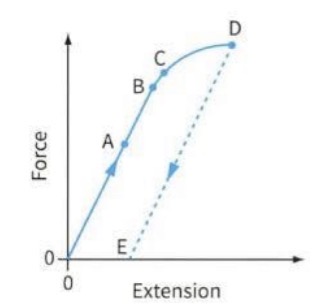
Describe A, B, C, D, D-E in relation to Hooke’s law
A = the linear section where Hooke’s law is being obeyed where the material is behaving elastically
B = At the end of the linear section: the limit of proportionality
C = Just beyond the straight section, where it reaches the elastic limit and starts to behave plastically
D = Point of fracture/break point
D-E = The unloading data where it has permanently deformed and has not returned to its original length
Describe what a non-linear Force extension graph means
That the material does not obey Hooke’s Law
Describe the graph of a rubber band
The rubber band extends and contracts by different degrees (non-linear=obeys Hooke’s Law) but still behaves elastically as it returns to its original length
Describe how the number of springs in series and parallel affect the spring constant of the system
Series: nk
Parallel: kn
State 2 equations for elastic potential energy
energyEp=21FΔL=21k(ΔL)2=2kF2
State what must be done to stretch a material
Work must be done
State the other name for elastic potential energy
Elastic Strain energy
State for elastic and plastic deformation the energy before and after being stretched, and how energy is lost
For elastic deformation, the work done to stretch the material is equal to the amount of energy released when unloaded
For plastic deformation, the work done to stretch the material is greater than the amount of energy released when unloaded
Energy is lost through heat
State the energy changes for a mass on a spring
Top = All GPE
Equilibrium = Less GPE, More KE and EPE
Bottom = All EPE
State what happens when a force is applied over a larger area
If a force is applied over a larger area, there is lower pressure and therefore has a smaller effect.
Define stress and strain in words and the units
Stress = Force per unit cross-sectional area, in Pascals (Pa)
Strain = Extension per unit length (no units)
In EPE equations what is F
F is the tension (in the string/wire/spring, not the weight)

Describe each point of a stress strain graph
A = Limit of Proportionality → The point beyond which the extension is not directly proportional to force applied to it
B = Elastic limit → Maximum force/stress that can be applied to the material before the material is permanently deformed
C = Yield Point = Where the material continues to deform with no increase/less stress/load
D = Ultimate tensile stress/strength = The maximum stress a sample can withstand
E = Breaking Stress = The point at which a material deforms
m = Young’s Modulus → stress/strain
State 2 equations that can be derived from Young’s Modulus = tensile stress / tensile strain
E=AΔLFL=AkL
Define Young’s Modulus
Its a measure of the stiffness of a material
What does it mean when the Young’s Modulus of a material is greater
The greater the Young’s Modulus, the stiffer the material is
Define ductile
The ability to be deformed plastically without breaking/be drawn into wires
Why is a material ductile
The layers of atoms slide over each other, making and breaking bonds, which prevents cracks
Define necking
Where the cross-sectional area of a material decreases significantly and unevenly. It occurs beyond its UTS. It occurs at points of concentrated stress+strain
Define brittle
When a material breaks with very little to no plastic deformation.
Why is a material brittle
Because the atoms are arranged in a giant rigid structure made up of very strong bonds. Applied stress causes tiny cracks which get bigger until fracture (a flat break).
Define a brittle fracture
When a material breaks suddenly with little to no plastic deformation
State some examples of ductile materials
Copper, aluminium, gold
State some examples of brittle materials
Glass, ceramic, cast iron