PHI 103 — Philosophy of Mind Exam Three Study Guide Flashcards
 Call Kai
 Learn
Learn Practice Test
 Spaced Repetition
 Match
Match Flashcards
 Knowt Play
1/22

Earn XP
Description and Tags
These vocabulary flashcards cover Kripke's modal metaphysics, Functionalism, Jackson's Knowledge Argument, and Nagel's problem of consciousness based on the PHI 103 study guide.
Name | Mastery | Learn | Test | Matching | Spaced | Call with Kai |
|---|
No analytics yet
Send a link to your students to track their progress
23 Terms
A priori
Knowledge known by reason alone, independently of experience.
ex. Mathematical truths, such as 2 + 2 = 4, are considered a priori knowledge, as they can be understood without sensory experience.
A posteriori
Knowledge known through experience or empirical investigation.
ex. Scientific theories, such as the laws of physics, are considered a posteriori knowledge, as they require observation and experimentation for validation.
Analytic
A semantic or logical distinction for truths that are true by definition.
ex. The predicate is already contained in the subject.
Example:Analytic truths are statements that hold true based solely on the meanings of the words involved, without requiring external verification.
“All bachelors are unmarried.”
“Bachelor” already means unmarried man.
Analytic = “true by language alone.”
Synthetic
A semantic or logical distinction for truths that are true by facts about the world.
ex. Examples include statements like "The cat is on the mat," which require factual verification about the world.
Necessary truth
A truth that holds in all possible worlds and couldn't be otherwise (e.g., 2+2=4).
ex. A necessary truth is a proposition that must be true in every conceivable situation and cannot be false.
Contingent truth
A truth that holds in some worlds but is false in others.
ex.
You go to UC Davis
The sky is cloudy today
Possible World
A framework for talking about how things could have been, thought of as parallel universes or complete, consistent ways history could have unfolded.
Non-Rigid Designators (Descriptions)
Terms like "the teacher of Alexander" that pick out whoever happens to satisfy that description in a given world.
Rigid Designator
A term, such as a proper name like "Aristotle," that picks out the same individual in every possible world where they exist.
Initial baptism
The start of a name's reference where the name is first attached to an object (e.g., "we shall call this child Aristotle").
Causal-Historical Theory of Reference
The theory that names get their reference through an initial baptism and a causal chain of speakers rather than through descriptions.
Natural kind terms
Words like water, gold, heat, and tiger that Kripke identifies as rigid designators.
Necessary a posteriori
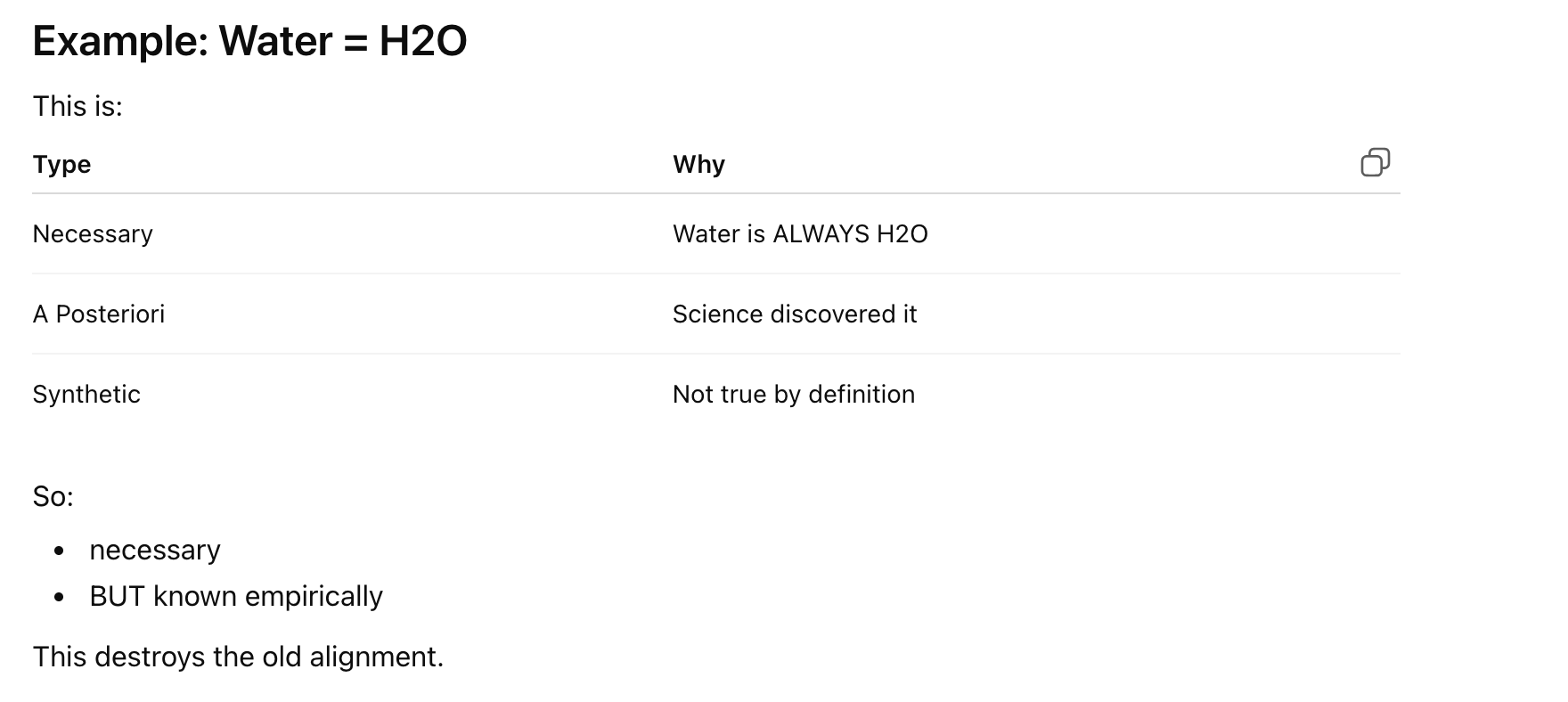
Truths that are necessarily true in every possible world but are only discovered through empirical science, such as "Water=H2O" or "Hesperus=Phosphorus."
Identity theory
The claim that mental states are identical to specific brain or physical states (e.g., pain=C-fiber firing).
Functionalism
Defining mental states by their causal-functional role—their causal relationships to sensory inputs, behavioral outputs, and other mental states—rather than physical substrate.
Multiple realizability
The idea that the same mental state could be physically realized in different ways (human brain, octopus nervous system, silicon chip) as long as it plays the right causal role.
Behaviorism
A view that defines mental states purely by behavioral dispositions, without requiring inner states.
Mary Thought Experiment
Jackson's scenario where a neuroscientist who knows all physical facts about color vision identifies a new learned fact (the quale) upon seeing red for the first time.
Quale (plural: qualia)
The subjective, felt quality or qualitative character of an experience, such as the redness of red.
Knowledge Argument
An argument for property dualism stating that if Mary learns something new upon seeing color, then not all facts are physical facts and physicalism is incomplete.
Property dualism
The view that physical and mental properties are distinct, even if there is only one substance.
Subjective character of experience
Nagel's concept of the "what it's like" that belongs to a particular perspective and cannot be captured by objective, physicalist accounts.
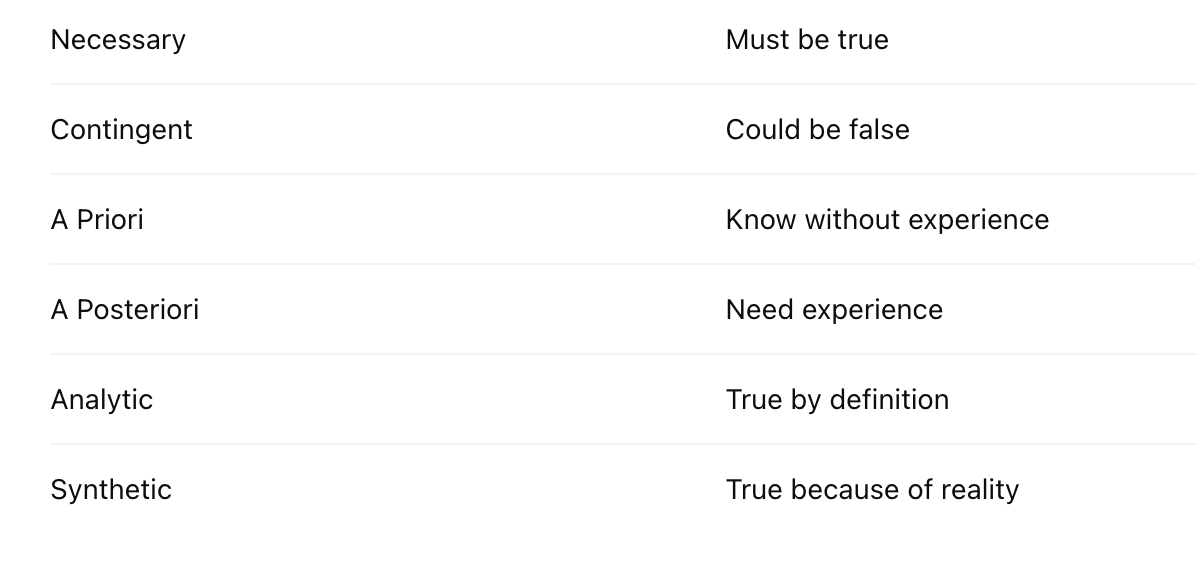
The Traditional Alignment Of Three Distinctions - Kripkes Argument
Traditionally, If something is:
necessary (true in all worlds; never false) → it should ALSO be a priori(known fact by reason) and analytic (True by DEFINITION/meaning.)
contingent (True in our world, but could’ve been different) → it should ALSO be a posteriori (known by experienec) and synthetic (true by facts of world; grass is green)
Kripke argues:
THESE DO NOT ALWAYS MATCH.