GEN BIO 2 FINAL MASTER SET
 Call Kai
 Learn
Learn Practice Test
 Spaced Repetition
 Match
Match Flashcards
 Knowt Play
1/91

Earn XP
Description and Tags
flashards in order of modules given on canvas
Name | Mastery | Learn | Test | Matching | Spaced | Call with Kai |
|---|
No analytics yet
Send a link to your students to track their progress
92 Terms
Taxonomy
naming, describing, classifying
think “taxadermy” classifying, naming
Phylogeny
evolutionary history
Taxon
Group at any level within a hierarchy
What does natural selection require?
heritable phenotypic variation
Are phylogenetic trees set in stone, or hypothesis?
Hypothesis
Taxonomy should relfect phylogeny
True
Characteristics of virus
Made of capsid and genome
Smaller than cells (usually)
Replicate within cells, use cell’s resources
What is the capsid made out of, what is it’s purpose? same with genome
capsid - protein coat, determines morphology and attachment to host
genome can be rna/dna and single/double stranded it can also be linear or circular or segmented
Viral envelope
Phospholipid bilayer surrounding capsid
Only present in some viruses
Acquired from host, contains virus AND host proteins
Does every virus have an envelope?
Nope, the envelope is acquired from the host and has a mix of host proteins + viral proteins
Viral replication cycle
Bind to host cell
Genome enters cell
Genome replication and gene expression
Assembly
Exit
Lytic cycle
General replication cycle – kills host cells
Horizontal transmission
Done by virulent phages
virulent v temperate phages
Virulent only do lytic cycle, they only kill
temperate do lytic or lysogenic cycle
lysogenic cycle
Viral replication without destroying host cell
Viral genome integrates into host genome as a prophage
Vertical transmission
Done by temperate phages
ex - lambda phage
what where the first cells? What was the process of these cells coming into existence?
Prokaryotes
Heterotrophs ( ate shit in the primoridial soup for energy ), photosynthetic autotrophs ( cyano bacteria, once stuff run out within the soup, they used the sun for energy), oxygen revolution → aerobes
Main characteristic prokaryotes lack compared to eukaroyes
membrane bound organelles
within the tree of life, what falls under prokaryotes
Bacteria, archaea
function of the cell wall in prokaryotes, what is it made of?
Maintains shape, prevents bursting protects cell
Bacterial cell wall made of peptitoglycan (carb polymer)
pos v negative taxis
Pos taxis toward stimulus
neg taxis away from stimulus
Flagella
mostly in prokaryotes, but found in all 3 domains (convergent evolution) same function, diff origin
Function:
H+ pumped across plasma membrane by ETC – forms gradient H+ diffuses through motor, E from diffusion turns motor
prokaryote reproduction method + characteristics
Binary fission
asexual, rapid, low cost, not risky,
How do prokaryotes have high diversity while reproducing asexually
Rapid reproduction + mutation
Genetic recombination
genetic recombination
combining DNA from 2 sources
3 mechanisms of genetic recombination
transformation - picks up dna from enviornment
transduction - bacteriophage transfers genes from one cell to another
conjugation - pilus and F factor, F+ has F factor, can transfer part of chromosome.
Sister group to eukarya
Archea, based on RNA
Proteobacteria
think mitochondria
Endosymbiosis of alpha proteobacteria → mitochondria
Cyano bacteria
think chloroplast
Photoautotrophs – oxygenic photosynthesis → oxygen revolution, Endosymbiosis → chloroplasts
Archaeal Diversity
extremophiles – thrive in extreme conditions
Halophiles – high salt environments
Thermophiles/hyperthermophiles – hot environments
Methanogens – release methane as biproduct of metabolism, Anaerobic, often swamps/marshes
Eukaryote dervied traits
Nucleas, membrane organelles, cytoskeleton,
CC types of endosymbiosis
Serial - series of endyosymbiotic events
primary - phagocytosis of bacterium by larger cell (mitochondria, chloroplasts)
Secondary - bigger eukaryote englufs smaller eukaryote - secondary plastid
Plastid
term for chloroplast and related organelles
secondary plastid derivation
Secondary plastids derived from red or green algae via secondary endosymbiosis
Explain eukaryote diveristy
Mostly unicellular
Photoautotrophs, heterotrophs, mixotrophs – capable of photosynthesis and heterotrophy
Ancestral eukaryotic traits
Nucleus, membrane-bound organelles
Aerobic respiration
Mitochondria from primary endosymbiosis
Archaeplastida
D.T. → chloroplasts via primary endosymbiosis (cyanobacteria)
reg algae, green algea, land plants.
Participated in secondary endosymbiosis, got eaten, became secondary plastids
SAR
D.T. → Secondary endosymbiosis of red algae, *remember saR, R = red algae
3 clades = stramenopiles, alveolates, rhizarians
Ameobozoa
D.T. → lobe/tube shaped pseudopedia ex - slime mold
Ophistokont
D.T. → n/a
includes: Animals, fungi, several groups of protists such as nucleariids
Discoba
D.T → chrystilline rod in flagella,
Secondary plastids via green algae – mixotrophic
4 taxa in archaeplastida ROAP
red algae
chlorophytes
charophytes
plants
4 taxa in ophistokont
Nucleariids
fungi
choanoflagelletes
animals
Fungi sister taxa
Nucleariids
explain land life pre plants
Green slime - cyanobacteria, algae, small heterotrophs including fungi
Fungi D.T.
Absorptive heterotrophy: Secrete hydrolases – hydrolytic enzymes, Polymers → monomers externally
What do Virusus not do?
Carry out metabolic processes
Reproduce independent of host cells
Contain nucleus, cytoplasm, organelles (
2 main types of fungi body structure
multicellular and unicellular
Characteristics of multicellular fungi
Hyphae - long, branched, threadlike filament, Basic building block of fungus body
Chitinous cell wall (derived) - polysaccharide
Mycelium
Tangled mass of hyphae, feeding network, grows in and around food source
Ariel hyphae v fruiting body
Ariel hyphae, to hold spores up to the wind for dispersion, simple
fruiting body, complex, organized specilized sturcutre producing and protecting millions of spores
spore reproduction
haploid cells, made by hyphae or fruiting body, non motile, sexual/asexual
Land in moist place with food → germinate → new mycelium
Fungal sexual reproduction
Mating types, not male/female. Hyphae release and Extend towards pheromones
if diff mating types plasmogomy occurs, but stops at a heterokaryon (n+n) if same, plasmogomy occurs resulting in diploid zyogte and meiosis contnues to restore halpoid.
spores then grow into new hyphae
Fungi Asexual reproduction
Filamentous fungi – spores via mitosis
Single-celled yeast – cell division/budding
fungal diversity
Chytrids: basal fungi, flagellated spores
zygomecytes decomposers, black mold
glomeromycetes, mycorrhizae, mutualism with plant roots
Ascomycetes - most species, diverse
Basidiomycetes - mushroom puffballs bracket fungi
ecological significance of fungi
Mutualists, decomposers, parasites
fungi as mutualists
Mycorrhizae - extension of root system
Endophytes - make toxins that deter herbivores
can help break down material in gut - leaf cutter ant
Lichens- Fungus and photosynthetic microorganisms
Fungal parasites
Plants – chestnut blight, enters cracks in bark, hyphae spread throughout
Mycosis: fungal infection in animals
Examples: ringworm, athlete’s foot, systemic mycosis
Symmetry
Asymmetry - none
radial symmetry - any plane yields equal halves (pizza)
bilateral symmetry - Only 1 plane of symmetry through longitudinal axis
associated with cephilization
3 traits to compare in animal body plans
Body cavities
symmetry
embryonic germ layers
characteristics of animals
Heterotrophy - cannot make own energy
Structure + organization
Eukaryotic, no cell walls
Multicellular (derived but not unique)
Extracellular matrix (derived and unique)
hierarchical organization (tissues, organs, organ systems)
development regulated by gene expression (hox gene)
3 germ layers
Ecto - outer layer, becomes nervous system
endo - innermost layer - digestive tube, other organs
mesoderm - muscle skeleton etc
Diplo v triplo blast
diplo only endo and ecto
triplo - has all three
can a diploblast have a body cavity
no, must have three embryonic germ layers
Def of Coelom & types
fluid filled cavity between digestive tube and body wall
aceloem , no cavity present
true celoem, cavity lined with mesoderm on both sides
psuedo ceoloem - cavity lined with mesoderm on outer surface, ecto derm on inner surface
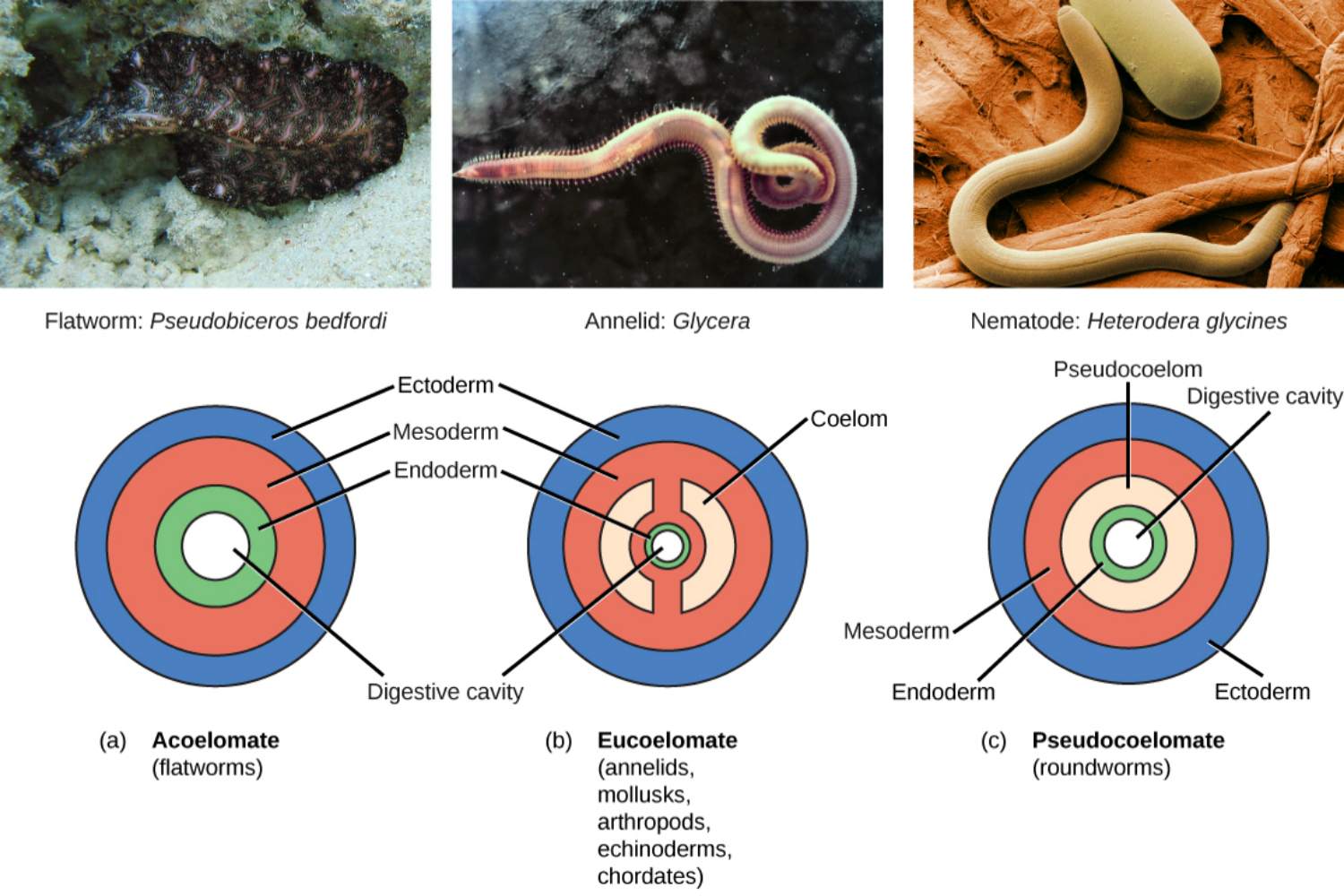
Coelom advantages
Hyrdostatic skeleton - water baloon analogy, squeeze one end of it, the front end moves (worm skeleton)
circulation - ceoloem allows for circulatory system development
2 modes of development
Protostome
Spiral cleavage, first opening becomes the head, determinate cleavage
Dueterostome
radial cleavage, first opening becomes anus, 2nd becomes head, indeterminate cleavage
Sister taxa to animals
Choanoflagellates - flagellated unicellular eukaryotes
Cambrian explosion
first appearance of many body plans in fossil record
First evidence of hard body parts
biological arms race tirggered by predation
Eumetazoa D.T.
Tissues, symmetry
Bilateria D.T.
bilateral symmetry, triploblasty
bilateral symmetry and triploblasty makes sense together because bilateral symm implies an amial with a defined head and rear, along with paired organs due to left and right side ( eyes arms legs etc)
This kind of animals is shaped for movement thus needing a mesoderm wich holds muscles + skeleton
Nephrozoa D.T.
Ceoloem, extratory structures
Deuterostomia D.T.
Deuterstome development
Protostomia D.T.
Protostome development
Spiralia D.T.
protostome development, grouped by genetic similarities
Ecydysozoa D.T.
ecdysis: molting/shedding of outer covering
Proifera
Sponges, multicellular basal metazoans and has choanocytes: feeding cells of sponges
Cnidaria (jellyfish)
Basal eumatazoans
True tissues, radial symmetry, diploblastic
nidocytes - stinging cells
Phylum that fall under spiralia and their respective characteristics:
Platylementhies
Flatworms ; DT= aceoloem
rotifera
crown of cilia at anterior end ; psuedo coloemate
mollusca
Mante, visceral mass, foot ; ceoloamte
annelids
segmented worms
Phylum under Ecdysozoa and respective characteristics
Nematoda
Psuedo celomate, cuticle
Arthopoda
chitinous exoskeleton, specialized exoskeleton, joints
Phylum Echinodermata
Bilateral, caco3 endoskeleton, water vascular system,
phylum chordata
D.T.’s: Notochord - support alond dorsal surface
Nerve chord - tube of nervous tissue
pharyngeal slits - folds/openings in throat
post anal tail
one hox cluster (basal chordates)
Vertebrates
D.T.: Bone/cartilage veterbrae that replaces notochord, >2 hox clusters - more complex body plan
Gnathostomes
hinged jaw, bony skeleton, 4 hox clusters
osteichthyes
lung/swim bladder
Lobe fins
muscular fin for locomotion
tetrapods
4 limbs with digits
neck
fused pelvic girdle
Amniotes
Amniotic egg
membrane and embryo - prevents dessiccation
Rib cage ventilation
mammal derived traits
Mammary glands
Give birth to live young (mostly)
Endothermy – warm-blooded
Eutherians
placental mammals – have complex placenta
Long gestation – complete embryonic development in utero
Most mammals are eutherians
D.T’s of primates
Large brain
Grasping hands/feet
Forward-facing eyes
High parental care
Complex social behavior
For monkeys and apes – fully opposable thumb
closest relative to humans
chimps
Hominin
species on human “side” of human-chimp divergence, homosapein is only living hominin
Homo sapien D.T’s
Bigger brains
Complex tools
Fully bipedal traits
Small jaws, “short” digestive system
Language, symbolic though