PE HVACR: Supportive Knowledge
 Call Kai
 Learn
Learn Practice Test
 Spaced Repetition
 Match
Match Flashcards
 Knowt Play
1/72

There's no tags or description
Looks like no tags are added yet.
Name | Mastery | Learn | Test | Matching | Spaced | Call with Kai |
|---|
No analytics yet
Send a link to your students to track their progress
73 Terms
ASHRAE 15?
Title: “Safety Standard for Refrigeration Systems”
CFMexhaust=100⋅(lbrefrigerant)0.5 , use the largest circuit
ASHRAE 34?
Title: “Designation and Safety Classifications of Refrigerants”
Safety classifications of refrigerants in Handbook.
A1 least toxic and least flammable.
B3 most toxic and most flammable.
Designation, read from right to left if less than 3 digits:
R-(C−1)(H+1)(F)
ASHRAE 55?
Title: “Thermal Environmental Conditions for Human Occupancy”
Summer: 75 °F DB / 50% RH
Winter: 68 °F DB / 45% RH
Comfort conditions based on air velocity, temperature, humidity, clothing, activity level.
ASHRAE 62.1?
Title : “Ventilation for Acceptable Indoor Air Quality”
CFM/person and CFM/ft² guidelines in Handbook
Class 1 air: low contaminants and odors. (ex: office, classroom, conference room)
Class 2 air: moderate contaminants and odors. (ex: bathroom, shower, weightroom, gym)
Class 3 air: high contaminants and odors. (ex: janitor closets)
Class 4 air: highly contaminated and dangerous (ex: chemical storage, lab fumes, paint booths)
Anything Class 2+ needs to be exhausted or can be retruned to a higher class space.
ASHRAE 90.1?
Title: “Energy Standards for Buildings Except Low Rise Residential Buildings”
Minimum energy efficiency requirements for HVAC systems.
NFPA 90A?
Title: “Standard for the Installation of Air-Conditioning and Ventilating Systems”
Fire Protection Standard
Class 1 Flexible Duct (typical):
Flame Spread Index < 25
Smoke Index < 50
Fire dampers & Smoke dampers
NFPA 90B?
Title: “Standard for the Installation of Warm Air Heating and Air-Conditioning Systems”
Fire Protection Standard
NFPA 96?
Title: “Standard for Ventilation Control and Fire Protection for Commercial Cooking Operations”
Fire Protection Standard
Grease Exhaust Ducts need 304 stainless, 16 gauge, continuously welded.
NFPA 70?
Title: “National Electric Code”
Standards for electrical installations.
NFPA 54?
Title: “National Fuel Gas Code”
Standards for gas installations.
Montreal Protocol?
Phase out ozone-depleting substances, like CFC and HCFC refrigerants.
Refrigeration System Components?
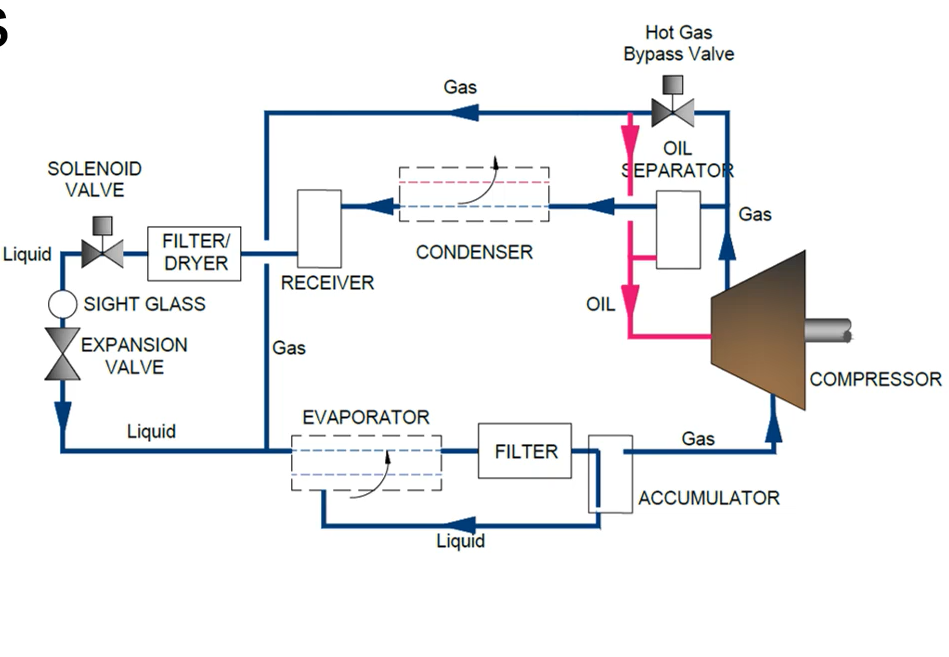
Evaporator: Provides cooling, refrigerant evaporates into a gas. Low pressure.
Filter: Removes contaminants from refrigerant before entering compressor.
Accumulator: Place for any remaining refrigerant liquid to go (incase of insufficient heat to fully evaporate refrigerant), ensures only refrigerant gas enters the compressor.
Compressor: Compresses refrigerant gas.
Oil Separator: Separates oil from discharge refrigerant gas, and sends it back to the compressor.
Condenser: Rejects heat, refrigerant condenses into mostly liquid. Still high pressure. Determines amount of subcooling.
Reciever: Collects refrigerant liquid after condenser.
Dryer: Removes water moisture from system, prevents freezing.
Solenoid Valve: Opens/closes for refrigerant flow.
Sight Glass: Visual place to ensure no water/moisture buildup in system.
Expansion Valve: Lowers pressure from refrigerant down to evaporator pressure. Monitors super heat and regulates refrigerant flow.
Hot Gas Bypass: Applies heat from hot gas discharge to the evaporator to put a false load on the evaporator. Helps ensure only refrigerant gas enters the compressor. Typically active during reduced heat load in the space.
Transmissibility? (Vibrations)
For small ratios: TR=1−r21
Low Transmissibility → Damping is effective
High Transmissibility → Damping is ineffective
Acoustics?
Frequency → Determines Pitch
Sound Pressure → Determines Loudness
A-weighting → Considers different frequency bands for human hearing and weighs some frequencies more.
NC Rating → Use worst of all ratings at different frequencies
If distance doubles, sound drops by 6 dB. Sound level decreases by the square of the distance (inverse square law).
If sound pressure halves, sound drops by 6 dB.
USA frequency?
60 Hz
Control point types?
Digital: On/Off
Analog: 0-100%
Controls Inputs?
Signal received in to the BAS.
Switches, sensors
Controls Outputs?
Signal sent out from the BAS.
Dampers, valves, on/off buttons, actuators
Bypass Chiller Piping?
Maintain minimum flow to the chiller to prevent freezing.
Heat Pipe?
Sensible heat transfer only.
Equivalent Diameter?
For rectangular and oval ducts, determines equivalent circular duct size and allows us to use standard circular duct charts and equations.
First step before further calculations.
Cooling Tower Relief?
Lowers/resets CWS temperature to the chiller by taking advantage of cooler outside conditions and increasing cooling tower fan speeds. Results in energy savings at the chiller compressor, because it does not have to produce as much lift to achieve the same heat transfer. Reduces lift by decreasing discharge pressure, thus decreasing condenser temperature.
Chillers use more energy than cooling towers, so saving energy at the chiller is a priority.
Chilled Water Supply Temperature Reset?
Resets CHWS temperature according to load.
Reduces lift by increasing suction pressure and thus increasing evaporator temperature. Energy savings at the chiller compressor.
Lithium Bromide Absorption Chiller?
Water acts as a refrigerant.
Li Br acts as an absorbent.
1 Cooling Tower Ton?
1 CT Ton = 15,000 Btu/h
Most environmentally harmful chemical in refrigerants?
Chlorine, being phased out.
Payback Period?
Payback Period = Initial Cost / Yearly Gain
Formula in handbook considers Salvage Value, but this refers to the Salvage Value of the previously installed equipment that is being replaced.
Real Power (Useful Power)
Power that actually does the work and what is billed for.
Powerreal=I⋅V⋅PF
Power Factor is how efficiently incoming power is converted to useful work.
Apparent Power is the total power the electrical system must supply (Electrical Engineer’s Job). Apparent Power - Real Power = Reactive Power, used to generate magnetic fields, moves back and forth, and is not actually consumed.
NTU?
Use when LMTD cannot be calculated.
Best way for windows to face for cooling design?
North, if in the Northern Hemisphere.
Sun angles from the South.
East and West receive direct sunlight at some point every day.
Time Delay?
Effects heat conduction from outside to space.
Metal → Low time delay & high thermal conductivity.
Concrete → High time delay & low thermal conductivity.
MERV?
MERV 1-6: <90% arrestance
MERV 7-14: <98% arrestance
MERV 18: >99% arrestance
Valve Cv ?
Valve Flow Coefficient, the GPM with 1 psi pressure drop across the valve fully open.
Higher Cv means the valve is larger and has less flow resistance
Lower Cv means the valve is smaller and has more flow resistance
Select a valve with a slightly higher Cv if the calculated value is between 2 table values.
ASHRAE Zones?
0 is really hot
8 is really cold
A is humid
B is dry
C is mild/mixed
Interpolating from a table?
y2−y1y−y1=x2−x1x−x1
Purpose of Pipe Supports?
Prevents the pipe from exceeding it’s allowable stress, determined by pipe material, pipe weight, fluid weight, thermal expansion, etc.
Expansion Tank types
Bladder: Uses replaceable “balloon”. Higher upfront cost, for higher pressures/larger systems. Can replace the balloon by itself if it fails.
Diaphragm: Uses permanently bonded flexible membrane. Lower initial cost, for smaller systems. Whole unit needs to be replaced if it fails.
Purpose of making duct long enough for 100% recovery?
Allows airflow from a fan to reach a uniform velocity profile, which will help minimize system effects.
9.3.6.7 in Handbook (Fan Outlet Conditions): Minimum duct length for 100% recovery equation.
On a cooling tower, what’s the most economical way to run the fans?
All fans at the same speed. By affinity laws, when a fan reduces in speed, there is a cubed reduction in power.
Pressure Dependent vs Pressure Independent VAV Terminal Unit?
Pressure Dependent: Thermostat controls damper % open to meet temperature setpoint. If main duct pressure changes (i.e. from other VAVs opening/closing), airflow volume changes even if the thermostat hasn’t moved. Thus, airflow depends on pressure. Less control, older systems.
Pressure Independent: Thermostat controls CFM to space, not directly the damper position, to meet temperature setpoint. An airflow sensor measures actual airflow, and the controller modulates the damper to maintain the target airflow even if main duct pressure changes. Thus, airflow is independent of pressure. More accurate control, standard in modern VAV systems.
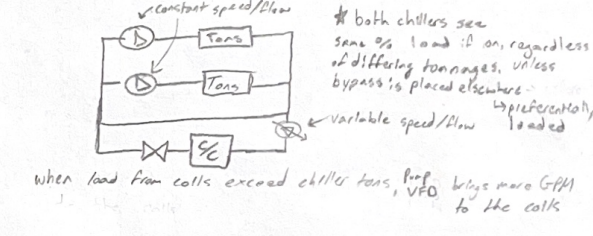
Primary/Secondary (Decoupled) System?
Primary: Production, pumps constant speed
Secondary: Distribution, pumps variable speed
Bypass: Maintains constant flow through the chillers (or boilers). No valve.
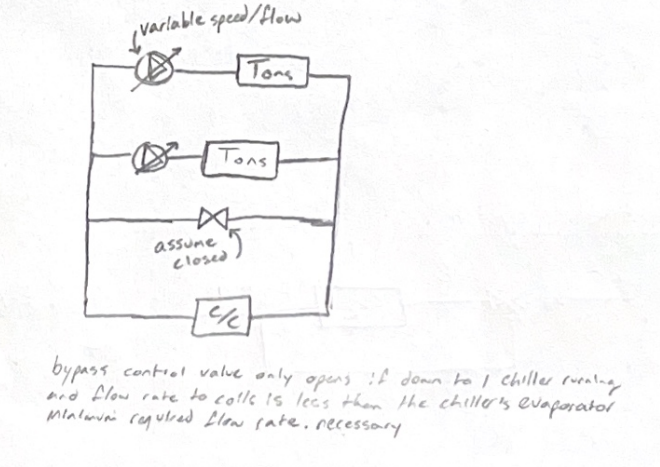
Variable Primary System?
Variable speed pumps at the inlets of the chillers (or boilers)
Bypass: Valve opens to maintain minimum flow if needed. Typically closed. Flow meter signals to actuator to open/close the bypass valve.
VAV Static Reset Strategies?
Damper Position Reset: Resets based on the most-open VAV damper position %
Flow Error Reset: Resets based on desired vs actual CFM at VAV boxes
Saturation Signal Reset: Resets based on overall VAV control effort (“saturation”) to meet zone demand
Fire Barrier Door ΔP Purpose?
Maximum pressure differential to ensure the door can be opened by people during emergency.
Minimum pressure differential to keep smoke out.
Fire barriers, especially stairwells in high rises, use smoke control and pressurization systems to keep toxic gases from entering evacuation routes.
Fire Dampers? Dynamic vs Static?
Fire dampers close when high heat/fire melts a fusible link.
Dynamic Fire Dampers: Spring-loaded to close against moving airflow. Used where HVAC airflow continues during a fire.
Static Fire Dampers: Gravity-operated (or curtain-style) and rely on airflow stopping before fully closing. Used where HVAC shuts down during a fire.
Fan/Pump HP Rating Meaning
The fan/pump horsepower rating is the required brake horsepower (BHP) at design conditions, used to select the motor. Actual required horsepower varies with flow, pressure/head, and efficiency and is usually lower than or near the design value.
Motor HP Rating Meaning
The motor horsepower rating is the maximum continuous shaft power the motor can safely deliver under rated conditions. The motor supplies only the horsepower required by the load, up to its rated limit.
Space Fraction?
In lighting, its the amount of heat produced by the light fixture that is gained by the space. The rest of the fraction is heat gained by the plenum.
Absorprtion Chillers
LiBr & Water: Water is the Refrigerant, LiBr is the Absorbent. For AC/Chilled water.
Ammonia & Water: Ammonia (NH3) is the Refrigerant, Water is the Absorbent. For Industrial Refrigerantion/Low Temp.
No compressor, replaced with a generator and absorber.
Purpose of minimum velocity in kitchen exhaust grease ducts?
Ensure great particles, VOCs, and smoke are exhausted to outdoors. Grease deposits can become a fire hazard if not removed.
Static pressure sensor location for VAV systems?
Rule of thumb: 2/3 of the way down the main supply duct from the AHU, or just before the furthest major branch.
ASHRAE: 75% of the way down.
Sound modeling for Equipment?
Approximately modeled as radiating outward in a sphere from a point source.
Cooling Tower Icing Prevention?
Fan Capacity Control: Prevents overcooling of condenser water.
Reversing Fans: Warm saturated discharge air flows downward through the tower.
Basin Heater: Prevents basin water from freezing when load is low/off.
Insulating exposed pipes: Reduces heat loss and pipe freezing risk, often combined with heat tracing in colder climates.
Vertical vs Horiztontal Centrifugal Pumps?
Vertical: Smaller footprint (motor stacked on top, tall/compact). Harder to install and maintain.
Horizontal: Larger footprint (long/wide). Easier to install and maintain.
Steam Piping Facts
Horizontal piping should be sloped in the direction of steam flow to allow condensate to drip in the opposite direction of the steam flow.
Branch lines should be off the top of mainlines at a 45° or 90° angle.
Horizontal piping should use eccentric reducers, positioned with the flat side on top. Curved side on the bottom for draining condensate.
Steam Trap Facts
Steam traps remove condensate from the bottom of the steam branch and main legs, and returns to the boiler.
Required after steam coils.
Steam condensate needs to be removed because it can cause water hammer, corrosion, and retain air (reducing heat transfer).
Altitude increase effect on boilers?
As altitude increases, atmospheric pressure decreases. Air density decreases, thus reducing the amount of oxygen in the air. Fuel gas density also decreases, thus reducing the heating value.
The amount of air supplied must be increased to match the fuel to air ratio required.
Heater capacity is directly related to atmospheric pressure, so we can use altitude correction density factors from the handbook to find a new rating at a different eleveation. This follows the local gas heat content equation in the handbook 10.6.
Respiration rate?
In refrigeration (especially cold storage for fruits, vegetables, and other produce), the respiration rate describes the heat generated by the produce itself as it “breathes” biologically after harvest.
Produce continues converting sugars and oxygen into carbon dioxide, water, and heat.
Terminal Units
Located at the end of the ductwork that conditions and controls air delivered from the AHU. Terminal units can include components such as dampers, reheat coils (hot water or electric), sound attenuators, and sometimes a fan, depending on the type.
Constant volume (CAV) terminal unit: Delivers constant airflow to the zone and controls temperature using supply air temperature reset or terminal reheat.
VAV terminal unit: Modulates a damper to vary airflow to the zone while maintaining a relatively constant supply air temperature, typically from a central AHU.
Series fan-powered VAV terminal unit: Uses a continuously operating local fan in series with the primary air stream to maintain nearly constant total airflow and improve comfort, especially in perimeter zones.
Parallel fan-powered VAV terminal unit: Uses a local fan that operates only when needed (typically at low load or heating conditions) to supplement or replace primary air with plenum air, reducing energy use compared to series fan-powered units.
Induction VAV terminal unit: Uses high-velocity primary air to induce and mix plenum or room air without a local fan, improving air distribution and reducing required primary air at low loads. Older.
GWP
Global Warming Potential
Reference point is Carbon Dioxide, where GWP = 1
Evaporative Cooling Effectiveness?
Lower ambient wet-bulb → higher evaporative cooling effectiveness, since drier air allows more evaporation and greater latent heat removal (cooling towers, evaporative coolers).
Capillary tube
Fixed small diameter expansion device in very small systems like window AC units; refrigerant flow varies with pressure differential across the tube.
Compressor housing types
Hermetic: Compressor and motor in same housing, permanently sealed. Motor heat added to refrigerant.
Semi-hermetic: Compressor and motor in same housing, not permanently sealed. Serviceable. Motor heat added to refrigerant.
Open drive: Compressor and motor are separate. Motor heat not added to refrigerant.
Sound types
Airborne Sound: Sound transmitted through air, via direct line of sight or reflected off environment.
Aerodynamic Sound: Sound from airflow turbulence, dependent on air velocity. Problem at duct fittings, dampers, and terminal units.
Ductborne Sound: Sound through ducts from fans or other spaces. Can travel upstream and downstream.
Frequency types and avoiding resonance?
Natural Frequency: Frequency at which a system freely vibrates due to its mass and stiffness.
Operating (Disturbing) Frequency: Frequency of the forcing function during normal operation (often RPM/60).
Resonance: Condition occurring when operating frequency equals or closely matches natural frequency, causing large vibration amplitudes.
Avoid resonance by decreasing the natural frequency by using softer spring vibration isolators.
Avoid resonance by decreasing the disturbing frequency by decreasing fan speed.
Infiltration driving force?
Positive pressure outside and negative pressure inside.
Stack effect (warm air inside has lower density, rises, and creates negative pressure)
Wind
Good piping materials for heat and pressure?
Steel and Copper
Cast iron should not be used under pressure due to its inherent brittleness, corrosion vulnerability, and joint weaknesses make it prone to catastrophic bursts!
Cooling tower types?
Forced Draft Colling Tower → Pushes air in with bottom mounted fans. Positive pressure inside the tower.
Induced Draft Cooling Tower → Pulls air out with with top mounted fans. Negative pressure inside the tower. Most common HVAC type.
Natural Draft Cooling Tower → No fans. Stack effect creates airflow. Common at power plants.
Chilled water chemical feed use?
Controls pH, minerals, and biological growth in the water. Helps prevent corrosion and biological scale.
Purge use in a chiller?
Removes air and water vapor from refrigeration cycle. Non-condensable gases reduce condenser performance so purge is placed before condenser.
Useful Refrigerant Info in Handbook?
8.6 Comparative Refrigerant Performance per Ton Refrigeration (at various evaporator temps, provided COPs, pressures, etc)
8.9 Refrigerant Safety (Safety classifications and chemical formulas)
Useful Boiler Combustion Info in Handbook?
10.1 Heating Values (LHV and HHVs for common fuels)
10.3 Stoichiometric Combustion of Fuels (air requirements, theoretical CO2 values, thermal efficiency, and combustion reactions)
Traits of higher efficiency boilers, considering the same fuel.
Lower leaving flue gas temperature → More heat was transferred to the water/steam and less heat was lost up the stack.
Lower excess air → Less energy is wasted heating unnecessary air that leaves through the stack.
Higher CO₂ in flue gas → Indicates less excess air dilution and more effective use of combustion air.
Lower O₂ in flue gas → Indicates less excess air is leaving the boiler unused.
Low CO in flue gas → Indicates more complete combustion and less fuel energy lost to incomplete combustion.