137I PSYCH: SOCIAL INFLUENCE FINAL
 Call Kai
 Learn
Learn Practice Test
 Spaced Repetition
 Match
Match Flashcards
 Knowt Play
1/286

There's no tags or description
Looks like no tags are added yet.
Name | Mastery | Learn | Test | Matching | Spaced | Call with Kai |
|---|
No analytics yet
Send a link to your students to track their progress
287 Terms
The Influence of Credible Sources
"We believe good men more fully and more readily than others: This is true generally whatever the question is, and absolutely true where exact certainty is impossible and opinions are divided. It is not true, as some writers assume in their treatises in rhetoric, that the personal goodness revealed by the speaker contributes nothing to his power of persuasion, on the contrary, his character may almost be called the most effective means of persuasion he possesses."
- Aristotle (Rhetoric)
Key characteristics of credibility:
expertise, trustworthiness, and goodwill
Classic Credibility Study: Oppenheimer versus Pravda (Hovland &Weiss, 1951)
Given a message written by either Oppenheimer or Pravda
• More influenced by nuclear submarine argument if they thought it was from Oppenheimer than from Pravda (a very biased Russian newspaper)
Sleeper Effect
messages from noncredible sources have increasing influence over time
• Also, highly credible source linked to weak message can become dissociated and lead to delayed persuasion (Albaraccin et. al., 2017)
Credibility: Expert Witness Study (Cooper et al., 1996)
Subjects gave verdict on mock trial concerning a company that exposed people to carcinogenic chemicals.
They varied 2 factors:
1) the credentials of the expert: low vs. high
2) complexity of testimony: Expert either spoke clearly or used technical jargon
• His expertise was most influential when he used technical jargon
• Why does this happen?
Expectations and Credibility
Our expectations of a speaker influence our judgments of credibility
• Often when our expectations are NOT met, we think the speaker is more credible
Knowledge bias
Presumption that a communicator is biased• Assume a speaker's background prevents objectivity
• When confirmed, the speaker is less credible
• When disconfirmed, the speaker is more credible
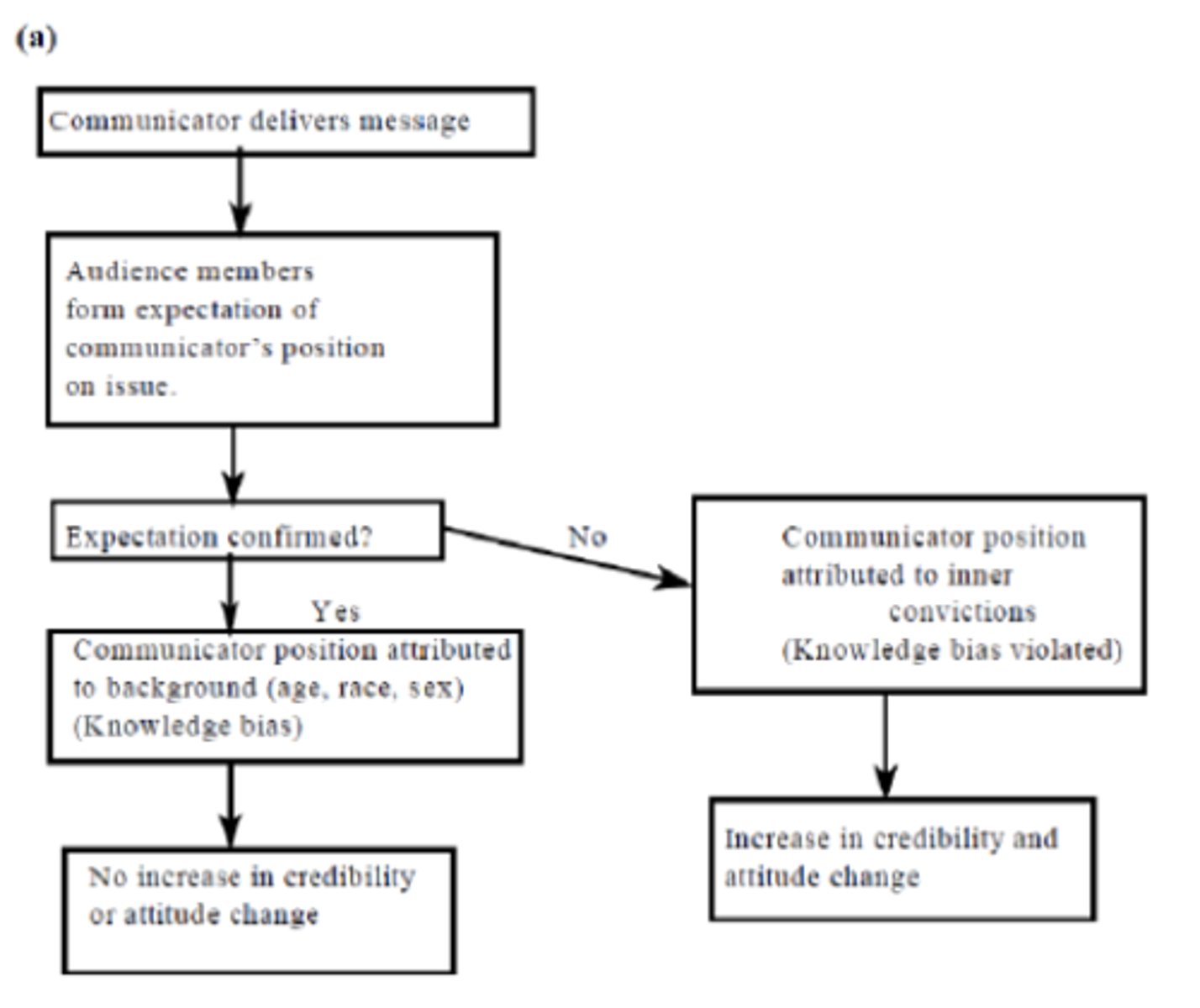
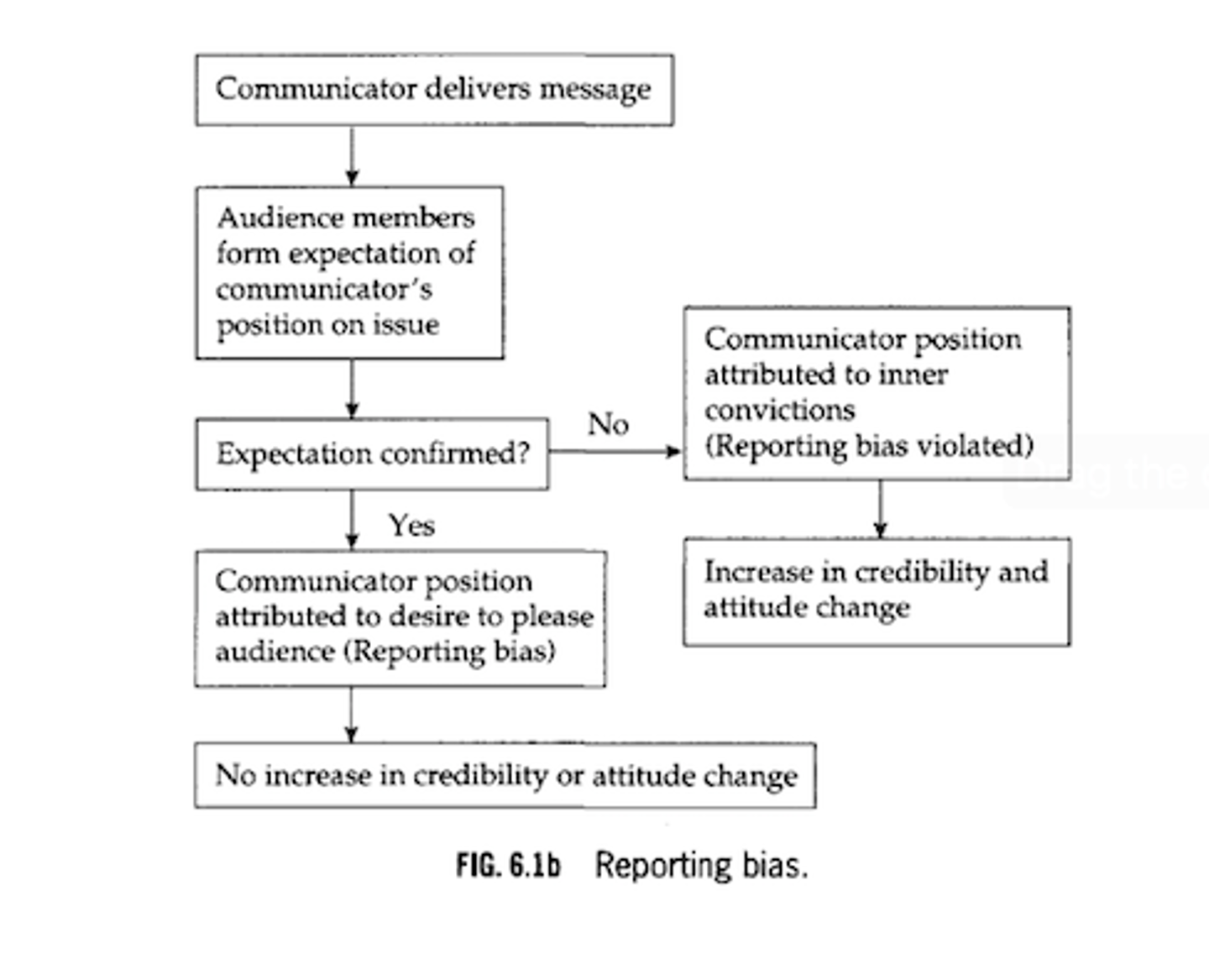
Reporting bias
• Presumption that communicator is just saying what audience wants to hear
• When confirmed, the speaker is less credible
• When disconfirmed, the speaker is more credible
• As long as position is within the latitude of acceptance
Increasing Trustworthiness
• Contradicting self-interest
• "Unintentional" persuasion (Walster & Festinger)
Confidence is an indicator of credibility
Increasing Trustworthiness: contradicting self-interest
Joe "the shoulder" study (Aronson, Walster, & Abrahams)
• Joe (a criminal) was as effective as a politician persuading participants about the merits of stricter courts and prison sentences.
• Rebel heirs Patrick Reynolds and John Robbins argue against their own self-interest
Increasing Trustworthiness: "Unintentional" persuasion (Walster & Festinger)
E.F. Hutton commercial: overheard comments are persuasive• Participants who overheard a discussion between grad students were more influenced if they believed the grad students were unaware of their presence
Exploiting Credibility: Con Men
• Con men rely on heuristics that project credibility
• Speaking quickly to enhance expertise
• Exploiting smiles to convey goodwill
• Acting confident to gain trust
Classic Confidence Study:
• Fake expert on Game theory (Dr. Fox) gave nonsense speech to an audience of mental health professionals
• When he spoke confidently and projected authority, audience gave him glowing evaluations
• Watch this TED talk on Confidence by Richard Petty:https://www.youtube.com/watch?v=cKu-32iyHs0•
Another Confidence Study: (Zarnoth & Sniezek, 1997)
• Subjects worked on several cognitive tasks like math problems and verbal analogies
• They were assigned to a group and offered a judgment on the correct answers
• Those who showed most confidence had more influence on group judgments even when they were wrong
social attractiveness
Four aspects make communicators more socially attractive:
-Physical attractiveness
• Likeability
• Similarity to audiences
• Familiarity
Physical Attractiveness
What is beautiful is good"
• Attractive people are seen as more talented, kind, honest, intelligent, charming, and healthier (Langlois, 2000)
a halo effect occurs when one positive characteristic dominates the way the person is viewed by others
• Attention: they cut through the clutter and capture our attention.
Attractiveness and Politics:
Attractiveness is a stronger predictor of electoral success than trustworthiness or competence (Palmer & Peterson, 2016)
• Canadian federal elections
Attractiveness & Work (Hosoda, Stone-Romero, & Coats, 2003)
• More successful at job interviews• More likely to promoted at work• Tend to earn more money
Attractiveness and the Legal System:
• Criminal justice (Stewart, 1980)• Civil justice (Kulka & Kessler, 1978)
Attractive people are more persuasive (Chaiken, 1979)
Attractive people are more persuasive (Chaiken, 1979)
Attractiveness in Children
• Interpretations of naughty acts (Dion, 1972)
• Presumptions of intelligence (Rich, 1975)
The Influence of Attractive Sources
Enough attractiveness already!
• Attractiveness seems surprisingly unrelated to self-esteem (Adams, 1977)
• Attractive people may perceive that positive evaluations are not based on actual abilities but on the "halo effect"
• Attractiveness doesn't work as well for deeply held attitudes or when we're motivated to think more carefully about an issue
• Is it ever a disadvantage to be too attractive?
• When to avoid looking too attractive:
- Academic job interview
- Displaying technical competence
Conditioning and Association
• An innocent association with either bad things or good things will influence how people feel about us.
• " Killing the messenger"
• People assume we share personality traits with our friends(Miller, Campbell, Twedt, & O'Connell)
• Attractive model → Car is faster, more appealing, more expensive-looking, and better designed (Smith &Engel)
• We deny the influence of attractiveness though
• Who influences you the most in ads? (Top Hat)
Likability: Likeable speakers
Make you feel good―which makes you think their message is better• Put you in a good mood―which makes you access positive thoughtsabout the product/message• Can easily convince you of goodwill
"Flattery will get you everywhere
If we believe someone likes us, we're more likely to like and comply with them
• Positive comments produce just as much liking whether or not they are true
Similarity
• We like people who are similar to us :
• Opinions, personality traits, background, life-style, race, appearance
• e.g. Dove ads with average women
• Similarity of dress, of age, religion, politics, smoking
"Mirror and match" posture, mood, verbal style
• Not just true for people: Career choices
Similarity and Politics
• One study examined attitudes towards 2004 presidential candidates
• Subjects looked at photos of candidates side by side, one of which was morphed with their own photo
• Undecided voters were more likely to endorse candidate that looked like them
Emphasizing Similarity May Save Your Life
• Ashley Smith was kidnapped by an accused rapist & murderer
• She told the kidnapper about her own addictions and troubled life.
• She was able to emphasize similarities in their lives
• He ended up turning himself in.
Familiarity
We like things that are familiar to us
Mere Exposure Effect:
Repeated exposure to a stimulus such as an object or person leads to greater liking of the stimulus.
Familiarity 2
Voters often vote for the candidate whose name seems more familiar
Familiarity → persuasion
When "familiarity breeds contempt"
Continued exposure under unpleasant condition such as conflict, competition, or frustration
Charisma
Charisma was traditionally thought to be an attribute of the leader, but it is primarily an attribution made by followers.
• Charisma centers on the capacity for a leader to be seen by followers as advancing group interests.
---its spell can be broken if leaders are discovered to be acting for themselves or for an opposing group.
A Charismatic leader
• A Charismatic leader is an entrepreneur of identity. They clarify what we believe rather than telling people what they believe.
3 Steps: Reflect, Represent, and Realize
Defining Attitudes: Sherif (1967) described them this way
"When we talk about attitudes, we are talking about what a person has learned in the process of becoming a member of a family, a member of a group, and of society that makes him react to his world in a consistent and characteristic way, instead of in transitory and haphazard way. We are talking about the fact that he is no longer neutral in sizing up the world around him; he is attracted or repelled, for or against, favorable or unfavorable."
Defining Attitudes:
a global evaluation of an object (person, place, or issue) along a positive-negative dimension that influences thought and action
• Attitudes are...
Learned: not born with attitudes
• Global evaluations
--• Summary evaluations of beliefs, feelings, intentions
• Attitudes influence...
thought and action
• Some stronger, some weaker
• Judgments about people/objects/issues
• Behavior toward others
Attitudes Affect Perception & Judgment
How does this photo of nearly 10,000Hondurans marching through Mexico towards the US border make you feel?
republican vs democrat
Attitude Structure
They are based on "ABC" Information:
• Affective Component
• Behavioral Component
• Cognitive Component
These three components are not always consistent with one another
affective component
• the person's emotions and affect towards the object
behavioral component
• how a person tends to act towards the object
cognitive component
• consists of thoughts and beliefs the person has about the object
is bad stronger than good?
there is a clear negativity bias in evaluation: negative stimuli generated greater brain activity than the positive or neural stimuli.
Divergent Attitudes: 2018 Nobel Prize Winners
#1: Do you approve of the scientific experiments using animals that have in fact resulted in the protection of millions of human beings, probably including yourself and your children, from diphtheria, hepatitis, measles, rabies, rubella, and tetanus? Do you believe that the scientific studies now in progress to combat AIDS, Lyme disease, Alzheimer's disease, heart disease, diabetes, and cancer—almost all of those studies relying essentially on the use of animals—are morally justifiable? Probably, you do. I surely do, with all my heart.
#2: We humans kill billions of animals every year, just in the United States. Frequently what we do causes them intense physical pain; often they are made to live in deplorableconditions; in many, possibly the majority of cases, they go to their deaths without havinghad the opportunity to satisfy many of their most basic desires ... (Imagine) a mugger haspushed you to the ground and stolen your money; you are left with a number of cuts and bruises—minor to be sure, but still painful. Next, let us try to imagine the pain felt by the dogs who were vivisected by the scientists ... the dogs who, without the benefit of anesthetic, had their four paws nailed to boards before being slit open. Are we to say that your minor pain is qualitatively worse than the much greater pain experienced by the dogs, because your pain is the pain of a human being, the dogs' pain not?
Values:
"desirable end states or behaviors that transcend specific situations, guide selection or evaluation of behavior and events, and are ordered by relative importance"
More global and abstract than attitudes
• e.g., freedom, equality, power, self-fulfillment, security
• Can compete: freedom versus equality?
Beliefs:
cognitions about the world; subjective probabilities that an object has a particular attribute or that an action will lead to a particular outcome
More specific and cognitive than attitudes• e.g., College students drink too much; The death penalty should be abolished. Kale is good for you.
Confusing Beliefs with Facts
Not always true or testable
• Taliban leader claims Americans don't love children
• 1/4th of Americans believe there's no evidence of global warming
• 1/3rd believe vaccines cause Autism
• 1/3rd don't believe in evolution
• Why?
Not always verifiable
• 68% of Americans believe in life after death
• 62% believe in hell and the devil
Identity-protective cognition :
tendency to selectively credit evidence in patterns that reflect people's commitments to their groups
• Need to belong outweighs need to be accurate
Study 1: Perceptions of Expertise Depend on Congruence with Group's Existing Attitudes
Study 1: Dan Kahan found that people compare new evidence with their groups' position
• If there is a mismatch, they dismiss the source as nonexpert.
• If it matches, they consider him an expert
Study 2: Disbelief in Global Warming is Not Due to Scientific Reasoning Ability
Study 2: Other research finds that disbelief in global warming is not about lack of scientific reasoning ability
Better scientific reasoning ability leads to even more polarization of attitudes
Attitudes, Values, and Beliefs
attitudes are the bridge between values and beliefs
Expectancy−Value Approach
• Attitudes are combination of:
• strength of beliefs that an object has certain attributes(expectancies)
• evaluation of those attributes (how good or bad is it?)
--Belief: "Vaping will make you popular."
--Evaluation: "It's very good to be popular."
• Ostensibly similar attitudes driven by different combinations of beliefs/evaluations
• These require different persuasion strategies to change
total attitude
a = sum b(i) X e(i)
b(i) = each belief and e(i) = each evaluation
Measuring Attitudes: Likert Scale
• A numerical scale used to assess attitudes; includes a set of possible answers with labeled anchors on each extreme
Measuring Attitudes: Semantic Differential
• Participants rate a concept using bipolar adjectives• Range of intervals to indicate the concept's position along the continuum
Measuring Attitudes: Indirect Methods
• Why do we use implicit measures?
Self-Presentational Concerns, Lack of Introspective Awareness
Measuring Attitudes: Response Latency
amount of time it takes to respond to a stimulus
• 1984 Presidential Election: Faster responders showed greater consistency between attitudes and behavior
Measuring Attitudes: Implicit Measures
an indirect measure of attitudes that does not involve a self-report• Implicit association test (IAT)
Measuring Attitudes: physiological measures
galvanic skin response, pupil dilation, EMG
Measuring Attitudes with fMRI
75% of Americans consider themselves environmentalists &80% believe in changing lifestyles to protect the environment
• But only 17% actually purchase green products and self-report measures explain < 10% of variance in actual green purchasing behavior
Mere Green Effect fMRI Study:
shown either pro-environment or control ads, indicated liking for the ads:
• Reported liking green ads more than control ads.
• Greater activation in VPFC and Ventral Striatum (associated w/ personal value and reward) for preferred control ads, but not for green ads
Brain-as-Predictor:
studies are showing brain activation maybe better predictor of behavior in certain cases
Attitudes may be poor predictors of behavior
LaPiere study in the 1930s• Traveling across the US with a Chinese couple at time when anti-Chinese prejudice was high
• Surprisingly, they were denied service at only one of the 250 places they visited
• However, when contacted later, 90% said they would not serve Chinese customers
Attitudes Can Be Inconsistent
Attitudes may be inconsistent• Emotional and cognitive aspects may conflict
• The different components of an attitude may not always align. In particular, there can be a rift between the affective component and the cognitive component
Former governor of NY Elliot Spitzer campaigned on importance of high ethical standards, but resigned because of participation in prostitution operation.
Attitudes Can Conflict with Other Powerful Determinants of Behavior
Attitudes may conflict with other influences on behavior•
--- other conflicting attitudes and situational factors may also influence behavior
---Social Norms are also an important influence on behavior
---- Research suggests that social norms have stronger influence on behavior when attitudes are ambivalent
----• Norms vary across cultures
Introspecting about the Reasons for Our Attitudes
Wilson & colleagues have found that introspecting about the reasons one likes or dislikes an attitude object can disrupt attitude-behavior consistency
---• Tim Wilson asked people to either give an overall evaluation of their partner or to list the reasons for the way they felt about their partner and then to give an evaluation• 9 mo.'s later, those who just gave an overall evaluation were more accurate predictors of their current relationship than those who gave reasons for how they felt about their partner•
• Introspection disrupts emotion-based attitudes more so than cognitive ones
• Can you think of any examples?
Compatibility Principle:
a strong relationship between attitudes and behavior is possible only if they are both measured at the same level of specificity
Compatibility Principle: Predicting Behavior From Attitudes
Attitudes better predict behaviors when specific attitudes toward a specific behavior are measured
• General attitudes predict broad classes of behavior that cut across different situations. Based on prototypical examples of situations and people
Predicting Behavior From Attitudes: Attitude Prototype Study
• Males expressed stereotypes & attitudes about gay men
• Asked if they would be willing to give a tour to John B., a gay man who either matched stereotype or not.
• If he didn't match their individual stereotype, attitudes didn't predict their behavior. If he did match, their behavior was strongly predicted by their attitudes towards gay men
When Attitudes are Good Predictors of Behavior
Strong attitudes are better predictors of behavior than weak ones
• Attitudes learned through direct experience
• Specific attitudes predict specific behaviors
• Low self-monitors have higher attitude-behavior consistency than high self-monitors
• Accessible attitudes predict behavior
----• Fazio's Accessibility Model suggests that when we don't have the motivation or ability to consider pros and cons of our actions, whatever attitudes are most accessible will automatically predict behavior
The Theory of Planned Behavior(aka Theory of Reasoned Action)
Behavior can be predicted, but depends on ...
• People's likes and dislikes (attitudes)
• People's natural propensity to please others (norms)
---• Injunctive: what we should do
---• Descriptive: what others are doing /will do
• People's confidence that they can carry out their plans (perceived behavioral control)
Predicting Attitudes from Behavior
• Attitudes may not predict behavior as strongly as expected, but behavior has a powerful influence on attitudes.
-• Attitudes may change in order to be consistent with behaviors
--• Our need to be consistent and authentic
• More on this next time when we discuss self-persuasion and cognitive dissonance theory
Self-Persuasion:
when we persuade ourselves to change our own attitudes or behavior
Classic Persuasion
when others attempt to change our attitudes or behavior
Self-Persuasion vs. Persuasion by Others
Self-Persuasion is more powerful and lasts longer than persuasion by others?• Why?
• We have a need to be in control of our own attitudes andbehavior.
Indirect vs. Direct Persuasion:
When others are trying to persuade us, we are usually aware of this, whereas with self-persuasion, we're convinced that motivation comes from within ourselves.
Early Cognitive Dissonance Theory
Blaise Pascal, first cognitive consistency theory: If we act a certain way, we change our attitudes to be consistent with our behavior
Self-Justification
The desire we have to justify our actions, beliefs, and feelings
• The example of Sam being hypnotized
Self-justification and Rumors
Towns in India that were not damaged by an earthquake but that felt the tremors experienced rumors forecasting impending doom (e.g., a flood is rushing toward them; Prasad)
• Towns that experienced damage did not experience rumors forecasting doom; their rumors were more positive and encouraging (e.g., water supply would be fixed soon; Sinha)
• Why did the rumors differ so dramatically between the towns?
---• An external cause of their fear/hope was not visible.
Cognitive dissonance theory (Festinger)
• A state of tension that occurs whenever an individual simultaneously holds two cognitions (ideas, attitudes, beliefs, opinions) that are psychologically inconsistent.
• Also, dissonance is created if a behavior is inconsistent with a pre-existing attitude
Cognitive dissonance theory: tension
Tension is unpleasant, and we are motivated to reduce it by:
-- changing one or both cognitions so that they are consistent.
-• adding additional cognitions to bridge the gap between original ones.
-• changing the preexisting attitude to be consistent with the behavior.
Example of Cognitive Dissonance: What are some of the ways one can reduce the dissonance of smoking cigarettes?
• What was the response to the initial Surgeon General's report in 1964 on the part of smokers and nonsmokers?
• Why do people explain the same behavior (smoking one to two packs a day) as either heavy or moderate smoking?
• When the motivation to be right and the motivation to believe that we are good people collide:
--• How did people who tried but failed smoking cessation programs explain their smoking? (Gibbons et al.)
What happens when commitment to an attitude is high?
• Cigarette company executives statements and behaviors?
• Heaven's Gate suicides (1997)
• Donald Trump campaign
Dissonance Reduction & Irrational Behavior: when is it irrational?
When it prevents us from learning important facts or finding real solutions to problems
Dissonance Reduction & Irrational Behavior: why do we behave irrationally?
There's a clash between our need to be right and trust others and our need to maintain a positive self-image that depicts us as good, smart, or worthwhile
Capital punishment study (Lord, Ross, & Lepper)
• We will distort information to fit our preconceived beliefs.
• Some participants favored capital punishment, some did not.
• Read one rational argument on each side of the issue (pro vs. con)
• Rather than moderate their attitudes, people on both sides of the issue were more steadfast in arguing their original position after reading the papers.
--• They believed that the opposing paper's position was flawed
--.• From a dissonance-reduction perspective, why did this happen?
After we make a decision, we experience dissonance
• Common way to reduce: focus on the positive aspects of our choice and the negative aspects of the ones we did not choose
• Seek advertising information that is reassuring (Ehrlich)
Appliance study (Brehm)
• Participants rated appliances and then were given the choice of two (that they previously rated as equal)
.• Participants were later asked to rate the items once again.
• Ratings increased for the selected appliance and decreased for the appliance not chosen.
Computer dating study (Johnson & Rusbult)
• People were shown pictures and rated their attractiveness and how much they would enjoy a date with them.
• The more committed the participants were to a current relationship, the less attractive they rated the women in the pictures
Another attractiveness rating study (Simpson)
• Compared people in committed relationships to those not in committed relationships.
• Those in committed relationships rated potential others as less physically and sexually attractive.
• Effects held only for those alternative dating partners who were available.
Decisions and Dissonance (Dating)
no threat - no dissonance - no derogation
Dissonance & Irrevocability
Once a decision is final, we experience dissonance and are motivated toreduce it, but there is a catch.
• This relationship holds when the decision is final (irrevocable)
.• Gamblers were more confident that their horse would win afterplacing a $2 bet than before placing the bet (Knox & Inkster)
• Voting study: Voters have greater confidence in chosen candidate after voting than before
• What happens when the decision is not final?
• People who were given a choice between two photographs liked their selection more if it was final versus those who were able to exchange it. (Gilbert & Ebert, 2002)
• How does making a decision reversible affect self-justification?
The decision to behave immorally
• Cheat on an exam (the difficult decision results in dissonance)
--• If cheat, reduce dissonance by softening stance on cheating
--• If do not cheat, harden stance against to justify made right decision
• Are you more ethical than a sixth grader? (Mills)
--• Sixth graders were put in situation where they could not win without cheating.
---• Ask them to indicate their views on cheating.
---• It was easy to cheat, so the children were tempted.
---• Some cheated, but some did not cheat.
---• When asked later their views on cheating, those who cheated had softened their stance; those who did not hardened their stance.
What is the relationship between external justification and internaljustification?
If an individual states a belief (or behaves in a way) that is difficult to justify externally, that person will attempt to justify it internally by making his or her attitudes more consistent with the statement (or behavior)
The Psychology of Insufficient Justification
• The "saying is believing paradigm"
---• When there is not adequate external justification, we will start to believe our statements (e.g., lies) that run counter to our preexisting attitudes.
• The smaller the external justification, the greater the internal attitude change.
• "Costly" behavior makes us like products better
---• When people pay for goods with cash (vs. credit) they are more committed to the product and the company because this feels more costly
---• Ikea effect: When people assemble a product, they end up enjoying it more
ikea effect:
When people assemble a product, they end up enjoying it more
The "$1-$20" study (Festinger & Carlsmith)
• Student performed a boring task for an hour.
• Asked to help the experimenter, who was running late, to lie to another student waiting to do the experiment (say it was interesting).
• They all lied and were offered $1 (low external) or $20 (high external)
.• When asked later, the $20 said was boring, and the $1 said it was interesting.
The "New Haven Police" study (Cohen)
• Students were asked to write a letter in support of the police department after they had behaved brutally toward student rioters.
• They were paid $10, $5, $1, 50¢.
• Can you predict who felt most favorably toward the police after writing?
• The results followed a linear trend.
Zimbardo et al.
• Electric shocks: high-dissonance group reported less pain than low-dissonance group
What Constitutes External Justification?
• Punishment, reward, praise, a desire to please . . . any others?
• What would produce the most dissonance?
--• Eating a grasshopper for a friend?
--• Eating a grasshopper that a stranger gave you?
• In which situation would you like the grasshopper most?
--• Research evidence (Zimbardo et al.): Reservists liked the grasshoppers more when asked to eat them by an unpleasant officer than a pleasant officer. Why?