N5 Minna no Nihongo Grammar Patterns
 Call Kai
 Learn
Learn Practice Test
 Spaced Repetition
 Match
Match Flashcards
 Knowt Play
1/114

There's no tags or description
Looks like no tags are added yet.
Name | Mastery | Learn | Test | Matching | Spaced | Call with Kai |
|---|
No analytics yet
Send a link to your students to track their progress
115 Terms
N1 は N2 です
I am Rose.
わたし は ローズ です。
N1 は N2 じゃありません。
I’m not Maria.
わたし は マリア じゃありません。
[Sentence] か
*N1 は N2 ですか。
(Is N1 N2?)
Who is that person?
あのひと は だれ/どなたですか?
That persom is Mrs. Delacruz
あの人 は デラクルズ さん です。
*Is Mr. Dela Cruz a teacher?
デラクルズさん は せんせい ですか。
Yes, Mr. Dela Cruz is a teacher.
はい、デラクルズさん は せんせい
です。
N1 も N2 です。
James is an Engineer.
ジェイムス は エンジニア です。
Anthony is also an Engineer.
アンソニー も エンジニア です。
N1 の N2
Anthony is an IBM Employee.
アンソニー は IBMのしゃいん です。
〜さん
(Mr. Mrs. Ms. Miss)
This is Mr. Anthony Mabini.
こちら は アンソニーマビーにさんです。
これ、それ、あれ
This, That, That thing over there.
This is a book.
これ は ほん です。
That is a dictionary.
それ は じしょ です。
That is a notebook (overthere)
あれ は ノート です。
この〜、その〜、あの〜
This (noun), That (noun), That (noun) over there
This umbrella is mine.
このかさ は わたしの です。
That book is mine too.
そのほん も わたしの です。
Who is that person over there?
あのひと は だれ ですか。
そう です。\ そう じゃありません。
Yes, it is/ No, it isn’t.
Is that a dictionary?
それ は じしょ ですか。
⭕ Yest, it is.
はい、そう です。
❌ No, it isn’t.
いいえ、そう じゃありません。
いいえ、ちがいます。
N1 か。N2 か。
Is it (noun1) or is it (noun2)?
Is it a 4 or a 9?
よん ですか。きゅう ですか。
N1 の N2
N1 explains what N2 is about
N1 owns N2
*N2 about N1
Book on Computer
コンピュータ の ほん。
This is my book on computers.
これ は わたしの コンピュータの
ほん です。
*N1 owns N2
My book.
わたしのほん。
Andrea’s desk.
アンドレアのつくえ。
そうですか。
I see/ Is that so?
Is this coffee yours?
このコーヒー は あなたのですか。
No, it’s Maria’s.
いいえ、マリアさんのです。
I see.
そうですか。
ここ、そこ、あそこ、(こちら、そちら、
あちら-polite version)
This/That/That over there (place/direction)
The Library is here.
じむしょ は ここです。
My room is there.
わたしのへや は そこです。
The Toilet is over there.
トイレ は あそこです。
N1 は N2 (place) です。
Noun 1 is in /on N2
The toilet is over there.
トイレ は あそこです。
The Pc Counter is on first floor.
パソコンうりば は いっかいです。
Ms. Saitou is on the conference room.
さいとうさん は かいぎしつです。
N1 は どこ\どちら ですか。
Where/ which way (direction) is Noun?
Where is the toilet?
トイレ は どこ ですか。
Where is the conference room?
かいぎしつ は どちら ですか。
N1 の N2
Noun 2 is mada in/by Noun 1
Italian shoe
イタリアのくつ。
Apple Smartphones
アップルのスマートフォン
Where is this bag made?
これはどこのかばんですか。
今、〜じ、〜ふん です。
How to express time (It’s 「hour」「munite」now.)
It’s 8pm now.
いま ごご はち じ です。
What time is it now?
いま なんじ ですか?
Verb + ます
Polite (masu) form of the verb
おきる ー おきます
I wake 6am everyday.
まいにち ごぜん ろくじ に おきます。
N (time+date) に Verb
[verb/action] at [time]
I sleep at 10.
わたし は じゅうじ に ねます。
I’ll work on April 1st.
わたし は しがつ ついたち に
はたらきます。
I’ll work on Monday.
わたし は げつようび はたらきます。
Verb ます、Verb ません、
(do [verb] /don’t [verb])
Verb ました、Verb ませんでした
(did [verb] didn’t [verb])
Verb Positive/Negative/ Verb Present/Past Tense Form
I wake up at 6 everyday.
わたし は まいにち ろくじ に おきます。
I don’t wake up at six everyday.
わたし は まいにち ろくじ に おきません。
I wake up at six this morning.
けさ ろくじ に おきました。
I didn’t study yesterday.
きのう べんきょうしませんでした。
N1 (Time/Place) から N2 (Time/Place)
まで です。
From N1 to N2
I work from 8 to 4.
わたし は はちじ から よじ まで はたらきます。
I work from Monday to Friday.
わたし は げつようび から きんようび まではたらきます。
It takes 4 hours from Manila to Tokyo.
マニラ から とうきょう まで よじかん
かかります。
N1 と N2
N1 and N2
I don’t work on Saturday and Sunday.
わたし は どようび と にちようび はたらきません。
Banks are closed on Saturdays and Sundays.
ぎんこう は どようび と にちようび やすみです。
Sentence ね
[Sentence] right?
It’s a holiday tomorrow, right?
あした やすみ ですね。
It’s hot, isn’t it?
あつい ですね。
It’s cold, isn’t it?
さむい ですね。
It’s tough, isn’t it?
たいへん ですね。
N (place) へ いきます・きます・かえります
Go to N (Place)
I will go to the Supermarket.
スーパー へ いきます。
I came to Japan last year.
きょねん にほん へ きました。
I’ll go back home next year.
らいしゅう うち へ かえります。
Where are you going?
どこ へ いきますか。
どこ「へ」もいきません・いきませんでした。
Not go anywhere. / Go nowhere.
Where are you going next week?
らいしゅう どこ へ いきますか。
I’m not going anywhere.
どこ も いきません。
Where did you go last week?
せんしゅう どこ へ いきましたか。
I didn’t go anywhere.
どこ も いきませんでした。
N (vehicle) で いきます・きます・かえります
Go by N (mode of transportation)
I’ll go by train.
でんしゃ で いきます。
I came by taxi.
タクシー で きました。
I went home from school on foot.
がっこう から あるいて かえりました。
How do you go to his house?
かれ の うち へ なんで いきますか。
By bicycle.
じてんしゃ で いきます。
N (person/animal) と ver
Go (verb) with N (person)
She goes to school with Maria.
かのじょ は マリア と がっこう へいきます。
He went to Germany with his family.
かれ は かぞく と ドイツ へ いきました。
Who did you go to London with?
だれ と ロンドン へ いきました か。
By myself/alone.
ひとり で。
いつ
When
When are your family coming?
かぞく は いつ きますか。
On the December 25th.
じゅうにがつ にじゅうごにち に。
When will you go back?
いつ かえりますか。
I’ll go back next year.
らいねん かえります。
Sentence よ
Sentence + [yo] to show emphasis
Hey, I’m going.
いきますよ。
It is!
そうですよ。
Hey, it’s delicious!
おいしいよ。
N(obejct)をVerb
Particle “を”
I drink tea.
おちゃ を のみます。
I smoke cigarette
たばこ を すいます。
What do you eat?
なに を たべますか。
N を します
Play/do something
Play soccer / Play cards.
サッカー を します。/ トランプ を します。
have a party / hold a meeting.
パーティ を します。/ かいぎ を します。
do homework.
しゅくだい を します。
なに を しますか。
What will you do?
What will you do on thursday?
もくようび は なに を しますか。
What did you do yesterday?
きのう なに を しましたか。
なん VS なに
What?
What is it?
なんですか。
What?
なに?
なに を
なに も
What kind / about
なんの /
How do you say…?
なんといいますか。
What language / What color?
なにご / なにいろ
How old / How many people
なんさい / なんにん
N (Place) で Verb
Particle で
I eat at the restaurant.
レストラン で たべます。
I bought Japanese wine at the store.
みせ で さけ を かいました。
I’ll take a photo in the garden.
にわ で しゃしん を とります。
いっしょに Verb ませんか。
Invite someone to do something.
Won’t you go to the station with me?
いっしょに えき へ いきませんか。
Won’t you drink some beer with me?
いっしょに ビール を のみませんか。
Won’t you eat lunch with me?
いっしょに ひるごはん を たべませんか。
Won’t you play tennis with me?
いっしょに テニス を しませんか。
Verb ましょう
Let’s 〜
I go.
いきましょう。
I eat.
たべましょう。
Let’s go to Kyoto.
きょうと へ いきましょう。
Let’s play soccer.
サッカー を しましょう。
お〜
Country
おくに
Alcohol
おさけ
Cherry Blossom Viewing
おはなみ
Name
おなまえ
N (tools/means) で Verb
Particle “で”
I eat with chopsticks.
はし で たべます。
I wrote the letter in English.
えいご で てがみ を かきました。
I’ll send the report by fax.
ファクス で レポート を おきります。
What do you use to eat with?
なんで たべますか。
Word / Sentence は 〜 ご で なん ですか。
What is 〜 in 〜 language?
What is “Thank you” in Japanese?
“Thank you” は にほんご で なんですか。
"ありがとう" です。
What is “Thank you “ in Spain?
“Thank you” は スペイン で なんですか。
“Gracias” です。
(Give to [someone]) N (person) に あげます・かします・おしえます
Particle に
I’ll give this to you.
あなた に これ を あげます。
Anthony lent money to Ken.
アンソニー は ケン に おかね を かしました。
Ms. Yamada teaches her Japanese.
やまださん は かのじょ に にほんご を おしえます。
Who will you give this to?
あなた は だれ に これ を あげますか。
❗❗Note❗❗
If the noun or the receiver of the action is a place such as company or school we use particle “へ”
I call the school.
がっこう へ でんわ を かけます。
I’ll send this package to ABC Company.
ABC かいしゃ へ にもつ を おくります。
(Receive from [someone]) N (person) に/から もらいます・かります・ならいます
Particle に
Maria received flowers from John.
マリアさん は ジョン に はな を もらいました。
I borrowed money from Emily.
わたし は エミリー から おかね を かりました。
She learned Japanese from Ms. Yamada.
かのじょ は やまださん に にほんご を ならいました。
Who did you borrow money from?
あなた は だれ に おかね を かりましたか。
❗❗NOTE❗❗
If you received from a company / organization only use “から”
は。
もう Verb しました
Did [Verb] Already
Did you eat already? / Have you eaten already?
もうたべましたか。
⭕Yes, I have. [Already ate.]
はい、もうたべました。
❌No, not yet.
いいえ、まだです。
な-adjective / い-adjective
Adjectives
See image below..

N は な-adjective / い-adjective
Noun is adjective
He is handsome.
かれ は ハンサム です。
She ia beautiful.
かのじょ は きれいです。
The movie is interesting.
えいが は おもしろいです。
The Philippines is hot.
フィリピン は あついです。
な-adjective / い-adjective じゃありません。
Is not な-adjective / い-adjective
He is not handsome.
かれ は ハンサム じゃありません。
She is not beautiful.
かのじょ は きれい じゃありません。
I am not free.
わたし は ひま じゃありません。
The movie is not interesting.
えいが は おもしろくないです。
The car is not good.
くるま は よくないです。
N は な-adjective / い-adjective ですか。
Is Noun [adjective]?
Are you free now?
いま あなた は ひまですか。
⭕Yes, I’m free.
はい、ひまです。
❌No, I’m not free.
いいえ、ひまじゃありません。
Is Mt. Fuji High?
ふじさんはたかいですか?
⭕Yes, it’s high.
はい、たかいです。
❌No, it’s not high.
いいえ、たかくないです。
N1 は な-adjective [な] / い-adjective N2 です。
Modify Noun (Adjective + Noun)
Osaka is a lively city.
おおさか は にぎやかなまちです。
That is a nice bag.
それ は すてきなかばんです。
Mr. Dela cruz is an interesting teacher.
デラクルズさん は おもしろい せんせいです。
Joseph is a good employee.
ジョセフ は いいしゃいんです。
な-adjective [な] ・い-adjective N2 を Verb
Modified Noun as an object of the verb
We saw a famous person at the restaurant.
わたしたち は レストラン で ゆうめいな
ひと を みました。
I got a nice bag.
すてきなかばん を もらいました。
Let’s go to a nice place.
いい ところ へ いきましょう。
とても・あまり
N は あまり な-adjective・い-adjective
です。
N は あまり な-adjective [な] じゃありません・い-adjective [い] くない です。
Very / Not so
Osaka is very lively.
おおさか は とても にぎやかです。
Mr. Dela Cruz is very interesting.
デラクルズさんは とても おもしろいです。
That is not a very nice bag.
それ は あまり すてきなかばん じゃありません。
He is not a very good employee.
かれ は あまり よくないしゃいんです。
N は どう ですか。
How is Noun?
How is the movie?
えいがはどうですか。
It’s interesting.
おもしろいです。
How is your job?
おしごとはどうですか。
It’s difficult.
むずかしいです。
How is your life in Japan?
にほんのせいかつはどうですか。
It’s fun.
たのしいです。
N1 は どんな N2 ですか。
What kind of N1 is N2?
What kind of town is Osaka?
おおさか は どんな まち ですか。
It’s a lively City.
にぎやかなまちです。
What kind of bag is it?
それはどんなかばんですか。
A red bag.
あかいかばんです。
S1 が S2
S1 そして S2
Sentence 1 but, Sentence 2
Sentence 1 and, Sentence 2
Japanese food is delicious but very expensive.
にほんのたべもの は おいしい ですが
とても たかいです。
Japan is beautiful and it is interesting.
にほん は きれいです そして おもしろいです。
どれ
Which
Which one is your car?
あなた の くるま は どれですか。
That white car over there.
あの しろい くるまです。
Which one is Sakura’s house?
さくらのうち は どれですか。
That Large house.
その おおきいうちです。
N が わかります・あります
Particle が
I understand Japanese.
にほんご が わかります。
I know Kanji.
かんじ が わかります。
Do you understand Japanese?
にほんご が わかりますか。
⭕Yes, I understand.
はい、わかります。
❌No, I don’t understand.
いいえ、わかりません。
I have a car.
くるま が あります。
I have something to do.
ようじ が あります。
Do you have something to do?
ようじ が ありますか。
⭕Yes, I have.
はい、あります。
❌No, I don’t have.
いいえ、ありません。
*N が すきです。
To like 〜
*N が きらいです。
Don’t like.
*どんな〜 が すきですか。
What 〜 do you like?
*N が じょうずです。
Good at 〜
N が へたです。
Bad at 〜
He likes sports.
かれ は スポーツ が すきです。
She Likes danciing.
かのじょ は ダンス が すきです。
Do you like sports Mr. Tanaka?
たなかさん 、 スポーツ が
すきですか。
⭕Yes, I like it.
はい、すきです。
❌No, I don’t like it.
いいえ、すきじゃありません。
I don’t like that movie.
その えいが が きらいです。
I don’t like vegetables.
やさい が すきじゃありません。
Do you hate vegetables?
やさい が きらいですか。
⭕Yes, I hate it.
はい、きらいです。
❌No, I don’t hate it.
いいえ、すきです。
いいえ、きらいじゃありません。
What sports do you like?
どんな スポーツ が すきですか。
I like Baseball.
やきゅう が すきです。
What food do you like?
どんなたべもの が すきですか。
I like Italian food.
イタリアりょうり がすきです。
He is good at sports.
かれ は スポーツ が じょうずです。
She is good at dancing.
かのじょ は ダンス が じょうずです。
Is he good at sport?
かれ は スポーツ が じょうずですか。
⭕Yes, he is good.
はい、じょうずです。
❌No, he isn’t.
いいえ、じょうずじゃありません。
I’m bad at cooking.
りょうり が へたです。
I’m not good at singing.
うた が じょうず じゃありません。
❗❗NOTE❗❗
We don’t ask someone are you bad at something so we always ask what he/she good at.
よく・だいたい・たくさん・すこし・
あまり・ぜんぜん
Very / A little / Not at all
[100%]よく・I understand ver well.
よく わかります。
[70-80%]だいたい・I understand English quite well.
えいご が だいたい
わかります。
[20-30%]すこし・I understand a little.
すこし わかります。
[10%]あまり・I don’t understand
very well.
あまり わかりません。
[0%]ぜんぜん・I don’t understand at
all.
ぜんぜんわかりません。
S1 から S2 / S2・S1 から
Sentence 1 that’s why Sentence 2
Sentence 2 because S1
I don’t have much time that’s why I didn’t study.
じかん が あまり ありませんから
べんきょうしせんでした。
I didn’t study because I don’t have much time.
べんきょうしませんでした。じかん が あまり ありませんから。
どうして
Interrogative “Why?”
Why didn’t you study?
どうしてべんきょしませんでしたか。
Because I don’t have time.
じかんがありませんから。
I’ll go home early today.
きょう はやく かえります。
Why?
どうして ですか?
Because I have something to do.
ようじ が ありますから。
N が います・あります
There is Noun
There is a man.
おとこのひと が います。
There is a dog.
いぬ が います。
There is a big window.
おおきい まど が あります。
There is a coffee shop.
きっさてん が あります。
N (place) に N が あります・います
There is Noun in/at/on N(place)
There is a man over there.
あそこ に おとこのひと が います。
Maria is at home.
うち に マリアさん が います。
There is a tv in the room.
へや に テレビ が あります。
There is a coffee shop on the 2nd floor.
にかい に きっさてん が あります。
N (place) に だれ・なに・が います・ありますか。
What / Who /is in/at/on N(place)?
Who is at home?
うち に だれ が いますか。
Maria is there.
マリアさん が います。
No is there.
だれ も いません。
What is on the 2nd floor?
にかい に なに が ありますか。
There is a coffee shop.
きっさてん が あります。
There is nothing there.
なに も ありません。
N は N(place) に います・あります
Noun is in/at/on N(place)
Mr. Garcia is in the office.
ガルシアさん は じむしょ に います。
USJ is in Osaka prefecture.
USJ は おおさかけん に あります。
The TV is in the bedroom.
テレビ は しんしつ に あります。
The coffee shop is on the second floor.
きっさてん は にかい に あります。
は VS が
When do we use “は” and when do we use "が”
は
A は XYZ
As for A, XYZ
VS
が
A が XYZ
It’s A, that is XYZ
は
かのじょ は きれい です。
as for her she is beautiful.
マリアさん は じむしょ に います。
これ は わたしのペン です。
いぬ は すき です。
as for dog this is I like.
が
かのじょ が きれい です。
Out of all the girls she is beautiful.
マリアさん が じむしょ に います。
これ が わたしのペンです。
いぬ が すき です。
out of all the aninals dog is what I
like.
N は どこ に います・あります か。
Where is Noun in / at / on?
Where is the dog?
いぬ は どこ に いますか。
▶ In the box.
はこ に います。
Where is USJ?
USJ は どこ に ありますか。
▶ In Osaka prefecture.
おおさかけん に あります。
Where is the TV?
テレビ は どこ に ありますか。
▶ In the bedroom.
しんしつ です。
N の N (position) (に います・あります)
N (thing/s position)
Where are the books?
ほんはどこにありますか。
▶ The books are on the top of the table.
ほんはテーブルのうえにあります。
Where is your husband?
ごしゅうじんはどこにいますか。
▶ … inside the supermarker.
スーパーのなかにいます。
N や N など
〜,〜,〜 etc.
There is a bed, table (and the like) in the room.
へや に ベッド や テーブル が あります。
I bought vegetables, fruits, and so on (etc.)
やさい や くだもの など を かいました。
It is I who bought vegetables, fruits and so on.
わたし が やさい や くだもの など をかいました。
N ですか。
Confirm something.
Excuse me, where is Yodobashi Camera?
すみません、ヨドバシカメラ は どこ
ですか。
▶ Yodobashi Camera?
ヨドバシカメラ ですか。
it’s the building in front of the station.
えきのまえのビルです。
N は ありませんか。
Do you have? (Inquiring about something)
Excuse me do you have Memory Card?
すみません、メモリカード は
ありませんか。
▶ Yes, they’re on the 3rd floor.
はい、さんがい に あります。
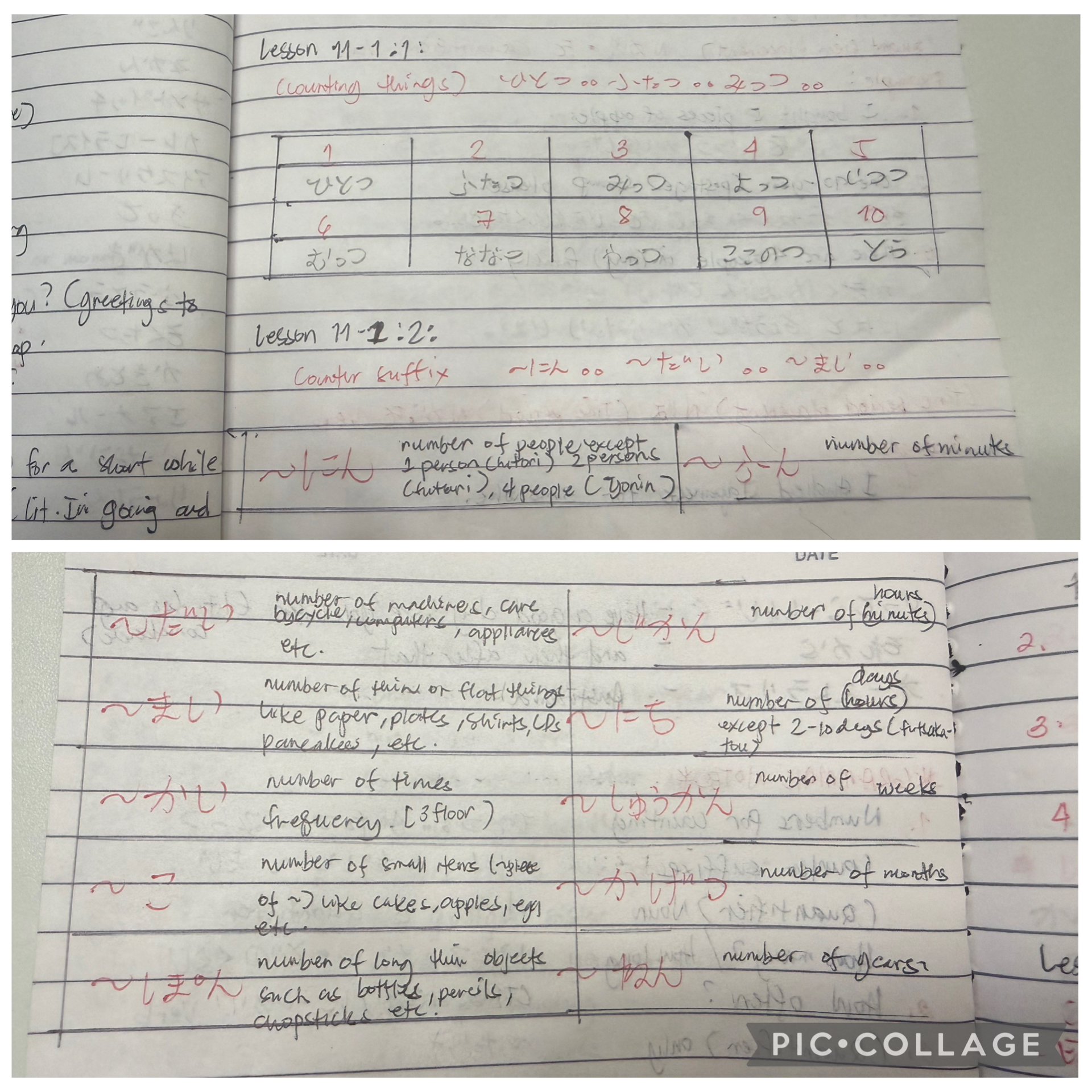
ひとつ。。。ふたつ。。。みっつ。。。
Number for Counting
〜人、〜だい、〜まい
Counter suffixes
N が・を Quantifier Verb
(Quantifier Placement) Noun
いくつ・なん〜・どのくらい
N は・が・を・いくつ・なん (counter suffix)
How many?
どのくらい・どのぐらい。。。ぐらい
How long?
(Time period) に 〜かい Verb
How often?
(Quantifier) だけ N だけ
(Only/Just)
❗❗NOTE❗❗
Attached image for Number for counting and Counter suffixes
(Quantifier Noun)
I bought 5 pieces of apple.
りんご を いつつ かいました。
One 90 yen (postage) stamp please.きゅうじゅう えん の きって を いちまいください。
There are 4 people in (my) family.
かぞく は よにん です。
はは と きょうだい が ふたり います。
✅REMINDER✅
Quantifier / Counter comes after particle を and placed before verb that is being used.
(Time Period Placement)
I studied Japanese for three months.わたし は さんかげつ にほんご を べんきょうしました。
I’ll go on a trip to Spain for two weeks.
スペイン へ にしゅうかん りょこう をします。
I worked at Canon for 1 year.
キャノン で いちねん はたらきました。
I’ll take a day off today.
きょう いちにち やすみます。
✅REMINDER✅
The time period comes after the noun and placed before を+Verb.
How many?
How many apples did (you) buy?
りんご を いくつ かいましたか。
▶ 5 apples.
いつつ かいました。
How many people are in (your)
family?
かぞくはなんにんですか。
▶ 4 people.
よにんです。
How many hours do you study Japanese everyday?
まいにち なんじかん にほんご を
べんきょうしますか。
▶ 4 hours.
よじかんべんきょうします。
How long?
How long did you study Japanese?
どのくらいにほんごをべんきょうしましたか。
▶ I studied for 3 years.
さんねんべんきょうしました。
How long will it take from Tokyo to Osaka?
とうきょう から おおさか まで どの
くらい かかりますか。
▶By registered mail it takes 2 days.
かきとめ で ふつか かかります。
▶It takes about 2-3 days.
にさんにち ぐらい かかります。
How often?
I work 5 times a week.
わたしはいしゅうかんにごかいはたらきます。
I eat (meals) 3x a day.
わたし は いちにち さんかい ごはんを
たべます。
How many times do you meet (your) friend?
なんかい ともだち に あいますか。
▶I meet my friend once a week.
いしゅうかん に いっかい ともだち に
あいます。
(Quantifier) Only
I only have one sibling.
きょうだい が ひとり だけ います。
I eat fast food only once a week.
いっしゅかん に いっかい だけ
ファストフード を たべます。
My dayoff is on Sunday only.
やすみ は にちようび だけ です。
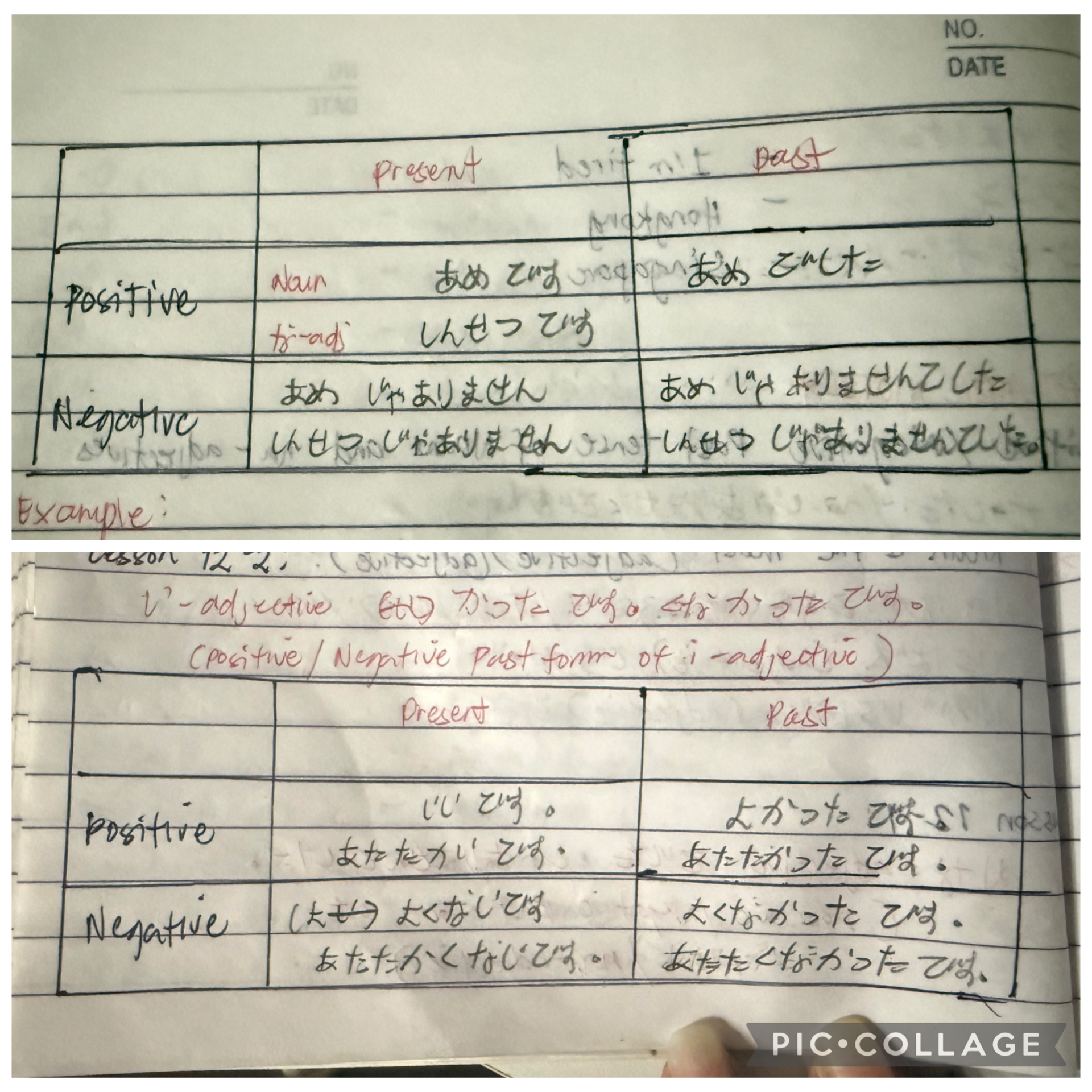
Nな-adjective でした・じゃありませんでした。
Positive / Negative Past form of Noun/な-adjective
い-adjective (い) かったです・くなかったです。
Positive / Negative Past form of i-adjective
N な-adjective
It was rainy yesterday.
きのうはあめでした。
It was not rainy yesterday.
きのうはあめじゃありませんでした。
Yesterday’s exam was easy.
きのうのしけんはかんたんでした。
Yesterday’s exam was not easy.
きのうのしけんはかんたん
じゃありませんでした。
い-adjective
The coffee was good.
コーヒー は よかったです。
The coffee was not good.
コーヒー は よくなかったです。
It was warm in Okinawa.
おきなわ は あたたかったです。
It was not warm in Okinawa.
おきなわ は おたたかくなかったです。
Nはどうでしたか。
How was?
How was yesterday’s exam?
きのうのしけんはどうでしたか。
▶ It was easy.
かんたんでした。
How was your trip?
あなたのりょこうはどうでしたか。
▶ It was very fun.
とてもたのしかったです。
N1 は N2 より (adjective) です。
N1 の ほうが N2 より (adjective) です。
N1 is more (adj.) than N2
N1 is better than N2
Japan is bigger than the Philippines.
にほん は フィリピン より おおきい
です。
Maria is better at singing than Julia.マリアさん の ほうが ジュリア さん より うたが じょうずです。
❗❗NOTE❗❗
N1 は N2 より is different to N1 の ほうが N2 より。
N1 は N2 より is comparing two nouns based on what they think is more than the other one.
While N1 のほうが is directly pointing out which is more than the other one.
Example:
Bullet trains are much faster than Local trains.
しんかんせん は ふつう でんしゃ より
ずっと はやいです。
Chris Evans is much more handsome than Chris Pratt.
クリスエヴァンス のほうが
クリスプラット より ずっと ハンサムです。
N1 と N2 と どちら が (adj.) ですか。
N1・N2 のほうが (adj.) です。
Which is (adj.) N1 or N2?
N1/N2 is (adj.)
Which is spicer, Indian Curry or Japanese Curry?
インドのかれー と にほんのかれー とどちらが からいですか。
▶ Indian curry is more spicier.
インドのカレー のほうが からいです。
Who is better at tennis, Serena or Venus?
セレーナさん と ヴィナス と どちらが
テニス が じょうずですか。
▶ Serena is better at Tennis.
セレーナのほうが テニス が
じょうずです。
Which do you prefer, coffee or tea?
コーヒー と おちゃ と どちら が いい
ですか。
▶ I prefer coffee.
コーヒーのほうがいいです。/
コーヒーをおねがいします。
Which do you like better, spring or fall?
はる と あき と どちら が ずきですか。
▶ I like fall better.
あきのほうが すきです。
N1 (のなか)で 何・どれ・どこ・だれ・いつ が いちばん (adj.) ですか。
N2 が いちばん (adj.) です。
In/among N1, wh ~ is the most (adj.)?
N2 is the most…
Among all the anime, what do you like the most?
アニメ の なかで なに が いちばん
すきですか?
▶ Naruto is what I like the most.
ナルト が いちばんすきです。
Among the Ghibli anime, which do you like the best?
ジブリのアニメ のなかで どれ が
いちばん すきですか。
▶ I like Spirited Away the most.
せんとちひろのかみかくし が
いちばんすきです。
In Japan where was the most interesting?
にほんのなかで どこが いちばん
おもしろかったですか。
▶ Kyoto is the most interesting.
きょうと が いちばん おもしろかった
です。
Among your friends, who is the kindest?
あなたのともだちのなかで だれが
いちばんやさしいですか。
▶ Lemia(bessy) is the kindest.
レミアー が いちばん やさしいです。
When is the hottest (month) of the year?
いちねん で いつ が いちばん あつい
ですか。
▶ April is the most hottest month.
しがつ が いちばんあついです。
わたし は N が ほしいです。
I want a (Noun)
N がほしいですか。
Asking Questions
ほしかった・ほしくなかった
Positive/Negative form of want (wanted/ didn’t want)
N(person) は N を ほし(い)がっています。
I feel like he/she wants (Noun)
I want a (Noun)
I want a car.
わたし は くるま が ほしいです。
I want a boyfriend.
わたし は かれし が ほしいです。
I don’t want a car.
わたし は くるま が ほしくないです。
I don’t want a boyfriend.
わたし は かれし が ほしくないです。
Asking Questions
Do you want a car?
あなた は くるま が ほしいですか。
▶ Yes, I want.
はい、ほしいです。
▶ No, I don’t want.
いいえ、ほしくないです。
Well then, what do you want?
じゃ、なに が ほしいですか。
▶ I want a boyfriend.
かれし が ほしいです。
What kind of boyfriend you want?
どんな かれし が ほしいですか。
▶ Umm.. I want a hot boyfriend the most.
ええと、イクメンかれし が いちばん
ほしいです。
Positive/Negative form of want (wanted/ didn’t want)
I wanted a car.
わたし は くるま が ほしかったです。
I didn’t want a car but now I do.
わたし は くるま が ほしくなかった
です。でも いま は ほしいです。
I feel like he/she wants (Noun)
He wants a new car.
❌ かれ は あたらしいくるま が
ほしいです。
⭕かれ は あたらしいくるま を ほしがって います。
Would you like some coffee?
❌コーヒー が ほしいですか。
⭕コーヒー が いかがですか。
❗❗NOTE ❗❗
When offering something use (Lesson 7 : ~が いかがですか。)
![<p><strong><mark data-color="green" style="background-color: green; color: inherit;">Verb (</mark><s><mark data-color="green" style="background-color: green; color: inherit;">ます</mark></s><mark data-color="green" style="background-color: green; color: inherit;">) たい です。</mark></strong></p><p><span style="color: yellow;"><mark data-color="blue" style="background-color: blue; color: inherit;"><span>Want to do (Verb)</span></mark></span></p><p><strong><mark data-color="green" style="background-color: green; color: inherit;">わたし は Verb(</mark><s><mark data-color="green" style="background-color: green; color: inherit;">ます </mark></s><mark data-color="green" style="background-color: green; color: inherit;">) たくないです。</mark></strong></p><p><span style="color: yellow;"><mark data-color="blue" style="background-color: blue; color: inherit;"><span>I don’t want to do (Verb)</span></mark></span></p><p><strong><mark data-color="green" style="background-color: green; color: inherit;">Verb(</mark><s><mark data-color="green" style="background-color: green; color: inherit;">ます</mark></s><mark data-color="green" style="background-color: green; color: inherit;">) たいですか。</mark></strong></p><p><span style="color: yellow;"><mark data-color="blue" style="background-color: blue; color: inherit;"><span>Asking Questions (interrogative)</span></mark></span></p><p><strong><mark data-color="green" style="background-color: green; color: inherit;">Verb(</mark><s><mark data-color="green" style="background-color: green; color: inherit;">ます</mark></s><mark data-color="green" style="background-color: green; color: inherit;">) たかった・Verb(</mark><s><mark data-color="green" style="background-color: green; color: inherit;">ます</mark></s><mark data-color="green" style="background-color: green; color: inherit;">) たくなかった</mark></strong></p><p><span style="color: yellow;"><mark data-color="blue" style="background-color: blue; color: inherit;"><span>Positive/Negative Past: wanted to do/ didn’t want to do</span></mark></span></p><p><strong><mark data-color="green" style="background-color: green; color: inherit;">N (Person) は N を Verb(</mark><s><mark data-color="green" style="background-color: green; color: inherit;">ます</mark></s><mark data-color="green" style="background-color: green; color: inherit;">) たがっています。</mark></strong></p><p class="has-focus"><span style="color: yellow;"><mark data-color="blue" style="background-color: blue; color: inherit;"><span>I feel like he/she want to [Verb]</span></mark></span></p><p></p>](https://assets.knowt.com/user-attachments/cb2530ee-d249-4f5c-adda-9ef18fe5b762.heic)
Verb (ます) たい です。
Want to do (Verb)
わたし は Verb(ます ) たくないです。
I don’t want to do (Verb)
Verb(ます) たいですか。
Asking Questions (interrogative)
Verb(ます) たかった・Verb(ます) たくなかった
Positive/Negative Past: wanted to do/ didn’t want to do
N (Person) は N を Verb(ます) たがっています。
I feel like he/she want to [Verb]
Want to do (Verb)
I want to buy a car.
わたし は くるま が かいたいです。
I want to meet Beyonce.
わたし は ビヨンセ に あいたいです。
I want to go to Korea.
わたし はかんこく へ いきたいです。
I’m hungry, I want to eat hamburger.
おなか が すきました、ハンバーガ を
たべたいです。
I don’t want to do (Verb)
I don’t want to study.
わたし は べんきょうしたくないです。
I don’t want to play.
わたし は あそびたくないです。
I don’t want to swim.
わたし は およぎたくないです。
I don’t want to get married.
わたし は けっこんしたくないです。
Asking Questions (interrogative)
What do you want to buy?
あなた は なに を かいたいですか。
Who do you want to meet?
あなた は だれに あいたいですか。
Where do you want to go?
あなた は どこ へ いきたいですか。
When do you want to go to Korea?
あなたは いつ かんこく へ いきたい
ですか。
What do you want to do?
あなた は なに を したいですか。
Positive/Negative Past: wanted to do/ didn’t want to do
I wanted to go to Korea.
わたし は かんこく へ いきたかった
です。
I didn’t want to get married.
わたし は けっこんしたくなかったです。
I feel like he/she want to [Verb]
She wants to go to Russia.
❌かのじょはロシアへいきたいです。
⭕かのじょ は ロシア へ いたがって
います。
Would you like to have coffee?
❌コーヒーをのみたいですか。
⭕コーヒーを のみませんか。
⭕コーヒーを のみたくないですか。
(don’t you want to have coffee with me?
❗❗NOTE❗❗
When inviting someone to do something use (Lesson 6: Verb まぜんか。)
N (place) へ Verb(stem) に いきます。
Go to [place] to [purpose] Noun
Interrogative Verb(stem) にいきますか。
Asking Questions
Go to [place] to [purpose] Noun
I will go shopping in Hongkong.
わたし は ホンコン へ かいもの に
いきます。
I came to Japan to study.
わたし は にほん へ べにょう に
きました。
I went back home to see my parents.
わたし は うち へ りょうしん に あい に
かえりました。
I’ll go play soccer with my friends.
わたし は ともだち と サッカー を し に
いきます。
Because it’s my family’s first time in Japan, I will go to the airport to pick them up.
かぞく は にほんで はじめてから、
くうこうへむかえにいきます。
I will go skiing in Hokkaido.
ほっかいどへスキーにいきます。
I go to Sapporo Snow Festival every year.
まいとし さっぽろのゆきまつり に
いきます。
Asking Questions
Where will you go study?
どこへべんきょうにいきますか。
What will you go buy at the the store?
ストア へ なに を かい に いきますか。
Who did you come to see?
だれ に あい に きましたか。
Around what time will you come pick me up?
なんじ ごろ わたし を むかえ に
きますか。
What are you going there for?
あなた は なに を し に いきますか。
N (place) に はいりまず・を でます
Enter Place / Leave Place
Let’s go inside the shop.
あのみせにはいりましょう。
He left the house around 7 o’clock
かれは7じごろうちをでます。
get on the train / get off the train
でんしゃ に のります /
でんしゃ を おります。
なにか (を)・どこか (へ)
Something / Somewhere
Would you like to eat something?
あなた は なにか たべませんか。
I’m thirsty, I want to drink something.
のどがかわきました、なにか のみたい
です。
I’ll have fun somewhere this weekend.
このしゅまつ に どこか へ あそびます。
Did you go anywhere last summer vacation?
なつやすみ は どこか いきましたか。
ご〜
Honorific prefix “go〜”
ごちゅうもん ー order
ごしゅじん ー your husband
ごかぞく ー your family
ごはん ー rice, meal
ごきょうりょくをおねがいします ー Thank you for your cooperation.
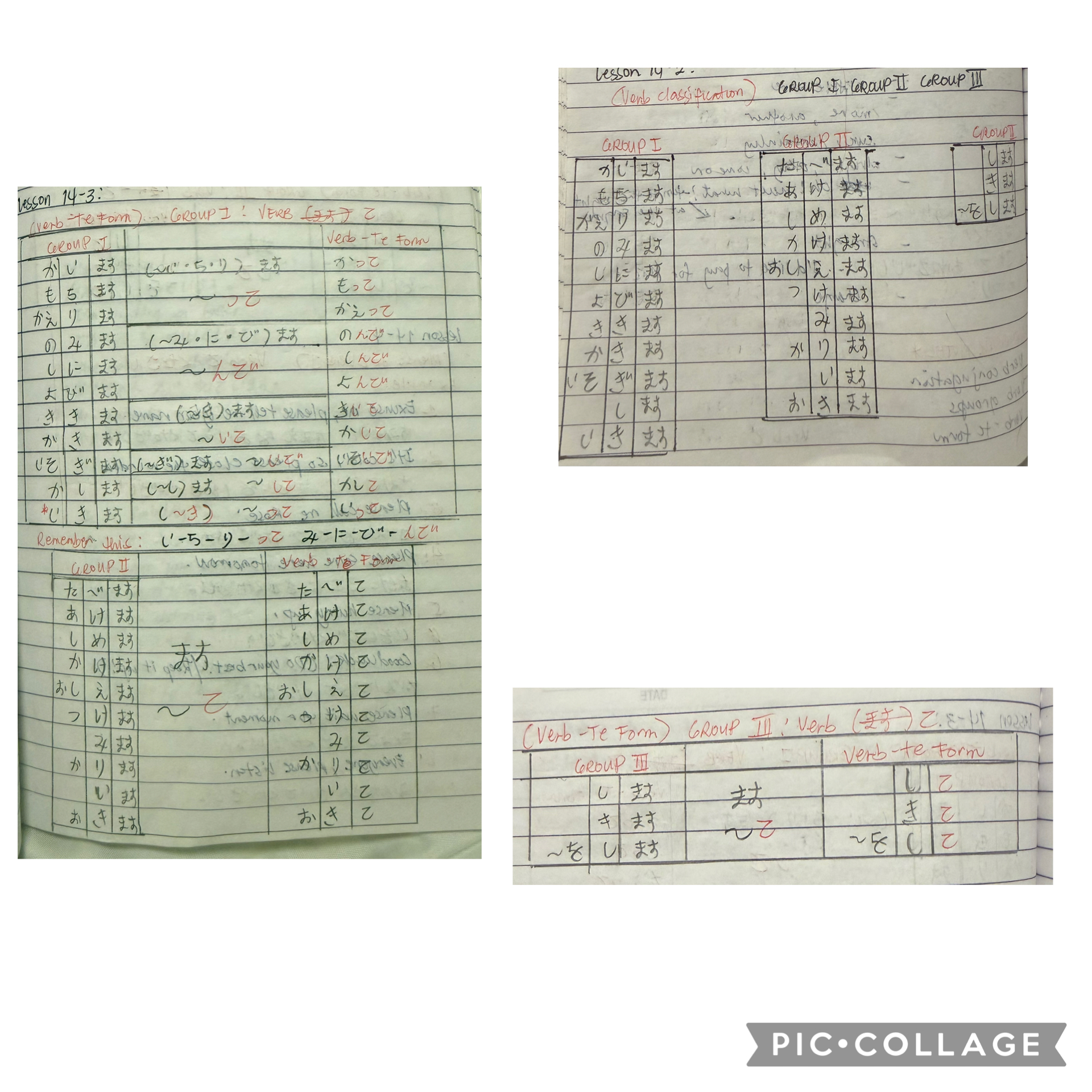
Verb Conjugation
Verb ます foem - polite form
Verb Dictionary Form - plain form
Verb Classification
Group I, II, III
Verb て form
Group I, II, III
See uploaded image for this lesson
Verb て ください
Please do [Verb]
Excuse me, please tell me your name.
すみません、なまえ を おしえて
くだだい。
It’s cold, so please close the window.
さむいから、まど を しめて ください。
Please call me Rose.
ローズ と よんで ください。
Please come here tomorrow.
あした ここ に きて ください。
Please hurry up.
いそいで ください。
Goodluck! (Do your best!/Keep it up)
がんばって ください。
Please wait for a moment.
ちょっと まって ください。
Everyone, Please listen.
みんなさん、きいて ください。
Verb て います
Is doing [Verb]
Verb て います か。
Are you doing [Verb]?
Verb て いません・Verb て しました・Verb て いませんでした。
Negative Present Progressive (is not doing [verb])
Positive Past Progressive (was doing [verb])
Negative Past Progressive ( was not doing [verb])
Is doing [Verb]
It’s raining!
あめ が ふっています。
I’m writing a letter.
てがみ を かいています。
The baby is sleeping.
あかちゃん が ねています。
Mr. Yamada is making a phone call.
やまださん は でんわ を かけていませ。
Are you doing [Verb]?
Is it Raining?
あめ が ふっていますか。
What are you writing?
なに を かいていますか。
Are you listening?
きいて いますか。
What are you doing right now?
いま なに を していますか。
Negative Present Progressive (is not doing [verb])
Positive Past Progressive (was doing [verb])
Negative Past Progressive ( was not doing [verb])
It is not raining.
あめ が ふっていません。
I was listening.
きいて いました。
I wasn’t doing anything yesterday.
きのう なにも していませんでした。
Verb (ます)ましょうか。
Shall I do [verb]
Shall I carry those luggages?
にもつ を もちましょうか。
▶ Yes, please.
すみません、おねがいしまず。
Isn’t hot? Shall I open the window?
あつくないですか。まど を
あけましょうか。
▶Yes, it is. Please open it a little bit.
そうですね。すこし あけて ください。
Shall I help you with work?
しごと を てつだいましょうか。
▶ No, thank you.
いいえ、けっこうです。
S1 が S2
Excuse me but…
Excuse me, but may I have your name?
しつれいですが、おなまえは?
I’m sorry, but please pass me the salt.
すみませんが、しお を とってください。
N が Verb
Natural Phenomenon
It’s raining. (Rain is precipitating)
あめ が ふっています。
It’s snowing. (Snow is falling down)
ゆき が ふっています。
The wind is blowing.
かぜ が ふいています。
Verb て も いい です。
You may do [Verb]
Verb て も いい ですか。
May I do [Verb]
You may do [Verb]
You may use my computer.
わたしのパソコン を つかって もいいです。
You may sit down over there.
あそこ に すわって もいいです。
You may put your luggages in that room.
その へや は にもつ を おいて もいい
です。
You may come in.
はいて もいいです。
May I do [Verb]
Do you mind if I smoke?
タバコ を すって もいいですか。
⭕ Yes, it’s fine go ahead.
ええ、いいです。
❌ I’m sorry, ummm..
すみません。ちょっと。。。
Can I keep this picture?
この しゃしん を もらって もいい
ですか。
May I borrow a pen?
ペン を かりて もいいですか。
Verb てはいけません。
You must not do [Verb]
You can’t smoke here.
ここで タバコ を すってはいけません。
You cannot take pictures inside the art gallery.
びじゅつかんのなかで しゃしん を
とってはいけません。
Can I park the car here?
ここで くるま を とめてもいいですか。
▶ No, you cannot.
いいえ、いけません。
いいえ、だめです。
Verb て いません。
Have been doing [Verb]
Verb て いますか。
Asking Questions
Have been doing [Verb]
He’s married.
かれ は けっこんしています。
My family lives in Nagoya.
かぞく は なごや に すんでいます。
I have been studying Japanese for 2 years.
にねんかん にほんご を
べんきょうしています。
I have an Iphone X.
アイフォーンテン を もっています。
Asking Questions
Are you married?
あなた は けっこんしていますか。
⭕ Yes, I’m married.
はい、けっこんしています。
❌ No, I’m single.
いいえ、どくしんです。
Where do you live?
どこ に すんでいますか。
▶ I live in Saitama Prefecture.
さいたま けん に すんでいます。
Verb て います。
Habitual Action
Verb て います。
Talking about someone’s present situation
Habitual Action
I buy Starbucks coffee everyday.
まいに ち スターバックスのコーヒー
を かっています。
I run every morning.
まいあさ、はしっています。
(They) sell cheap electronic goods at Nippon Bashi in Osaka.
おおさかのにほんばし で やすい でんき
せいひん を うっています。
Tesla makes electic cars.
テスラ は でんき じどうしゃ を つくって います。
Talking about someone’s present situation
What do you do?
なに を していますか?
What is your job?
おしごと は なんですか。
I work at Google.
グーグル で はたらいています。
I am studying at Tokyo University.
とだい で べんきょうしています。
しっています・しりません
I don’t know
しりません VS わかりません
I don’t know
I don’t know
Do you know Ms. Hashimoto from engineeing departmenr?
エンジニアぶ の はしもとさん を
しっていますか。
⭕ Yes, I know.
はい、しっています。
❌ No, I don’t know.
いいえ、しりません。
Do you know my address?
あなたのじゅしょ を しっていますか。
⭕ Yes, I know.
はい、しっています (わかります)
❌ No, I don’t know.
いいえ、しりません (わかりません)
I don’t know
Excuse me what time is it?
すみません、なんじですか?
⭕ It’s 1:15.
1じ15ふんです。
❌ Sorry, but I also don’t know.
すみません、わたしも わかりません。
What will you do on weekend?
しゅうまつ は なに を しますか。
⭕ I’ll go shopping
かいもの に いきます。
❌ ummm.. I still don’t know.
ええと、まだ わかりません。
Can you undestand English?
えいご が わかりますか。
⭕ Yes, I can.
はい、わかります。
❌ No, I cannot.
いいえ、わかりません。
Verb1 て、Verb2 て、Verb3
Do [Verb] then do [Verb]
Q: あさ は なに を しますか。
In the morning, I take a shower, eat breakfast, and do work.
あさ シャワーを あびて、あさご はん を たべて、しごとをします。
Q:にちようび は なに を しましたか。
I met my friend at Shibuya, watched a movie and ate dinner.
しぶや で ともだち に あって、えいが
を みて、ゆうしょく を たべました。
Q:よこはまえきからぎんざえきまでのいきかたをおしてください。
From Yokohama station, please ride the JR train, get off at Shimbashi, then after that, transfer to a subway train, then get off at Ginza station.
よこはまえきから、JRでんしゃに
のって、しんばしで おりて それから
ちかてつ に のりかえて、ぎんざえきで
おりてください。
い-adj. (い) くて
Connecting Sentence with い-adj.
Q:おとうさんはどんなひとですか。
My father is a kind and smart person.
おとうさん は やさしくて あたま が
いい ひと です。
Q:ほっかいどはでんきがどうでしたか。
The weather was fine and cool in Hokkaido.
ほかいど は てんき が よくて すずし
かったです。
Q:シンガポールのたべものはどうですか。
The food is delicious and cheap. I higjly recommend it.
たべもの は おいしくて やすくてすごく
おすすめです。
❗the red highlighted part are the answer I got wong. Need more understanding and practice in translating sentences from nihonggo.
Noun / な-adj. で。。。
Connecting sentences with Noun/な-adj.
Kyoto is beautiful and there are many interesting things.
きょうと は きれい で おもしろい
もの が たくさん あります。
Ms. Nguyen is Vietnamese and a foreign exchange student.
グェンさん は ベトナムじん で
りゅうがくせいです。
My father is a pilot and my mother is a nurse.
ちち は パイロット で はは は かんごし
です。
The bullet train is fast but expensive.
しんかんせん は はやい ですが たかい
です。
(The last example is from Lesson 8:Connecting sentences with contradiction.)
❗the red highlighted part are the answer I got wong. Need more understanding and practice in translating sentences from nihonggo.
Verb1 てから、Verb2
After [Verb1], do [Verb2]
Verb てから、なにをVerb2か。
Asking Question
After [Verb1], do [Verb2]
After inserting the card, please push this button.
カード を 入れて から、このボタン を
おしてください。
After graduating from university, I will travel the world.
だいがく を でてから、せかい を
りょこうしましす。
Would you like to drink beer with after we finish work?
しごと を おわってから、ビール を
のみませんか。
Asking Question
What will you do after you quit your job?
しごとをやめてから、なにをしますか。
You went to Kyoto and then what did you do?
きょうと へ いって から、なに を
しましたか。
Are you going somewhere after the meeting is finished?
かいぎ が おわってから、どこか
いきますか。
❗the red highlighted part are the answer I got wong. Need more understanding and practice in translating sentences from nihonggo.
Noun1 は Noun2 が Adj.
[Noun1]’s [Noun2] is [Adj.]
Anna has black hair and big eyes.
アンナさん は かみ が くるくて め が
おきいです。
That player is short but fast.
そのせんしゅ は せが みじかい ですが
あしがやいです。
In France, the food is delicious and wine is famous all over the world.
フランス で たべもの が おいしくて
ワイン が せかいじゅう で ゆめいです。
❗the red highlighted part are the answer I got wong. Need more understanding and practice in translating sentences from nihonggo.
どうやって Verb か。
How to [Verb]
How do you go to school?
がっこう まで どやって いきますか。
▶ From the station, I take the no.1 bus, then I get off in front of the shrine. From there, I walk for about 5 minutes to school.
えきから、いちばんの バス に のって、
じんじゃ の まえ で おりて。そこから
がっこう まで ごふん ぐらい
あるきます。
How do you use the vending machine?
じどうはんばいき は どうやって
つかいますか。
▶ First, please insert the money, then push the button of the drink that you like.
まず、おかね を いれて、すきな
のみもの の ボタン を おして ください。
どの Noun [このN、そのN、あのN]
Which [Noun] {3 or more}
Which person (one) is your brother.
おにいさん は どの ひと ですか。
▶ That tallest person over there.
あのいちばんせがたかいひとです。
Which car is your car?
あなたのくるま は どのくるま ですか。
▶ That car is my car.
その くるま は わたしのくらまです。
Which one is your car?
あなたのくるま は どれですか。
(The last example is from Lesson 8: どれ which one… {3 or more})
❗❗NOTE❗❗
どの is always followed by Noun while どれ is not.
❗the red highlighted part are the answer I got wong. Need more understanding and practice in translating sentences from nihonggo.

Group I,II,III Verb-ます Form to Verb-ない Form
See uploaded image for this Lesson..
Verb ないでください。
Please don’t do [Verb]
Please don’t lose your tickets.
チケット は なくさないでください。
Please don’t take pictures inside.
なかで しゃしん を とらないでください。
I’m fine. Please don’t worry.
だいじょうぶです。
しんぱいしないでください。
Please don’t forget your passport.
パスポート を わすれないでください。