BISC 1303: Chapter 9 - Cellular Communication
 Call Kai
 Learn
Learn Practice Test
 Spaced Repetition
 Match
Match Flashcards
 Knowt Play
1/18

There's no tags or description
Looks like no tags are added yet.
Name | Mastery | Learn | Test | Matching | Spaced | Call with Kai |
|---|
No analytics yet
Send a link to your students to track their progress
19 Terms
Ligand
a molecule produced by a signaling cell that binds with a specific receptor, delivering a signal in the process
releases from “signaling cells”
bind to “receptor proteins” on “target cells”
4 types of Signaling Mechanisms
Autocrine
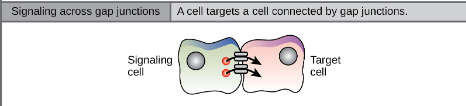
Direct Signaling
Paracrine
Endocrine
Autocrine
ligand binds to receptor on signaling cell
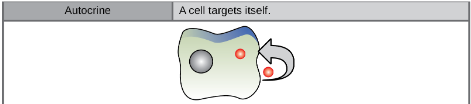
Direct Signaling
ligand travels directly from cytoplasm to cytoplasm from signaling to target cell
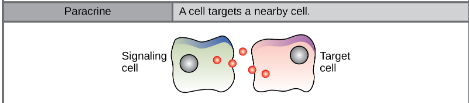
Paracrine
ligand binds to receptors on NEARBY cells
rapidly degraded ligand ensures signal is local
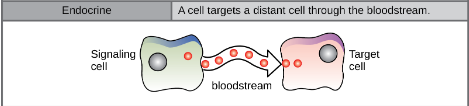
Endocrine
ligand binds to receptors on DISTANT cells
stable ligand ensures it can travel across body
2 types of Receptors
Intracellular Receptor
Cell surface receptor
Intracellular Receptor
receptor protein in cytoplasm of cell
ligands for these receptors must be small and hydrophobic to diffuse across membrane
E.G. steroid hormones
Cell surface receptors
receptor protein on surface of cell
anchored in plasma membrane
have 3 distinct domains:
extracellular - exposed to outside of cell, binds ligand
transmembrane - spans membrane
cytoplasmic - exposed to cytoplasm
ligands for these receptors are water-soluble
E.G. small molecules or proteins
Signal Transduction
binding of ligand leads to change in shape of receptor protein
behaves different
E.G. an intracellular receptor may enter nucleus and cause genes to be turned on/off
E.G. may lead to release/creation of a second messengers
E.G. a cell surface receptor may phosphorylate proteins
Second messenger
a small, non-protein molecule that propagates a signal within the cell after activation of a receptor causes its release
Phosphorylation
modification of protein by addition of phosphate group(s) from ATP
catalyzed by a class of enzymes called “kinases”
Dephosphorylation
removal of phosphate group(s) from a protein
catalyzed by a class of enzymes called “phosphatases”
Based on its phosphorylation state…
the function of a protein can be switched on or off
Signal Transduction can ultimately result in
altered cell behavior
cell growth/division
apoptosis
Apoptosis
programmed cell death
Singled-celled yeasts…
secrete a “mating factor” ligand to find other yeast cells to mate with
Some bacteria can communicate…
E.G. Quorum sensing
some bacteria can form structures called biofilms but this requires high cell density to form, would waste energy to try to form with few bacteria
released ligands (called autoinducers) communicate cell density to other bacteria
low ligand density - ligand diffuses
high ligand density - signaling pathway activated, formation of biofilm
Biofilm
a matrix of proteins and sugars that protects colonies of pathogenic bacteria from the host immune system