3.5 Lipids
 Call Kai
 Learn
Learn Practice Test
 Spaced Repetition
 Match
Match Flashcards
 Knowt Play
1/98

There's no tags or description
Looks like no tags are added yet.
Name | Mastery | Learn | Test | Matching | Spaced | Call with Kai |
|---|
No analytics yet
Send a link to your students to track their progress
99 Terms
What are lipids known as?
fats and oils
What elements are lipids made out of?
carbon, hydrogen and oxygen
Lipids that are solid at room temperature?
fats
Lipids that are liquid at room temperature?
oils
3 different types of lipid?
triglycerides, phospholipids and cholesterol
Why are all lipids non-polar molecules?
the electrons in the outer orbital that form bonds are more evenly distributed than in polar molecules
What do lipids being non-polar mean about their charge?
there are no positive or negative areas within the molecule
Why are all lipids non-soluble in water?
they are hydrophobic (due to being non-polar)
hydrophobic?
repel water molecules
What type of molecule are lipids?
macromolecules
What are macromolecules?
large complex molecules
What are macromolecules built from?
repeating units, or known as monomers
Triglycerides: what elements are they made out of?
Carbon, hydrogen, oxygen
Triglycerides: what are they made from combining?
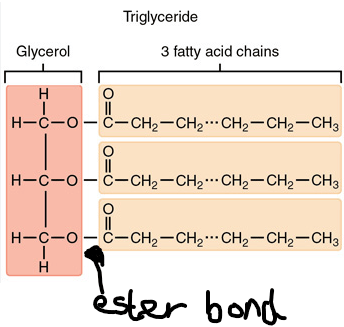
one glycerol molecule with three fatty acids
Triglycerides: What group of molecules is glycerol a member of?
alcohols
Triglycerides: What group of molecules do fatty acids belong to?
carboxylic acids
Triglycerides: Fatty acid structure?
a carboxyl group with a hydrocarbon chain attached
Triglycerides: carboxyl group chemical formula?
–COOH
What do the molecules glycerol and fatty acids contain?
hydroxyl (OH) groups
What molecules do these hydroxyl groups interacting form?
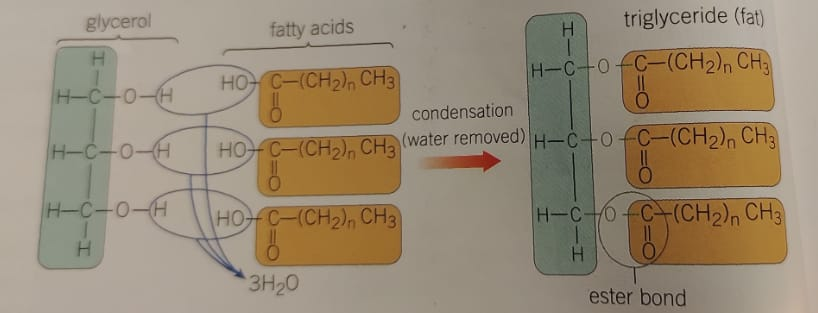
three water molecules
What bonds do these hydroxyl groups interacting form?
ester bonds
What are bonds ester bonds?
bonds between the fatty acids and the glycerol molecule
What is the reaction that forms ester bonds called?
Esterification
What type of reaction is esterification an example of?
condensation reaction (produces 3 water molecules)
How are triglycerides synthesised?
by the formation of the ester bond between each fatty acid and the glycerol molecule
diagram of triglyceride?
…
How many water molecules are produced during esterification (and diagram of process)?
3
How do you break down triglycerides/each ester bond?
three water molecules need to be added to reverse the reaction that formed the triglyceride
What is this reaction an example of?
a hydrolysis reaction
What are the two types of fatty acids?
Saturated and unsaturated.
What are saturated fatty acids?
no double bonds present between their carbon atoms
Why are these fatty acids called 'saturated'?
Because the carbon atoms form the maximum number of bonds with the hydrogen atoms (they are saturated with hydrogen atoms)
What are unsaturated fatty acids?
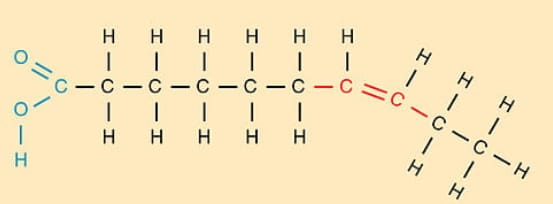
Fatty acids with at least one double bonds between carbon atoms
Monosaturated?
just one double bond
Polysaturated?
two or more double bonds
What does the presence of double bonds cause the molecule to do?
kink or bend
Diagram of a saturated hydrocarbon chain?
…
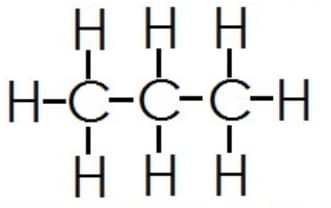
Diagram of an unsaturated hydrocarbon chain?
…
What does the kink or bends caused by double bonds make saturated fatty acids unable to do?
can't pack so closely together
What do unsaturated fatty acids not being able to pack so closely together cause their state to be at room temperature?
liquid (not solids) - therefore described as oil at room temp rather than fats
What type of triglycerides do plants contain?
unsaturated triglycerides
What do these unsaturated triglycerides normally occur as in plants?
oils
Which type of triglyceride tends to be more healthy?
unsaturated (oils) are more healthy than saturated (solid - fats)
What does some evidence show an excess of saturated fats can lead to (however evidence remains inconclusive)?
coronary heart disease
What does an excess of any type of fat lead to?
obesity - also puts a strain on the heart
What are phospholipids?
modified triglycerides
What elements do phospholipids contain?
phosphorus as well as carbon, hydrogen and oxygen
Where are phospholipids found?
cell membranes (eukaryotes and prokaryotes)
What is one of the fatty acid chains replaced with in a triglyceride to make a phospholipid?
a phosphate group (meaning there are only 2 fatty acid chains in a phospholipid)
What makes phosphate ions soluble in water?
they have extra electrons - negatively charged
Phospholipid structure diagram?
…
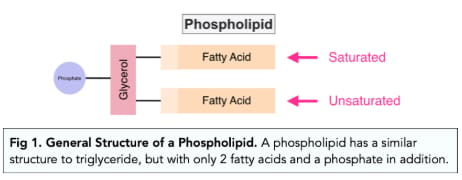
What part of the phospholipid are the fatty acid chains?
non-polar tails
What part of the phospholipid is the phosphate group?
the charged heads
Hydrophobic?
repelled by water
Hydrophilic?
will interact with and are attracted to water
What part of the phospholipid is hydrophobic?
non-polar tails
What part of the phospholipid is hydrophilic?
the Phosphate head
What part of the phospholipid is hydrophilic?
the charged Phosphate head
What do the non-polar tails mix readily with?
fat
Why do phospholipids behave in an interesting way when they interact with water?
due to their dual hydrophobic/hydrophilic structure
Why are phospholipids called surfactants (surface active agents)?
they form a layer on the surface of the water
When forming a layer on the surface of water where are the phosphate heads positioned?
in the water (hydrophilic)
When forming a layer on the surface of water where are the fatty acid tails positioned?
sticking out of the water (hydrophobic)
a bilayer?
two-layered sheet formation
What are the hydrophobic tails protected from the water by?
the hydrophilic heads (on the outside)
Why does the phospholipid bilayer act as a good barrier?
the centre of the bilayer (tails) are hydrophobic so water-soluble can't easily pass through it
As a result of this bilayer arrangement what do phospholipids play an important role in?
cell membranes
What do they separate the aqueous cytosol in cells from?
an aqueous environment
What are macromolecules?
very large molecules, also known as polymers, which are built from repeating smaller units called monomers
Examples of macromolecules/polymers?
triglyceride and phospholipid
What are sterols known as?
steroid alcohols
What are sterols?
complex alcohol molecules (another type of lipid found in cells)
Example of a sterol?
Cholesterol
Polar?
has a slightly negatively charged region and has a slightly positive charged region
Structure of cholesterol?
a four carbon ring structure attached to hydrocarbon tail
What does the carbon ring structure have attached to it?
a hydroxyl (OH) group at one end
Elements present in cholesterol?
carbon, hydrogen, and oxygen
What part of cholesterol is polar?
the hydroxyl group
What part of cholesterol is hydrophilic?
the hydroxyl group (because it is polar)
What part of cholesterol is hydrophobic?
the rest of the molecule (apart from the hydroxyl group)
Where is cholesterol primarily made in the body?
Liver and intestines
What does cholesterol have an important role in?
the formation of cell membranes
Where is cholesterol positioned within the cell membrane?
between the phospholipid - with the hydroxyl group at the periphery of the membrane
Periphery?
outer edge
Why does cholesterol size and shape allow it to fit in between the phospholipid molecules in the membrane?
small size and flattened shape
What causes cholesterol to pack more closely together with the phospholipids in the membrane?
cholesterol binds with the hydrophobic tails of the phospholipids
What is the function of cholesterol in membranes (that them packing closely together allows them to be able to do)?
strengthen cell membranes (adds stability) and regulates their fluidity
Regulating cell membrane temperature: low temperatures?
keeps membranes fluid at low temperatures
Regulating cell membrane temperature: high temperatures?
stopping them becoming too fluid at high temperatures
3 examples of things manufactured using cholesterol?
Vitamin D, steroid hormones and bile
Roles of lipids: membranes?
membrane formation and the creation of hydrophobic barriers
Roles of lipids: what are key in the production of?
hormones
Roles of lipids: electrical insulation?
electrical insulation necessary for impulse transmission
Roles of lipids: waterproofing - examples?
in birds' feathers and on plant leaves
What do triglycerides in particular have an important role in?
long-term energy storage
Where are they stored?
under the skin and around vital organs
What do lipids provide under the skin and in these vital organs: thermal insulation?
thermal insulation to reduce heat loss (e.g. in penguins)
What do lipids provide under the skin and in these vital organs: cushioning?
cushioning to protect vital organs (e.g. heart and kidneys)
What do lipids provide under the skin and in these vital organs: buoyancy?
buoyancy for aquatic animals like whales