Sliding filament theory
 Call Kai
 Learn
Learn Practice Test
 Spaced Repetition
 Match
Match Flashcards
 Knowt Play
1/3

There's no tags or description
Looks like no tags are added yet.
Name | Mastery | Learn | Test | Matching | Spaced | Call with Kai |
|---|
No analytics yet
Send a link to your students to track their progress
4 Terms
Sliding filament theory
explains how a muscle can shorten from a macroscopic perspective
sliding filament theory: during contraction the thin filaments slide past the thick filaments so that actin and myosin overlap to a greater degree
when a muscle shortens it shortens at the sarcomere and within the sarcomere the thin filaments attached to the z discs are sliding over the thick filaments so the Z discs move closer together during muscle contraction
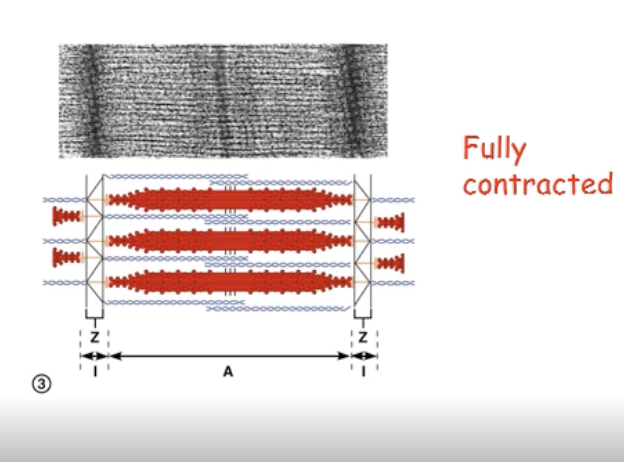
Sarcomere shortening: relaxed
Z discs: dark ling, easy to distinguish
H zone is bisected by the M line
can see I band and A band
there are regions of the sarcomere where there is either no thick or thin filament
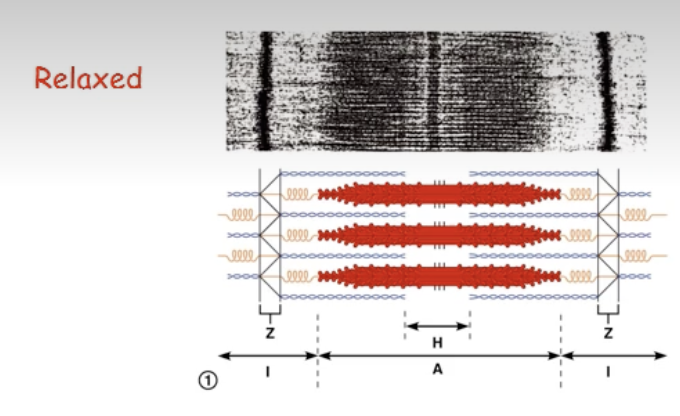
Sarcomere shortening: partially stimulated
z discs in this image are closer together
Z discs move towards the center by the thin filaments are sliding over the thick filaments and the thin filaments are attached to the Z discs
if the thin filaments are sliding past the thick filaments, the distance between the z discs will decrease
- as contraction continues, the distance between the z discs get even shorter
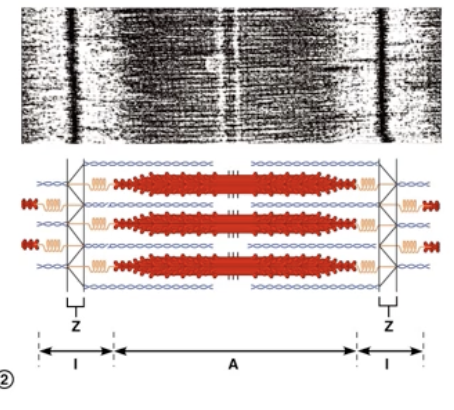
Sarcomere shortening: fully contracted
when the sarcomere is fully contracted, you will no longer be able to see the I bands, but may be able to distinguish the M lines