psychology final
 Call Kai
 Learn
Learn Practice Test
 Spaced Repetition
 Match
Match Flashcards
 Knowt Play
1/80

There's no tags or description
Looks like no tags are added yet.
Name | Mastery | Learn | Test | Matching | Spaced | Call with Kai |
|---|
No analytics yet
Send a link to your students to track their progress
81 Terms
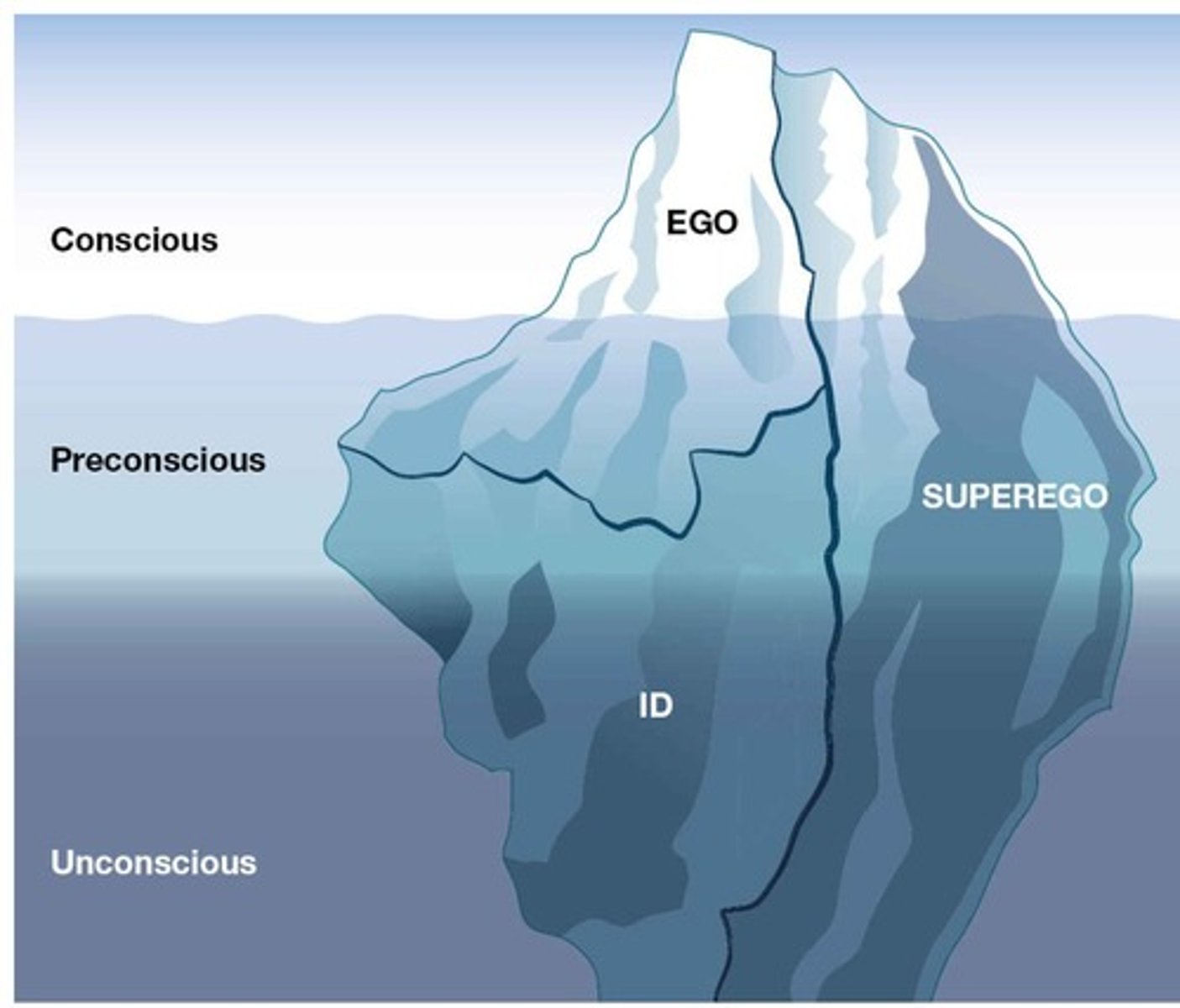
psychoanalytic/psychodynamic
Unconscious forces—such as wishes, desires, and hidden memories—determine behavior and influence personality.
According to Freud, unique interactions among the id, superego, and ego produce individual differences in personality.
Personality is based on unconscious wishes that create conflict between the id, ego, and superego.
Biological Approach
an approach to psychology focusing on the body, especially the brain and nervous system
Views personality as a product of genetic inheritance, brain structure, and biological processes (hormones, neurotransmitters). This view investigates how DNA, evolution, and nervous system structure dictate why people behave differently. (google)
social-cognitive perspective
views behavior as influenced by the interaction between people's traits (including their thinking) and their social context.
Views personality as a result of the interaction between a person's thoughts, cognitive processes, and their social environment. It emphasizes observational learning, self-efficacy, and how people interpret and react to situations. (google)
Humanistic Approach
An approach to psychology emphasizing a person's positive qualities, the capacity for positive growth, and the freedom to choose any destiny.
Focuses on human potential, free will, self-awareness, and the conscious subjective experience. Humanists believe personality develops as an individual strives to achieve their full potential, or self-actualization, emphasizing personal growth and free will.
Trait Approach
an approach to studying personality that focuses on how individuals differ in personality dispositions.
Views personality as a set of stable, measurable, and characteristic patterns of behavior, thought, and emotion. Personality is considered a combination of traits (such as the "Big Five") that are consistent over time and situations.
Three structures of personality
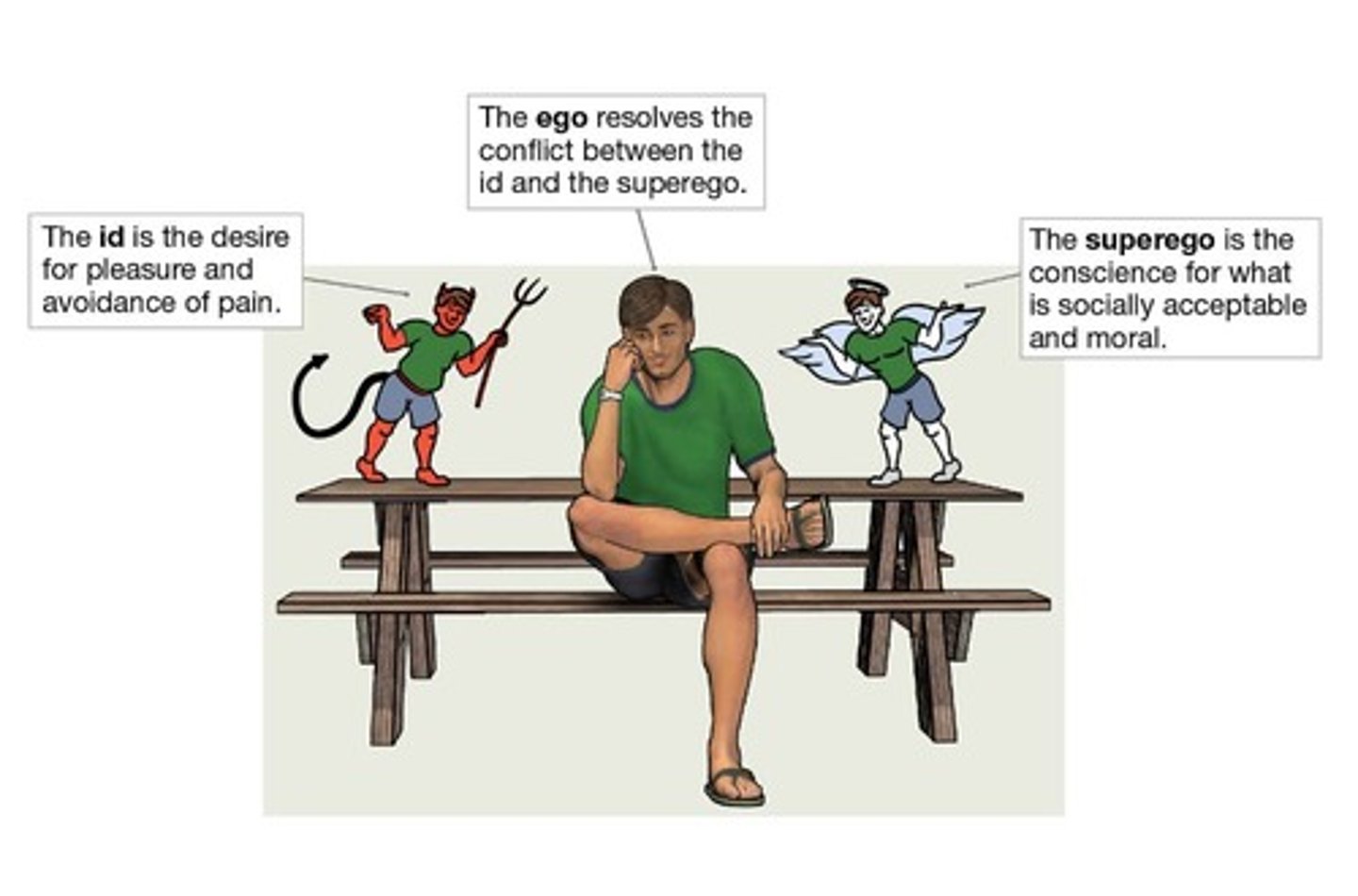
id, ego, superego
Id
In psychodynamic theory, the component of personality that is completely submerged in the unconscious and operates according to the pleasure principle
Superego
In psychodynamic theory, the mostly unconscious component of personality that reflects the internalization of societal and parental standards of conduct; it is a rigid structure of morality or conscience.
Ego
In psychodynamic theory, the component of personality that tries to satisfy the wishes of the id while being responsive to the rules of the superego. It operates according to the reality principle.
defense mechanisms
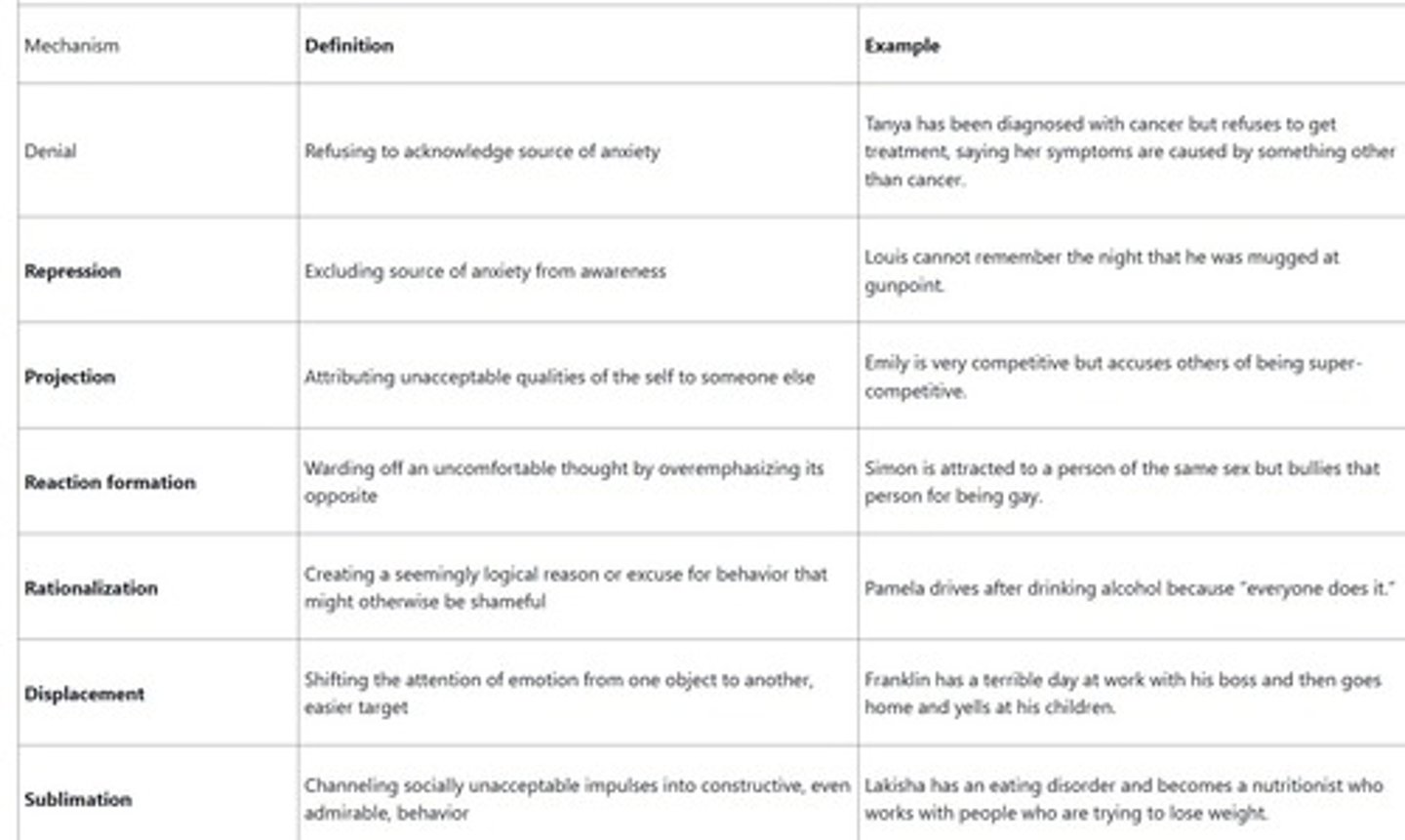
In psychodynamic theory, unconscious mental strategies that the mind uses to protect itself from distress.
self-actualization
occurs when people achieve their personal dreams and aspirations.
A self-actualized person is living up to his or her unique potential and therefore is truly happy.
Locus of Control
to describe generalized expectations that people can or cannot control the rewards and punishments that they receive.
internal locus of control
to describe generalized expectations that people can or cannot control the rewards and punishments that they receive. People with an internal locus of control believe that they influence outcomes because you worked hard.
external locus of control
People with an external locus of control believe that outcomes—and therefore their personal fates—result from forces beyond their control
unconditional positive regard
Rogers encouraged parents to accept and prize their children no matter how the children behave or how well they meet parents' expectations, an approach called unconditional positive regard
self-schema
which is an integrated set of memories, beliefs, and generalizations about yourself
This information is organized as a network of interconnected knowledge about yourself
Your self-schema helps you quickly perceive, organize, interpret, and use information about yourself.
It also helps you filter information so that you are likely to notice things that are relevant to you, such as your name.
Bandura's Social Cognitive Theory
Albert Bandura (1977a) emphasized that personality factors always interact with the situation, and this interaction produces behavior.
(1) your current environment
(2) multiple person factors, which include your characteristics, self-confidence, and expectations,
(3) how your behavior affects your current environment
reciprocal determinism
According to Bandura, personality factors always interact with the situation, and this interaction produces behavior. Three factors influence how you act: your current environment, multiple person factors (such as self-confidence), and how your behavior affects your current environment.
Big Five Theory of Personality (OCEAN)
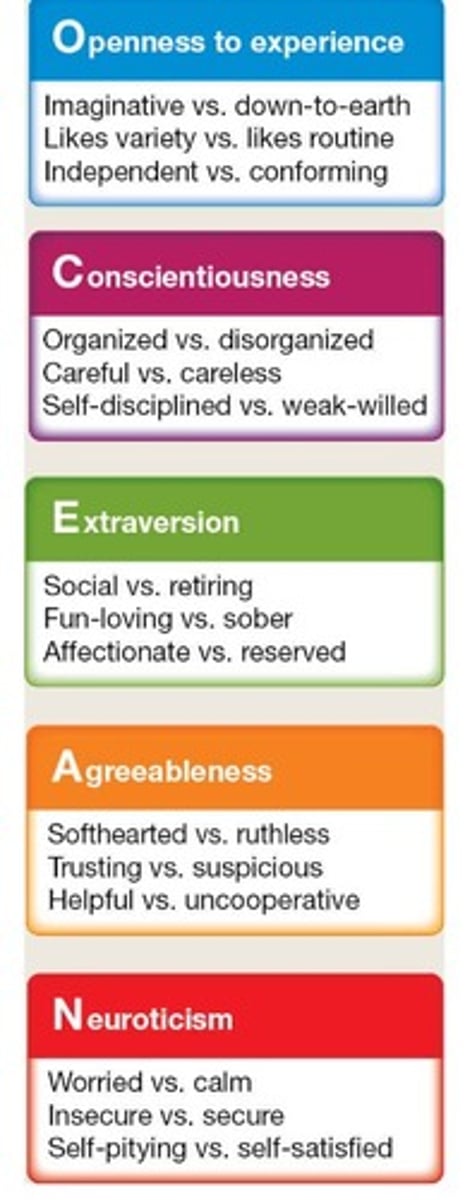
1. Openness to experience. Imaginative versus down-to-earth, Likes variety versus likes routine, and Independent versus conforming.
2. Conscientiousness. Organized versus disorganized, Careful versus careless, and Self-disciplined versus weak-willed.
3. Extraversion. Social versus retiring, Fun-loving versus sober, and Affectionate versus reserved.
4. Agreeableness. Soft hearted versus ruthless, Trusting versus suspicious, and Helpful versus uncooperative.
5. Neuroticism. Worried versus calm, Insecure versus secure, and Self-pitying versus self-satisfied.
Openness to Experience
Imaginative versus down-to-earth, Likes variety versus likes routine, and Independent versus conforming.
Conscientiousness
Organized versus disorganized, Careful versus careless, and Self-disciplined versus weak-willed
Extraversion
social vs. retiring
fun-loving vs. sober
affectionate vs. reserved
Agreeableness
softhearted vs. ruthless, trusting vs. suspicious, helpful vs. uncooperative
self personality/measures
Personality tests in which people respond to questionnaire items that reveal traits and behaviors.
projective personality tests/measures
Personality tests that examine unconscious processes by having people interpret ambiguous stimuli.
fundamental attribution error
The tendency to overemphasize personality traits and underestimate situations when attempting to explain other people's behavior.
situational attribution/external attribution
Explanations for why events or actions occur based on external factors, such as the weather, luck, accidents, or other people's actions.
personal attributions/dispositional attributions/internal attributions
Explanations for why events or actions occur based on people's internal characteristics, such as abilities, traits, moods, or efforts.
Conformity
The act of altering your own behaviors and opinions to match those of other people or to match other people's expectations.
Compliance
The act of agreeing to do things requested by others.
Obedience
The act of following the orders of a person of authority.
Stanley Milgram's Obedience Study (page 488)
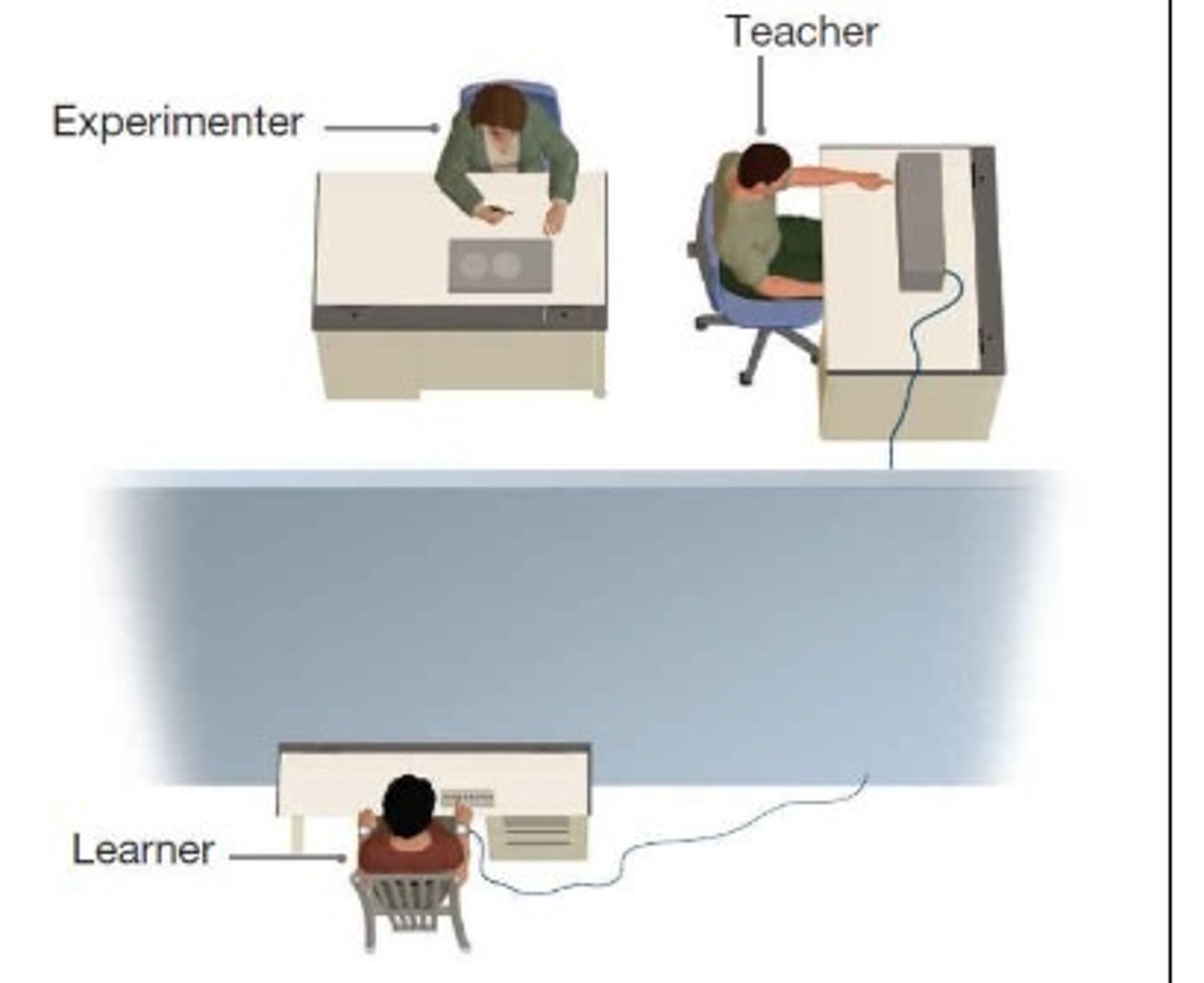
study showing a person willingly harming another solely because an authority figure was there telling them to do so- used a shock board
One participant was assigned to serve as a "teacher." The experimenter sat next to the teacher.
Another participant, located in the next room, was the "learner."
Each time the learner gave a wrong answer to a question, the teacher gave the learner what the teacher was told was an electric shock.
As the test proceeded, the teacher was supposed to gradually increase the strength of the shocks.
cognitive dissonance
An uncomfortable mental state due to a contradiction between two attitudes or between an attitude and a behavior.
bystander intervention effect
the study of situational variables related to helping a stranger
most notably the decreased likelihood of helping as the number of bystanders increases
Stereotypes
Schemas that allow for easy, fast processing of information about people, events, or objects, based on how that information is categorized
prejudices
Negative feelings, opinions, and beliefs associated with a stereotype about people in a particular group.
Discrimination
The inappropriate and unjustified treatment of people based on the groups they belong to
self-fulfilling prophecy
People's tendency to behave in ways that confirm their own or other people's expectations.
sensory memory
Function of storage:Lets perceptions appear to be unified wholes
Encoding for storage: In the sense it is experienced: visual, auditory, taste, smell, touch
Duration of storage: Visual: under 1 second
Auditory: 3-4 seconds
Capacity of storage: Vast due to huge amount of sensory input
Short-term storage
Function of storage:Maintains information for immediate use
Encoding for storage: Primarily auditory
Also visual and semantic
Duration of storage:Under 20 seconds
Indefinite with working memory manipulation of items
Capacity of storage:About 7 items, plus or minus 2
Using working memory aids capacity
long-term memory
Function of storage:Stores information for access and use at a later time
Encoding for storage:Primarily semantic
Also visual and auditory
Dual coding provides richest encoding
Duration of storage:Probably unlimited
Capacity of storage:Probably unlimited
According to George Miller’s memory span, how many items can we hold in our short-term memory at one time?
The cognitive psychologist George Miller noted that the capacity limit of short-term storage is generally seven items (plus or minus two), which is called the memory span.
Miller's estimate may be too high, as some research suggests that short-term storage may be limited to as few as four items
chunking
Using working memory to organize information into meaningful units to make it easier to remember.
semantic memory
A type of explicit memory that includes a person's knowledge about the world, independent of personal experiences.
episodic memory
A type of explicit memory that includes a person's personal experiences.
procedural memory
A type of implicit memory that involves learning motor skills and behavioral habits and knowing how to do things.
maintenance rehearsal
Using working memory processes to repeat information based on how it sounds (auditory information)
provides only shallow encoding of information and less successful long-term storage.
elaborative rehearsal
Using working memory processes to think about how new information relates to yourself or your prior knowledge (semantic information);
provides deeper encoding of information for more successful long-term storage
context dependent memory
when you are in the same context where you learned information, the environment where learning took place provides a cue that aids your access to the information
retrograde amnesia
A condition in which people lose the ability to access memories they had before a brain injury.
anterograde amnesia
A condition in which people lose the ability to form new memories after experiencing a brain injury.
What are some of the reasons we forget?
In retroactive interference, access to older memories is impaired by newer memories
in proactive interference, access to newer memories is impaired by older memories.
Blocking often occurs because of interference from words that are similar in some way, such as in sound or meaning, and that are repeatedly experienced.
Absentmindedness is the inattentive or shallow encoding of events. The major cause of absentmindedness is failing to use selective attention to pay attention to relevant information and ignore irrelevant information. This form of absentmindedness, which is a failure in prospective memory, often occurs because you are caught up in another activity.
Blocking
You cannot recall the name of a song. You forget the name of someone you are introducing. You "blank" on some lines when acting in a play.
This type of forgetting is called blocking. Blocking occurs when we are temporarily unable to remember something. It is frustrating but common.
Blocking often occurs because of interference from words that are similar in some way, such as in sound or meaning, and that are repeatedly experienced
Misattribution
Misattribution occurs when you misremember the time, place, person, or circumstances involved with a memory
Suggestibility
distorts memory by incorporating external, misleading information into an individual's recollection of past events.
This phenomenon, a "sin of commission," often leads to the creation of false memories where people vividly remember details that never occurred, usually influenced by leading questions or post-event misinformation (based on google)
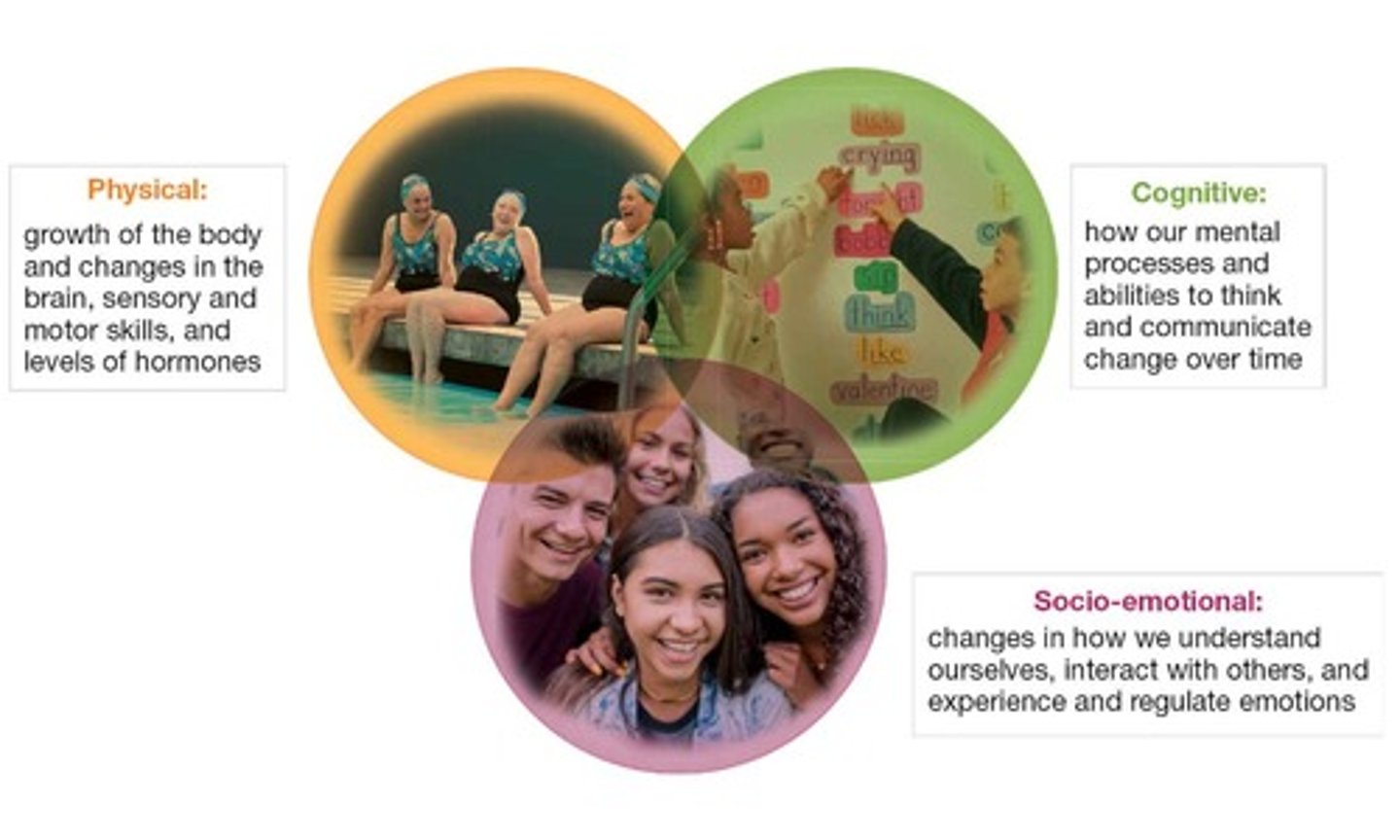
three domains of human development
Physical depicts:growth of the body and changes in the brain, sensory and motor skills, and levels of hormones.
Cognitive depicts:how our mental processes and abilities to think and communicate change over time.
Socio-emotional depicts:changes in how we understand ourselves, interact with others, and experience and regulate emotions.
teratogens and how they influence prenatal development
Environmental substances that can harm prenatal development.
The impact of each teratogen depends on when exposure occurs, the amount of exposure, and how long it lasts during prenatal development.
The physical impact of some teratogens can be obvious at birth. However, some teratogens have effects that are not apparent until the child is much older.
These effects include disorders involving language, reasoning, attention, social behavior, and/or emotions.
There are no standards about how much exposure to any teratogen is safe for healthy development. Even small exposure to some teratogens can have major effects.
attachment
An enduring emotional connection that can motivate care, protection, and social support.
secure attachment
The attachment style for infants who are confident enough to play in an unfamiliar environment as long as the caregiver is present and who are readily comforted by the return of the caregive
ambivalent attachment
The attachment style for infants who seem to have mixed feelings about the caregiver—they cry when the caregiver leaves the room, but they both seek out and reject the caregiver upon the caregiver's return.
avoidant attachment
The attachment style for infants who do not look at the caregiver when the caregiver leaves or returns and who play happily with the stranger in the caregiver's absence.
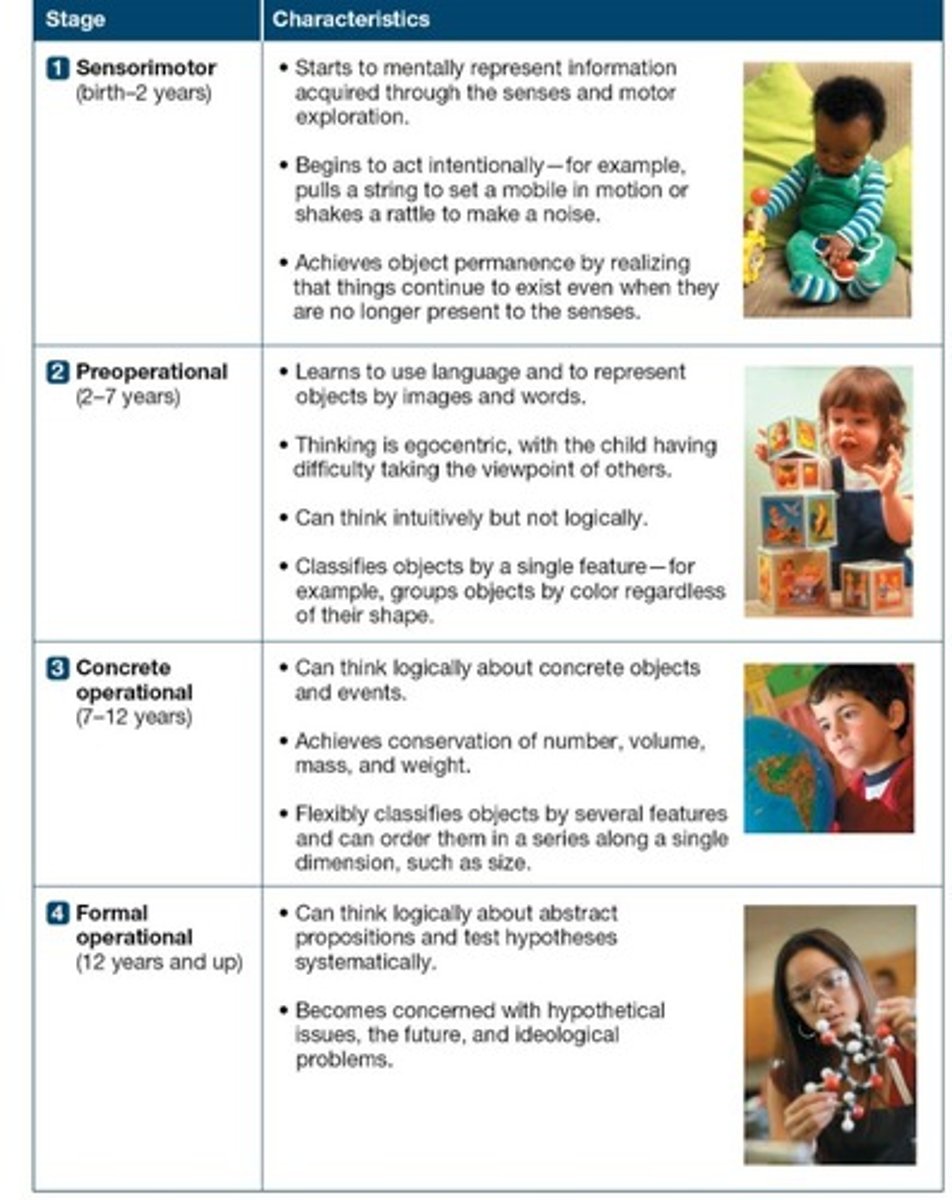
four stages of cognitive development (piaget)
1. sensorimotor
2. preoperational
3. concrete operational
4. formal operational
sensorimotor stage
The first stage in Piaget's theory of cognitive development; during this stage, infants acquire information about the world through their senses and motor skills.
preoperational stage
The second stage in Piaget's theory of cognitive development; during this stage, children think symbolically about objects, but they reason based on intuition and superficial appearances rather than logic.
concrete operational stage
The third stage in Piaget's theory of cognitive development; during this stage, children begin to think about and understand logical operations, and they are no longer fooled by appearances.
formal operational stage
The fourth and final stage in Piaget's theory of cognitive development; during this stage, people can think abstractly, and they can formulate and test hypotheses through logic.
object permanence
the understanding that an object continues to exist even when it is hidden from view.
According to Piaget, a child's full comprehension of object permanence is one key accomplishment of the sensorimotor period.
principle/law of conservation
law of conservation. This law states that even if the appearance of a substance changes in one dimension, the properties of that substance remain unchanged.
Piaget believed that humans do not develop logic until they begin to think about and understand operations. A classic operation is an action that can be undone (preoperational)
Egocentrism
Another cognitive characteristic of the preoperational period is egocentrism.
Preoperational thinkers generally view the world through their own experiences.
Their thought processes tend to revolve around their own perspectives.
Abstract Thinking
Piaget's final stage of cognitive development is the formal operational stage.
During this stage, people can reason in sophisticated, abstract ways.
Formal operations involve critical thinking, such as the ability to form a hypothesis about something and test the hypothesis through logic.
Critical thinking also involves using information to systematically find answers to problems
Amygdala in adolescent development
(The "Emotional Driver")
Rapid Development: Matures earlier, making it highly active during teen years.
Emotional Processing: Responsible for intense emotions, emotional reactivity, and processing potential threats or fear.
Reward Seeking: Fuels the desire for immediate gratification, thrill-seeking, and risky choices (e.g., substance use).
Social Focus: Plays a key role in social interaction and reading emotions.
Prefrontal Cortex in Adolescent Development
(The "Rational Regulator")
Delayed Maturation: Continues developing until the mid-20s, acting as the "brake" on impulsive behavior.
Executive Function: Manages long-term planning, decision-making, judgment, and impulse control.
Top-Down Control: Responsible for inhibiting inappropriate actions initiated by the limbic system.
Erikson's Eight Stages of Psychosocial Development
1. Basic trust versus basis mistrust (birth to 18 months)
2. Autonomy versus shame/doubt (18 months to 3 years)
3. Initiative versus guilt (3 to 6 years)
4. Industry versus inferiority (6 to 12 years)
5. Identity versus role confusion (adolescence)
6. Intimacy versus isolation (young adulthood)
7. Generativity versus stagnation (middle adulthood)
8. Ego integrity versus despair (late adulthood)
infancy
0-2
Trust versus mistrust
Children learn that the world is safe and that people are loving and reliable.
toddler
2-3
Autonomy versus shame and doubt
Encouraged to explore the environment, children gain feelings of independence and positive self-esteem.
preschool
4-6
Initiative versus guilt
Children develop a sense of purpose by taking on responsibilities, but they also develop the capacity to feel guilty for misdeeds.
Childhood
7-12
industry versus inferiority
By working successfully with others and assessing how others view them, children learn to feel competent.
Adolescence
13-19
Identity versus role confusion
By exploring different social roles, adolescents develop a sense of identity.
Young adulthood
20s
Intimacy versus isolation
Young adults gain the ability to commit to long-term relationships.
Middle adulthood
30s to 50s
Generativity versus stagnation
Adults gain a sense that they are leaving behind a positive legacy and caring for future generations.
old age
60s and beyond
Integrity versus despair
Older adults feel a sense of satisfaction that they have lived a good life and developed wisdom.