Occlusion I - Alignment and Occlusion of Dentition
 Call Kai
 Learn
Learn Practice Test
 Spaced Repetition
 Match
Match Flashcards
 Knowt Play
1/67

There's no tags or description
Looks like no tags are added yet.
Name | Mastery | Learn | Test | Matching | Spaced | Call with Kai |
|---|
No analytics yet
Send a link to your students to track their progress
68 Terms
What are factors that affect tooth positions?
surrounding musculature, oral habits involving extra-oral objects, tooth contacts
Which of the following is not a factor or force that determines tooth position?
A) muscles
B) tooth size/arch length ratio
C) tooth contacts
D) oral habits with external objects
E) none of the above
E) none of the above
What is neutral position?
tooth position in the oral cavity where labiolingual and buccolingual forces are equal
What happens when there is inadequate space for teeth in the dental arch?
A) supraeruption
B) teeth fall out
C) crowding
C) crowding
What conditions occurs when an overactive or enlarged tongue displaces the neural zone labially and/or buccally?
A) crowding
B) anterior open bite
C) posterior open bite
D) closed bite
B) anterior open bite
True/False: thumb-sucking has no effect on neutral position
False
What is mesial drift?
movement of teeth toward the midline
True/False: proximal contacts maintain tooth alignment
True
True/False: mesial drift maintains proximal contact
True
A patient loses tooth #28 due to trauma. What will happen to tooth #29?
A) supraeruption
B) mesial drift
C) lateral drift
D) tooth resorption
B) mesial drift
True/False: occlusal contact prevents teeth from continuing to erupt
True
A patient loses tooth #2. What will most likely happen to tooth #31?
A) supraeruption
B) mesial drift
C) lateral drift
D) tooth resorption
A) supraeruption
Define intra-arch alignment
the normal relationship of the teeth as they are aligned within each dental arch
When viewed from the lateral view, the plane of occlusion in the mandible is
A) concave
B) called the curve of Wilson
C) called the curve of Spee
D) A and B
E) A and C
E) A and C
When viewed from the frontal view, the plane of occlusion in the mandible is
A) concave
B) called the curve of Wilson
C) called the curve of Spee
D) A and B
E) A and C
D) A and B
What is the plane of occlusion?
average plane established by the incisal and occlusal surfaces of the teeth
Why does the plane of curvature exhibit curvature?
teeth inclinations
The inclination of the mandibular arch is
A) anterior teeth are mesially inclined
B) posterior teeth are mesially inclined
C) anterior teeth are distally inclined
D) posterior teeth are distally inclined
E) A and B
F) C and D
G) none of the above
E) A and B
The inclination of the maxillary arch is
A) anterior teeth are mesially inclined
B) posterior teeth are mesially inclined
C) anterior teeth are distally inclined
D) posterior teeth are distally inclined
E) A and B
F) A and D
G) B and C
F) A and D
True/False: posterior teeth in the maxillary arch have a slight lingual inclination
False
True/False: posterior teeth in the mandibular arch have a slight lingual inclination
True
The combination of the curve of Spee and curve of Wilson results in what?
Monson sphere
The occlusal table makes up what percent of the total buccolingual width?
A) 40-50%
B) 50-60%
C) 60-70%
D) 100% - the occlusal table is the total buccolingual width
B) 50-60%
Define the occlusal table
area within the perimeter of cusp tips and marginal ridges
What is the outer incline?
A) cusp tip to buccal or lingual height of contour
B) cusp tip to central fossa
A) cusp tip to buccal or lingual height of contour
What is the inner incline ?
A) cusp tip to buccal or lingual height of contour
B) cusp tip to central fossa
B) cusp tip to central fossa
What are the inclines called on either side of a cusp tip?
A) buccal and lingual inclines
B) mesial and distal inclines
C) facial and lingual inclines
B) mesial and distal inclines
Define inter-arch alignment
normal relationship of maxillary and mandibular arches to each other when brought into occlusion
What is the average maxillary arch length?
A) 125 mm
B) 126 mm
C) 127 mm
D) 128 mm
D) 128 mm
What is the average mandibular arch length?
A) 125 mm
B) 126 mm
C) 127 mm
D) 128 mm
B) 126 mm
Mandibular buccal cusps occlude in maxillary:
A) maxillary mesial marginal ridges
B) maxillary distal marginal ridges
C) maxillary triangular ridges
D) central fossa areas
D) central fossa areas
Maxillary lingual cusps occlude in mandibular
A) interproximal spaces
B) facial embrasure
C) central fossa
area
D) marginal ridges
C) central fossae area
True/False: in a normal interarch relationship, the maxillary teeth should overlap the mandibular teeth
True
What is the term form when the mandibular arch overlaps the maxillary arch (the maxillary arch is smaller than the mandibular arch)?
A) anterior open bite
B) posterior open bite
C) posterior cross bite
D) anterior cross bite
C) posterior cross bite
Maxillary lingual and mandibular buccal cusps are called everything EXCEPT
A) centric
B) noncentric
C) supporting
D) functional
B) noncentric
Maxillary buccal and mandibular lingual cusps are called everything except
A) noncentric
B) centric
C) nonsupporting
D) nonfunctional
B) centric
True/False: centric cusps occlude with the opposing central grooves (fossae or marginal ridges)
True
All of the following are major roles of the centric cusps EXCEPT one. Which one is the exception?
A) maintains vertical dimension of occlusion
B) mastication
C) prevents tissue impairment
C) prevents tissue impairment
All of the following are functions of the noncentric cusps EXCEPT one. Which one is the exception?
A) prevents tissue impairment
B) maintains bolus of food on occlusal table
C) helps guide mandible into maximum ICP
D) maintains vertical dimension of occlusion
D) maintains vertical dimension of occlusion
The centric cusps are located
A) 1/2 into B-L width of tooth
B) 1/4 into B-L width of tooth
C) 1/3 into B-L width of tooth
D) 1/6 into B-L width of tooth
C) 1/3 into B-L width of tooth
Noncentric cusps are located
A) 1/2 into B-L width of tooth
B) 1/4 into B-L width of tooth
C) 1/3 into B-L width of tooth
D) 1/6 into B-L width of tooth
D) 1/6 into width of tooth
What is the buccolingual occlusal line?
A) buccal cusps of mandibular teeth line up with each other
B) lingual cusps of maxillary teeth line up with each other
C) line connecting central fossa of teeth
A) buccal cusps of mandibular teeth line up with each other
What is the lingual occlusal line?
A) buccal cusps of mandibular teeth line up with each other
B) lingual cusps of maxillary teeth line up with each other
C) line connecting central fossa of teeth
B) lingual cusps of maxillary teeth line up with each other
What is the central fossa line?
A) buccal cusps of mandibular teeth line up with each other
B) lingual cusps of maxillary teeth line up with each other
C) line connecting central fossa of teeth
C) line connecting central fossa of teeth
True/False: proximal contacts are slightly lingual to the central fossa line
False
True/False: the lingual embrasures are bigger than the facial embrasures
True
What areas can centric cusps contact?
fossa areas, marginal ridges, embrasures
True/False: the mandibular central incisors contact 2 opposing teeth
False
True/False: all teeth except the mandibular central incisors and maxillary third molars contact 2 opposing teeth
True
Identify the class:
- MB cusp of mandibular 1st molar occludes in the embrasure area between the maxillary 2nd premolar and 1st molar
- MB cusp of maxillary 1st molar is aligned with the B groove of the mandibular 1st molar
A) class I
B) class II
C) class III
A) class I
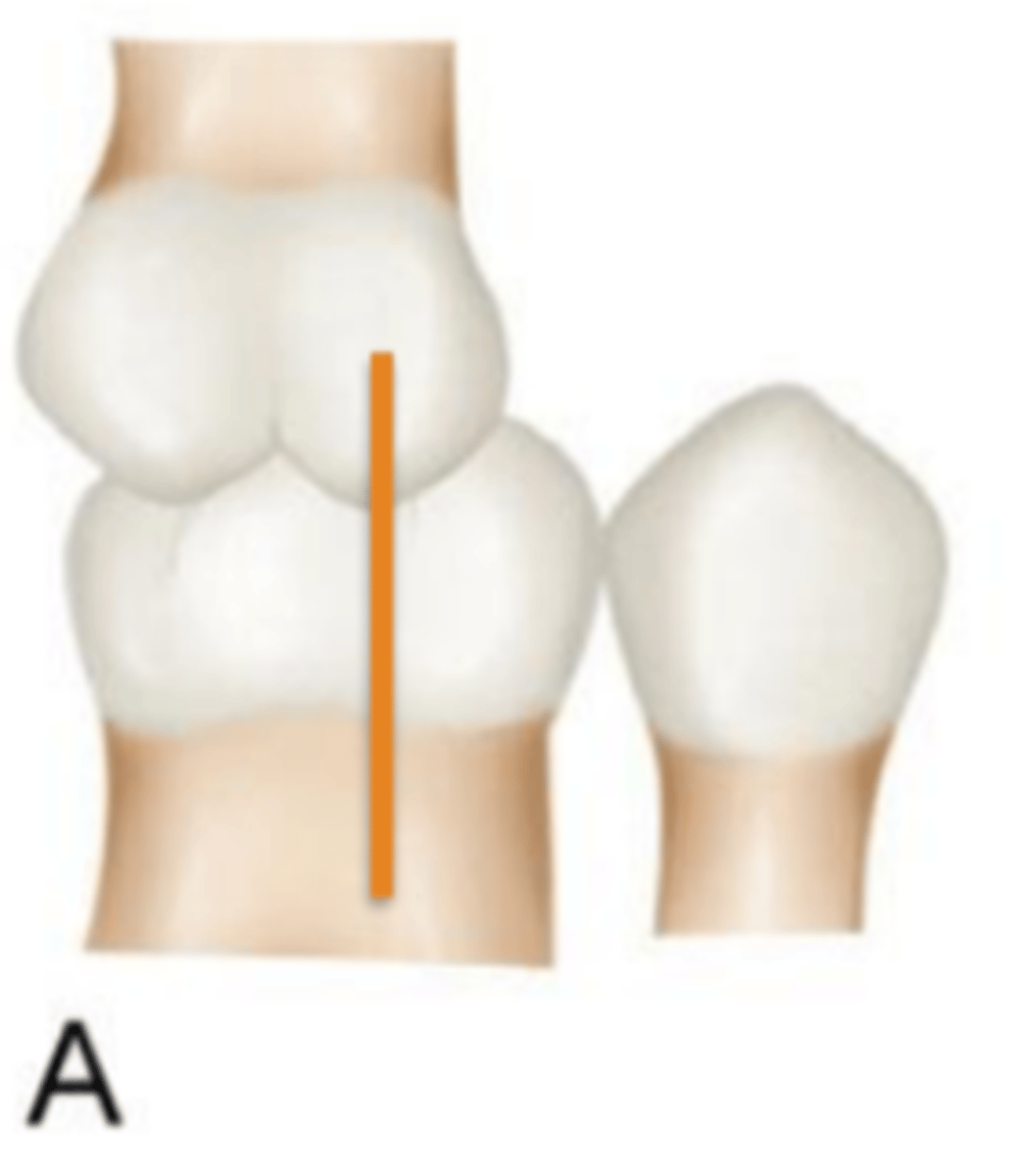
Identify the class:
- maxillary arch is large and/or positioned anteriorly
- MB cusp of mandibular 1st molar occludes in the central fossa area of the maxillary 1st molar
A) class I
B) class II
C) class III
B) class II
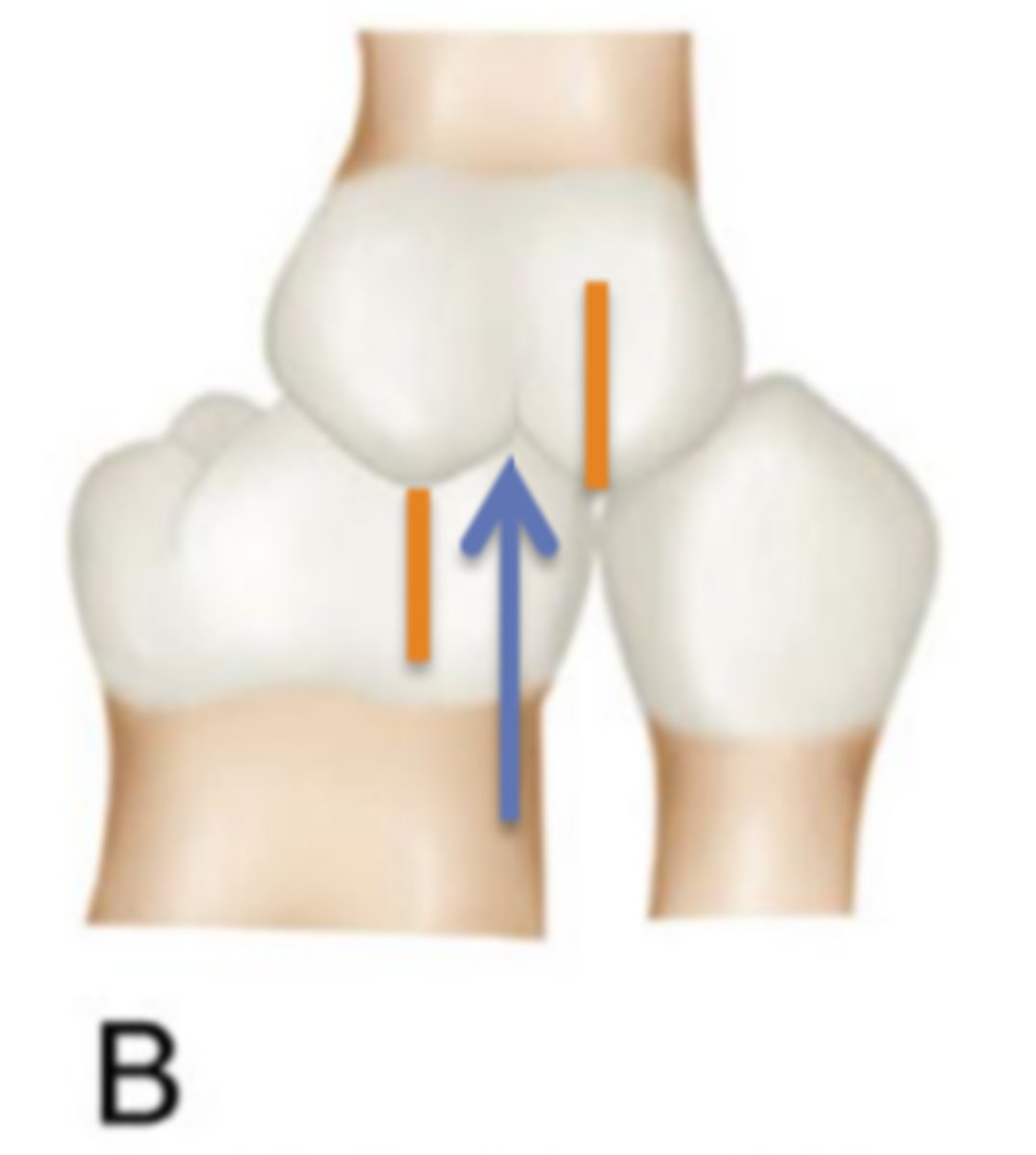
Identify the class:
- maxillary MB commonly located in embrasure between 1st and 2nd molar
- each occlusal contact is located mesial compared to class I
A) class I
B) class II
C) class III
C) class III
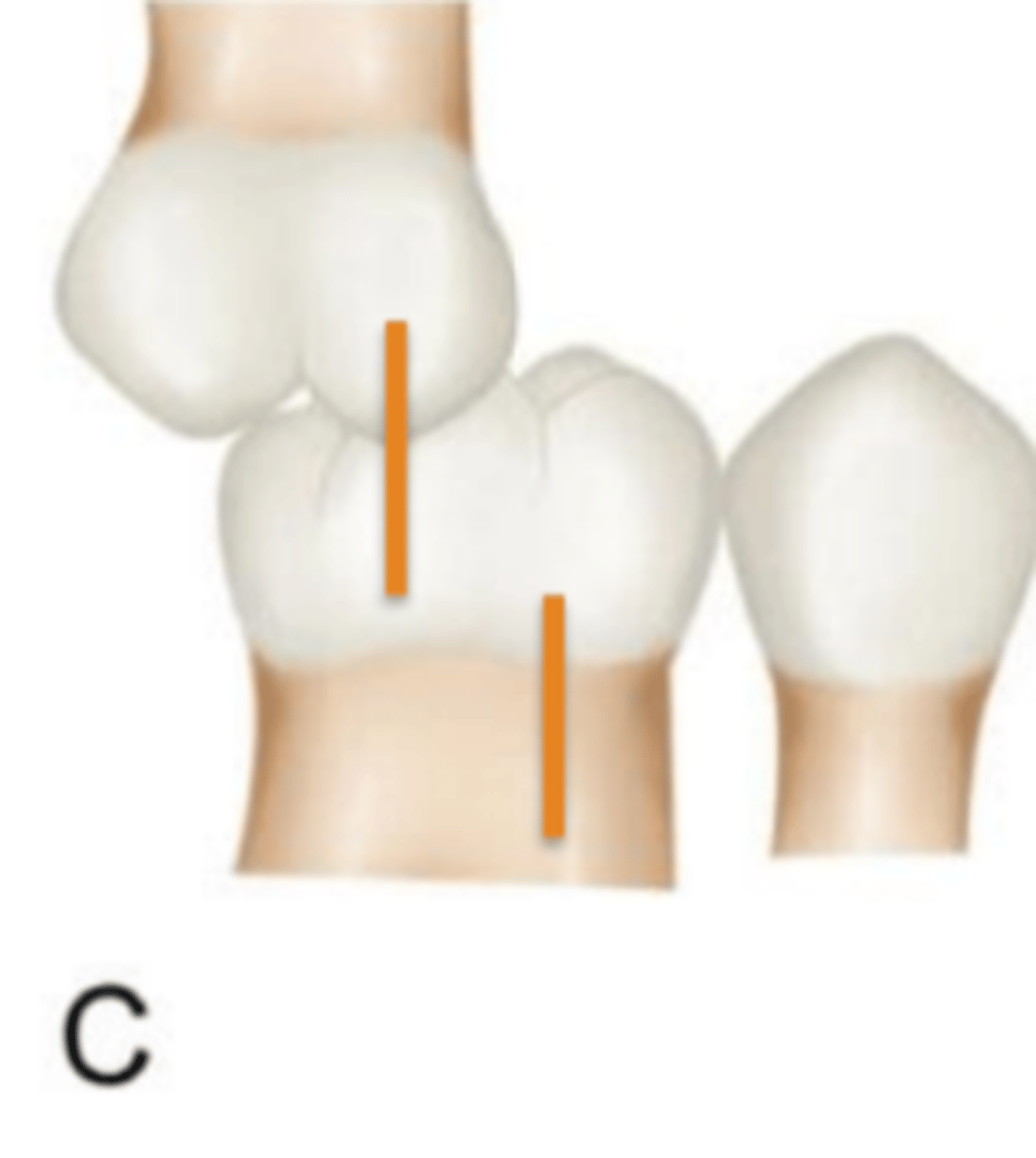
What are class II and III tendencies?
not class I and not extreme to satisfy class II or III
True/False: posterior teeth serve as guiding teeth
False
What is vertical overlap?
height of overlap of maxillary teeth over mandibular teeth
What is the average height of overlap?
1/2 lower incisor length (3-5 mm)
What is horizontal overlap/overjet?
distance of how far forward maxillary teeth are compared to mandibular teeth (~2 mm)
What is Class II, division I?
A) class II molar retention w/ normal labial inclination of incisors
B) class II molars relation with lingual inclination of the incisors
A) class II molar retention w/ normal labial inclination of incisors
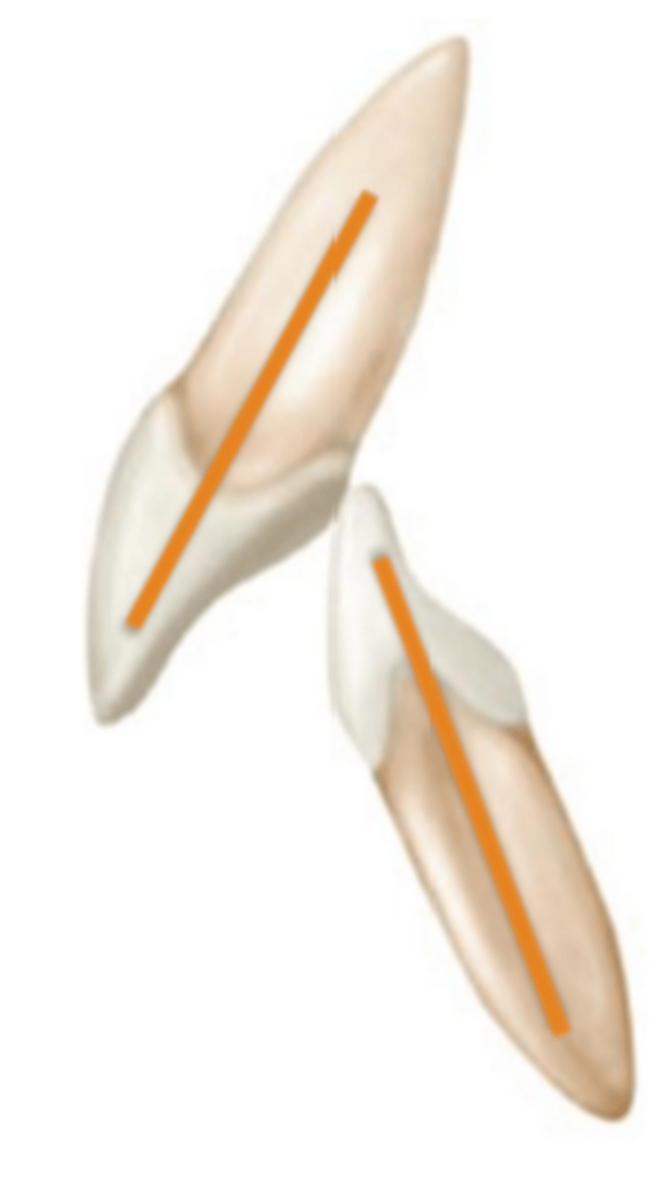
What is Class II, division II?
A) class II molar retention w/ normal labial inclination of incisors
B) class II molars relation with lingual inclination of the incisors
B) class II molars relation with lingual inclination of the incisors
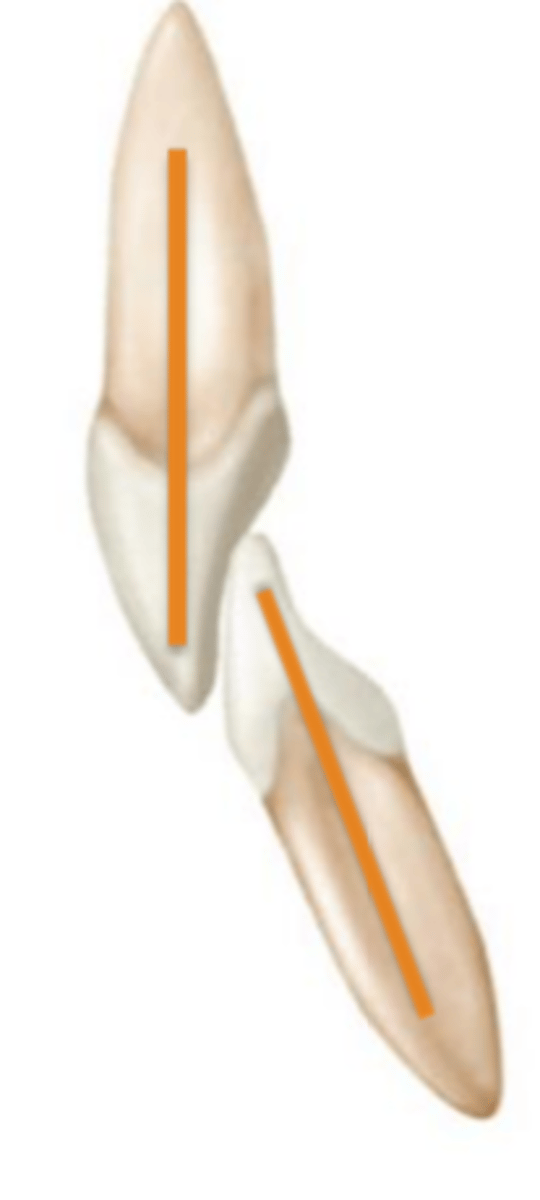
What is class III: end-to-end?
A) class II molar retention w/ normal labial inclination of incisors
B) class II molars relation with lingual inclination of the incisors
C) mandibular incisal edges occlude with maxillary incisal edges
C) mandibular incisal edges occlude with maxillary incisal edges
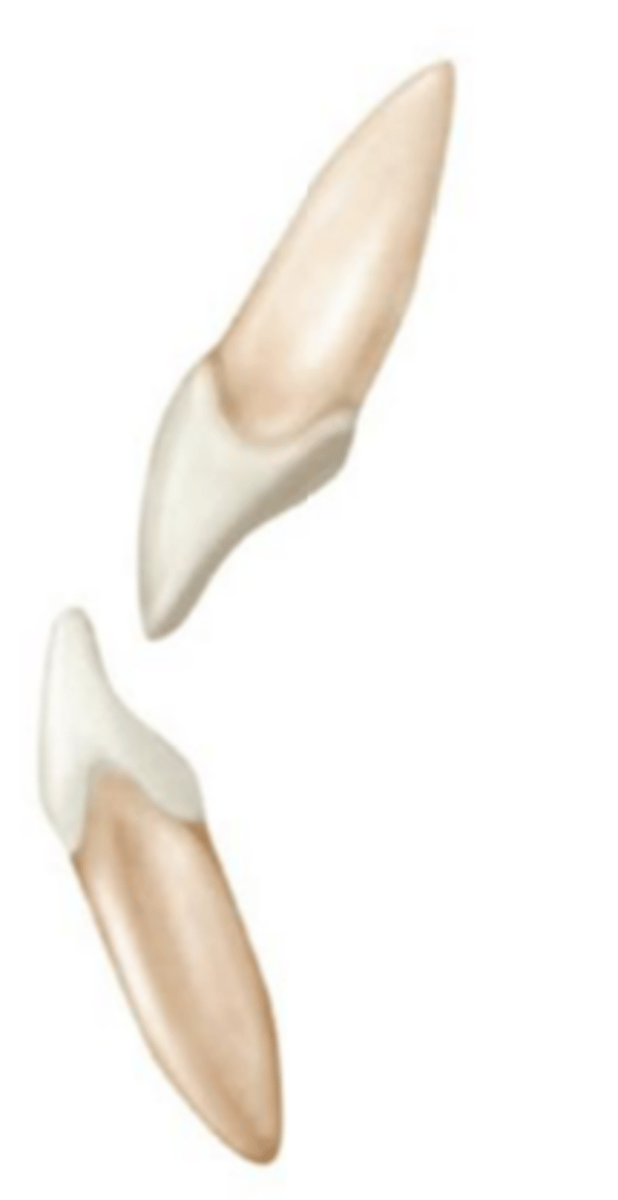
What are the three planes of mandibular movement?
sagittal, frontal, horizontal
What are the three types of eccentric movements of the mandible?
protrusive, laterotrusive, retrusive
What is protrusion?
A) mandible moves froward
B) right and left posterior mandibular teeth pass opposing teeth in different directions
C) mandible moves posteriorly from ICP
A) mandible moves forward
What is laterotrusion?
A) mandible moves froward
B) right and left posterior mandibular teeth pass opposing teeth in different directions
C) mandible moves posteriorly from ICP
B) right and left posterior mandibular teeth pass opposing teeth in different directions
What is retrusion?
A) mandible moves froward
B) right and left posterior mandibular teeth pass opposing teeth in different directions
C) mandible moves posteriorly from ICP
C) mandible moves posteriorly from ICP
What are functions of anterior teeth?
guidance, incising food, speech, lip support, esthetics
True/False: laterotrusion has more potential tooth contacts
True
Mediotrusion has what type of contacts?
balancing contacts