psychology
 Call Kai
 Learn
Learn Practice Test
 Spaced Repetition
 Match
Match Flashcards
 Knowt Play
1/25

Earn XP
Description and Tags
- Process - Performance - Outcome - Short and Long Term
Name | Mastery | Learn | Test | Matching | Spaced | Call with Kai |
|---|
No analytics yet
Send a link to your students to track their progress
26 Terms
Benefits of goal setting
Goals enhance focus & concentration
- Goals boost self-confidence
- Goals help create a positive mental attitude
- Goals increase intrinsic motivation to excel
- Goals improve the quality of practices by making training more challenging
- Goals enhance playing skill, techniques and strategies
- Goals improve overall performance
Outcome goals
Typically focus on a competetive result of an event (end results, times).
Can be hard to achieve as they are linked to factors the athlete can’t control. (performance of others).
E.g. finishing top 5 in a marathon.
Performance goals
Focus on achieving standards or performance objectives independently of other competitors.
Usually based off of comparisons with ones previous performances.
e.g. improving basketball free throw % from 35-40%.
Process goals
Focus on actions (physical movement or game stratergies) that athletes must perform during a competition to reach peak performance.
They provide the means to improve our performance and take us to a level which may well see us achieive a desired result.
Are stepping stones which the athlete will follow to improve performance. (provide structure for training sets, sessions, year, career.)
E.g. an athlete using a trigger word which instantly refocuses the athletes concentration to the action required.
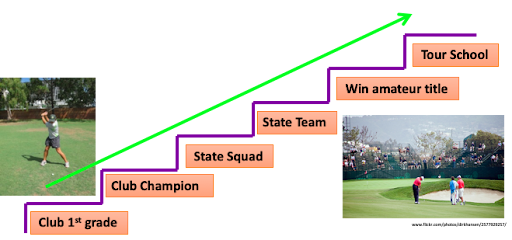
Stepping stone model of short and long term goals
Short term goals help you attain long term goals. help you maintain focus on long term goals.
Long term goals are achievable by attaining short term goals and over a long period of time.
SMARTER
Specific
- Measurable
- Achievable or Action oriented or Agreed or Accepted
- Realistic
- Time framed or phased
- Evaluate or Exciting
- Recorded or Reviewed
Types of Anxiety
- Competitive Anxiety/ State Anxiety / Trait Anxiety
- Choking
Symptoms of anxiety
- Psychological (behavioural changes, emotional responses & cognitive functioning)
- Physiological changes (somatic)
Competition anxiety
can cause athletes to react both physically (somatic) and mentally (cognitive) in a manner which can negatively affect their performance.
State anxiety
The anxiety inherent in a situation as perceived by the participant.
e.g. skydiving= immediate fear.
Trait anxiety
The anxiety of our personality or an underlying disposition to certain levels of anxiety given in a particular situation.
Arousal
Arousal can simply be thought of as the amount of readiness or activation a person experiences when faced with a task.
Optimally aroused performer
attends to only relevant stimuli in the environment and can shift their attention quickly to meet the needs of the situation.
Under aroused performer
Lacks the intensity to attend to all the relevant stimuli in the environment and their attention is focused on other non relevant thoughts which detracts from their performance.
e.g. a bored slips fielder thinking about going clubbing after the game, is probably going to drop the next catch.
Over aroused performer
Has a decreased ability to shift their attention focus.
Athletes in this state often have narrow internally focused attention, therefore can miss important cues in the environment.
e.g doesn’t spot an unmarked player in a scoring position.
Self efficacy
Is the situation form of self confidence or the belief that one is confident and can perform within a specific situation. Thus task specific efficacy relates to confidence that individuals have in their ability to perform components of a specific task.
Motivation
Is the direction and intensity of ones efforts.
Types of motivation
Positive motivation
Intrinsic motivation
Extrinsic motivation
Negative motivation
Amotivation
Flow state
Positive motivation
people to do their best to improve their performance. Should be displayed after the desired behaviour.
Social reinforcers: Smile, praise.
material reinforcers: trophies, medals
Activity reinforcers: games instead of drills at training.
Intrinsic- self motivated
Intrinsic motivation is usually in the form of satisfaction from doing something well, feeling proud about what you have achieved and enjoying the activity for what it is.
Intrinsic motivation comes from within, is fully self-determined and characterised by interest in, and enjoyment derived from, sports participation.
Extrinsic motivation
Extrinsic – Motivation which is driven externally or extrinsically.
Extrinsic motivation is usually in the form of reward or recognition for performance. It could be money, a trophy, and a medal or TV interview.
Usually result driven, and doesn’t really consider the process .
Negative motivation
aims to control the negative efforts of an activity. Seeks a sense of fear in the athlete. Imposed after an undesirable behaviour. Making them do push ups, demoted of a grade, criticism.
Include making the athlete perform sit-ups or star jumps as punishment for an incorrect move during training, disapproving comments or rebukes, and demotion in grade.
Typically work for short term. But long term they backfire.
Flow state
The highest level of intrinsic motivation is flow state
Flow is characterised by complete immersion in an activity, to the degree that nothing else matters.
Central to the attainment of flow is a situation in which there is a perfect match between the perceived demands of an activity and an athlete’s perceived ability or skills.
Amotivation
represents a lack of intention to engage in a behaviour. It is accompanied by feelings of incompetence and a lack of connection between one’s behaviour and the expected outcome.
Inverted U hypothesis
This theory states that as arousal increases so too will the quality of performance until arousal passes beyond an optimal level. Beyond this optimal range of arousal performance will diminish.