Final practice percept & cogn
 Call Kai
 Learn
Learn Practice Test
 Spaced Repetition
 Match
Match Flashcards
 Knowt Play
1/32

There's no tags or description
Looks like no tags are added yet.
Name | Mastery | Learn | Test | Matching | Spaced | Call with Kai |
|---|
No analytics yet
Send a link to your students to track their progress
33 Terms
What does electromagnetic frequency and amplitude mean?
frequency : hue
amplitude/intensity : brightness
Opponent process colour theory
we perceive colour in opposing processing pairs - like tug of war
ex: red suppresses green, blue suppresses yellow
colour processed in relation to each other
red, green, blue. cones. LGN processes it into opposing colour pairs AFTER LEAVING THE RETINA
comes up in colour blindness (red/green). also comes up in artists for striking colour combos. fatiguing the cones can create opposite images on your retina
Trichromatic colour theory
Young-Helmholtz theory
we must have receptors which respond to shorter wavelengths, medium and for longer (blue, green, red) BEFORE LEAVING RETINA
the cones overlap btw in what they can perceive
see how this impacts colour blindness - we can see
Muller’s doctrine
sensory pathway determines nature of perception. it is the neural code that is sent which is important
origin of sensory information not important (stimulus)
its all in your head
rods
low res
high sensitivity
black/white
cones
high res
low sensitivity
coloured sight
unconscious inference
describes the unconscious, pre-rational processing of stimuli. reflexive action
we see what we expect to see from past learning
Hermann von Helmholtz
monocular cues
Occlusion or Interposition
Elevation
Relative Size
Linear Perspective
Aerial Perspective (clarity w distance)
Light & Shade
cortical colour blindness
colour blindness caused by damage in ventro-medial occipital and temporal lobes
olfactory pathways
Apperceptive agnosia
failure to
recognize objects, to discriminate
objects, shapes & basic forms
Associative agnosia
failure to link
perception with stored knowledge
Gestalt laws
The whole is greater than the sum of all its parts
1. Proximity
2. Similarity
3. Good Continuation
4. Closure
5. Common Fate
structuralism
We see whole objects
by combining elementary sensations
size constancy
Our perception of the size of objects is
relatively constant (& veridical) despite the fact
that the size of objects on the retina vary
greatly with distance.
• Our perception of size involves estimate of
distance
•When our perception of distance is erroneous,
size constancy breaks down
•This is illustrated in bad photography & in two
famous illusions, the moon illusion & the Ames
room illusion
what information can skin cells give us?
nociception
temperature
pressure
What information active touch gives us
texture
size
shape
??
what part of body has highest spatial resolution?
fingertips
Ian Waterman
no proprioception head down
What do clinical cases suggest
about object & face recognition?
Separate stages of processing
(1) one in which we process the elements or parts
of an object
(2) one in which we process the whole structure
• First stage occurs in early visual processing
(occipital cortex)
Feature Detection Models
Selfridge (1959)
image demons. take in raw visual input
feature demons. detect specific components of visual information
cognitive demons. interpret signals and assign them meaning related to previous knowledge
decision demons. make final decision about what the stimulus is
What is colour for?
Scene Segmentation
camouflage
perceptual organisation
neuro-methods pros cons
CT, PET, MRI and fMRI: highest spatial, low temporal
EEG: high temporal, low spatial (lower than fMRI)
MEG: high temporal, good spatial (lower than fmri)
ERP: high temp, low spatial? (lower than fMRI)
TMS: high temp, high spatial, high interference
Pros of single-case methodology
allows for identification of the function of certain brain areas both through lesion and indepentently preserved areas
dual task paradigm
behavioral procedure in which subjects are required to perform two different tasks simultaneously.
AB on neural
Early Perception/Attention: (P1, N1) not modulated by reported visibilit
Categorization (N2) and Semantic Processing (N4) are linearly related to visibility
Working Memory update (N3, P3a,b) shows the “all-or-nothing” pattern of the AB, i.e. access to Global Workspace and awareness
Episodic buffer function
- Integrates information from PL and VSS into a coherent rich MULTIMODAL
representation.
- Includes “chunking” based on LTM (what forms a single entry in STM?).
- Accounts for awareness Baddeley (2003): equivalent with the concept
of a GW for aware processing (e.g. Dehaene et al., 1998, 2003, 2006)
rao et al 1997
Stimulus-specific neural populations in PFC = objects vs locations?
BUT: neurons changed their response preferences when the task changed = can be easily “re-trained” Goes against innate, hard-wired preferences
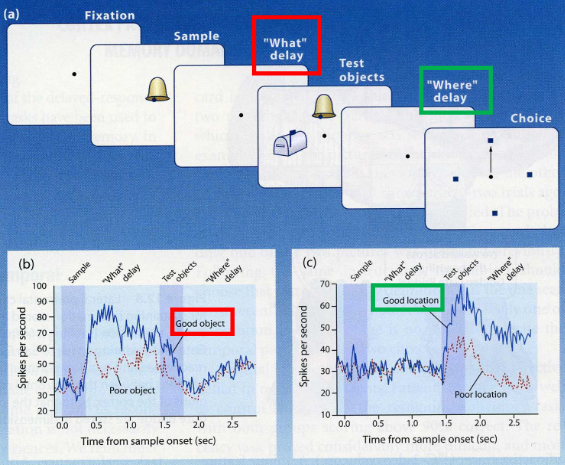
Goldman-Rakic (1987; 1989), Fuster (1989)
: single cell recordings in monkey’s PFC
Goldman-Rakic (1996) argued for
• A division between the content of information
processed in dorsolateral and ventrolateral regions
D’Esposito et al., 2000
Dorsolateral: compensate capacity limitations during encoding, manipulation during delay, scanning memory during recall
ventrolaterall: PFC related to maintenance and to control of interference during recall
Petrides PFC and posterior
PFC: DLPFC - manipulate and monitor. VLPFC - maintain activity, retrieve info
posterior cortex: storage site of info
Tomita et al. (1999)
Top-down activation of object representations via PFC in
Tomita et al - conforming to Petrides’ view
sever first POSTERIOR corpus callosum (still other pathways between hemispheres). cuts hemispherical visual processing
patterns are activated top-down via the still intact connection between the two PFCs instead
slightly slower than standard (bottom-up) processing found in posterior corpus callosum
complete corpus callosum severing —) no PFC connection
top-down activity was what was activating it