D1.3 Mutation and Gene Editing
 Call Kai
 Learn
Learn Practice Test
 Spaced Repetition
 Match
Match Flashcards
 Knowt Play
1/16

There's no tags or description
Looks like no tags are added yet.
Name | Mastery | Learn | Test | Matching | Spaced | Call with Kai | Chat |
|---|
No analytics yet
Send a link to your students to track their progress
17 Terms
Mutation Definition
A mutation occurs when the sequence of DNA bases is altered.
3 main types of gene mutation
Substitution: SNPs (single-nucleotide polymorphisms)
one base in coding sequence is replaced by another.
can happen by chemical changes to bases or by mispairing during replication.
Insertion:
a nucleotide is inserted, so extra base in the sequence.
more major as a break is needed in the sugar phosphate backbone.
Deletion:
a nucleotide is removed so there is one less base in the sequence.
this requires two breaks in the backbone.
Mutation is good?
mutation drive the exposure of new alleles to help with variation and evolution
Consequences of base substitution:
Mutations become most significant if they cause a frameshift.
Same-sense
Nonsense
Mis-sense
Mostly neutral or deleterious and in some cases lethal. In non-coding DNA, they are unlikely to have any effect – only changes to coding sequences can affect amino acid sequences of polypeptides
Same-sense
Same-sense mutations change one codon for an amino acid into another codon for same amino acid. Possible due to redundancy of genetic code. Eg. a change from AGC to AGT still codes for serine. No effect on phenotype
Nonsense
Nonsense mutation change a codon for an amino acid into a stop codon (ATT, ATC or ACT). So translation is terminated before polypeptide is complete. Doesn’t function properly.
Mis-sense
Mis-sense mutations alter one amino acid in the sequence in a polypeptide. May not have much effect if new amino acid has similar structure + chemical prop. But can be lethal, cause of many genetic diseases like sickle cell
Mis-sense further info
When DNA from individual humans is sequenced, large numbers of historical base substitutions are found.
Known as single-nucleotide polymorphisms (SNPs).
Can occur in non-coding regions of DNA.
Presence of some SNPs is associated with certain diseases.
These correlations allow scientists to determine an individual’s genetic predisposition to developing a disease.
Consequences of Insertions and Deletions
Major insertions and deletions almost always result in a functionless polypeptide.
Minor insertions and deletions (one or two nucleotides) can have the same result.
They are frameshift mutations – they change the reading frame of every codon from the mutation onwards. (→)
Causes of Gene Mutation
Increased risk during DNA replication, when base-pairing errors are sometimes made and not corrected by DNA repair.
Radiation:
- increases rate if it has enough energy to chemically
change DNA
- alpha particles, gamma rays, x-rays & UV are mutagenic.
Chemical:
- chemical substances can cause chemical changes to DNA
- eg. polycyclic aromatic hydrocarbons & nitrosamines.
Randomness in Mutation
Unpredictable and cannot be directed by living organisms to achieve an intended outcome.
Mutations can occur anywhere in a genome’s base sequence, although some bases have a higher probability of mutating than others.
This is because some chemical changes happen more easily.
Effects of a mutation in a somatic cell may be tested when the gene is expressed, but it is eliminated when cell dies.
Traits due to mutations acquired during a lifetime which prove to be beneficial cannot be inherited by offspring.
This helps to explain how evolutionary change occurs.
Consequences of mutation in germ & somatic cells:
Germ cells give rise to gametes, so genes in germ cells can be passed to offspring.
So, a new allele, produced by a mutation in a germ cell, can be inherited.
causes a genetic disease.
important to minimise mutation in germ cells
Mutations in somatic cells are eliminated when the individual dies, so consequences are limited.
Mutation as a source of genetic variation:
Allele = variant of a gene.
Mutations change an allele into another allele.
Mutations increase number of alleles, and therefore genetic variation, in a population.
Meiosis and sexual reproduction can increase variation by generating new combinations of alleles, but mutation is the original source of all genetic variation.
Most mutations are either neutral or harmful however mutation is needed in all species.
Natural selection requires genetic variation, so species cannot evolve without it.
Gene Knockout
Gene knockout = technique used to investigate function of a gene by changing it to make it inoperative.#
Method:
Prepare DNA with a base sequence that allows it to be
inserted into genome of embryonic mouse cells as a
replacement for a target gene, which is deleted.
(2) Select successful cells and grow into adults – these will
only have one copy of target gene.
(3) Mate males and females – 25% of offspring will have no
copies of target gene, ie. knockout mice.
(4) Investigate phenotype to find out which traits have been
altered.
Use of CRISPR sequences & Cas9 in gene editing:
CRISPR = Clustered, Regularly Interspaced, Short Palindromic Repeats.
Repeats – same base sequence occurs several times.
Short – number of base pairs in repeat is 23 – 47.
Clustered – repeats grouped in one part of genome.
Regularly interspaced – repeats separated by spacers. Each spacer is unique. Derived from viruses and allow viral DNA sequences to be recognised if reinfection occurs.
Palindromic – each repeated sequence has parts which read the same backwards as forwards (dyad symmetry).
Cas9
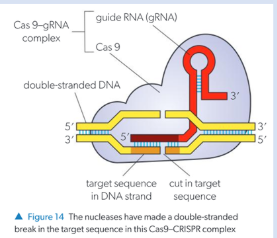
Finds specific base sequences in genome using guide RNA (gRNA) bound to it. Made of a spacer and repeat
Spacer forms a base sequence at 5’ end of gRNA which is complementary to target DNA being searched for.
Repeat forms other parts of gRNA generating loops and distinctive molecular shape that promotes binding to Cas9.
Cas9 moves along DNA molecule, uncoiling it and bringing DNA adjacent to variable base sequence of gRNA.
Cas9 contains two endonucleases - if target sequence is recognised, endonucleases cut one sugar-phosphate bond in each strand forming double-strand break in target DNA.
This how prokaryotes recognise & destroy foreign DNA – especially viral DNA.
Using Cas9-CRISPR in gene editing:
Cas9-CRISPR can be used to find target sequence. It has been modified so that it can also make changes to it.
Prime editing is a promising approach.
Prime editing guide RNA (pegRNA) is prepared.
At 5’ end, it has usual guide sequence transcribed from the spacer in a CRISPR array, along with sequences that allow binding to Cas9.
Two extra sequences are added immediately adjacent to each other at 3’ end: