Biology Final
 Call Kai
 Learn
Learn Practice Test
 Spaced Repetition
 Match
Match Flashcards
 Knowt Play
1/108

There's no tags or description
Looks like no tags are added yet.
Name | Mastery | Learn | Test | Matching | Spaced | Call with Kai |
|---|
No analytics yet
Send a link to your students to track their progress
109 Terms
Which of the following characteristics do viruses share with biological organisms?
ability to evolve, possessing genetic material
Which of the following is a requirement for a good scientific hypothesis?
it must lead to testable predictions
Apply what you have learned about natural selection for variation in fur coat color in a population of beach mice. Which of the following statements is best explained by natural selection?
Lighter coat colors in beach mice evolved to provide camouflage against sandy environments, reducing predation and therefore increasing survival.
Which of the following is not exclusively a characteristic of life?
can respond to natural selection
biology is best defined as…
the study of living, and nearly living, organisms.
An article in the New York Times stated the following: "Scientists have discovered micro-organisms living beneath the ocean floor that appear to have not evolved for more than two billion years, a finding that nonetheless may support the theory of evolution." The lack of evolution of these microorganisms could be caused by
the bacteria’s unchanging environment.
strong evidence in support of the common ancestry of all life comes from which of the following observations about living things?
the existence of a nearly universal genetic code
charles darwin proposed that “descent with modification” resulted when organismsof a particular species became adapted to their environment because they possess which of the following characteristics?
heritable traits that enhance their survival and reproductive success in the local environment.
a rare hair color is caused by a recessive allele with a frequency of 0.02. What proportion of the population would be expected to express this trait, assuming Hardy-Weinberg equillibrium?
1 in 2500
Beak morphology of Darwin’s finches are a Prime example of…
Adaptation
which of the following conditions is not required for a population to be in Hardy-Weinberg equilibrium?
Individual differences in reproductive success.
which of the following must exist in a population before natural selection can act upon that population?
heritable phenotype variation among individuals
individuals that are well adapted to their environment are evolving; true or false?
False
which of the following statements describes an individual that is likely to be most successful in an evolutionary sense?
an organism that dies after five days of life but leaves 10 offspring, all whom survive to reproduce.
which is one of Darwin’s observations and inferences
since resources are finite individuals must compete for these limited resources.
in a large sexually reproducing population of rabbits, a major source of heritable trait variation from one generation to the next arises from…
fertilization
mutations can be
neutral, harmful, or beneficial
which type of selection is most likely responsible when both very small and very large individuals have a survival advantage, but individuals with average traits are selected against?
disruptive selection
a rare recessive hemophilia disease has a prevalence of 1 in every 6667 males in the United States. What is the expected frequency of the hemophilia allele in the population?
0.012
migration can drive the evolution of a population because…
gene flow from new migrants causes allele frequency shifts in the population.
Using the Hardy-Weinberg model, you predict the allele frequencies in population "X". The observed allele frequencies in population "Y" of the same species, is not significantly different from what you predicted in population "X." Which of the following should you conclude?
A particular gene of interest is not undergoing any mechanisms of evolution.
what does the term fitness mean in the context of natural selection?
the genetic contribution of an individual to the future
during a study session about evolution, one of your fellow students remarks, “the giraffe stretched its neck while reaching for higher leaves; its offspring inherited longer necks as a result.” Which statement is most likely to be helpful in correcting this student’s misconception?
characteristics acquired during an organism’s life are not passed on through genes.
A population of field crickets in Pennsylvania have heritable phenotypic variation for a fast and slow chirp song. The frequency of alleles for both chirp types is 0.5. If hurricane Ida hit this population of field crickets and reduced the population by 80% which of the following is most likely over the next 2 generations?
the population may evolve because a population bottleneck will cause chance fluctuations in allele frequencies.
which of the following examples does not provide evidence for the evolutionary patterns of unity and diversity of life?
a male clown fish changes sex when the dominant female dies.
if a researcher is testing whether a population is in Hardy-Weinberg equilibrium, she is trying to…
assess if the evolution is occurring at a particular location in the genome.
humans use artificial selection to alter our crops. which of these examples best shows the connection between artificial and natural selection?
Humans take pollen from male mustard greens with certain traits and fertilized gametes of females with certain traits to produce broccoli, brussels sprouts, and cabbage.
a population of 100 fungi, the frequency of allele A is 0.6. Assuming a Hardy-Weinberg equilibrium, what is the expected frequency of heterozygous individuals (Aa)?
0.48
which scenario is a prezygotic isolating mechanism?
two frog species breed in different seasons.
a river changes course and splits a continuous population into two isolated populations that then diverge. This is allopatric speciation by:
vicariance
reproductive isolation is central to speciation because it:
prevents gene exchange, allowing populations to diverge genetically.
using the morphospecies concept, you would most likely directly test whether a group contains more than one species by:
measuring and comparing consistent physical traits among individuals.
genetic divergence and reproductive isolation are related because:
reproduced gene flow allows divergence; as divergence accumulates, reproductive barriers become stronger.
two closely related plant species flower at different times of year in the same meadow. this is best described as:
temporal isolation (prezygotic)
in sympatric speciation by disruptive selection, gene flow is reduced primarily because:
hybrids have lower fitness, so selection acts against intermediate forms.
under the biological species concept (BSC), a species is best defined as:
a group that can interbreed and produce viable, fertile offspring.
which scenario is a postzygotic isolating mechanism?
Hybrids are viable but infertile.
which organisms do not fit easily into the biological species concept?
asexual bacteria and species known only from fossils
morphospecies often correspond to BSC-defined species because:
if individuals exchange genes, they tend to share many traits and look similar.
a phylogenetic tree is best defined as:
a hypothesis about evolutionary relationships among organisms
two organisms share similar traits, but they don’t share a most recent common ancestor and their closest relatives lack this trait. The similar traits most likely evolved by…
convergent evolution
sister taxa (sister groups) are:
two taxa that share the most recent common ancestor on a tree
A large community of rattlesnakes, from El Paso, Texas, is separated into two groups. One group is taken 46 miles northwest to Las Cruces, New Mexico. The other group goes 712 miles north to Estes Park, Colorado. Which of the following statements is most accurate?
the group moved to estes park will require a series of adaptations to survive the new environment.
A large population of laboratory animals has been allowed to breed randomly for a number of generations. After several generations, 25% of the animals display a recessive trait (aa), the same percentage as at the beginning of the breeding program. The rest of the animals show the dominant phenotype, with heterozygotes indistinguishable from the homozygous dominants. What proportion of the population is probably heterozygous (Aa) for this trait and did the population evolve?
0.50; no
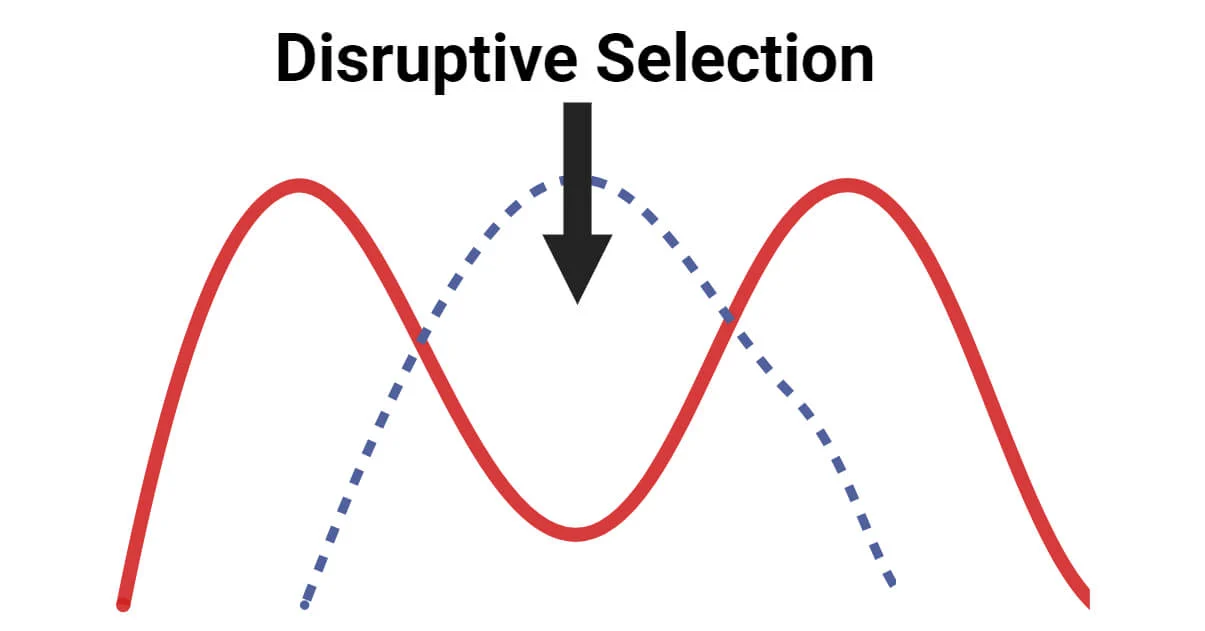
disruptive selection
A type of natural selection that favors extreme phenotypes over intermediate ones, increasing genetic and phenotypic varation.
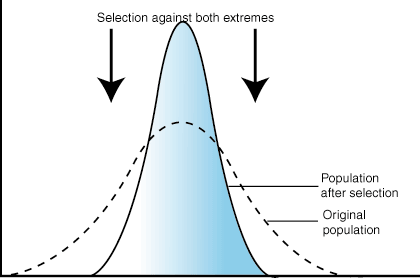
Stabilizing selection
A type of of natural selection that favors average phenotypes rather than extreme variations, reducing genetic diversity within a populations.
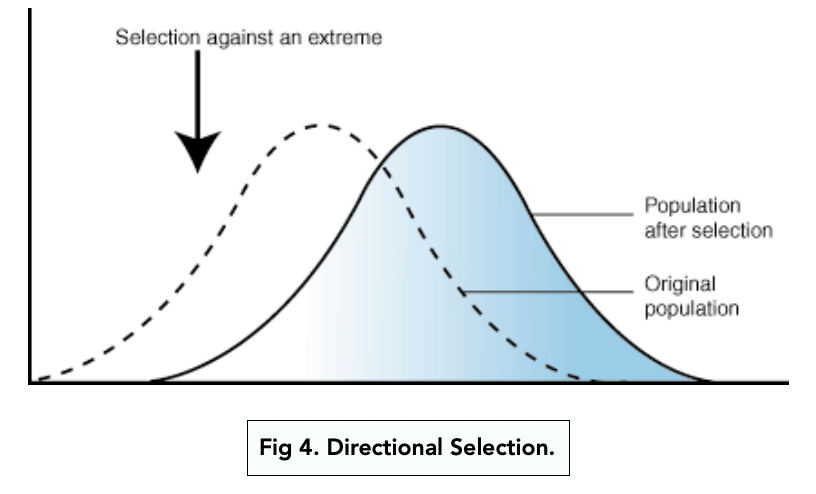
Directional selection
a mode of natural selection where a single extreme phenotype is favored over intermediate or opposite traits, shifting a population’s distribution toward that extreme over time.
Speciation
is the evolutionary process by which populations evolve to become distinct species.
allopatric speciation
the formation of new species due to geographic isolation, which stops gene flow between populations
sympatric speciation
the process by which new species evolve from a single ancestral population while inhabiting the same geographic location, without physical barriers
Hardy-Weinberg Equilibrium
A principle stating that genetic variation in a population remains constant from one generation to the next in the absence of disturbing factors like mutation, selection, or drift.
biological species concept (BSC)
defines a species as groups of actually or potentially interbreeding natural populations that are reproductively isolated from other such groups

monophyletic group
a taxonomic group consisting of a single common ancestor and all of its descendants, living and extinct.
Paraphyletic group
a set of organisms that includes a common ancestor and some, but not all, of its descendants.
Polyphyletic group
a set of organisms grouped together based on similar traits that did not evolve from a common ancestor, but rather through convergent evolution.
convergent evolution
the independent evolution of similar features in species of different lineages, typically driven by similar environmental pressures rather than shared ancestry
prokaryotic cells are generally small because many obtain nutrients primarily by…
diffusion across the cell membrane
cyanobacteria are significant in earth’s history because they:
perform oxygenic photosynthesis
TM7x is a bacterium that has been found in human saliva. This bacteria is so small it doesn't have cellular machinery and instead co-opts other bacterial cells. This can result in the death of both beneficial and harmful bacteria in the human mouth. Which of the following relationships likely characterizes TM7x and other oral bacteria?
parasitism
one way a bacteria can transfer antibiotic resistance to other bacteria is through…
transfer of a plasmid containing antibiotic resistance genes.
photosynthesis can occur without producing oxygen when the electron donor is not water. This is called:
Anoxygenic photosynthesis
which of the following is the most valid and accurate measure of darwinian fitness?
number of offspring or close kin that survive to reproductive age.
life’s only known biological mechanism for generating oxygen gas is:
oxygenic photosynthesis
conjugation in bacteria involves…
transfer of DNA through direct cell-to-cell contact.
genomic surveys expanded estimates of bacterial diversity primarily because they:
allow DNA to be extracted directly from environmental samples
which statement best matches a key difference often emphasized for Archaea?
their transcription/translation machinery is more similar to eukaryotes than to bacteria.
respiration can occur without oxygen by using alternative electron acceptors such as:
Nitrate (NO3-) or sulfate (SO4²-)
which of the following describes an organism that obtains both carbon and energy by ingesting prey?
heterotroph and chemotroph
Sulfurovum riftiae is a bacterium that has a symbiotic relationship with Giant Tuberworms near hydrothermal vents. This bacterium provides tubeworms with carbohydrates by acquiring cellular energy from oxidizing hydrogen sulfide and its carbon from carbon dioxide. What is the nutritional mode of this bacterium?
chemoautotroph
which organisms would be correctly identified as prokaryotes?
archaea and bacteria
an antibiotic that was specifically targeting bacterial infections and not other organisms, could target _____.
peptidoglycan
bacteria can generate new gene combinations without sexual reproduction through…
horizontal gene transfer, mutation, and conjugation.
a carbon metabolism pathway unique to some Archaea is:
methanogenesis
True or false: evidence suggests that eukaryotes and archaea are each other’s closest living relatives, and prokaryotes are a valid evolutionary grouping.
True
Nitrogen fixation converts atmospheric N2 into:
Ammonia (NH3) or related reduced nitrogen forms.
Pseudomonas aeruginosa is a gram-negative bacteria that commonly parasitizes human burn victims. It’s ability to resist antibiotics could stem from what.
Rapid mutation rate resulting in novel resistance genes, the presence of very little peptidoglycan, horizontal gene transfer from other antibiotic resistant bacteria, and the presence of an outer membrane.
In the sulfur cycle, bacteria and archaea are important because they can:
reduce and oxidize sulfur compounds via respiration and chemosynthesis/ photosynthesis.
Which of the following is the most likely sequence of events, from earliest to most recent, in the evolution of sponges (organisms with many cells that have different functions)?
single-celled eukaryote
single-celled prokaryote
multicellular eukaryote
colonial eukaryote
2,1,4,3
endosymbiosis is best defined as:
a symbiosis in which one partner lives within the other.
Mitochondria are thought to be descendants of certain alpha proteobacteria. They are, however, no longer able to lead independent lives because most genes originally present on their chromosome have moved to the nuclear genome. Which phenomenon accounts for the movement of these genes?
horizontal gene transfer
in a sample of pond water, a new organism is identified with the following characteristics: It consists of 70 cells surrounded by rigid cell walls that join the cells together. Inside each of these identical cells are mitochondria and chloroplasts. Such an organism would most likely be classified as a
colonial photosynthetic eukaryote.
what is true of Eukaryote evolution?
endosymbiosis can be found in all eukaryotic lineages.
which pair best summarizes the two hypotheses described for the origin of the eukaryotic cell?
a pre-existing eukaryotic host engulfed bacteria vs a symbiosis between an archaeon and a bacterium preceded the modern eukaryotic cell.
why can eukaryotes be considered “combination” organisms?
their diversity outnumbers prokaryotes by over 1 million species.
all protists
are eukaryotic
which of the following traits do all archaeans and bacteria share?
unicellularity
which statement is correct about the evolution of eukaryotes?
the ancestor of all eukaryotes evolved mitochondria when it engulfed a aerobic bacterium.
which of the following is not evidence for the endosymbiotic theory if eukaryotic evolution?
modern bacteria share the same nucleus as chloroplasts and mitochondria
according to the reading guide, a major novel contribution of eukaryotes to carbon cycling is:
the ability to capture and ingest other cells.
which of the following is not a distinguishing feature of all eukaryote cells when compared with bacteria and archaea?
the presence of a plasma membrane
communication between cells is especially important in complex multicellularity because it enables:
coordinated development and differentiation into tissues and organs.
which statement best describes how most fungi obtain nutrients?
they secrete enzymes to digest material outside the body, then absorb small molecules through their cell walls.
a multicellular fruiting body is best described as a specialization for:
spore dispersal
the reading guide connects the evolution of large, complex multicellularity organisms to
abundant oxygen that supports higher energy demands
an endophyte is best described as a fungus that:
lives inside plant tissues (often without causing disease)
why is simple multicellularity more common in aquatic environments?
aquatic organisms can use diffusion to obtain nutrients from the environment that entirely surrounds them.
which statement about diffusion is false?
diffusion allows long distance movement of molecules
as a spherical cell increases in radius its surface area-to-volume ratio…
decreases
fungi are major decomposers of wood largely because many fungi can:
degrade lignin, which provides access to cellulose.
in a typical mycorrhizal mutualism, the fungus primarily helps the plant by increasing:
water and mineral nutrient uptake