Unit 5-Macroeconomics
 Call Kai
 Learn
Learn Practice Test
 Spaced Repetition
 Match
Match Flashcards
 Knowt Play
1/23

There's no tags or description
Looks like no tags are added yet.
Name | Mastery | Learn | Test | Matching | Spaced | Call with Kai |
|---|
No analytics yet
Send a link to your students to track their progress
24 Terms
What is Macroeconomics?
The study of entire economies.
Why is economic growth important?
Allows for a country to:
Increase the standard of living
Compete in the global market
Increase domestic resources (gov services)
-Increased tax base
What does GDP measure?
Gross Domestic Product (GDP): dollar value of all final goods and services produced within a country during a given year.
Dollar value = total cash value of sales
Final goods/services = In the form sold to consumers.
National borders = only domestic goods/services.
What is the equation to calculate GDP?
GDP = C + I + G + (X - M)
C: Personal consumption expenditures
I: Gross investment
G: Gov purchases of goods & services
(X - M): Exports - Imports
What happens when a country imports more than it exports?
This led to a trade deficit triggering unemployment.
Nominal vs Real GDP?
Nominal GDP: measured in current prices
Real GDP: adjusted for inflation
What are the limitations of GDP?
Non-Market Activities: services people do for themself.
Mowing the lawn
Underground Economy: Transactions not reported to the government.
Black market
Gamebling.
Negative Externalities: Unintended economic effects that are not subtracted from GDP measurements
Quality of Life: Increasing GDP doesn’t necessarily make life better or reflect general well-being.
What is the business cycle?
Economic fluctuations
What are the 4 “phases’ of the business cycle? What does each one mean? Graph?
1) Recovery/Expansion:
Increase in GDP = Economic Growth
2) Peak
Height of expansion
3) Contraction
Decrease in GDP
4) Trough
Lowest point
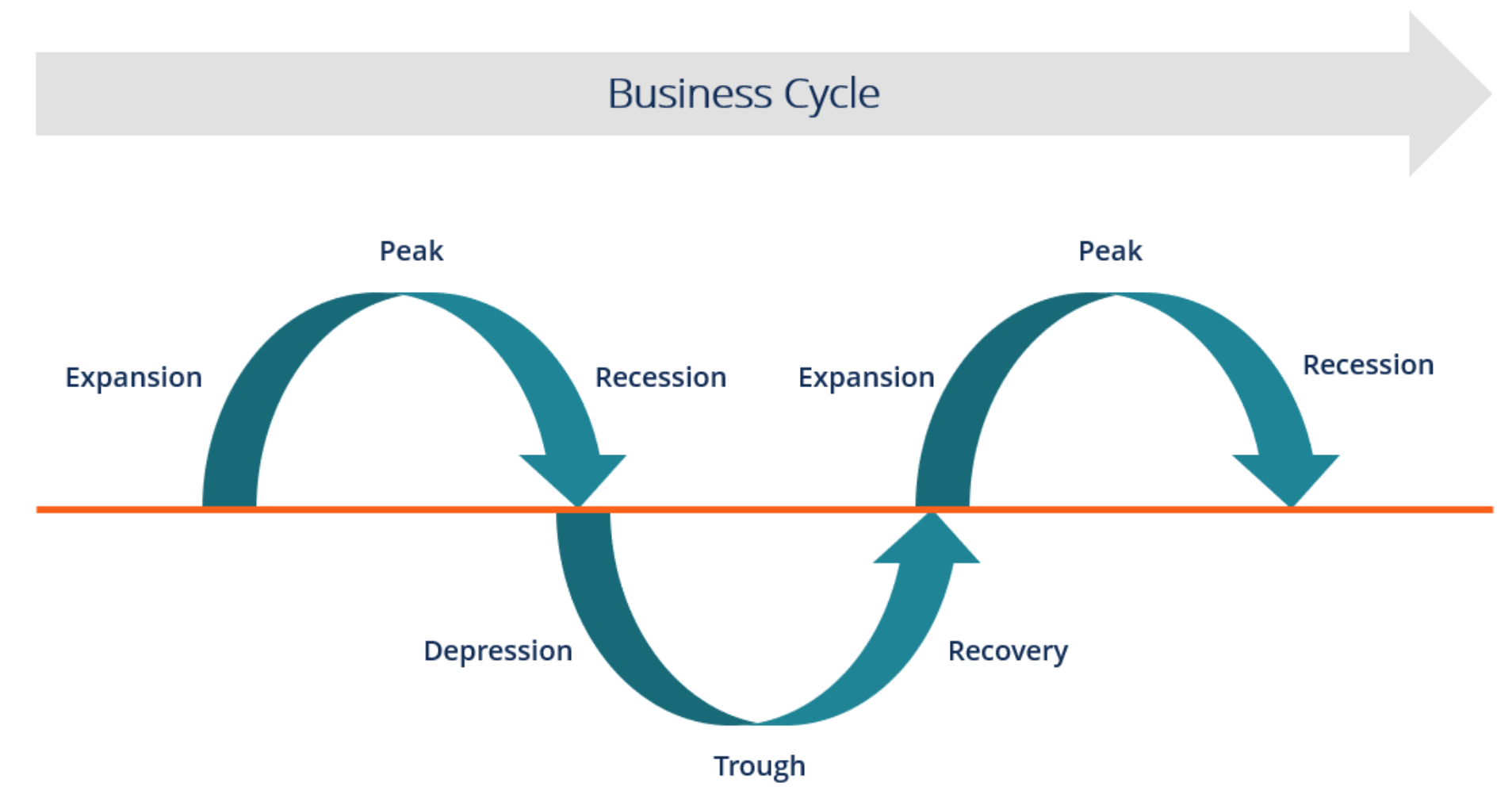
Recession vs. Depression
Recession: Prolonged economic decline
Depression: An especially long recession
4 things that “influence” the business cycle
1) External Factors
Inventions, technology, wars, COVID
2) Public Expectations
Producers and consumers
3) Business Investment
Lack of investment
4) Government Actions: Access to Money and Credit
Monetary and Fiscal Polices.
What is the “unemployment rate”?
Who is or isn’t counted as “unemployed”?
Unemployment Rate: % of people in the civilian labor force who are unemployed.
Discouraged workers: stop looking
Underemployed: “wasted resources”
Unemployed: Jobless, looking for a job, available to work.
people with a job, disabled, or retired.
What is “Full Employment”?
Some unemployment is normal & healthy part of an economy
4-6 % = employment
What are the 4 different types of unemployment?
1) Frictional
people who have left their job to look for another.
New to the workforce or re-entering.
2) Seasonal
Regular fluctuations in jobs
Holiday, school year, harvest seasons.
3) Structural
Unemployment that occurs as a result of changes in tech or the way the economy is structured
4) Cyclical
Resulting from recession or economic downturn: layoffs.
What is inflation?
Increase in prices across an economy
Reduce the purchasing power of the dollar
Too much money in circulation
More demand than supply
What is the target inflation rate in the US?
2 %
What is the Consumer Price Index (CPI) used for?
Measures price of the market basket of typical consumers
What is the “market basket”?
Representative collection of goods and services.
What are the effects of inflation on wages?
On purchasing power?
On savings?
1) Reduce purchasing power of the dollar
2) Decrease value of real wages
3) Interest rates
4) Savings and Investing
5) Production costs
What is “stagflation”?
Why is it “the worst of both worlds”?
Stagflation = stagnant growth (low output, high unemployment) + high inflation (rapidly rising prices)
Together, it reduces purchasing power through rising costs and limits income.
What are two economic impacts of tariffs?
Increase the cost of living for consumers
Raise production costs for businesses
What is the “poverty threshold”?
The lowest income that a family needs to maintain a basic standard of living
$15,000
What is the “poverty rate”?
% of people living in poverty
According to the documentary Inequality for All, what is the leading cause of income inequality for middle-class Americans?
Caused a decline in labor unions
Weaken middle class purchasing power