AP Calculus BC Unit 1
 Multiple Choice & FRQ
 Call Kai
1/23

Earn XP
Description and Tags
Limits, Continuity, IVT, Squeeze Theorem
24 Terms
sin(2x)
2sinxcosx
cos(2x)
cos²x-sin²x
1-sin²x
2cos²x-1
cos²x
1+2cosx/2
sin²x
1-2cosx/2
Special limits
lim x→0 sin(x)/x = 1
lim x→0 1-cos(x)/x=0

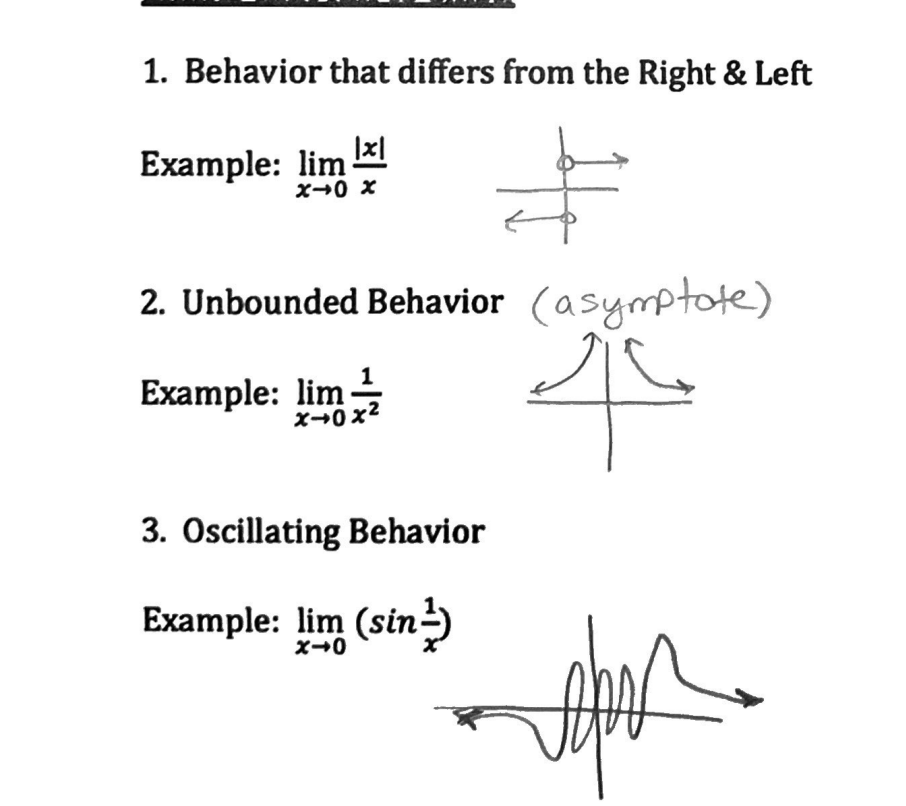
Limits that fail to exist
|x|/x
Unbounded behavior (asymptote)
Oscillating behavior lim x→0 (sin (1/x))
Limit of a constant
lim x→C A=A
Limit of identity
lim x→c x=c
Limit of a sum
lim x→c [f(x)+g(x)] = lim x→c f(x) + lim x→c g(x)
Limit of a difference
lim x→c [f(x)-g(x)] = lim x→c f(x) - lim x→c g(x)
Limit of a product
lim x→c [f(x)*g(x)] = lim x→c f(x) * lim x→c g(x)
Limit of a constant times a function
lim x→c [k*g(x)] = k * lim x→c g(x)
Limit of a power
lim x→c [f(x)]ⁿ = [lim x→c f(x)]ⁿ
Limit of a root
lim x→c [f(x)]^(m/n) = [lim x→c f(x)] ^ (m/n)
Limit of a quotient
lim x→c [f(x)/g(x)] = lim x→c f(x)/ lim x→c g(x)
Limit of a composite function
lim x→c f(g(x))=f (lim x→c g(x))) if f is continuous at lim x→c g(x))
Definition of continuity
f ( c ) is defined
limx→c f(x) exists (lim x→c- f(x) = lim x→c+ f(x))
f ( c ) = lim x→c f(x)
Removable discontinuity
A hole (limits can exist at these)
Ex: Factor out and cancel
Jump discontinuity
lim x→c- g(x) does not equal lim x→c+ g(x) (limits DNE)
Ex: x-5/|x-5|
Removable discontinuity
Vertical asymptote, based on the denominator (limits DNE)
Limits at infinity
Degree of numerator < degree of denominator: lim x→infinity f(x) = 0
Degree of numerator > degree of denominator: lim x→infinity f(x) = DNE
Degree of numerator = degree of denominator: lim x→infinity = ratio of the leading coefficients
Intermediate Value Theorem
1. f(x) is continuous on [a,b]
2 f(a) < or > k f(b) < or > k (k is any number between f(a) and f(b))
3. Therefore, there must be some value "c" for which f(c)=k on [a,b]
Squeeze Theorem
If f(x) is in between two functions, in (a, b), h(x) and g(x), and if lim x→c h(x) = lim x→c g(x), therefore lim x→c f(x) = lim x→c h(x) = lim x→c g(x)
Hierarchy of growth
*Only works with infinite limits
Slowest→Fastest: log x, polynomials, exponentials, factorials (x!)
lim x→infinity (slow/fast) = 0
lim x→infinity (fast/slow) = infinity/DNE