friends and enemies
 Call Kai
 Learn
Learn Practice Test
 Spaced Repetition
 Match
Match Flashcards
 Knowt Play
1/33

There's no tags or description
Looks like no tags are added yet.
Name | Mastery | Learn | Test | Matching | Spaced | Call with Kai |
|---|
No analytics yet
Send a link to your students to track their progress
34 Terms
What is a friend?
Relationship of mutual affection, reciprocal
Each member of dyad agrees are friends
Voluntary relationship - first people they choose for themselves
Trust, talking to them about problems
Start to express preferences for particular peers in preschool years - ⅔, clear in who they want/dont want to play with
Behave differently with friends
Can be volatile and have more conflict with friends than with non-friend peers. Could be because spend more time or because it means more to them.
Resolve conflicts in different ways, more likely to negotiate with friends, think carefully about how to sort out conflict with friends.
Similarity of friends
Do we seek friends who are like us
Notion of homophily
Similarity in: Gender, Age (who they'll see in school, be in classes with, dif developmental stage so want to do dif things), Behaviour (Berndt, 1982):
More controversial – similarity or complementary? Eg introverts may want to be friends with extroverts
Adolescents similar in attitudes towards school and towards culture, eg really into music or sport etc
Selection (choose friends who are like us) or socialisation (influence each other - become more similar when become friends)?
Both processes operating together - choose friends that are similar, then influence each other - become more similar to our friends
Importance of similarity in behaviour depends on reputational salience of behaviour - how important is that beh in terms of child's peer status - accepted or rejected by other children
Hartup (1996) - similarity in boys vs girls
Peer ratings of 11 year olds in classroom
Rated on prosocial behaviour, antisocial behaviour and emotional withdrawal
Friends similar to each other in these types of beh (also asked to rate who was their friend)
Concordance greater for antisocial behaviour (more important for reputation and standing in peer group)
Gender differences: girls show more similarity between friends on prosocial and antisocial (important things for girls in terms of reputational standing), boys on shyness. So shyness more important for boys social standings, eg shy boys less popular, whereas more acceptable for girls to be shy
Reflects differences in reputational salience of attributes
So similar in beh that represent peer standing
Benefits of friendships
Emotional support and validation
Enhancement of worth
Combat loneliness
Also good at bringing people down to earth - shouldn't undermine self-esteem but may gave them a reality check
Buffering effect against victimization by peers:
Victimization related to behaviours exhibited - certain beh make children more susceptible to being victimized - cry, anxious, lack of self-esteem - wont fight back if picked on
Does this interact with social factors?
Number of friends correlates with victimisation (Hodges et al., 1997)
Behavioural risk and social risk both important
Also mitigates effects of victimisation - reduces effects of victimisation, even having one good friends can make feel better, have fewer adjustment problems
Development of social and cognitive skills - Friends use more constructive criticism, eg why dont we do it like this instead, elaborate on each others ideas
Development of moral skills - Piaget: discover different points of view through peer interactions
Long-term benefits
Longitudinal follow-up study from age 10 to age 23 (Bagwell et al., 1998)
Those who had stable mutual friend at 10 vs. those who were ‘chumless’ (did not have a mutual best friend)
At age 23, chumless lower self-esteem, more psychopathology, more adjustment problems
No correlation between whether had friends at 10 vs at 23
Disadvantages of friendships
Negative friendships very damaging - High levels of conflict and rivalry can lead to negative interactions with others, may learn that that's how you interact with people - spills into other relationships
Influence on antisocial behaviour
Aggression, disruptiveness, drug/alcohol use
Magnification hypothesis (Berndt, 2004) - copy beh of those around us, friends also reinforce beh. If antisocial children friends with each other - become more antisocial
Influence increased when friendship high in quality
Danger of grouping antisocial children together
Social support theory
Supportive social relationship always beneficial, regardless of who the friendship is
Some evidence consistent with social support
Types of aggression
Physical aggression – damage or threat to another’s physical well-being
Relational aggression – damage or threat to another’s relationships or feelings of inclusion, may occur between friends, trying to control other people’s beh. Social exclusion, threatening not to do things if don’t do what they want
Verbal aggression – threats or verbal insults
Indirect aggression – covert behaviours (behind someone’ back), eg dont tell … but… - try to damage someone's relationship but not directly to their face
Social aggression – damage to another’s self-esteem or social status
Subtypes of aggression
Reactive aggression is a defensive response or angry reaction to provocation
Intent is to retaliate
Reactive relational aggression such as using social exclusion to retaliate against perceived provocation
Proactive aggression is deliberate behaviour to achieve a goal eg hitting someone to make a point
May not be provoked
Proactive relational aggression such as threatening to tell secrets to get control
Relational vs. Physical aggression
Only a modest correlation between the two on reports by parents, peers, teachers (Crick et al., 1999) - seem to be quite distinct forms of beh
Connection higher for males?
Informants agree more on physical aggression than relational - more visible, particularly to parents and teachers
Relational occurs more frequently in girls and physical in boys?
When consider both, girls and boys equally aggressive
Preschool + middle childhood - girls show more relational aggression, however girls develop lang sophistication earlier than boys
Children view relational aggression as an aggressive act - designed to harm them
Social Information Processing Model (Dodge & Crick, 1990)
Explains the development of aggressive beh.
What cog processes are evoked in response to social stimuli.
Stage 1: someone bumps into arm
Then make an interpretation - they're always trying to get at me or busy halfway (meaning behind beh)
Could ignore beh, push back, ask to apologize
Evaluate according to social goal - eg get out of situation without any hassle, also based on expectations of outcome
Cognitive processes in response to social stimulus
Looks at how perceive cues, make attributions, generate solutions, and decide how to respond behaviourally
Stages 2 and 4 most studied in aggression research
Physically aggressive children have hostile attributional biases (stage 2)
Cog processes affected by past experience, attachment relationships also come into play
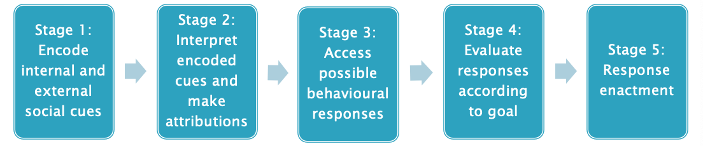
SIP model: relational vs physical aggression
Stage 2:
Instrumental conflicts problematic for physically aggressive children
Relational conflicts provoke hostile attributional biases in relationally aggressive children
Stage 4:
Physically aggressive children show response decision deficits
Relationally aggressive boys but not girls evaluated relationally aggressive responses positively
Developmental course of physical aggression
Second year of life: object possession struggles
Preschool years: instrumental aim to acquire object, e.g. toy
Verbal aggression increases and physical decreases
Middle childhood: more concerned with individuals rather than objects
Large proportion of aggression at this age is bullying
Adolescence: general decrease in physical aggression
Small number increase in serious violence
Gender differences are marked
Developmental course of relational aggression - preschool
Not really been found before age 3 - need lang and sociocognitive skills
Preschool: Show RA in basic ways
Only just learning social skills
Tends to be in response to immediate problems
“Child A (a girl) who wants to climb on some plastic blocks pushes child B (a boy) who is currently climbing on the plastic blocks. Child B yells “don’t push me” and pushes her back. Child A yells back “don’t scream!”. Child C (a girl), who was standing near them, moves away. Child A then moves beside Child C and says “I have to tell you something!”. She then whispers something to Child C, excluding Child B. Child B watches, looking very uncomfortable” (Crick et al., 1999)
Trying to damage child b - very unsophisticated level, not manipulative beh seen later on in childhood
developmental course - middle and adolescence
Middle childhood: more sophisticated and complex acts of RA
Need for friendships more salient
Manipulate peer group against child
Relatively covert eg “They tell their friends not to be that kid’s friend”
Retribution for action in the past
Adolescence: RA continues and becomes more complex and subtle
Contexts for expression of RA may change
Opposite-gender relations become important
Harm through damaging romantic relationship
Or through standing with opposite-gender peers
“Women hurt other women by the amount of affection from men they receive. For example, saying ‘Mark called and he likes me better than you’”
Bullying
Bullying or victimization: exposing an individual to repeated negative acts perpetrated by one or more other individuals
A) Aggressive behaviour carried out intentionally
B) repeatedly and over time
C) imbalance of power between bully and victim - victim finds it harder to defend themselves against the bully eg social/physical
Not provoked by beh towards the bully
Prevalence rates unclear - children may not admit to being bullies
Victims range widely, but may be around 25%
Bullies could be as high as 20%
Noticeable group of bully/victims - children who have been on both sides of the relationship
Victim is usually individual, bully is part of a group
Who are the victimised? (Olweus, 2003)
Do they have “external deviations”? - how different they look etc. Not always supported
Passive, submissive victim
Low self-esteem
Lonely
Not aggressive or teasing in behaviour
Physical weakness if boys
Overprotective parenting? - havent learnt self-reliant/self-confident skills
Provocative victim
Small group who are anxious and aggressive
Hyperactive - makes others notice them, not in a positive way
Who are the bullies?
Not necessarily anxious and insecure, could be somewhat opposite
Average or slightly below in popularity - popularity goes down with age
Show evidence of general conduct-disorder and anti-social behaviour
More likely to be convicted of crime later in life
Bullies show aggressive behaviour with weak control over impulses
Tolerance for aggressive behaviour
Physical strength if boys
Use force dispassionately - not in the heat of the moment, but more manipulatively/calculated. Those who are relational bullies have quite strong social skills
Gender differences in bullying/victimisation
Trend for boys to be more exposed to direct bullying and physical victimisation
Boys carry out more of the bullying
4 times more boys than girls (Olweus)
Girls more relational victimization?
Preschool: some evidence
Middle childhood and adolescence: Unclear results (Crick, Casas & Nelson, 2002)
Are the consequences of victimization the same for girls and boys? Girls may be more affected by RA than boys are, girls more concerned about relationships during middle years
Outcomes of victimisation
Physical and relational have negative consequences
Poor peer relationships - may not trust them, or peers avoid them because they don't want to be targeted by the bully
Increased anxiety and depression
Increased externalizing problems - acting out, show aggressive beh themselves
Poor physical health
Increased levels of psychosis like symptoms
Effects are concurrent but also predictive
RV – less research so further studies needed
Mostly cross-sectional so far
What factors contribute to risk of RV?
More focus on small peer group and dyads
Outcomes for bully/victims? (Wolke et al., 2000)
1639 6-9 year olds
Direct : 4.3% bullies, 10.2% bully/victims, 39.8% victims
Relational: 1.1% bullies, 5.9% bully/victims, 37.9% victims
Relational bullies rated lower in beh+emotional problems as teachers and parents dont see it
bully/victim group most at risk
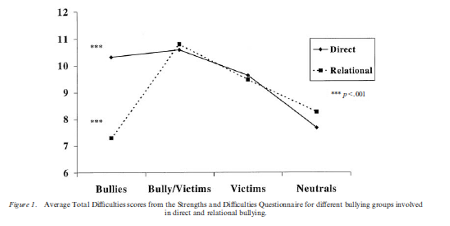
Effects of new technology
Impact of new technology on friendships?
‘Cyberbullying’ = “an aggressive, intentional act carried out by a group of individual, using mobile phones or the internet, repeatedly and over time against a victim who cannot easily defend him or herself” (Smith et al., 2008)
Awareness from about 2001 in UK
What type of aggression is this?
Relational, verbal, indirect, social
Cyberbullying
Cyberbullying is there all the time - cant get away from it
Also anonymity - don't know who it is, makes it more scary
Cyberbullying and related factors
Is role and prevalence of cyberbullying overstated?
Reported rates vary from as low as 4-5% to up to 24%+
Definition of cyberbullying? Date of survey? Age of sample?
Effects of cyberbullying
increases risk of depressive symptoms
Associated with psychosomatic problems
Also with suicidal thoughts
Associations with popularity - more popular people could be more at risk
Correlations between cyberbullying and traditional victims
Cyberbullying vs “Traditional”
Does it have to be repetitive? Less clear in cyberbullying what constitutes one act More impact act has (eg get a big audience), less repetition needed
Reaches larger group - So more long-lasting? - hard to get rid of once posted. More bystander effects?
Does there have to be a power imbalance? Anonymity as power
Age differences - Increases with age (especially perpetration), Peaks at age 15; later than for TB
Gender differences - Mixed findings, Females more interested in social networking sites so more affected
Debate surrounding which has greater effects on victims’ mental health
Prevalence currently less for serious incidents but suggestion TB decreasing over time whilst CB is not
More moral disengagement? Could say things online that you would never say in person
What can we do about bullying?
Olweus – bullying intervention programme
Children aged 11-14
Reduction in bully/victim problems
Reduced percentage of new victims
Core principles:
Increase awareness of bully/victim problem, among other school children and teachers/parents
Active involvement of teachers and parents
‘Zero tolerance’ - sanctions for bullies
Clear rules against bullying
Support and protect victims
Does this approach work?
Depends on what adults see - do they see what's happening, not as good effects for relational aggression
Effects seem to be small
Wolke – improve coping competence of victim
Adaptation to stressful events depends on use of active coping strategies
Best environment to learn strategies is highly similar to environment in which they occur
Use of virtual social environments
Sapouna, Wolke et al., 2010
18 UK schools, 9 German – children aged 7-11 years
Classes in experimental or waiting control group
Baseline assessments of bullying
Intervention group 1x week for 30mins for 3 weeks
Type in advice to someone thats been bullied, they then see the outcome of their advice
Virtual reality intervention findings
Followed up one (T1) and four weeks (T2) after
German teachers rated software poorly – 70% would not use it again
Victims at baseline measure:
Those in intervention group more likely to escape victimisation than those in control at 1 week
Only significant for UK at 4 weeks
All students:
Significantly lower victimisation rates at T1 for UK only
Cyberbullying strategies?
England schools worst for cyberbullying
Needs a multipronged approach
Conclusions
Children make friends with those who are similar to them on important attributes
Friendships help emotions, peer adjustments, and other skills; effects last
May be problematic if friends exhibit negative characteristics
Children can be aggressive to each other using different forms of aggression
Relational and physical aggressors differ in way in which social information is processed
As children get older, become more skilled at using relational aggression
Boys more bullied and bullying
Both victims and bullies at risk for poor outcomes
Cyberbullying – new form of aggression possible
Cyberbullying can be as bad as face-to-face bullying?
Interventions tricky – need several strands to them