Cognitive Psych Exam 2
 Call Kai
 Learn
Learn Practice Test
 Spaced Repetition
 Match
Match Flashcards
 Knowt Play
1/63

Earn XP
Description and Tags
Long term memory + Conceptual Knowledge + Language (working memory on)
Name | Mastery | Learn | Test | Matching | Spaced | Call with Kai |
|---|
No analytics yet
Send a link to your students to track their progress
64 Terms
what are concepts?
mental categories of things, people, places, actions, etc.
what are prototypes?
the first thing that comes to mind and is usually a good representation of the concept
what are characteristics of concepts?
unique to each person, nested, and sometimes have blurred boundaries
how do concepts form?
“know it when you see it” by comparing similarities to our prototype
what is a prototype example?
comparing a hairless dog to a golden retriever
what is a production task?
simply list things that fall into a particular category
what is a sentence verification task?
true or false questions about the prototype
what is the response speed when the subject is closer to the prototype?
fast
what are rating tasks?
rating the subject based on typical-ness
what are ways to test prototypes?
production task, sentence verification task, and rating tasks
what is attractiveness correlated to, in prototypes?
more or less typical
what is the subordinate for bird?
Carolina chickadee
what is the superordinate for bird?
animal
what makes it easier to adjust categories?
exemplar
what is an exemplar?
provide info about category variability
what is conceptual knowledge?
a mic of exemplars and prototypes
what do prototypes and exemplars let us do?
determine category membership and recognize objects
how do atypical features change categorical membership?
they don’t
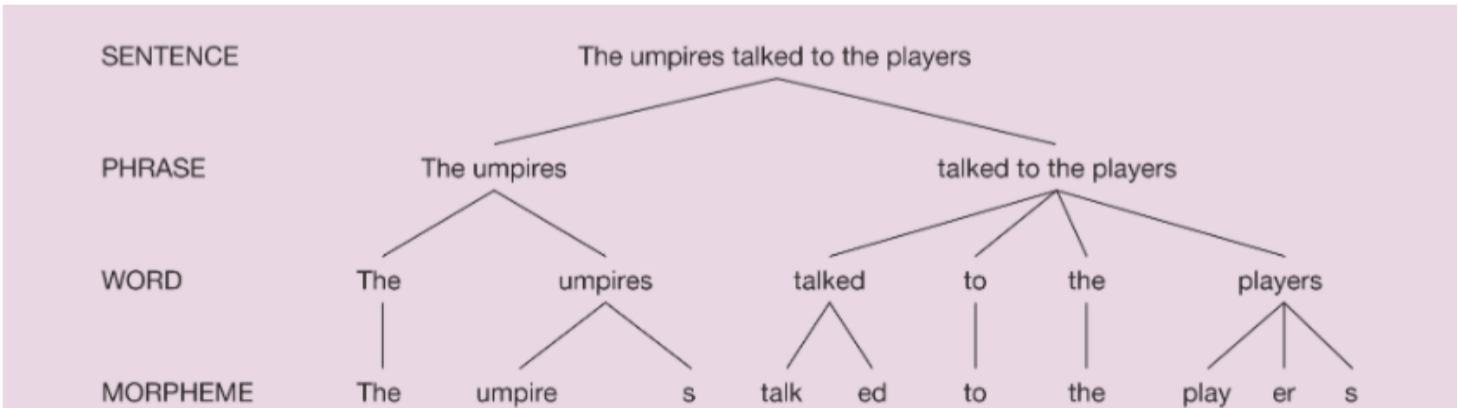
what is a morpheme?
the smallest unit of meaning in language
what is a phoneme?
smallest unit of sound
how many phonemes does English have?
around 40
what is phonology?
how speech is produced
what mouth feature produces voiced sounds?
vocal folds
How do lips and tongues make vowels?
modifying sounds
How do lips, teeth, and tongue make consonants?
make their own sound
what controls tone of voice?
shape of the nasal cavity and throats
what is voicing?
vocal folds open and close to produce vibrations
how are v, z, and n voiced?
voiced
how are f, s, and t voiced?
unvoiced
what is a characteristic of airflow for letters p, b, and t?
stops airflow
what is a characteristic of airflow for letters f, z, and r?
airflow continues
why do p and b vs. f and v vs. t and d sound different?
shape of lips
what is voicing?
vocal folds open and close to produce vibrations
how is speech made?
complex changes in sound pressure over time
what does disambiguate mean?
figure out which word is being said
what is coarticulation?
pronunciation of phonemes will change because of the surrounding phonemes
why do phonemes overlap?
planning for the next phoneme before finishing the previous one
what can change the way the same phoneme sounds?
context
what is phonemic restoration?
the ability to fill in the gaps in language due to previous experiences
what allows us to do phonemic restoration
top-down processing
what are the components of language?
syntax, semantics, grammar, context, and pragmatics
what are bed rot and doom scrolling examples of?
Language can create new combinations from existing units
what are rage bait and click bait examples of?
language is patterned
what tends to be the syntax structure for English?
subject-verb-object
what is prescriptive grammar?
enforcing syntax and other rules
what is descriptive grammar?
studying and explaining the rules that people use in their natural speech
what did Noam Chomsky believe?
all children are born with an innate language ability that allows them to produce and understand sentences never heard before
what does prosody communicate?
speakers intended meaning, emotion, urgency, and word meaning
what is prosody?
pitch and rhythm of speech
what are nonlinguistic non-prosody sounds?
laughter, screams, crying
what is reasoning?
how we think in a way to reach a conclusion
what is logic?
reasoning under strict principles
what do humans rely on more than logic?
heuristics
what is a logic syllogisms?
3-part logical argument with 2 premises leading to a conclusion
what is belief bias?
if a syllogism’s align with beliefs, people are more likely to think the syllogism is valid
what is attribute substitution?
relying on an easier kind of information
what is the availability heuristic?
information that is more readily available is believed to be more probable
what is the representativeness heuristic?
basing expectations for new things on a prior experience
what is confirmation bias?
believe information that supports our opinion and ignore contradicting evidence
what is the endowment effect?
placing an irrationally high value on our possessions
what is the gamblers fallacy?
believing an event is more likely to occur because it has been a while since it happened
what is the sunk cost fallacy?
continuing an endeavor after an investment has been made, regardless of the prospects of an endeavor
what is the dual process model?
type 1 thinking is fast and relies on gut reaction and type 2 thinking is slow and logical which requires more time and focus