Direct Composite Veneers
 Call Kai
 Learn
Learn Practice Test
 Spaced Repetition
 Match
Match Flashcards
 Knowt Play
1/46

There's no tags or description
Looks like no tags are added yet.
Name | Mastery | Learn | Test | Matching | Spaced | Call with Kai |
|---|
No analytics yet
Send a link to your students to track their progress
47 Terms
What is the difference between direct and indirect veneers?
direct: placed directly in mouth at time of visit
indirect: made in lab and then cemented in later
What are some benefits to going with indirect veneers?
improved composite quality
higher control of margins and contour
potential difference in chair time ( though additional visits may make the time equal overall)
When are indirect method & direct method recommended respectively?
indirect: multiple veneers
direct: single veneers
Intrinsic vs Extrinsic staining?
intrinsic - inside surface of tooth
extrinsic - on surface, can usually clean with things like prophy paste
Indications for veneer placement
mild intrinsic discoloration
enamel surface defects
- hypoplasia
- hypocalcification
-pitting
large class 3,4,5 defects
veneer replacement
Two subtypes of veneer ( having to do with amount of coverage)
full veneer - full facial surface
window veneer - partial facial surface
What should you do before making a recommendation for veneers?
make all diagnostics.
Some examples from lecture:
are the teeth viable?
are teeth overcrowded?
is there need for bleaching?
is there need for endodonic treatment?
are the diastemas?
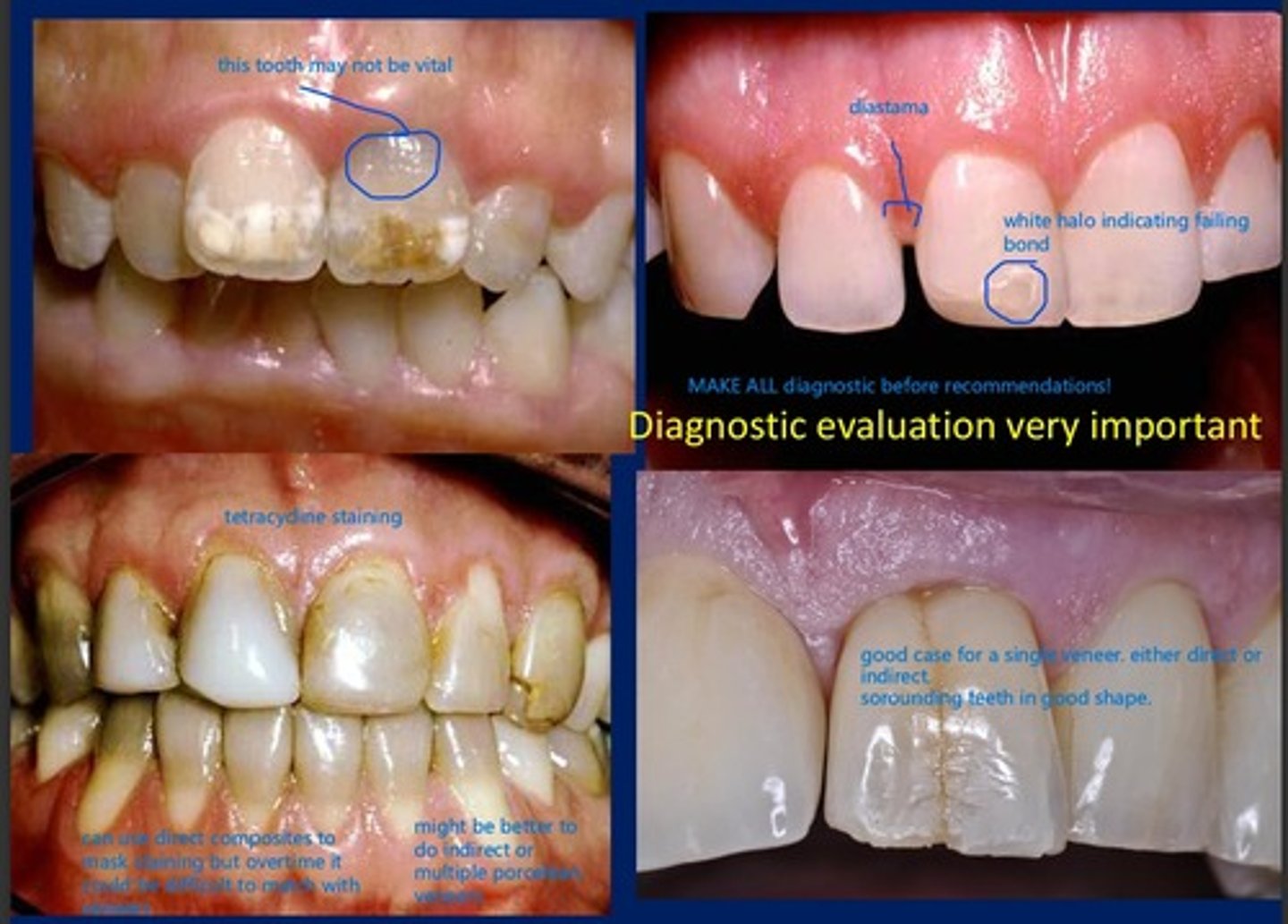
What is one problem with placing single veneers when there are other composite restorations nearby (in regards to shading)?
staining can change over time, different materials stain differently. etc
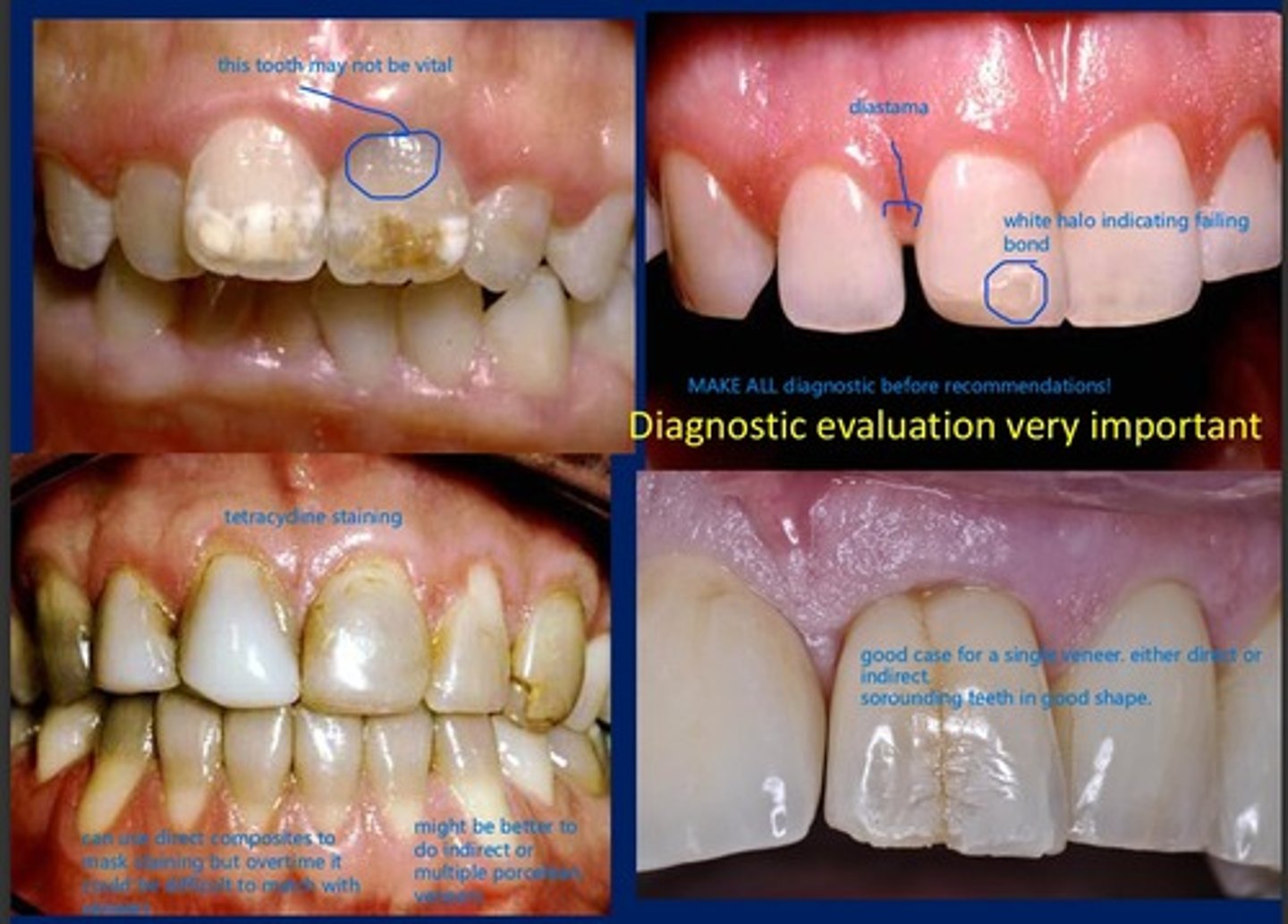
In regards to tetracycline staining? What types of staining tend not to be successful for binding to veneers?
very dark stained probably not going to be successful with composite veneers. May instead want to do full coverage restorations.
What might might you opt to do instead of a veneer for a trauma induced class 4? Under what circumstances? What two things mighy you do in combination?
If the rest of the tooth is solid, undamaged, and healthy then we may just opt to do a class 4 restoration with a long scalloped bevel rather than a full facial veneer. This would keep more natural tooth structure.
You can also palace veneers along with a tooth recontouring in the cass of say a facially tilted lateral/central incisor.
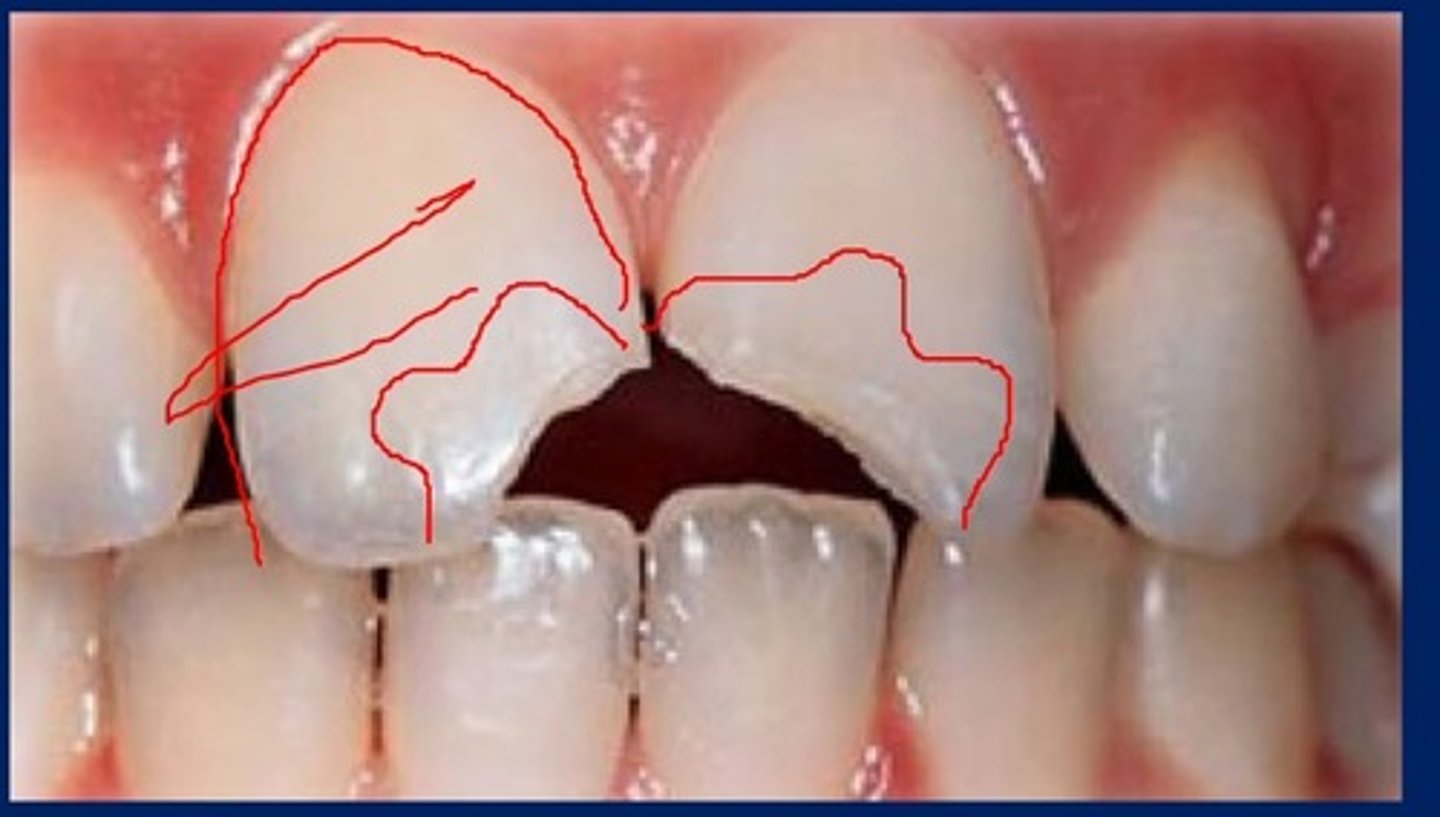
What are 5 main alternatives to the classic composite veneer discussed in lecture?
bleaching
Localized facial bonding ( partial veneer / window veneer
Esthetic recontouring
Porcelain veneers
What is a good candidate for bleaching prior to or in the stead of a veneer? Why?
a non-vital tooth even if it has a history of successful endodontic treatment. Bleaching can bring base shade closer to the adjacent tooth prior to placement of a veneer,.
Can also be done with a partial veneer to bring surrounding tooth structure closer to what will be the placed partial veneer
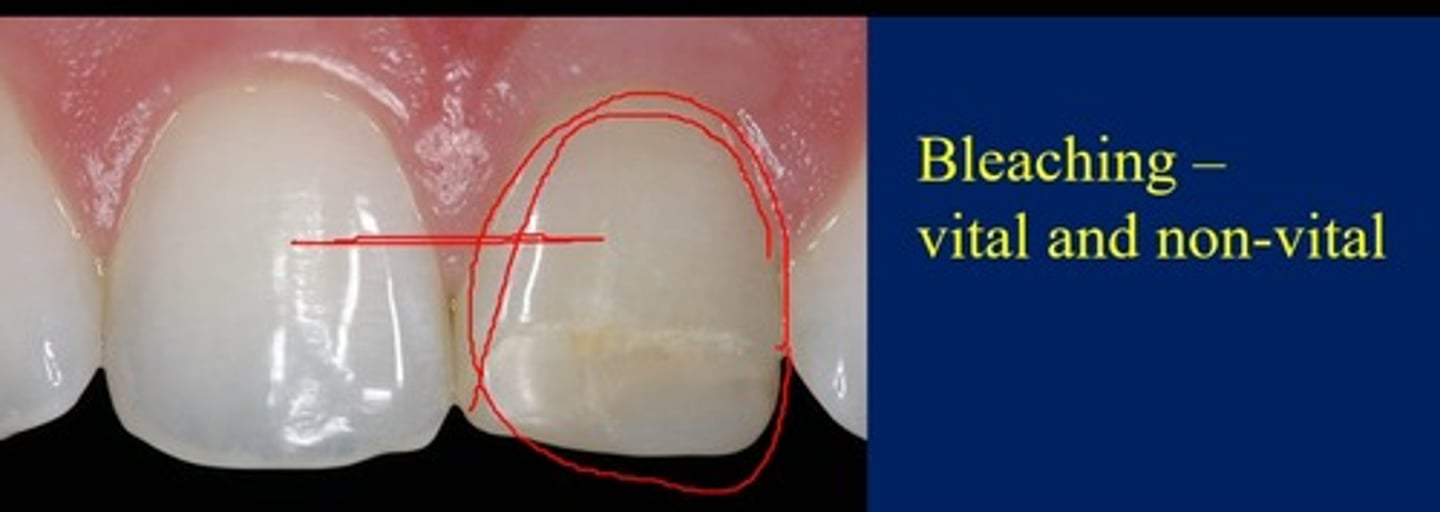
What is microabrasion? When would we perform microabrasion?
chemically and mechanically removing up to 0.2 mm to get rid of slight staining. Staining that would indicate this treatment is usually caused by too much flouride in the diet.
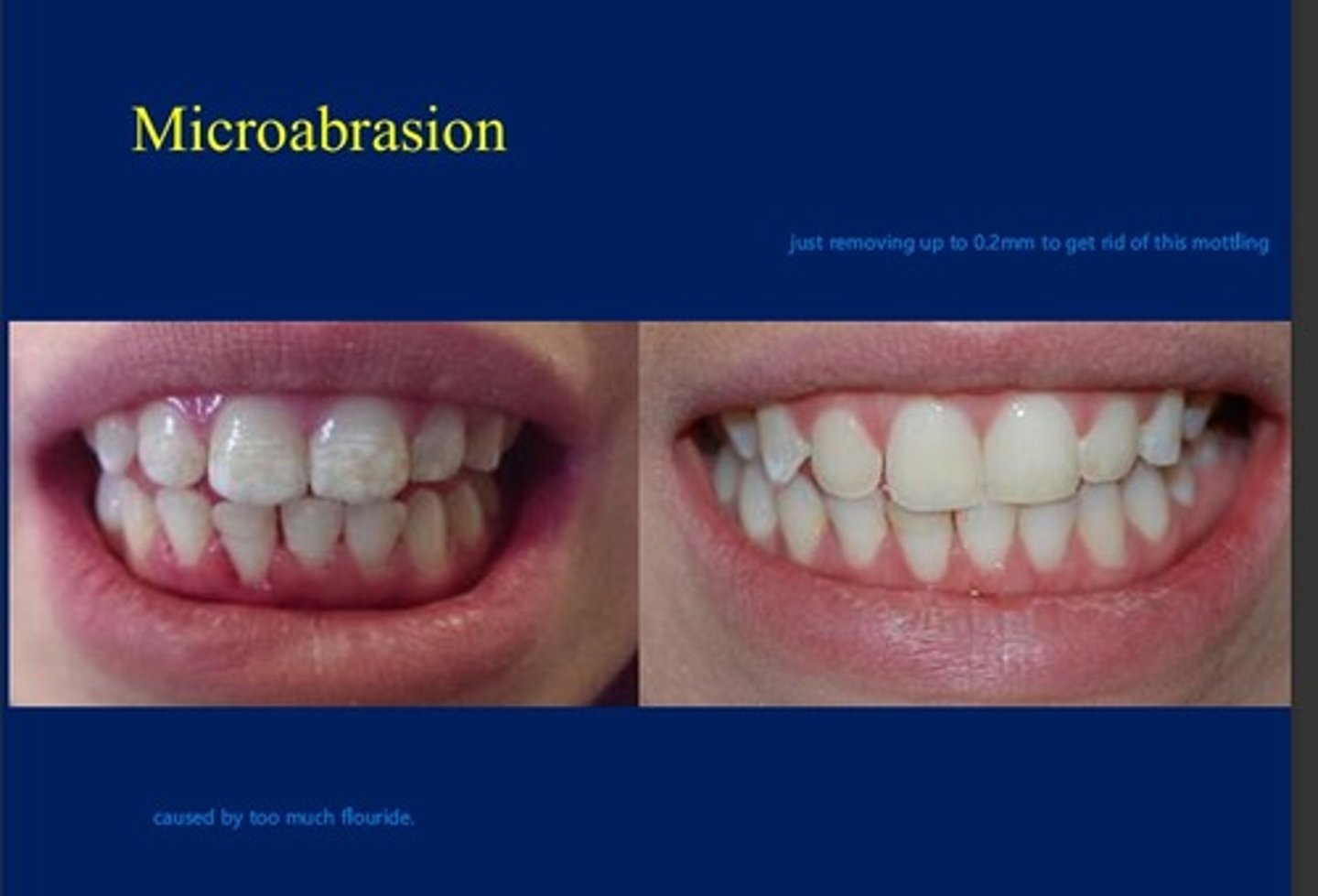
What two things should be used after microabrasion? Why?
MI paste ( calcium and phosphate) to restrengthen tooth after removing enamel.
can then follow up with home bleaching.
When performing an esthetic recontouring, how should gingiva be retracted?
212 clamp or, if not, use flat instrument to manually retract gingiva while prepping and polishing.
( 212 is typically what we use for a class 5 but we can also use it for this purpose)
What are some issues with no prep veneers?
too much space taken up in mouth.
strained upper lip
teeth out beyond lower lip
does not look as natural
potential problems with occlusion / bite.
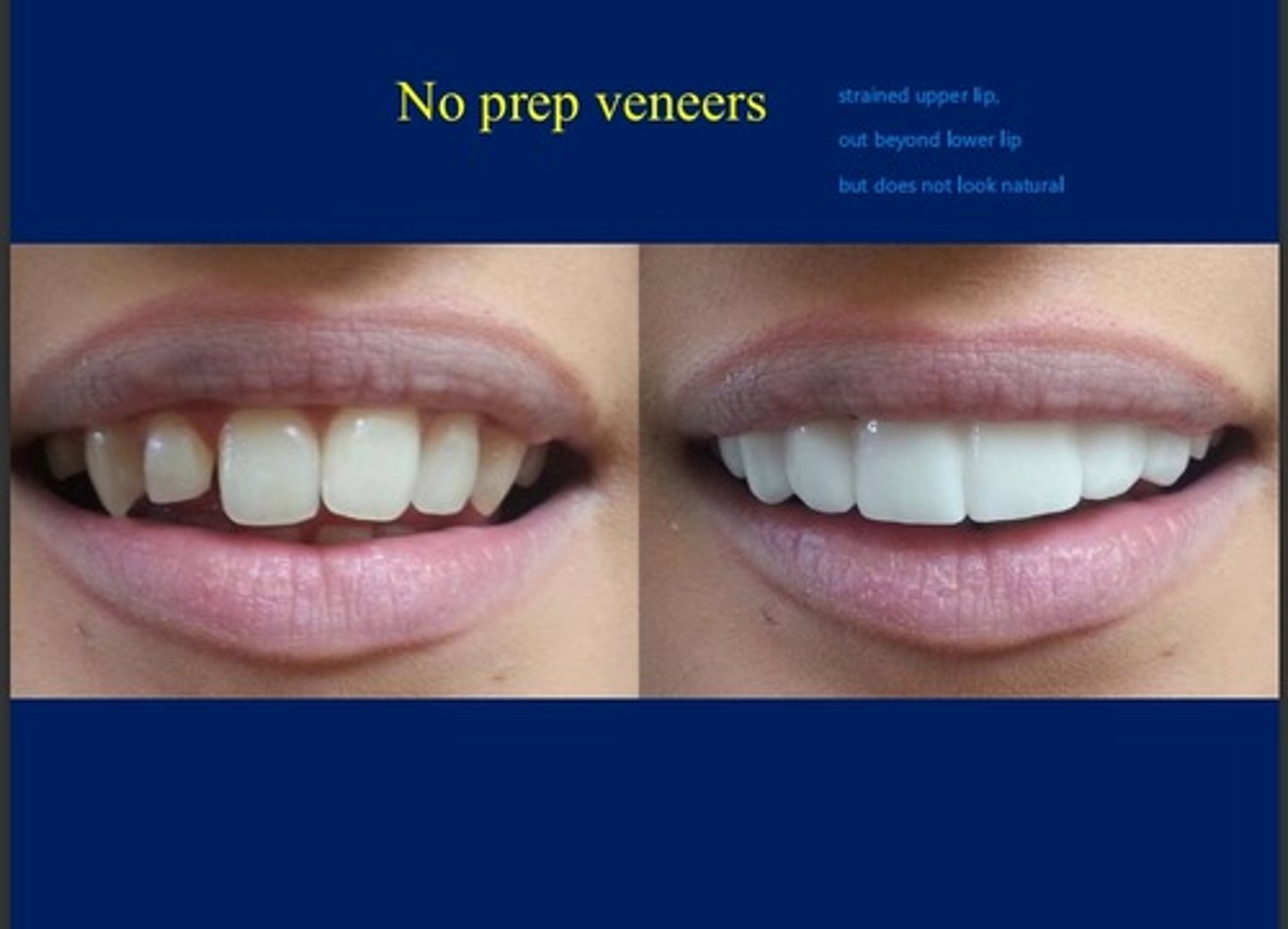
Should enamel be reduced? Why yes, why no?
usually YES:
provides space for composite and esthetic layering
creates bondable rough surface
establishes a definite finish line that doesn't attract plaque.
some cases for NO:
procedure is more reversible
space for composite is not always needed.
What type of bur can be good for creating champfer? What should we consider when doing so?
round ended tappered diamond bur
using only HALF diameter of bur (or even less depending on diameter of specific bur) to create proper finish line.
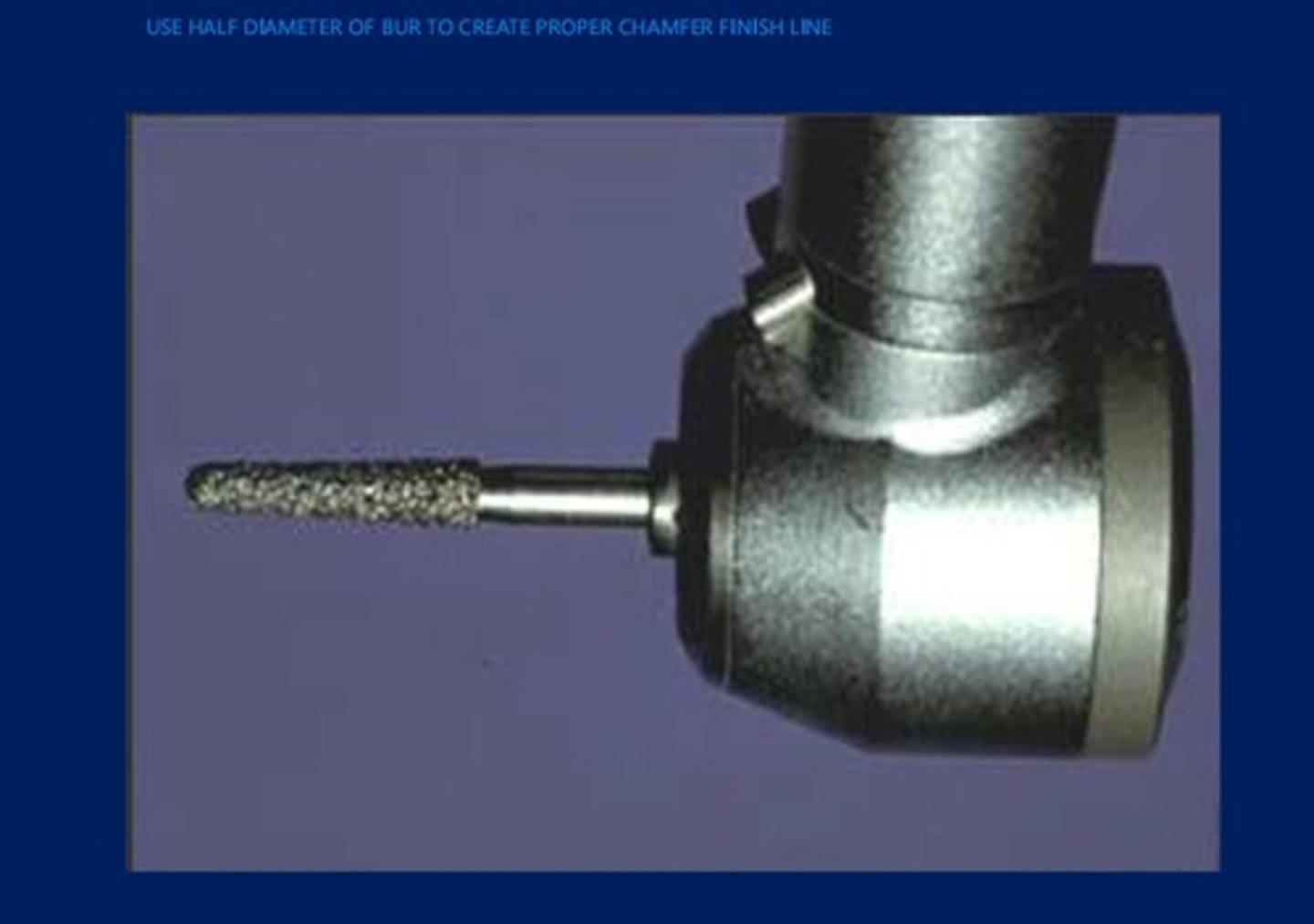
What types of burs can be useful for horizontal depth cuts?
depth cuting burs.
0.3 for across surface for gingival
0.5 for mid facial and towards incisal
What are the typical measurements for enamel reduction?
general rule : 1/2 enamel thickness
specifics:
0.3-0.5 gingivally
0.5 midfacial
0.75 incisally
specifics though will always vary depending on tooth size
What should be considered when performing a tooth reduction?
facial contour. Need to angle the bur properly to get uniform reduction.
What are the typical contours of an anterior tooth surface as discussed in lecture?
gingival 1/3 follows free gingival margin
mid-facial is usually flat
incisal 1/5 usually tilts lingually
4 main accomplishments for tooth reduction for a final preparation prior to veneer placement:
reduce the line angles
include al lvisible proximal surface
do NOT break contact
"exact representation of anatomy of tooth prior to starting"
no INTENTIONAL vertical reduction of incisal edge
( note some reduction will occur naturally as a result of the contour of the tooth)
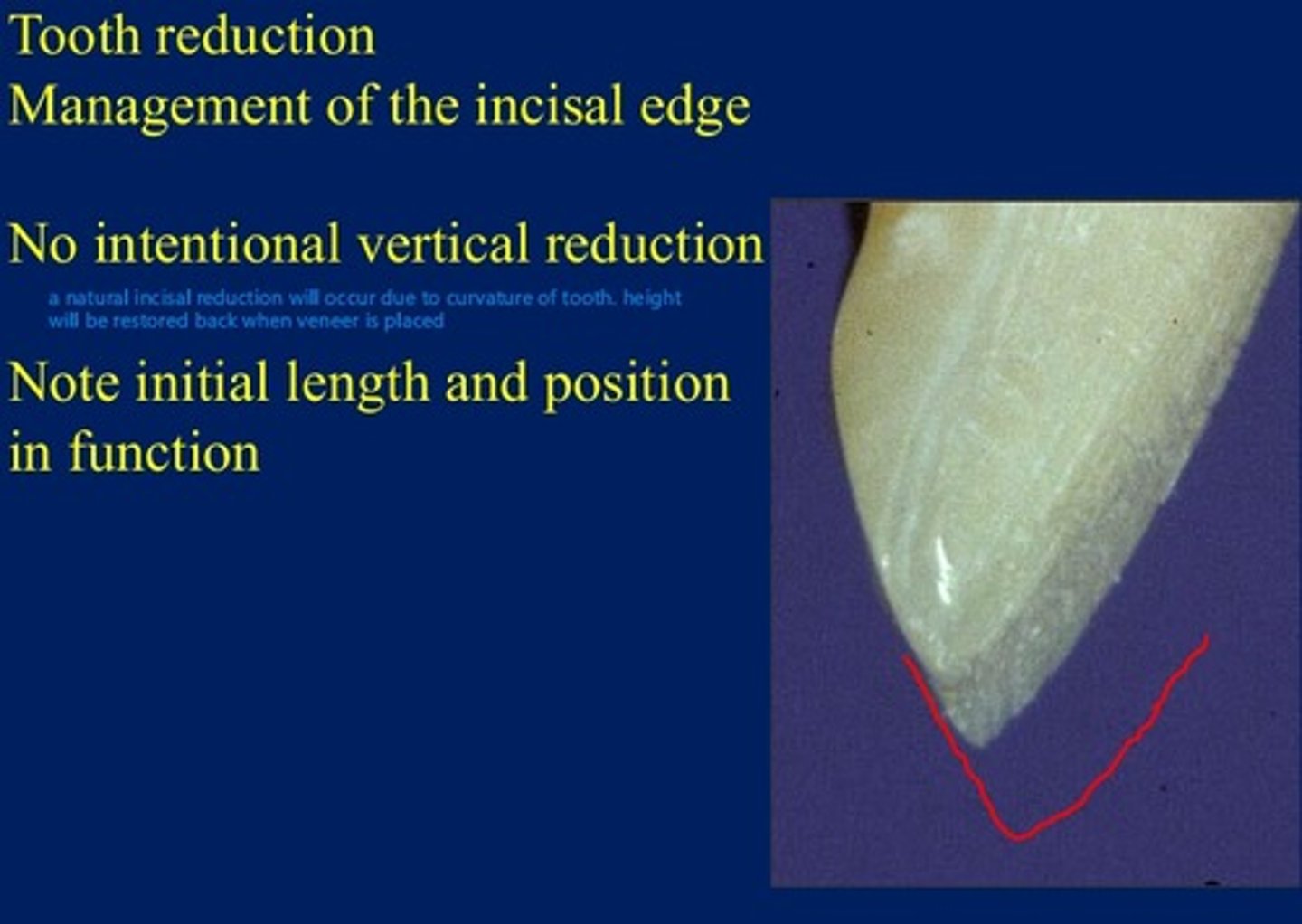
How do we manage cavosurface margin during tooth reduction?
definite margin needed for finishing
slight chamfer is created
Enamel margins are preferred unless defect extends subgingival
How do we best create the slight chamfer? Why?
using a round end tapered diamond
larger diameter creates a favorable chamfer ( only using half diameter!)
round bur or smaller diamonds can fit into proximal areas
What is an emergence profile?
basically: the qualities of the tooth at the site of emergence ( gingival).
angle of emergence, size of tooth at emergence, etc.
too flat / too bulky will affect gingival tissue
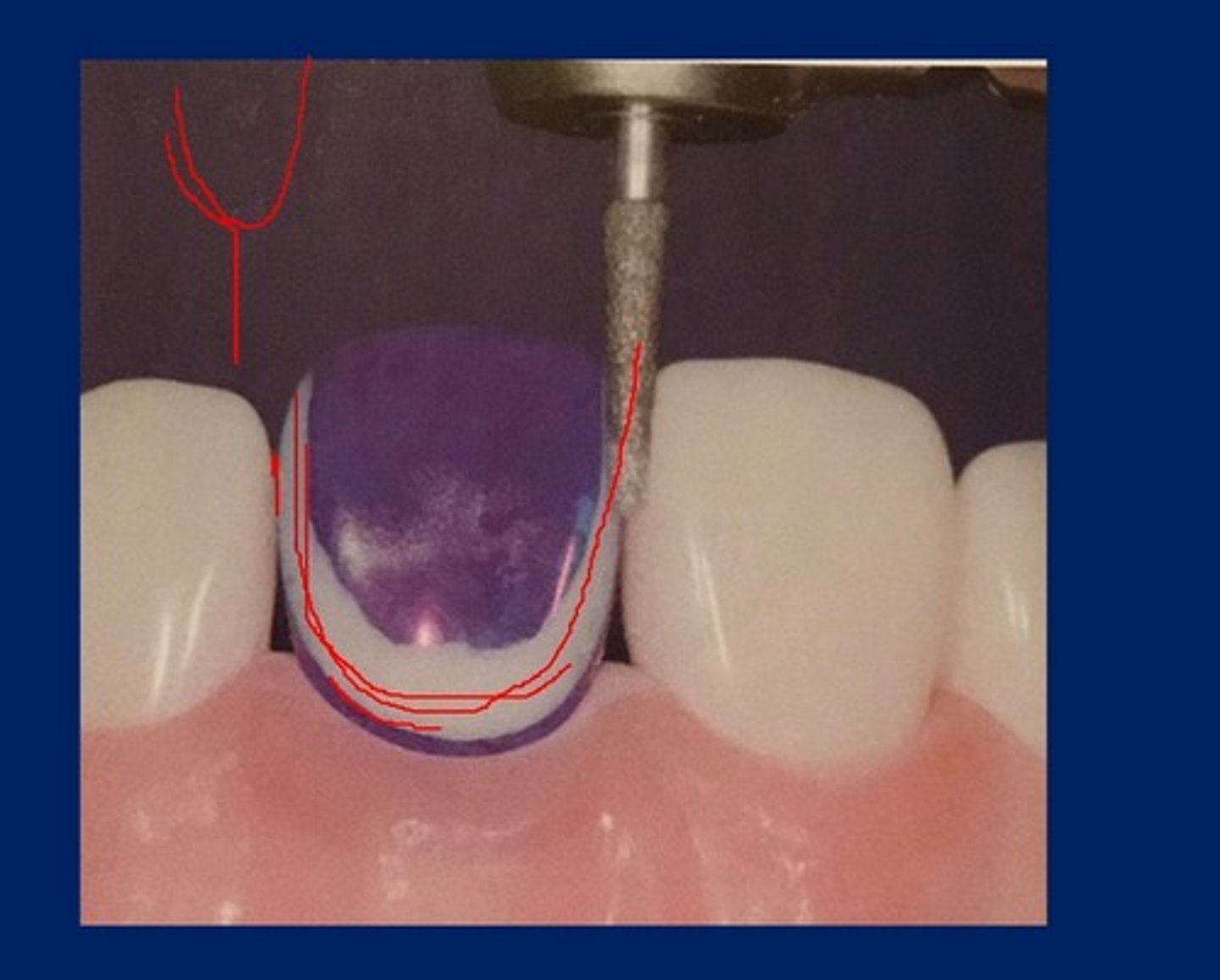
describe the creation of a chamfer finish line as demonstrated towards the end of lecture
starting with bur as close to adjacent tooth without touching it and going down and then all the way around the tooth to create a cavosurface margin going into the contact point but not breaking it.
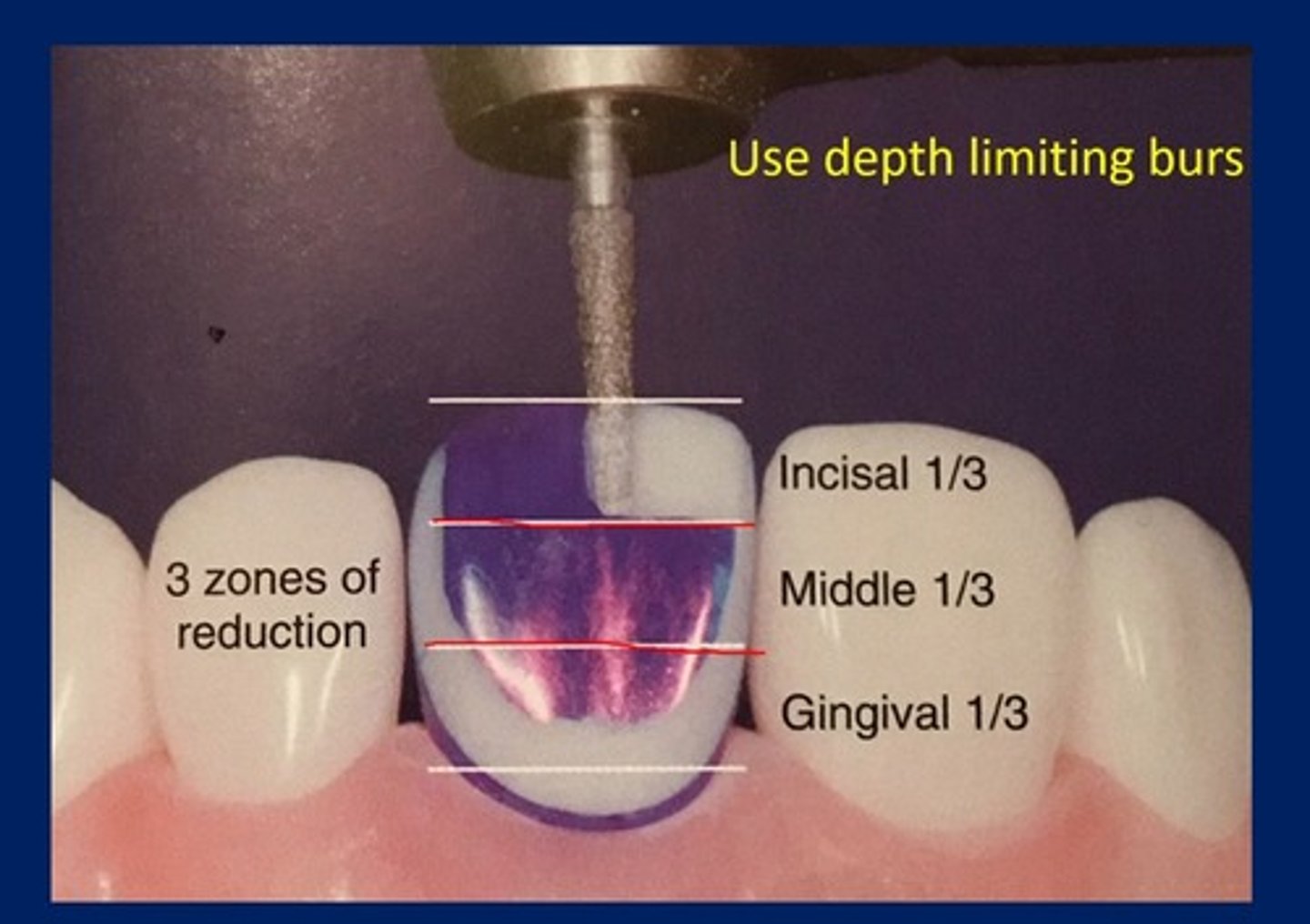
What do we do after establishing that finish line?
use depth limiting burs to create depth cuts across the surface of the tooth before coming back with our round ended tappered diamond.
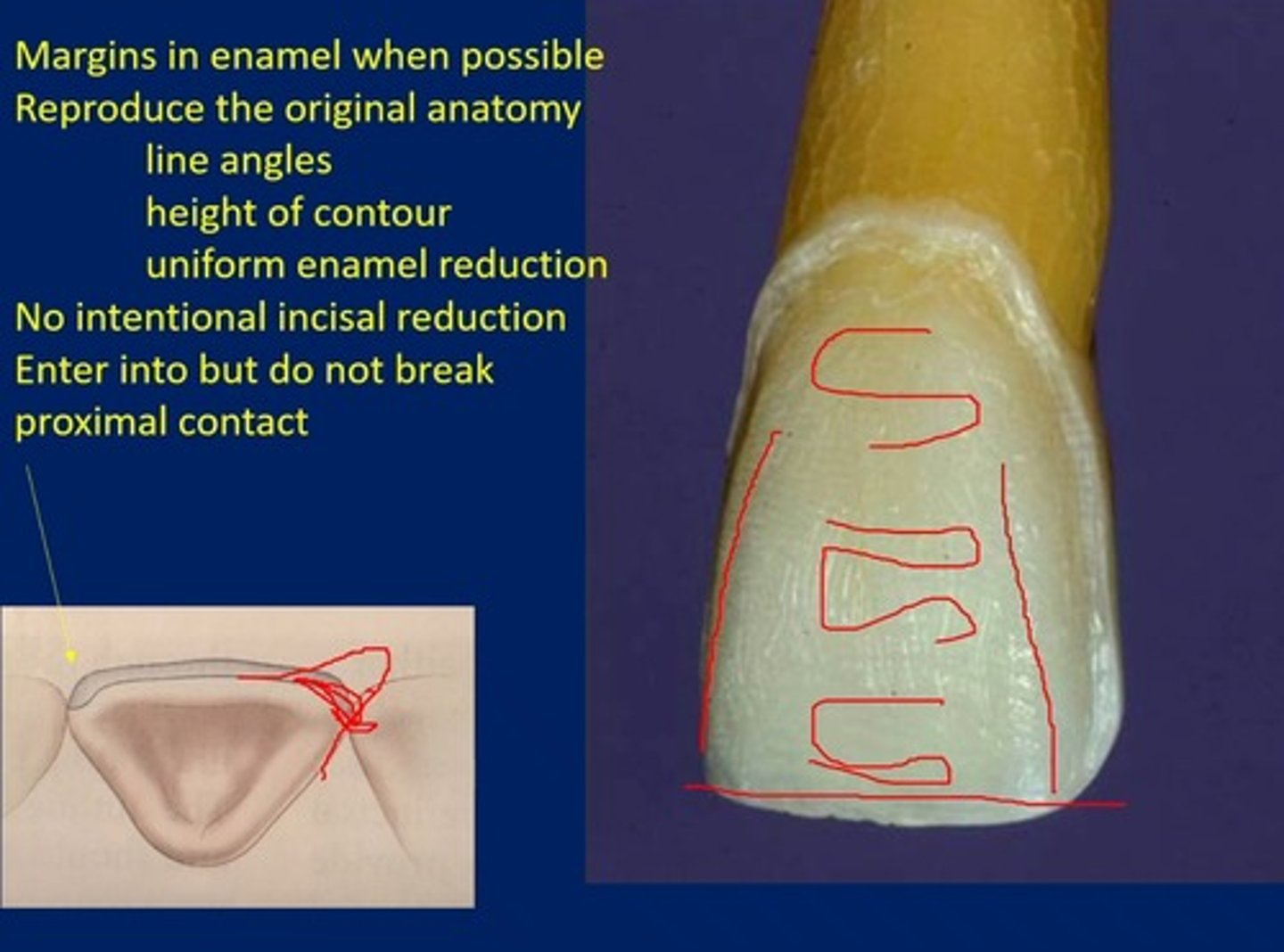
When might you do an intentional reduction of the incisal?
when doing an enameloplasty on, for example, a rotated tooth to make it symmetrical with the adjacent tooth
What type of matrix band do we use for veneer?
dead soft or clear matrix
both help shape the proximal contour while also protecting adjacent tooth from etch.
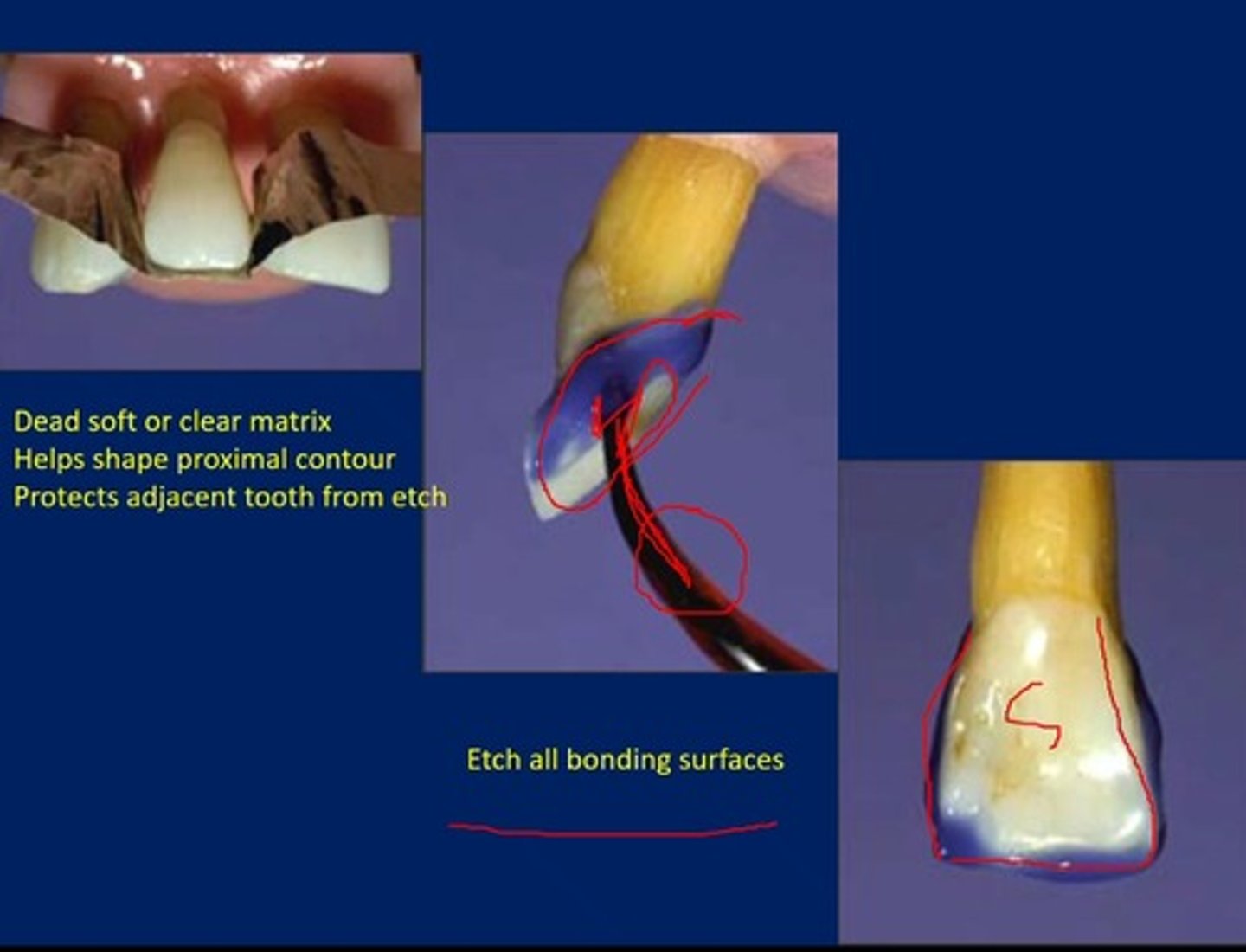
What parts of the tooth do we etch?
etch all the bonding surfaces of the tooth.
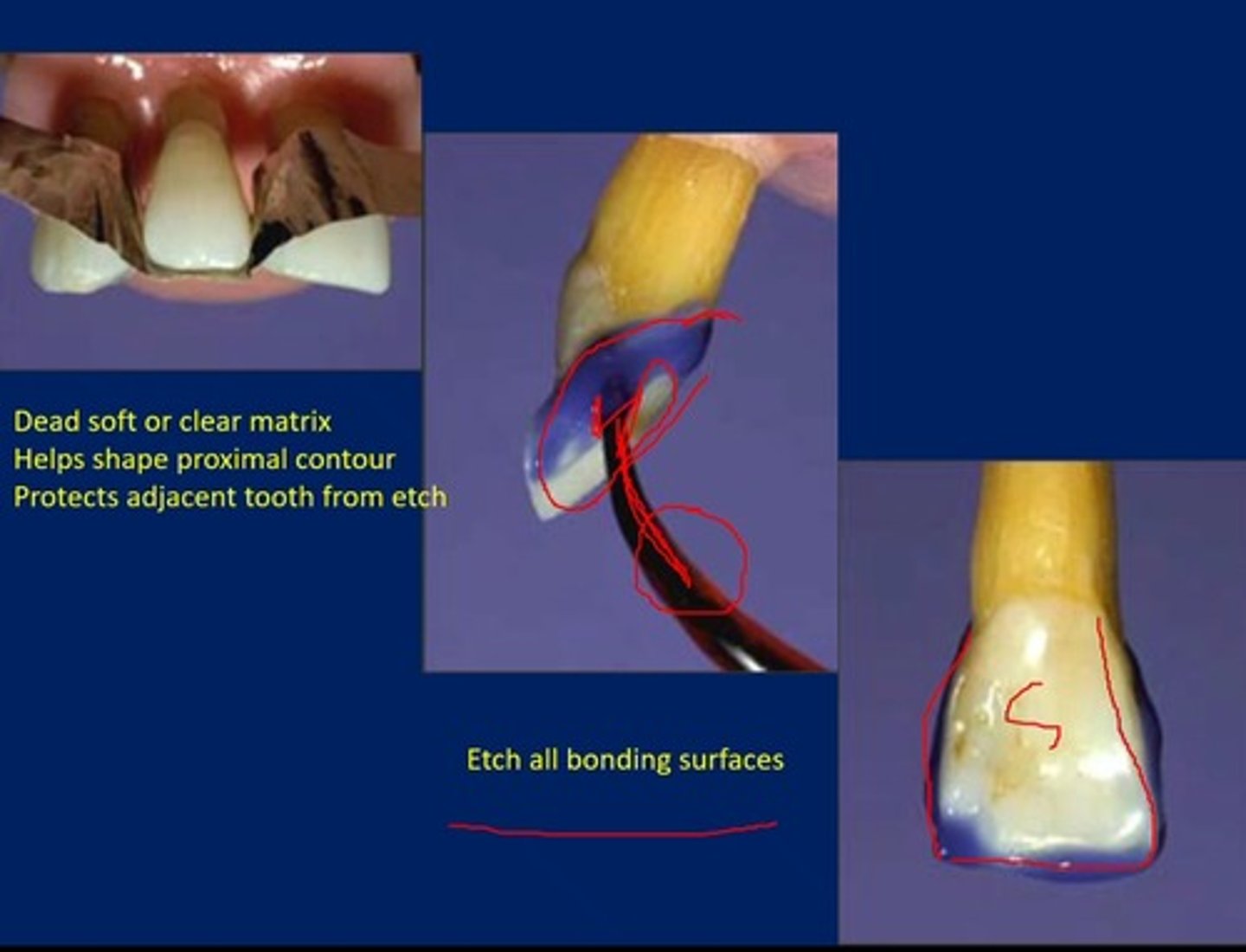
steps after etching:
etch is rinsed, tooth dried, bonding agent applied, light stream of air, apply curing light. apply composite.
When applying composite to the veneer, where should we start?
at the gingival margin to ensure it is closed and then pushing it incisally. It is much easier to remove excess material from the incisal.
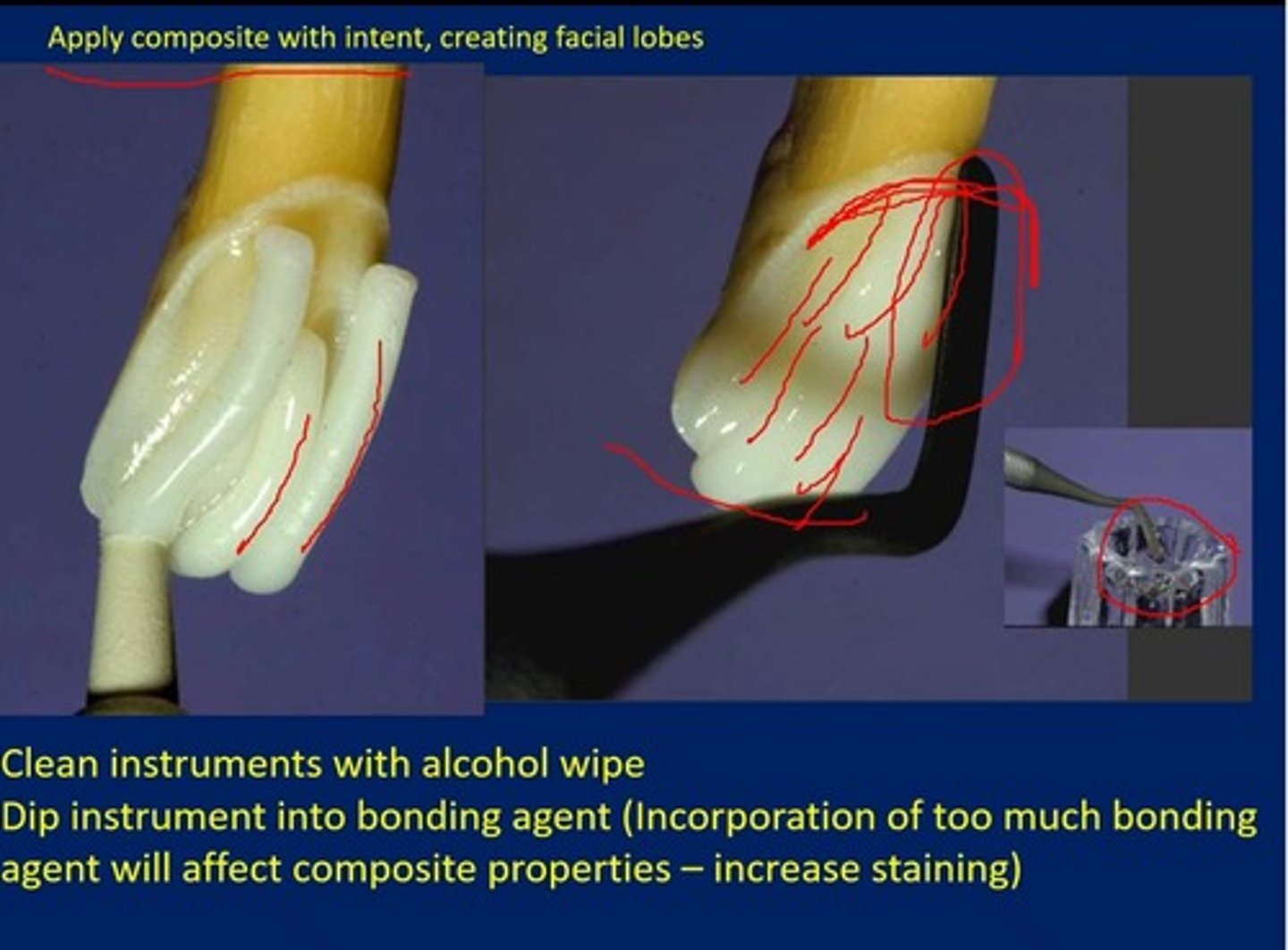
4 Steps / considerations for finishing and polishing veneer
obtain initial esthetic contour with careful placement of composite resin prior to curing
use finishing diamond to make initial corrections to esthetic contour and remove excess
use enhance and brassler flexible discs and polish with polishing paste
DO NOT use coarse diamonds of discs
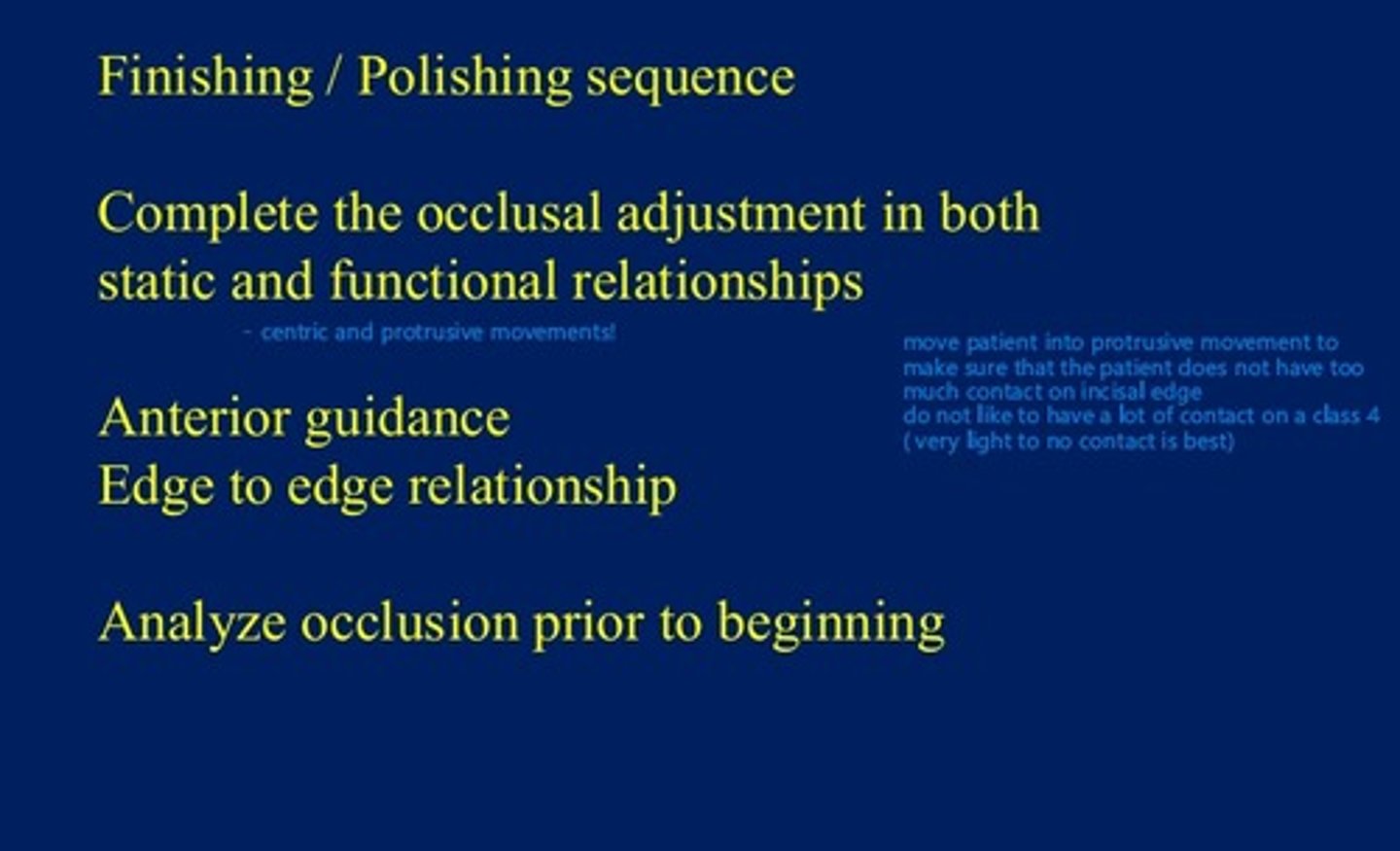
Prior to obtaining final esthetic shape and contour, it is very important to account for the ______ and _____ relationships of the teeth by completing _______.
static and functional relationships of the teeth by completing occlusal adjustment
What do we mean when we say we need to account for the static and functional relationships of the teeth? How do we check this?
take into account centric and protrusive movements. Antior guidance, edge to edge relationships.
check occlusion prior to beginning! Also: move patient into protrusive movements to make sure there is not too much contact on incisal edge.
we want very light to no contact on completed restoration.
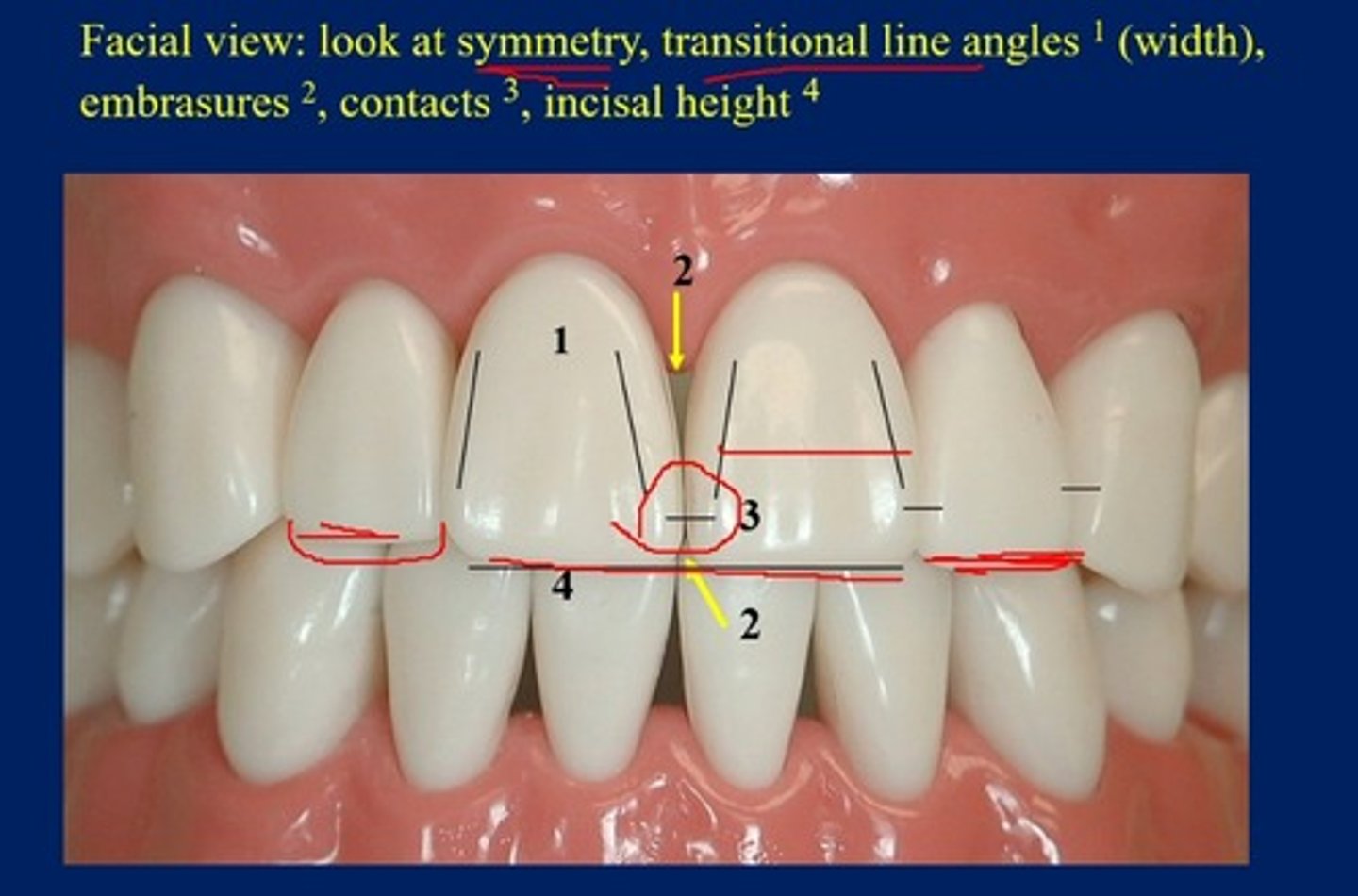
What do we check for on facial view?
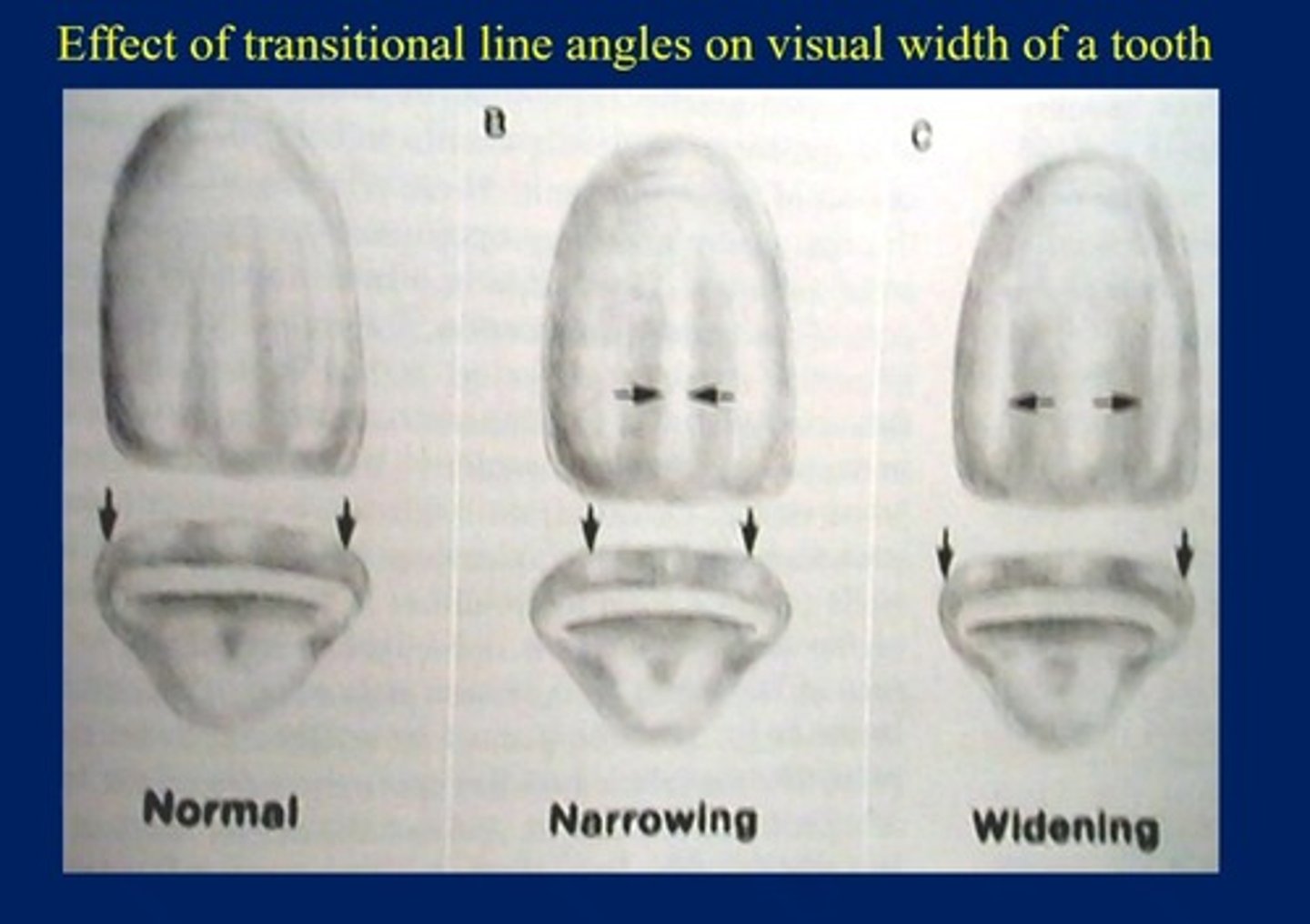
symmetry, transitional line angles ( width), contacts, incisal height
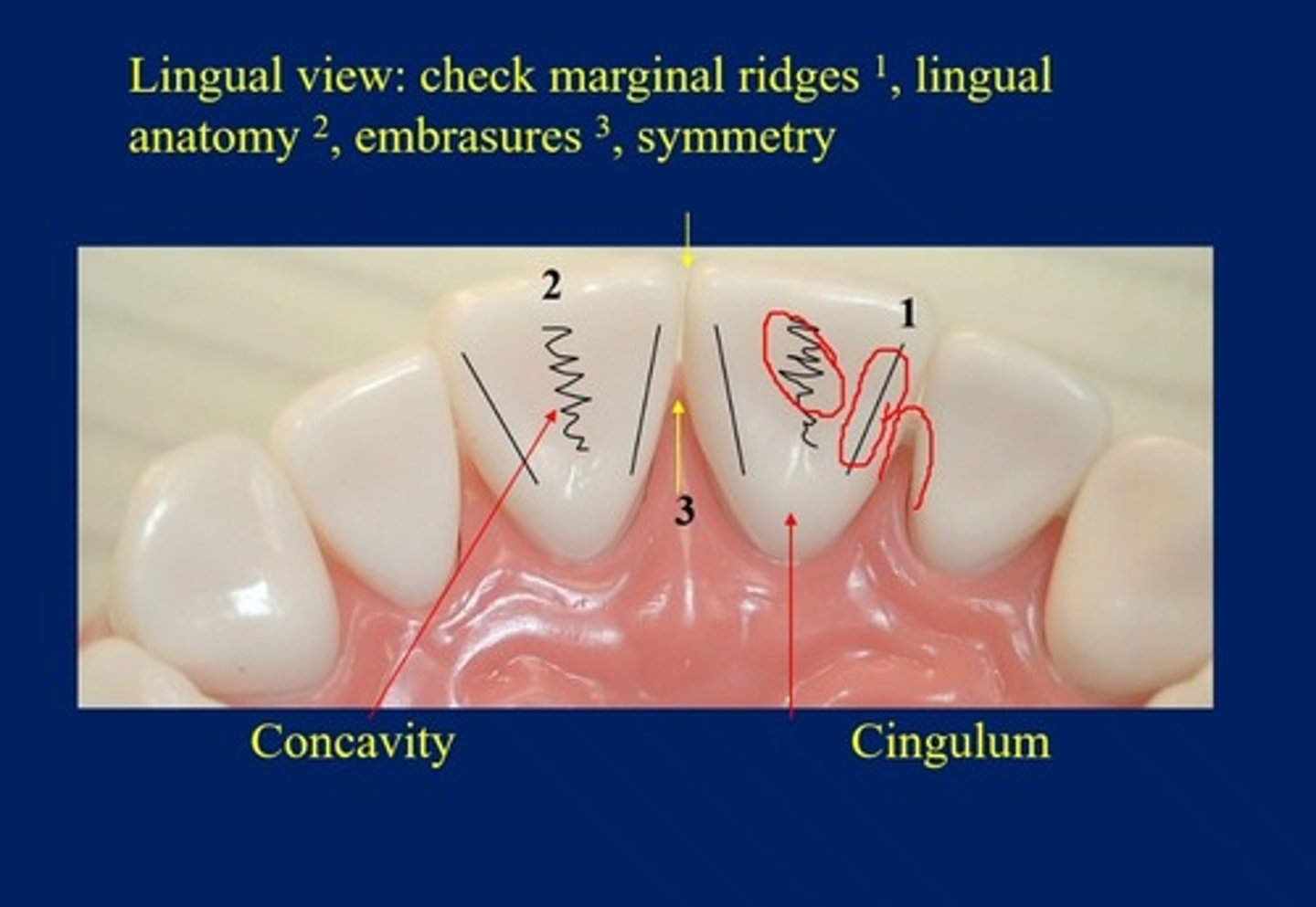
What do we check for on a lingual view?
check marginal ridges, lingual anatomy, embrasures, symmetry
Describe the effect of changing transitional line angles on visual width of tooth
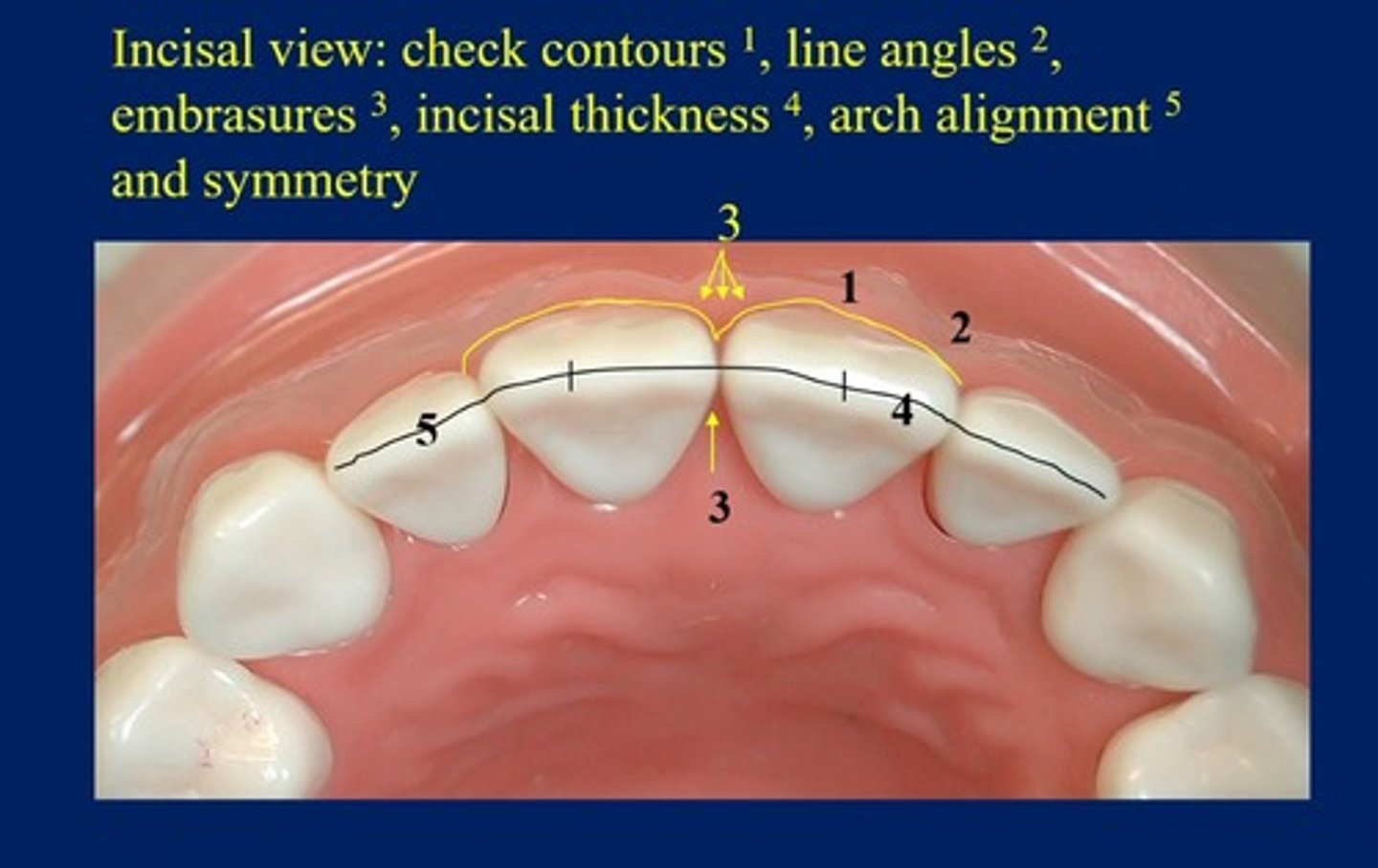
What do we check for on incisal view?
contours, line angles, embrasures, incisal thickness, arch alignment, and symmetry
If something is wrong with symmetry embrasures, what is usually contributing?
transitional line angles.
What do we check for on lateral view?
contours, height of contour
Which is worse for an emergence profile: too bulky or too flat?
too bulky
distal line angle on a central incisor is more _____ than the mesial
rounded
Tooth lengthening strategies (6) ( narrowing)
accentuated lobes and depressions
closely placed line angles
irregulaar incisal edge
minimal horizontal features
slightly darker tooth shade
large incisal embrasures
Tooth shortening strategies (6) (widening)
minimal lobes and depressions
widely spaced line angles
straight incisal edge
accentuated horizontal features
slightly lighter tooth shade
minimal incisal embrasures
Which type of veneer has the highest satisfaction after two years
porcelain: doesn't stain. high luster.
composite tends to stain.