END OF YEAR BIOLOGY
0.0(0)
Studied by 0 people View linked note
 Call Kai
 Learn
Learn Practice Test
 Spaced Repetition
 Match
Match Flashcards
 Knowt Play
Card Sorting
1/60

There's no tags or description
Looks like no tags are added yet.
Last updated 11:14 AM on 6/15/23
Name | Mastery | Learn | Test | Matching | Spaced | Call with Kai |
|---|
No analytics yet
Send a link to your students to track their progress
61 Terms
1
New cards
Cells can either be
prokaryotic-single cell and eukaryotes-organisms
2
New cards
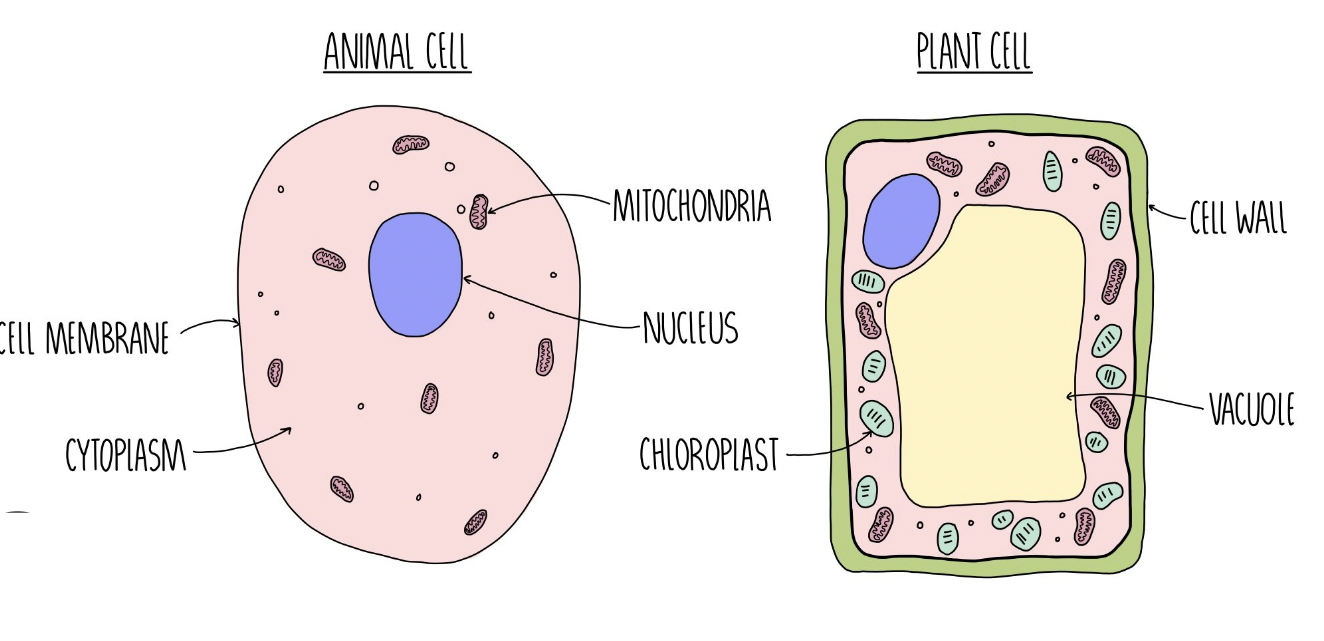
What are the diffrences between plant and animal cells
animal cells dont have a cell wall or chloroplasts to do photosynthesis with.
3
New cards
Bacteria
They dont have mitochondria or chloroplasts. they also dont have a nucleus. DNA floats freely in the cytoplasm.
4
New cards
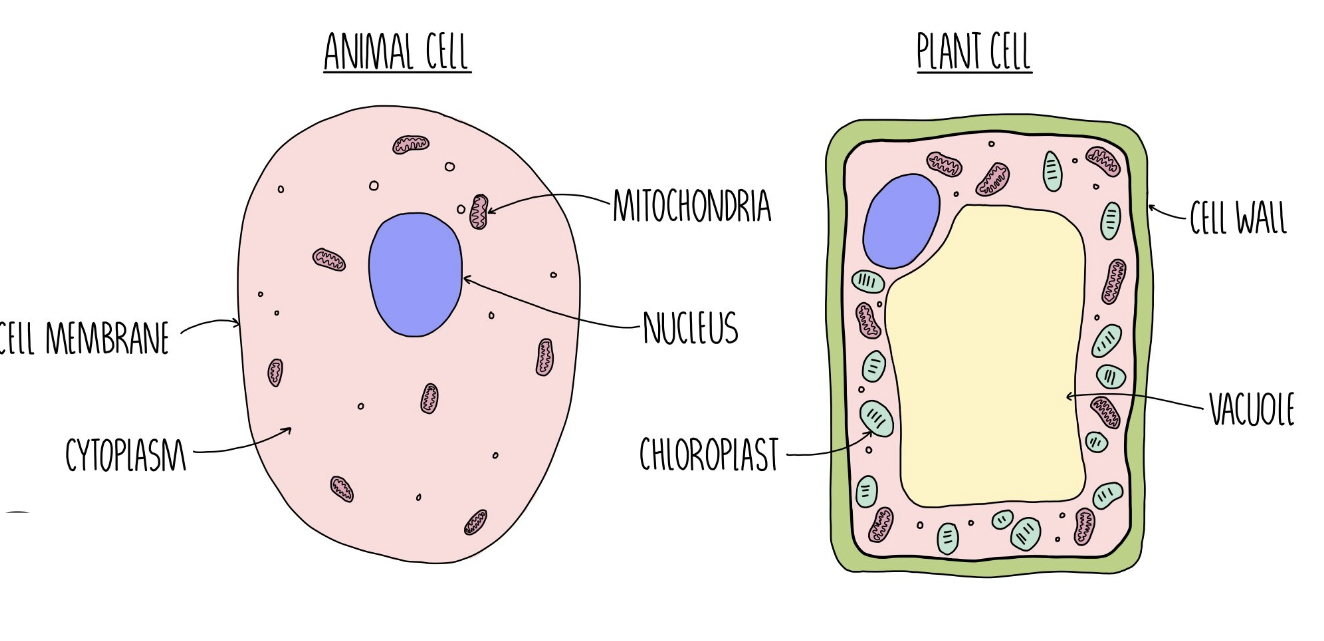
Diffrences between plant and animal cells
animal cells dont have cell walls or chloroplasts.
5
New cards
magnification =
image size/real size
6
New cards
Differation
when a cell changes to become specialised
7
New cards
Sperm cells
repoduction
8
New cards
nerve cells
rapid signalling
9
New cards
muscle cells
contraction
10
New cards
root hair
absorbsion of water and minerals
11
New cards
Phloem and xylem
transporting substances
12
New cards
Organs systems
are organised into organ systems, which work together to form organisms.
13
New cards
Organs
are groups of tissues performing specific functions.
14
New cards
A tissue
is a group of cells with a similar structure and function.
15
New cards
Cells
they make up all living organisms
16
New cards
diffusion
movement of a substance from a region of high concentration to a region of low concentration
17
New cards
What affects diffusion
The greater the difference in concentration, the quicker the rate of diffusion.
The higher the temperature the faster they will move and mix.
The greater the surface area, the faster the rate of diffusion.
The higher the temperature the faster they will move and mix.
The greater the surface area, the faster the rate of diffusion.
18
New cards
what diffuses in and out of cells
O2 CO2 and glucose
19
New cards
Surface area to volume ratio
find area (length X width)
Find volume (lenght X width X height)
put into ratio
Find volume (lenght X width X height)
put into ratio
20
New cards
how the small intestine and lungs in mammals, and roots and leaves in plants, are adapted for exchange of substances.
they all have large surface areas and a thin membrane.
21
New cards
What is osmosis?
It is the movement of water across a semipermeable membrane from high concentration
22
New cards

how to investigate the effect of salt or sugar solutions on plant tissue.
prepare sugar solutions with a range of concentrations
set up one with distilled water to act as the control
cut up potato and measure the mass of each one
leave the potato in each of the solutions for 24 hours
After 24 hours take the potatoes out of the solution and measure their mass
calculate percentage change in mass
change in mass= (mass at end - mass at start)/ mass at start X 100
set up one with distilled water to act as the control
cut up potato and measure the mass of each one
leave the potato in each of the solutions for 24 hours
After 24 hours take the potatoes out of the solution and measure their mass
calculate percentage change in mass
change in mass= (mass at end - mass at start)/ mass at start X 100
23
New cards
Active transport
movement of cells from low to high concentration.
24
New cards
photosynthisis
co2+water → glucose+o2
25
New cards
Lactic acid
makes muscles hurt is toxic, oxygen is used to get rid of it
26
New cards
AEROBIC 1
releases lots of energy, uses o2, produces c02 and h2o, long time, low intensity, C6H12O6+O2→CO2+H20,
27
New cards
ANAEROBIC
RELEASES LESS ENERGY, SHORT TIME, HIGH INTENSITY, GLUCOSE→LACTIC ACID, HAPPENS IN MUSCLE CELLS
28
New cards
ALVIOLI ADAPTATIONS
THIN CELL WALLS, LARGE SURFACE AREA
29
New cards
OXYGEN DEBT
The amount of oxygen required to remove the lactic acid, and replace the body's reserves of oxygen
30
New cards
LIMITING FACTORS
A FACTOR THAT LIMITS PHOTOSYNTHESIS PRODUCTS OF RESPIRATION WATER AND CO2
31
New cards
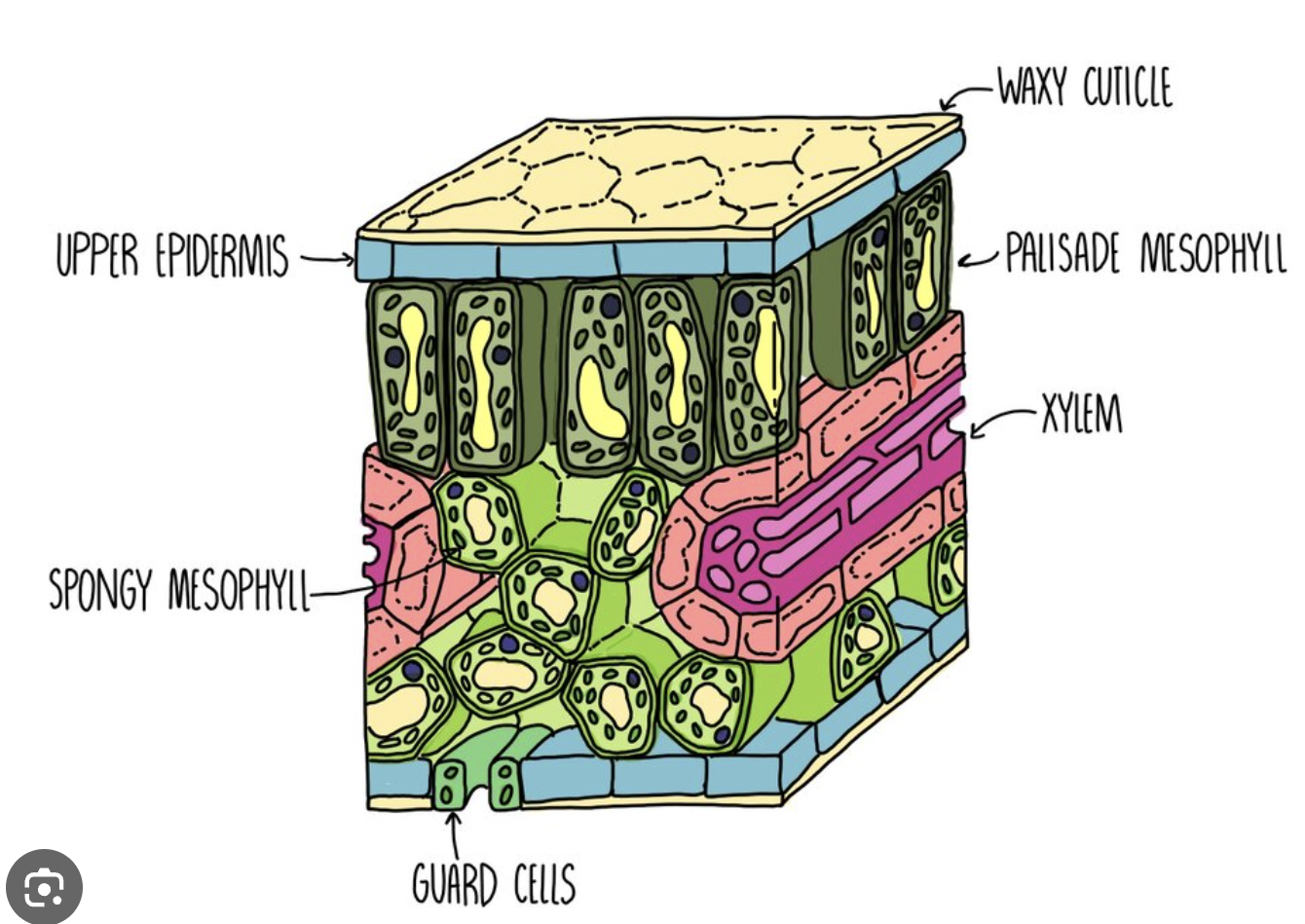
Layers of plant tissue
waxy cuticle-stops water from evaporating out of leaf
palisade layer- contains chloroplasts , this is where most photosynthesis takes place.
spongy layer- allows teh interchange of gases during photosynthesis.
Guard cells-control what goes in and out of the leave
palisade layer- contains chloroplasts , this is where most photosynthesis takes place.
spongy layer- allows teh interchange of gases during photosynthesis.
Guard cells-control what goes in and out of the leave
32
New cards
affect of co2 on photosynthesis
as co2 increases so does photosynthesis until something else becomes a limiting factor.
33
New cards
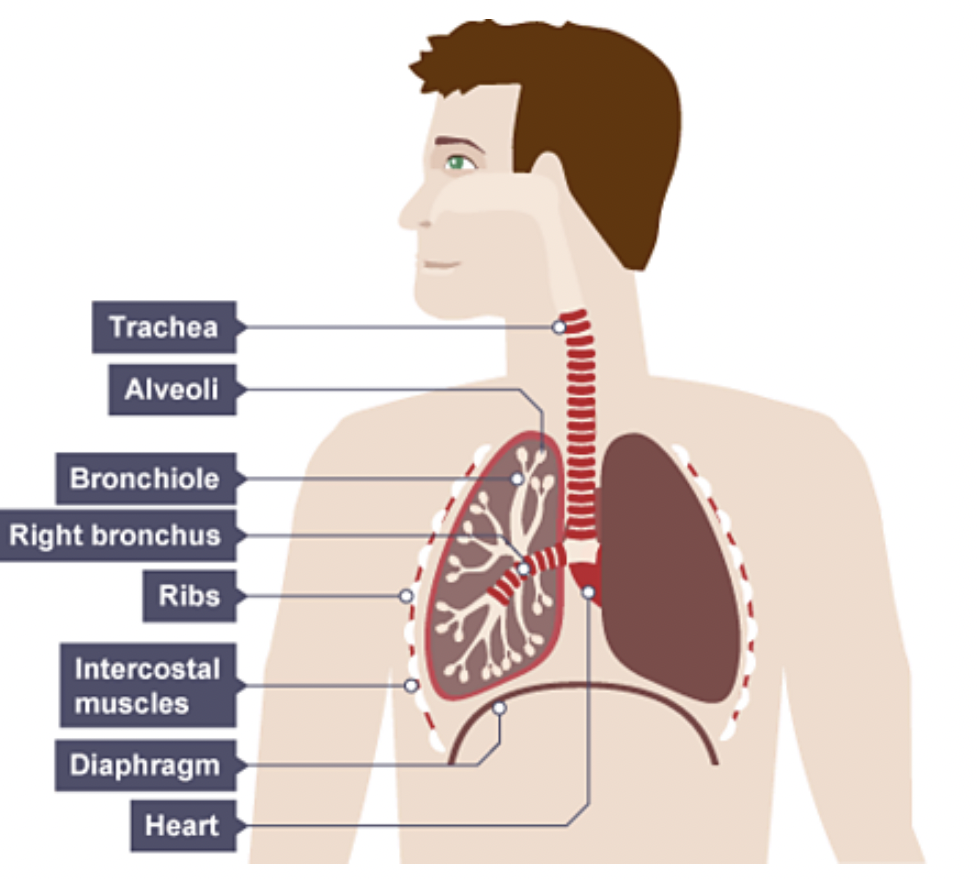
What do alveoli do
carry out gas exchange gas exchange
34
New cards
Adaptations of an alveoli
thin walls
good blood supply
large surface area
good blood supply
large surface area
35
New cards
What are enzymes
Enzymes are catalysts. They speed up useful chemical reactions in the body.
36
New cards
Enzymes need a specific pH and temperature to work. If they are not in this environment they will
denature. this means that the active site changes and it no longer fits the substrate
37
New cards
Starch is broken down into
sugars
38
New cards
Protiens is broken down into
amino acids
39
New cards
Lipids are broken down into
glycerol and fatty acids
40
New cards
Lipids is broken down by
Lipase
41
New cards
Starch is broken down by
Amylase
42
New cards
Where is bile produced
in the liver
43
New cards
where is bile stored
in the gallbladder
44
New cards
Where is bile released
in the small intestine
45
New cards
what does bile do
It neutralises the stomach acid acid emulsifies fats
46
New cards
Salivary glands
Produce amylase in saliva
47
New cards
Oesophagus
Muscle that transports food to stomach
48
New cards
Liver
Bile is produced here
49
New cards
Stomach
Pummels food Produced protease Produced hydrochloric acid-To kill bacteria and give right pH for protease
50
New cards
Gallbladder
Bile is stored
51
New cards
Pancreas
Makes Protease, amylase, lipase
52
New cards
Large intestine
excess water is absorbed
53
New cards
small intestine
digested food is absorbed into the blood
54
New cards
Test for sugars
Benedict’s test Positive-Blue to green to yellow to red
55
New cards
Test for starch
iodine Positive- Orange to black or blue
56
New cards
Test for Proteins
biuret Positive- Blue to purple
57
New cards
Test for lipids
Sudan 3 Positive- Red layer
58
New cards
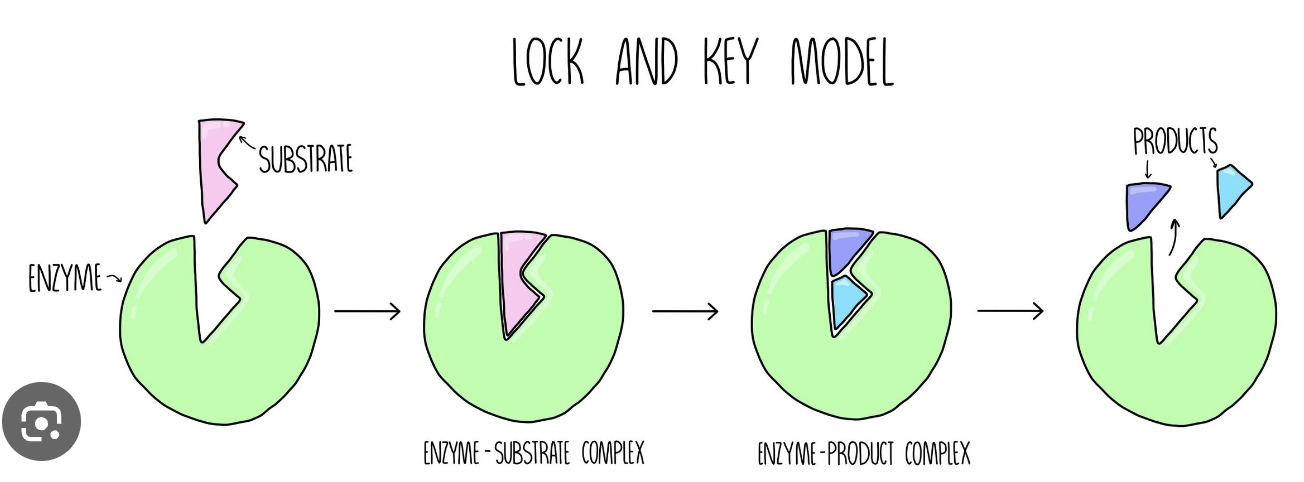
Lock and key model
every active site will have a substrate that will fit perfectly in it .
59
New cards
Digestive system
Digestive system
60
New cards
Method reqired praq limiting factors
* Ensure the water is **well aerated** before use by **bubbling air through it**
* This will ensure oxygen gas given off by the plant during the investigation form **bubbles** and **do not dissolve in the water**
* Ensure the plant has been **well illuminated** before use
* This will ensure that the plant contains all the enzymes required for photosynthesis and that any changes of rate are due to the independent variable
* Set up the apparatus in a **darkened room**
* Ensure the pondweed is submerged in **sodium hydrogen carbonate solution (1%)** – this ensures the pondweed has a controlled **supply of carbon dioxide** (a reactant in photosynthesis)
* Cut the stem of the pondweed **cleanly** just before placing into the boiling tube
* Measure the volume of gas collected in the gas-syringe in a **set period of time** (eg. 5 minutes)
* **Change the independent variable** (ie. change the light intensity, carbon dioxide concentration or temperature depending on which limiting factor you are investigating) and repeat step 5
* Record the results in a table and plot a graph of volume of oxygen produced per minute against the distance from the lamp (if investigating light intensity), carbon dioxide concentration, or temperature
* This will ensure oxygen gas given off by the plant during the investigation form **bubbles** and **do not dissolve in the water**
* Ensure the plant has been **well illuminated** before use
* This will ensure that the plant contains all the enzymes required for photosynthesis and that any changes of rate are due to the independent variable
* Set up the apparatus in a **darkened room**
* Ensure the pondweed is submerged in **sodium hydrogen carbonate solution (1%)** – this ensures the pondweed has a controlled **supply of carbon dioxide** (a reactant in photosynthesis)
* Cut the stem of the pondweed **cleanly** just before placing into the boiling tube
* Measure the volume of gas collected in the gas-syringe in a **set period of time** (eg. 5 minutes)
* **Change the independent variable** (ie. change the light intensity, carbon dioxide concentration or temperature depending on which limiting factor you are investigating) and repeat step 5
* Record the results in a table and plot a graph of volume of oxygen produced per minute against the distance from the lamp (if investigating light intensity), carbon dioxide concentration, or temperature
61
New cards
aerobic respiration is
glucose + oxygen → carbon dioxide + water + energy.