amh 2097- The Fourth Movement of Immigrants/Mexican Immigration in Fourth Movement
 Call Kai
 Learn
Learn Practice Test
 Spaced Repetition
 Match
Match Flashcards
 Knowt Play
1/27

There's no tags or description
Looks like no tags are added yet.
Name | Mastery | Learn | Test | Matching | Spaced | Call with Kai |
|---|
No analytics yet
Send a link to your students to track their progress
28 Terms
Largest wave out of all waves, with millions of immigrants
The Fourth Movement is known as the
Anywhere in the US; come on airplanes majority (no more Ellis/Angel Island/Castle Garden)
Ports of Entry for Fourth Wave
The “Rights” Movement in the 1960s
Any movement that involves getting more rights (voting, existing, financial); Women’s, Black, Chicano, LGBTQ+, happened under JFK
President Lyndon B. Johnson; “The Great Society“
Who was the successor after JFK and what important thing did he implement?
“The Great Society”
Series of ambitious 1960s domestic programs launched by President Lyndon B. Johnson, aiming to eliminate poverty and racial injustice.
Ended 1921 and 1924/system; should not be judged by which country your form, but what you can do for the US
Immigration and Nationality Act of 1965 (Hart-Celler Act)
Main Enactments of the “Great Society” (2)
Immigration and Nationality Act of 1965 (Hart-Celler Act)
Allegedly put incoming immigrants to the US on equal footing by first-come-first serve basis. No more than 20,000 immigrants per home country. Key policy is family reunification (those who alr have family in US)
80% of immigrants coming from Latin America and Asia
What was the result of the “Great Society” loosening immigration?
Creation of the terms “New, New Immigrants“ and “Undocumented“
End of Quota Acts= ended the exception rule of Quota Acts, which ends Bracero Program, resulting in decreased Mexican Immigration
Other effects of the the “Great Society” enactments
“New, New Immigrants”
Term referring to the wave of immigrants arriving in the U.S. post-1965, largely from Latin America, the Caribbean, and Asia. U
“Undocumented“
Term created in effect of the establishment of visas; Individuals residing in a country without legal authorization, often entering without inspection or overstaying visas.
Mexicans now must apply for Visa like everyone else due to Immigration and Nationality Act of 1965. Women now immigrate.
Due to new established Immigration and Nationality Act of 1965, how do Mexicans enter the US in the Fourth Movement?
1. Official Visa
Commuter Visa
“Border Crosser“ Visa
Undocumented
4 Ways Mexican Men AND Women enter US
Official Visa
Apply for Visa, go through medical tests, fingerprinting, etc. all in home country and then get into US by walking/public transport to border.
Official Visa (only 20,000 allowed a year). Most Mexicans want this bc then they would be official and also wouldn’t be stopped from going back and forth at border by US
Which Visa was the most coveted for Mexicans? Why?
Commuter Visa
Visa that allows Mexicans to live in Mexico and still be citizen of Mexico but work in US, must maintain distance from 20 miles away from border.
“Border Crossers” Visa
Visa that allows short-term work permits. Can come to US for temporary work (1-2 yrs) then go back and must reapply again
Undocumented (No Visa)
Mexicans entering without documentation supported the stereotype that all Mexicans are illegal
Violence
Wages- Lowest of any group in the US (couldn’t negotiate a minimum wage bc excluded from white labor unions)
Segregation- Barred from white neighborhoods
US Commission on Civil Rights in 1970-71 reports- Mexicans affected more than any other group in the US
Discrimination against Mexicans in the Fourth Movement
Border Patrols
Reform and Control Act (1986)
Border Wall of Fencing
Racial Profiling
US Government Responses to Undocumented Immigration
Reform and Control Act (1986)
Shifted the blame of illegal/undocumented immigration from Mexicans to he American’s who employed them. If an American employs an immigrant, they will be fined/have the burden of proof. Undocumented Mexicans already in the US have the option of amnesty.
Burden of Proof (in application to Mexican Immigration)
Reform and Control Act (1986); American employers have the legal obligation to provide sufficient evidence to support their claims that they do not employ undocumented immigrants
Amnesty
Under Reform and Control Act (1986); granted amnesty if you go in and turn themselves in; many Mexicans think this is a trick to round up and ship them off so they don’t apply for amnesty
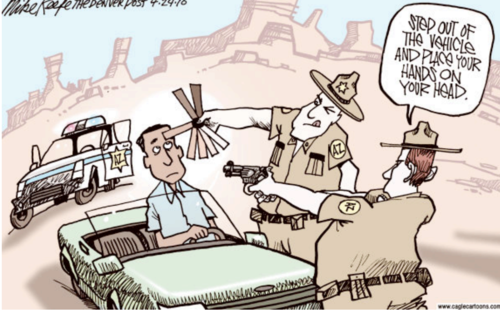
“Step Out of the Vehicle” Political Cartoon
Reinforced discrimination by racial profiling. Officers in Arizona were given skin tone placards to determine if they are undocumented are not based on skin tone. Guns in cartoon feed into “violence” stereotype. In convertible so they could see his skin tone while driving.
Many did not assimilate, but few did.
Did Mexican and Mexican-Americans in the Fourth Movement assimilate?
Incorporated Americans- First Mexicans in America were Incorporated Americans, not immigrants, so kept culture they had already living in that territory before it became US
Ancestors of Incorporated- remind them of their culture so less assimilation
Refresh (TV)- reinforce positive stereotypes about Mexican community
Ethnic Enclaves (neighborhoods)- keep structure of previous ethnic enclaves
Proximity to Mexico- if you’re living right across the border, Americans will likely not try to assimilate you
Reasons why many Mexicans did not assimilate
Chicano/Chicana Movement
Part of the rights movements of the 60s.Embracing Mexican culture, great interest in Mexican art and music and being proud. instead of fearful, “Mexican” as a positive connotation. Keeping traditional names, going back to church, parades
United Farm Workers (UFM)
First farm workers union created ever. To get a minimum wage, the right to organize, collectively bargain.