EDHD 460 2nd Half of Semester
 Call Kai
 Learn
Learn Practice Test
 Spaced Repetition
 Match
Match Flashcards
 Knowt Play
1/149

Earn XP
Description and Tags
In preparation for Final Exam
Name | Mastery | Learn | Test | Matching | Spaced | Call with Kai |
|---|
No analytics yet
Send a link to your students to track their progress
150 Terms
Cognitive learning processes
how information is received, organized, stored, and retrieved by the mind. (e.g., social cognitive theories, information processing theories, metacognition, conceptual learning, reasoning/thinking, and problem solving/creativity)
Metacognition
Cognition about cognition, deliberate conscious control of cognitive activity, people’s awareness of their own cognitive processes
Helps us understand WHY phases of information processing theory occur
Flavell: jumpstarted research abt metacognition
Declarative knowledge
factual information (knowing THAT something occurred, e.g., facts, historical dates)
Procedural knowledge
knowing HOW something occurs (reading strategies, goal settings, math algorithms)
Conditional knowledge
Knowing WHEN & WHY to use declarative/procedural knowledge (e.g., skimming the text to find the main idea when it’s appropriate; adapting teaching method to meet a student’s need), IMPORTANT for metacognition
Helps students select/apply declarative/procedural knowledge that applies to task goals
Lack of conditional knowledge abt when/why d and p knowledge is valuable -> inappropriate use (e.g., skimming important reading)
Represented in LTM as propositions in networks and linked w d & p knowledge to which it applies
An integral part of self-regulated learning (selecting effective strategies before starting a task)
Metacognition Involves 2 related sets of skills:
1. Knowing WHAT a task requires (skills, strategies, resources)
2. Knowing HOW AND WHEN to use skills/strategies effectively to ensure the task is completed successfully (e.g., monitoring/regulating thinking, checking progress, planning, managing time, etc.)
Learner variables (1/3 variables influencing metacognition)
developmental level/age (we become better at evaluating our learning as we age), individual differences (accuracy in monitoring learning, over/underestimating understanding)
Task Variables (1/3 variables influencing metacognition)
Task difficulty (older kids are better at evaluating a task’s difficulty and how they’ll approach the task), task strategies, familiarity (more routine tasks may not require as much monitoring)
Strategy variables (1/3 variables influencing metacognition)
note-taking, rehearsal, self-testing (as we age, our strategies are refined)
Epistemic thinking
cognitive (attention, remembering, perception, etc) & metacognitive processes involving learners’ beliefs abt how they learn
Epistemic metacognition
develops as we age (children develop theory of mind and later develop understanding that the same info can be interpreted in diff ways
Metacognition and Behavior
knowing what strategies to use doesn’t guarantee you’ll USE them (effective use of strategies depends on when, where, and why)
Implications for instruction: teaching metacognitive strategies in isolation doesn’t mean students will automatically use them, students need underlying knowledge/skills to make strategies MEANINGFUL, students need opportunities to PRACTICE using strategies across diff tasks, and teachers should provide FEEDBACK on effectiveness of strategies
Metacognition and Reading
SKILLED readers: determine goal (find main idea, skim), use strategy that’s most appropriate, monitor understanding throughout the task and adjust
Teachers and parents help kids develop metacognitive abilities
Effective teaching procedure: informs kids of goal, brings awareness of relevant info, arrange situation conducive to problem solving, and remind kids of goal progress
Summarizing (strategy for reading that fosters ACTIVE engagement w texts)
Identifying/restating most important ideas from text to check understanding
Questioning (strategy for reading that fosters ACTIVE engagement w texts)
Generating questions abt key ideas to focus attention and guide comprehension
Clarifying (strategy for reading that fosters ACTIVE engagement w texts)
Identifying confusing parts of text & using strategies to resolve misunderstandings
Predicting (strategy for reading that fosters ACTIVE engagement w texts)
anticipating what comes next based on prior knowledge/text clues
Concept Learning
the process by which experience allows one to categorize objects into classes for the purposes of generalization, discrimination, and inference
Concept: any labeled set of objects, symbols, or events that share common characteristics or attributes; mental constructs/representations of a category that allow one to identify examples & nonexamples of this category
Can be concrete objects or abstract ideas
Nature of Concepts (Bruner, Goodnow, & Austin, 1956)
Learners form hypotheses about the RULE underlying the concept (discerning characteristics)
Participants shown boxes w different geometrical patterns
Task: identify concept represented in diff subsets of boxes
Conjunctive, disjunctive, and relational concepts were studied
Features Analysis Theory
Concepts involve rules that define the critical features, or the intrinsic/necessary attributes of the concept
Through our experiences, we formulate rules that satisfy the conditions and retain the rules as long as they function effectively
Predicts: diff instances of a concept should be recognized equally quickly because each instance is judged against critical features (examples are closely related)
Some categories are harder to verify (are cats always fluffy?)
Prototype Theory
Prototype: a generalized image of a concept; may include only some of the concept’s defining attributes; AKA schemas (organizes forms for the knowledge we have abt a concept)
When confronted w an instance, we recall the most likely prototype from LTM and compare it to this instance to see if they match
Concept Attainment
there are diff ways to learn/modify concepts
One way is being exposed to a typical instance of a concept that reflects classic attributes
The second way is abstracting features from 2+ examples
Prototypes can change over time as we better define a concept and its examples
Gagne’s Multistage Sequence of concept learning
Stimulus feature is presented as an instance of the concept along with a non-instance
Discrimination (defining triangel and haing triangle and circle to reference)
Generalization: learner identifies other instances & non-instances
Stimulus feature (now concept) is varied & presented along with non-instances -> establish Concept Attainment (e.g., new exam question on exam abt what we learned, understanding the concept = being able to solve question)
Model of Concept Attainment (Klausmeier, 1990–92): 4 stages
Concrete level: learners recognize an item as the same one previously encountered when the context/spatial orientation in which it was originally encountered remains the same
Identity level: recognizing item as the same one previously encountered when it’s observed from a different perspective or in a diff modality
Classificatory level: requires that learners recognize at least two items as being equivalent
Formal level: requires learner to identify examples & nonexamples of the concept, name the concept & its defining attributes, give a definition of the concept, and specify the attributes that separate the concept from similar ones
Model of concept teaching (Tennyson, 1980-81)
Determine the structure of the concept to include superordinate, coordinate, and subordinate concepts; identify critical/variable attributes
Define the concept in terms of critical attributes, prepare examples with critical/variable attributes in the lesson
Arrange examples based on attributes, ensure that examples have similar variable attributes within any set containing examples from each coordinate concept
Order & present the sets in terms of the divergence & difficulty of examples, order examples according to learners’ current knowledge
Conceptual Change
Process of restructuring concepts that are foundational to the beliefs surrounding relevant knowledge & information
FOUR necessary conditions: dissatisfaction with your current conception, the new concept must make sense, the new concept must be plausible (will be applied in the future), and we must perceive the new concept as fruitful (is useful/valuable)
Conceptual change involves interactions between students’ cognitions & motivational beliefs
Conceptual Change & Science Education
Rather than simply providing knowledge, teachers must take students’ prior knowledge and ideas into account when planning instruction & ensure that instruction includes motivation for learning
Students often develop scientific misconceptions and simplistic scientific models
Help students challenge and correct misconceptions!!!
Promote more hands-on activities, collaborative work, and selective questions to encourage students to explain their thinking
Three-stage Model for Belief Change (Nussbaum & Novick, 1982)
Reveal & understand students’ preconceptions
Create conceptual CONFLICT with those conceptions (offer instances that contradict/conflict with students’ preconceptions)
Facilitate the development of new or revised schemas/prototypes about the phenomena
Problem Solving
efforts to achieve a goal for which we don’t have an automatic solution (part of learning/working through complex tasks)
Problem
Situation in which you’re trying to reach a goal and you must find a means to get there
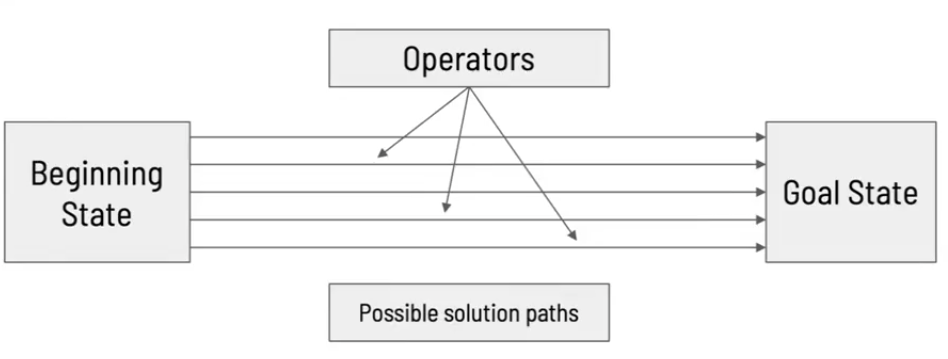
Common features of problems: initial state (learner’s current knowledge/skills), a goal, and operations (cognitive/behavioral activities used to move from initial state -> subgoals -> goals)
Trial and error
Thorndike’s research w cats involved escaping the cage as the problem. Animals would perform certain behaviors and test their consequences. After opening the cage, the cats would slowly get better at escaping.
Cons: not reliable/effective, takes time
Insight
The brief moment where u suddenly become aware of a possible solution
Graham Wallas’s four-step model of insight/AKA 4 stages of creativity:
Preparation: learning abt problem and gathering info for a solution
Incubation: thinking abt problem, perhaps stepping away from it for a bit
Illumination: insight moment!
Verification: time to test the proposed solution to determine if it works
Rule learning
Rules help with learning and retention bc they offer a simple description of the phenomenon and organize material. By arranging/rearranging elements, learners can eventually gain INSIGHT
Rote memorization involves recalling a lot of info which is inefficient
Functional fixedness
inability to see new uses for objects or new configurations of elements in a situation that is required to solve a problem
Also happens when learner uses a well-learned procedure on a problem for which the procedure is inappropriate
To help students avoid rigid thinking, expose them to various procedures during instruction
Heuristics
general methods for solving problems that use principles (rules of thumb) that usually lead to a solution; helpful when working with unfamiliar content
Polya’s list of mental operations
Involved in problem solving: understanding problem, devising plan, carrying out plan, looking back/reviewing plan
IDEAL (Bransford & Stein)
identify the problem, define & represent the problem, explore possible strategies, act on strategies, look back & evaluate effects of activities
Information Processing Model of Problem Solving (Newell & Simon)
We start at the beginning state and can take multiple paths towards reaching our final goal state
As we move along a path, we use different operations
We build mental representation of problem and try to find a solution that has the shortest distance between the beginning and goal states -> info is held in WM
Info in WM -> activates related knowledge in LTM -> help us select strategy
As we work through a problem, we may alter our mental representation as we think more
Overly complex/incomplete representations -> improper solution
General Strategies for problem solving
Applied across domains regardless of content (e.g., breaking goal into small steps); helpful when solution isn’t immediately obvious, less helpful than specific strategies when working in highly familiar content.
Generate-and-test strategies (GENERAL)
Useful when there’s a limited number of possible solution and you can test to see if one/many help you attain the goal (helpful when you can order solutions by how likely they are to succeed and when at least one solution is apt to solve problem)
Means-ends analysis (GENERAL)
compare current situation with the goal and identify differences
Use subgoals to reduce differences
Perform operations to accomplish subgoals and repeat until you reach goal
Likely to solve problem when subgoals are properly identified
Can be used to work from initial -> goal (working forward) OR work from goal to initial state (working backward)
Analogical reasoning (GENERAL)
Involves drawing a connection between problem (target) and a situation that you’re familiar with (base or source)
Access info from LTM and bring it into WM to be able to relate/apply to current problem
Successful when two situations are structurally similar (even if surface features differ)
Map steps from the familiar situation onto the current problem (e.g., looking at textbook examples and trying similar problems on your own)
Teaching kids to use analogies help all kinds of students
Works best when you have a lot of prior knowledge on original/familiar problem
Brainstorming (GENERAL)
Useful for formulating possible problem solutions. Steps include
Define the problem
Generate as many solutions without evaluating them yet
Decide on criteria for judging solutions
Use criteria to select the best solution
Successful brainstorming requires that participants WITHHOLD criticisms of ideas until after ideas are generated (ideas inspire more ideas!)
Specific strategies
useful only in a particular domain
Production system (used in problem solving)
Networks of condition-action sequences, AKA rules, Conditions are the set of circumstances that activate system. Actions are what you do once conditions are met.
A production system consists of if-then statements (if = goal/test conditions, then = action to take)
Productions can be general (e.g., heuristics) or specific
General productions are unpacked step by step until more specific productions can be used
Differences between expert & novice problem solvers
Experts: have more declarative knowledge, have better hierarchical organization or knowledge, spend more time planning & analyzing, recognize problem formats more easily, represent problems at a deeper level, monitor performances more carefully, and understand better the value of strategy use
Critical Thinking
a reflective cognitive activity focused on deciding what to do or what to believe (conscious/active efforts); more about HOW to think deeply rather than WHAT to think
Differences from problem solving: focused on understanding nature of problem, operates at a more general level, doesn’t require a decision/solution
Components of critical thinking
Knowledge: some knowledge of issue helps us ask questions & judge new info/perspectives
Inference: making connections between two or more ideas
Evaluation: analyzing, judging, and weighing evidence (find relevant/trustworthy info)
Metacognition helps us monitor our thought processes/reflect on adequacy of conclusions
Teaching implications: use real-world examples, class discussions
Reasoning
mental processes involved in generating & evaluating logical arguments
Yields a conclusion from thoughts, percepts, & assertions & involves working through problems to explain why something happened or what will happen
Clarification: identifying and formulating questions, analyzing elements, & defining terms
Basis: info from personal observations, statements by others, & previous inferences that support our conclusion abt a problem
Inference: scientific reasoning proceeds inductively or deductively
Inductive Reasoning
developing general rules, principles, & concepts from observation
Classification, concept, and analogy are common when assessing inductive reasoning
Solving this: sugar -> sweet, lemon -> ____
Teaching implication: model how you evaluate info, make rules, & come to conclusion
Deductive Reasoning
applying inference rules to a formal model of a problem to decide whether specific instances logically follow (take prior generalizations and apply them to specific scenarios)
Goal: figure out if a conclusion logically follows from what we already know. We proceed from general concepts (premises) to specific instances (conclusions)
Deduction problem example: Three-term series - “K is taller than T, but MB isn’t as tall as T, who’s the tallest?”
Deduction problem example: syllogism - “all students in K’s class are good in math, all students who are good in math will attend college, all students in K’s class will attend college.” (you have general premises and deduce certain conclusions)
Evaluation
using criteria to judge the adequacy of a problem solution. Students also address questions like:
Is the data sufficient to solve the problem? Do I need more info? Are my conclusions based on facts, opinions, or reasoned judgments?”
Evaluation involves deciding on what ought to happen next by formulating hypotheses abt future events
Creative Thinking
development of a novel idea, problem solution, or product that is of value & appropriate for the individual or larger social group
Differences from other cognitive processes: NOVELTY & Value (appropriateness)
Big C creativity: RARE, ideas that are transformative (e.g., discovery of electricity)
little c Creativity: small, local, everyday events (e.g., organizing a room), still indicative of thinking outside the box
Creativity is dependent on combining concepts in new or unusual ways
Key question: Can students learn to be more creative? YES!!!
Creativity is affected by motivational factors (intrinsic vs extrinsic motivation)
Divergent thinking: thinking about various solutions to a problem
Teaching implication: We want to encourage students to think differently
Convergent thinking: thinking about a single, “correct” solution to a problem
Creative Problem Solving (CPS) Model
Understand the challenge (defining problem, gathering info)
Generating multiple ideas (divergent thinking)
Preparing for action (choosing an appropriate solution, metacognition)
Constructivism
Psychological & philosophical perspective contending that individuals form or construct much of what they learn & understand; learning is actively built through interactions with the world
Knowledge is a working hypothesis that’s wormed within us (not imposed by outsiders)
Situated Cognition
Key premise in Constructivism; thinking and learning are embedded in physical & social contexts rather than solely the mind!
Many processes interact to produce learning
Differences between Constructivism & Behaviorism
Rather than relying on external forces to explain learning (B), there’s more focus on the LEARNER & what goes on internally (C)
Learning is constructed (C) rather than acquired (B)
Assumptions that Constructivism REJECTS
Thinking is solely in the mind rather than emerging through interactions/situations
Processes of learning/thinking are UNIFORM across people, some situations foster higher-thinking better than others
Thinking primarily derives from knowledge/skills developed in formal instructional settings more than broader conceptual competencies that come from daily experiences and innate abilities
Scientific truths exist & await discovery
Assumptions in Constructivism
People are ACTIVE learners & develop knowledge for themselves
Teachers shouldn’t teach in the traditional way of delivering instruction. They should create situations where learners can become actively involved w content through manipulation of materials & social interactions
Exogenous Constructivism (1/3 perspectives)
Learning involves reconstructing structures that already exist in the world; knowledge is built through experiences, teaching, and exposure to models. Strong emphasis on external environment. Knowledge is accurate to the extent that it reflects external reality. (similar to schemas, productions)
Helpful when we want to study how accurately students grasp knowledge
Endogenous Constructivism (1/3 perspectives)
More emphasis on internal cognitive activity. Knowledge is NOT a reflection of the external world. Instead, knowledge develops through cognitive abstraction (building on prior mental structures).
As seen in Piaget’s theory of cognitive development
Helpful for studying how learners become more advanced
Dialectical Constructivism (1/3 perspectives)
Knowledge derives from interactions between people and their environment. Constructions aren’t solely tied to external world or internal processes. Knowledge reflects the outcomes of mental contradictions that result from one’s interactions with the environment
Aligns w Bandura’s social cognitive theories, motivation theories, Bruner and Vygotsky’s theories
Helpful when designing instruction/interactions that challenge students and consider social influences (peer work, modeling)
Piaget’s Theory of Cognitive Development
Concerned with knowing (how we acquire knowledge), reflects fundamental ideas of constructivism
children move through FOUR distinct stages—sensorimotor, preoperational, concrete operational, and formal operational—transforming how they understand the world. Development occurs through active exploration and two key processes: assimilation (fitting new info into existing schemas) and accommodation (modifying schemas)
Each stage builds on prior stages
Equilibration (Piaget)
Biological drive to achieve an optimal state of equilibrium between cognitive structures and environment. Central factor & motivating force behind cognitive development. Helps us coordinate all factors and helps make internal structures consistent with external experiences.
Cognitive Development depends on…
Biological maturation
Experience with the physical environment
Experience with the social environment
Equilibration
Assimilation (Piaget)
Fitting external reality (new info) to existing cognitive structure to help reach equilibration (e.g., adjusting new info to fit your prior knowledge)
Accommodation
Changing internal structures to provide consistency w external reality (e.g., changing beliefs to align w new info)
Sensorimotor (Birth-2yrs)
Learn through direct action; understanding is rooted in what one can do. Begin to develop the capacity for symbolic thought.
Preoperational (2-7 yrs)
Children learn to think abt past & future (not just present); thinking is still heavily tied to perception; focusing on 1 dimension at a time (e.g., length, width); difficulty understanding that actions can be reversed; language developing rapidly; children begin to recognize that others have thoughts/feelings; trouble discerning fact/fiction
Concrete operational (7-11 yrs)
Significant cognitive growth, more logical thinking; develops key concepts for reasoning, less egocentric, less influence of immediate perception.
Formal Operational (11 - adult)
think abstractly, consider hypotheticals; more sophisticated thinking, can think abt multiple dimensions; more idealistic thinking
Cognitive Conflict
Conflict between cognitive structures & external world/reality help promote learning. Kids engage in assimilation or accommodation to construct/alter internal structures
Learning is optimal when conflict is small & when kids are transitioning between stages
New info should be partially understood (assimilation) before it can promote structural change (accommodation)
Constructivist teaching implications
Cognitive develop is only accelerated through teaching
Teachers should understand cognitive development
Keep students ACTIVE (exploration, hands-on)
Instruction should create cognitive conflict to help kids learn
Provide opportunities for social interaction to expose kids to diff perspectives
Bruner’s Theory of Cognitive Growth
Highlights various ways that children represent knowledge. Does not link changes in development w cognitive structure or argues that there are diff stages (like Piaget does)
Development is shaped by technological advances (language & instruction)
Cognitive processes (thoughts, belilefs) MEDIATE the relationship between stimulus & response. Stimulus -> Thoughts/Beliefs -> Response
Enactive representation (Bruner 1/3 ways of representing knowledge)
involves motor responses or ways to manipulate the environment (thinking abt playing w a ball)
Iconic Representation (1/3 Bruner ways of representing knowledge)
action-free mental images; visualizing a concept (e.g., thinking abt a ball)
Symbolic representation (1/3 Bruner ways of representing knowledge)
Reading & using symbol systems (language, math notation, cultural symbols) to encode knowledge. We rely a lot on this final stage.
Spiral Curriculum
Constantly revisiting topics over time with increasing complexity & nuance
Concepts should initially be taught very SIMPLY so that kids understand them
Concepts should be represented in a more complex fashion with development
Bruner: teaching should be tailored to individual ways of representing knowledge as a means of prompting cognitive development
Instruction should be differentiated to match children’s cognitive capabilities
Similarities between Bruner & Piaget’s theories
Bruner’s theory is constructivist bc it assumes that any age, learners assign meaning to stimuli & events based on cognitive capabilities and EXPERIENCES with social and physical environments
Bruner’s forms of knowledge representation are similar to operations kids engage in Piaget’s stages
sensorimotor = enactive (involve motor responses), concrete operational = iconic (involve visualizations), formal operational = symbolic (abstract thinking)
Difference between Bruner & Piaget’s theories
Bruner’s theory believes that concepts can be mentally represented in multiple modes SIMULTANEOUSLY (we can revert back to iconic/enactive when it’s more relevant/useful. Piaget’s stages are more fixed/linear
Bruner’s implications for teaching
Represent content in multiple modalities/ways (videos, discussions, activities, real-world applications). These diff experiences help students revisit concepts.
Periodically review content in increasing complexity
Devise ways to help learners at all ages to meaningfully understand content
Vygotsky’s Sociocultural Constructivism Theory
Emphasizes that learning & development are primarily shaped by social environment, language, and cultural context, with humans actively transforming their environment rather than reacting to it.
Historical/intellectual context: Vygotsky was influenced by Marxist thought & the Russian Revolution -> Focus on social mediation of learning and a shift from reflex-based psych to cultural-historical perspective. Lots of work was delayed due to political constraints.
Basic principles of sociocultural constructivism
Vygotsky rejected introspection, believed social interaction is central to development, and that engagement w others shapes human consciousness
Development results from the interaction of interpersonal (social), cultural-historical, and individual factors. Learning is always embedded in context.
Cognition is shaped & changed through cultural tools such as language, symbols, and social institutions, which are internalized & used to guide thinking & behavior.
Vygotsky argued that all higher mental processes originate in the SOCIAL environment (but criticized for being too strong)
Zone of Proximal Development (ZPD)
The gap between what a learner can do independently & what they can do with guidance or collaboration. This represents the potential for learning under the right conditions.
Development occurs through guided participation & use of cultural tools, with learners actively constructing meaning
Learning involves internalization of social interactions & can occur through sudden insight
Highlights the role of cultural context & social institutions (school) in sharing development
Scaffolding (Vygotsky teaching implications)
Teacher builds on students’ prior knowledge to introduce new information. The teacher gradually gives up more responsibility to the students & support is gradually withdrawn so that learners gain competence. This allows learners to perform tasks independently within the ZPD
Helps support learners by managing difficult task elements so that students can focus on what they’re ready to learn
Aligns with modeling & Shaping, guiding learners through stages of skill development while keeping instruction targeted & supportive
Reciprocal Teaching
Involves interactive dialogue between teacher & small group. Teacher models strategies & students gradually take on the role of the teacher, reflecting scaffolding & social interaction.
Peer collaboration supports learning through shared responsibility & interaction, aligning w Vygotsky’s idea of collective activity
Effective peer learning requires clear roles/shared accountability and is used across domains. This highlights importance of social environment in learning.
Apprenticeship
Involves novice working closely w experts on real tasks, allowing learning to occur within the ZPD through social interaction & shared activity
Learning is supported through modeling & gradually reduction of support (responsibility shifts from expert to learner over time)
Widely used across contexts (teaching, research, internships). This highlights the importance of mentorship & real-world learning environments for skill development
Private Speech (Vygotsky)
Self-directed language that supports self-regulation but isn’t meant for communication w others. It helps people guide their thinking.
Through social interaction, kids internalize language & use private speech to organize thought, solve problems, & regulate actions.
Over time, private speech shifts from overt (spoken aloud) to covert (internalized), though it can reappear during challenging tasks. Its role in self-regulation increased with age.
Verbalization & Achievement
Verbalizing rules, strategies, & procedures supports learning & mirrors the shift from overt -> covert private speech, promoting self-regulation
Most helpful for students w learning difficulties, as it improves attention, rehearsal, and systematic task engagement
Can be ineffective or distractive for learners who already manage tasks well or for younger kids w limited cognitive capacity
MOST effective when task-relevant, flexible, and gradually internalized, supporting long-term self-regulation & learning
Socially Mediated Learning
Vygotsky stresses that learning is fundamentally socially mediated through tools like language, symbols, & signs, which are internalized & used for higher cognitive processes (like concept learning & problem solving)
Kids develop concepts through both independent observation & social instruction. Language plays a key role in labeling & organizing knowledge
Effective learning requires teaching kids the cognitive tools needed for understanding. These tools enable learners to construct knowledge & support others’ learning.
Constructivist Learning Environment
involve rich, meaningful experiences where students actively construct understanding through interaction, inquiry, and reflection
Classroom Application of Constructivist Theory
Emphasize big ideas & active engagement rather than breaking content into isolated skills or relying on passive instruction
Learning driven by meaningful problems & relevance, which helps connect experiences & challenge thinking
Focus on HOW students arrive at the answer rather than accuracy, prioritize students’ thinking & perspectives
Assessment is integrated into instruction & guides learning, rather than being a separate, test-focused activity
Assessment (Constructivist approach)
Ongoing & integrated; helps teachers evaluate both student understanding & effectiveness of instruction
Incorporate authentic tasks like reflection/application rather than traditional tests; prioritize deep, meaningful learning
Focus on student thinking. Assessment is a tool for guiding instruction (very complex)
APA Learner Centered Principles
Provide guidelines for designing instruction & school reform grounded in constructivism
4 major principles: cognitive/metacognitive factors, motivational/affective, developmental/social, & individual differences
Emphasize that multiple factors shape learning
Most useful when the goal is deep understanding & active learning, though teacher-centered instruction can still be appropriate in other situations
Peer-assisted learning (Vygotsky-inspired)
instructional approaches where peers act as active agents in the learning process; cooperative learning
Improves achievement & motivation, especially for young/underserved kids
Peer tutoring promotes engagement, questioning, & individualized support in a more comfortable learning setting
Cooperative learning builds collaboration skills & shared responsibility, effective when properly structured
Successful implementation: clear goals, group accountability, & thoughtful group strategies
Discovery learning (Bruner-inspired)
obtaining knowledge for oneself through testing hypotheses & questions, rather than reading/listening to lectures
Form of problem-solving involving hypothesis testing, exploration, and inquiry; teachers provide structure/guidance
Effective discovery requires prior knowledge (declarative, procedural, conditional); best for complex, process-oriented learning tasks
Guided discovery (w scaffolding) is more effective than pure discovery, as fully unguided approaches overwhelm learners/hinder learning
Inquiry teaching
form of discovery learning that uses Socratic questioning to promote reasoning, hypothesis testing, & application of principles
Teacher guides learning through structured questioning strategies (counterexamples, probing predictions) to help develop a generalizable understanding
Requires prior knowledge from the teacher, appropriate student readiness & support
Implemented through one-on-one or small group settings, so that teachers provide individualized questions & support
Class Discussions & Debates (Piaget-inspired)
Useful when the objective is acquiring greater conceptual understanding of MULTIPLE sides/perspectives in a topic
Promote concept understanding & exploration of multiple perspectives, especially controversial/complex topics
Effective use requires a supportive class environment, clear rules, & teacher facilitation that encourages participation & respectful dialogue
The teacher guides learning by probing student thinking (e.g., asking for explanations/elaborations) instead of focusing on correct answers
Flexible formats (e.g., small group, debates) increase participation & engagement, especially for larger classes
Motivation
Goal-directed behavior. Learners use cognitive & behavioral strategies (planning, persistence). It’s observed indirectly through actions like effort, choices, & engagement.
Motivated students: persist through difficulty, actively process info, ask questions, & engage in learning even when it isn’t required
closely tied to learning; it energizes & sustains learning processes (e.g., attention, rehearsal, elaboration)
Drive Theory (Woodworth)
Behavior is driven by internal physiological needs (e.g., hunger/thirst) that create a DRIVE to restore internal balance
Drives: internal forces sought to maintain homeostatic body balance (internal balance)
Need (deprivation of essential need) -> Drive -> Behavior (to reduce need & drive)
Primary needs: (e.g., food, water) generate drives
Secondary reinforcers: (e.g., money) gain value through association w primary needs
Limitations: drive theory may not work well with complex/long-term goals or fluctuating motivation; we don’t always act on drives