Supply Chain Midterm 3
 Call Kai
 Learn
Learn Practice Test
 Spaced Repetition
 Match
Match Flashcards
 Knowt Play
1/53

There's no tags or description
Looks like no tags are added yet.
Name | Mastery | Learn | Test | Matching | Spaced | Call with Kai |
|---|
No analytics yet
Send a link to your students to track their progress
54 Terms
Strong Supplier Partnerships
Important to achieving win-win competitive performance for the buyer and supplier
10 keys to developing successful strategic partnerships:
1. Building Trust
2. Having a Shared Vision and Objectives
3. Developing Personal Relationships
4. Establishing Mutual Benefits and Needs
5. Gaining Commitment from Top Management
6. Managing Change
7. Information Sharing and Lines of Communication
8. Understanding and Influencing Capabilities
9. Continuous Improvement
10. Measuring Performance
Supplier Evaluation
A process to identify the best and most reliable suppliers
Supplier Evaluation: Performance
Some relevant metrics include:
Price and cost performance
Product quality
Delivery performance
Contractual compliance
Participation in product development initiatives
Cooperativeness in third-party production management
Support of ethics and sustainable practices
Key Supplier Selection
Conducted by a cross functional team using evaluation forms or scorecards.
Benefits of Supplier Certification Programs
Reducing the amount of time and labor necessary for the buyer to conduct incoming inspections of products and materials from certified suppliers, creates cost savings.
Building long term relationships
Recognizing excellence
Decreasing the supplier base
Supplier Certification
Used as verification that select suppliers operate, maintain, improve, and document effect procedures that relate to the buyer’s requirements for supply elements such as cost, quality, delivery, flexibility, etc.
International Organization for Standardization
an independent, non-governmental international organization that develops voluntary, consensus-based, market-relevant international standards for various industries
Example of Criteria used for an internal Certification Program
Supplier has no incoming product rejections for a specified time period.
Supplier has no incoming late deliveries for a specified time period
Supplier has no significant negative quality related incidents for a specified time period
Supplier is ISO 9000 certified or has successfully passed a recent on-site quality system evaluation
Supplier consistently meets a mutually agreed-upon set of clearly specified quality performance measures
Supplier has a fully documented process and quality system with cost controls and continuous improvement capabilities
Supplier’s processes are determined to be stable and in control
Examples of Major Manufacturing Strategies
Make-to-Stock (MTS)
Make-to-Order (MTO)
Assemble-to-Order (ATO)
Engineer-to-Order (ETO)
Make-to-Stock (MTS)
Means to manufacture products for stock based on demand forecasts. Push system.
Make-to-Order (MTO)
a manufacturing strategy in which manufacturing starts only after a customer's order is received. Creates additional wait time for the customer to receive the product, but allows customers to purchase products that are customized to their specifications.
Assemble-to-Order
manufacturing strategy where products ordered by customers are produced quickly and are customizable to a certain extent. ATO is a hybrid strategy, attempting to combine the benefits of both Make-to-Stock and Make-to-Order strategies, getting products into customers' hands quickly while allowing for some customization to take place.EX: Dell laptops
Engineer to Order (ETO)
a manufacturing strategy in which the product is designed, engineered, and built to the customer’s specifications after receipt of the order.
Intermittent Processes
used to produce a large variety of products with different processing requirements in lower volumes.
Repetitive Processes
used to produce one, or a few, standardized products in high volumes
Job Shop Production aka Project Production
− Creates a custom product for each customer
− One-off or small number of items produced, generally one unit manufactured at a time.
− High customization - Normally made to customs specifications
− Often undertaken by small, specialist businesses
− Examples: Architects - Custom Home Construction, Ship Builders, Road Builders
Total Cost of Manufacturing
the complete cost of producing and delivering products to your customers, includes manufacturing and procurement activities, inventory and warehousing activities, transportation activities
What Happens as Volume Goes Up?
A. Manufacturing and Procurement costs go down due to economies of scale. Generally-step function applies as more capital is required to produce.
B. Inventory and Warehousing costs go up.
C. Transportation costs go down, but level off at high volumes as the shipping container gets filled to capacity and another container must be used.
Lean
A management philosophy based on the Toyota Production System (TPS)
Goals of Lean:
Eliminate everything that does not add value
(waste) in the customer’s eyes
Using Value Stream Mapping as primary work unit
Focusing on improving process performance
Having a clear view of the end state
A wide range of Lean tools are available
Learn-by-doing approach to performance
improvement and capability-building
LEAN Manufacturing
Satisfying internal customer demand
Communicating demand forecasts and production schedules up the supply chain
Quickly moving products in the production system
Optimizing inventory levels across the supply chain
Increasing the value, capabilities, and flexibility of the workforce through cross-training
Extending collaboration and alliances beyond just 1st tier
suppliers and customers to include 2nd and 3rd tier suppliers and customers as well
LEAN Layout
Move people and materials when and where needed, and as soon as possible
Are very visual (lines of visibility are unobstructed) with operators at one processing center able to monitor work at another
Manufacturing cells:
─ Process similar parts or components saving duplication of
equipment and labor
─ Are often U-shaped to facilitate easier operator and material movements
LEAN Layout Photo
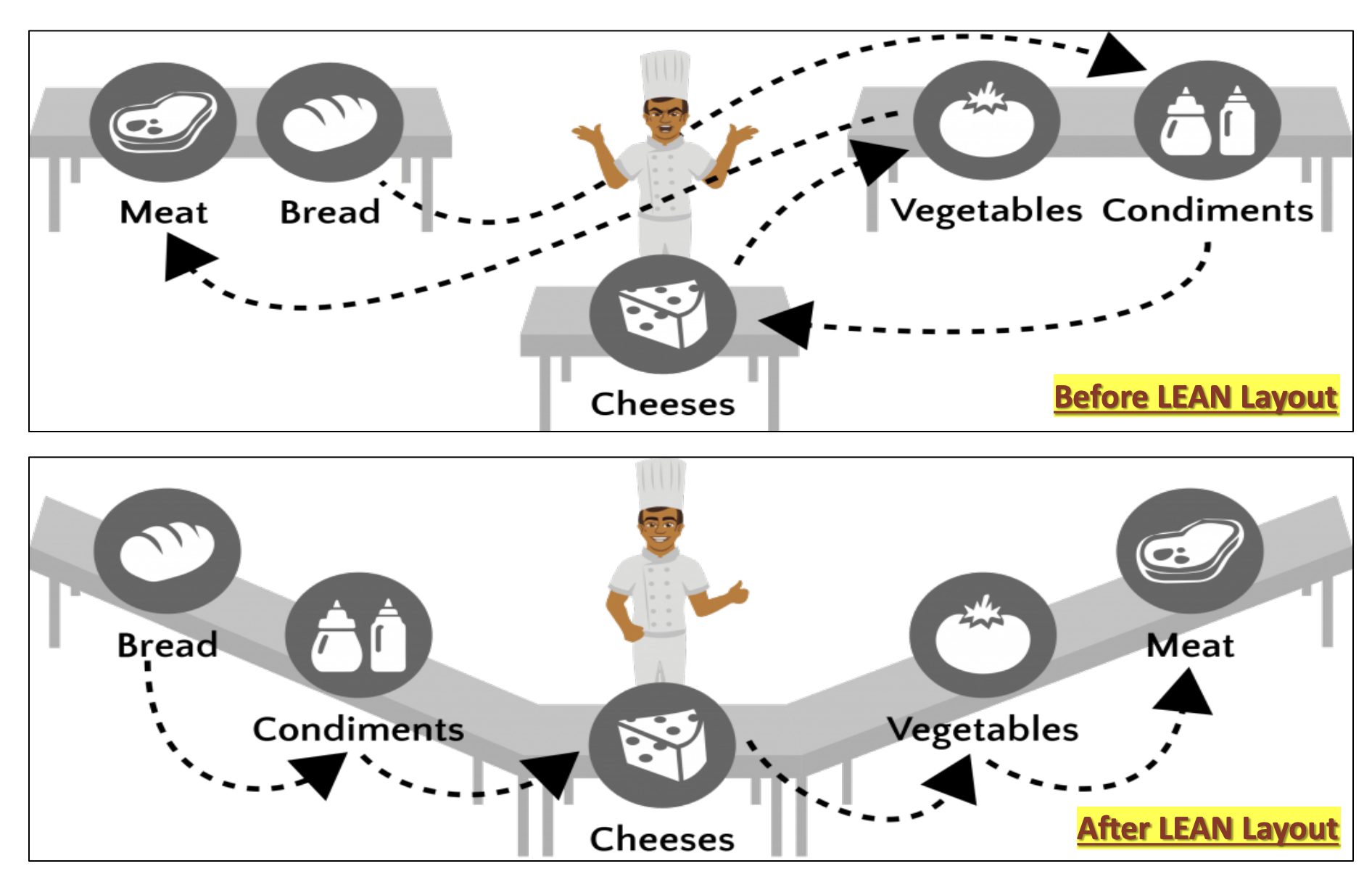
Notable Examples of LEAN Layouts
McDonalds
Voice of the Customer
Term used in business to describe the in-depth process of capturing internal and external customer's expectations, preferences, likes, and dislikes.
Ways to Capture VOC
Customer Interviews
Market Surveys
Focus Groups
Customer Specifications
Observation
Warranty Data
Field Reports
Complaint Logs
Cost of Quality
An approach that supports a company’s efforts to determine the level of resources necessary to prevent poor quality, and to evaluate the quality of the company’s products and services.
Cost of Good Quality
─ Appraisal Costs
─ Prevention Costs
Cost of Poor Quality
─ Internal Failure Costs
─ External Failure Costs
Appraisal Costs
Costs associated with the evaluation of purchased materials, processes, products, and services to ensure that they conform to specifications.
Prevention Costs
Costs related to the design, implementation, and maintenance of the quality management system. They are planned, and experienced before actual products or materials are acquired or produced.
Internal Failure Costs
Occurs when the product or service does not meet the designed quality standards, and are identified before the product or service is delivered to the customer.
External Failure Costs
Occurs when the product or service does not meet the designed quality standards, but is not detected until after the product or service is delivered to the customer.
Acceptance Sampling
When a shipment is received from a supplier, a statistically significant representative sample is taken and measured against the quality acceptance standard.The entire shipment is assumed to have the same quality as the representative sample that was taken.
Supplier’s Risk for Acceptance Sampling
The buyer rejects a shipment of good-quality units because the sample quality level did not meet the acceptance standard (type I error)
Buyer’s Risk for Acceptance Sampling
The buyer accepts a shipment of poor-quality units because the sample falsely provides a positive result against the acceptance standard (type II error)
Six Sigma
A quality management process that focuses on improving the quality of process outputs by identifying and removing the causes of defects (errors) and minimizing variability in manufacturing and business processes.
Goal of Six Sigma
Attain less than 3.4 Defects Per Million Opportunities (DPMO)
History of Six Sigma
Motorola developed the concept in the 1980’s, created the methodology, and copyrighted it as well.
Motorola has documented > $16 Billion in savings as a result of Six Sigma.
Six Sigma became famous when Jack Welch made
it central to his successful business strategy at
General Electric in 1995
Thousands of companies globally have adopted Six Sigma.
Three foundational aspects of Six Sigma
1. Quality is Defined by the Customer
2. The Use of Technical Tools
3. People Involvement
The Seven Tools of Quality Control
1. Check Sheets
2. Histograms
3. Pareto Analysis
4. Cause & Effect Diagrams
5. Flow Diagram
6. Control Charts
7. Scatter Diagrams
Warehouse Ownership Types
Public Warehouses
Contract Warehouses
Private Warehouses
Public Warehouse
A business that provides storage and related warehouse functions to companies on a short or long-term basis, generally on a monthto-month basis for a fee. (Hotel for Inventory)
Own their own equipment and hire their own staff to manage the facility.
Fees are typically a combination of a monthly storage fee plus a pallet-in fee
and a pallet-out fee.
They may also have some document fees and account management fees.
Advantages of Public Warehouse
No capital investment or property taxes
Flexibility
Can be short or long term contract
For seasonal products
Add storage capacity even on short notice
Lower costs and reduced risk
Access to special features and services:
Temperature-controlled storage
Customer Service, Inventory Ordering, etc
Office space for customer’s sales, accounting, etc
Disadvantages of Public Warehouse
Potential for incompatible computer systems
Specialized services may not be what is required/needed
Space may not be available when/where needed
Contract Warehouse
A variation of public warehousing that handles the shipping, receiving, and storage of goods on a contract basis for a fee. (Renting an apartment for inventory)
The contract can be for an entire building, or for a defined portion within a building
Usually requires a client to commit to services for years rather than months
The fee structure may be fixed cost, cost-plus, or a combination of both.
The company providing the space handles the employees, equipment, and maintenance.
Advantages of Contract Warehouse
Services: client can obtain specialized services tailor-made to suit their needs.
Cost: can be bundled in the contract and negotiated at a lower cost.
Cost: can be bundled in the contract and negotiated at a lower cost.
Disadvantages of Contract Warehouse
Duration: The client company is expected to enter into a contract for a specific period of time; generally three years
Private Warehouse
A storage facility that is owned by the company that owns the goods being stored in the facility. (Buying House for Inventory)
Generally established by companies that have a large volume or highly valuable goods, or the need for some type of specialized storage or handling
Can be operated as a separate division within a company
Can be co-located on-site with manufacturing, or off-site.
Advantages of Private Warehouse
Control: Offers greater flexibility in designing the warehouse and gives users significant control over operations.
Visibility: inventory, material flow, handling, supervision, and associated costs.
Cost: Operating cost can be 15% - 25% lower if the company achieves at least 75% utilization.
Disadvantages of Private Warehouse
High Start-up Cost: Capital to build or buy a warehouse. Long, risky investment. Cost of hiring and training employees. Purchase of material handling equipment.
Fixed Location: Not easy to move to another location if the market changes.
Fixed Size and Costs: When volume is low, the company still assumes the fixed costs.
Types of Warehouses:
Consolidation
Break-Bulk
Cross-Docking
Consolidation Warehouse
Warehouse operation that receives products from different plants or suppliers, stores them, and then combines them with similar shipments from other plants or suppliers for further distribution.