Economy under Lenin
 Call Kai
 Learn
Learn Practice Test
 Spaced Repetition
 Match
Match Flashcards
 Knowt Play
1/22

There's no tags or description
Looks like no tags are added yet.
Name | Mastery | Learn | Test | Matching | Spaced | Call with Kai |
|---|
No analytics yet
Send a link to your students to track their progress
23 Terms
Russia's problems
- economic problem as far behind in industrialisation (had industrialised 1890-1914 but still behind)
- economy shattered from WW1
- uncertainty about what communist economy entailed
Lenin's early ideas
- believed socialism was possible in Russia in 1917
- revolution had destroyed capitalism but economy not strong enough for socialism - 'state capitalism'
- the equal distribution of goods according to need could only be achieved if there were goods to distribute
- believed socialist economy would be highly efficient, workers would be free and productive
- faith in expertise, desired efficiency and discipline, disregarded leisure
State Capitalism (March-June 1918)
- nationalisation of industry (taking it away from middle class)
- nationalised industries run by Vesenkha (placed factories under control of specialists, coordinated economic production to meet needs)
- only large industries nationalised
- state capitalism unpopular as not radical enough
- land reform
- Land Decree (Oct 1917)
- Decree on Workers' control (Nov 1917)
- private banks nationalised (27 Dec 1917)
Were Lenin's decrees successful?
No as gave power to workers and peasants but detrimental effect on economy (works gave themselves huge pay rises, managers and experts dismissed)
War Communism (1918-1921) - Measures
- Food Dictatorship - grain requisitioning, rationing
- Nationalisation - state ownership of industry without compensation (under control of Vesenkha)
- Labour discipline - working day extended to 11 hours(1918), work made compulsory for 16-50 year olds (1919), harsh punishments for slacking, death penalty for striking
- abolition of market - money and private trade abolished, complete nationalisation, conscription
- removed Lenin's decrees (Decree on Land, Decree on Workers')
- cheka enforced policies, red terror (1918-22)
War Communism (1918-1921) - Consequences
- Red Army supplied and won Civil War
- Economic collapse and agricultural decline
- Famine
- Growth of black market
- mass poverty
- political crisis
- ideological victory
- NEP
War Communism consequences explained
- grain requisitioning led to lower rates of agricultural production as no incentive
- industrial production declined as no incentive
- government resources stolen for bartering
- shortages of commodities
- unemployment rose
- August 1920-June 1921 - Tambov uprising
- March 1921 - Kronstadt sailor mutiny
New Economic Policy (1921) - Measures
- ended war communism
- created mixed economy
- agricultural production left to free market
- grain requisitioning ended and replaced by a 'tax in kind'
- no forced collectivisation
- private trading legalised for small-scale businesses
- small factories were denationalised allowed to trade freely
- large factories, transport and banks remained nationalised
- in state-owned factories, piecework and bonuses given
- money reintroduced
- services charged for
- rationing forced out
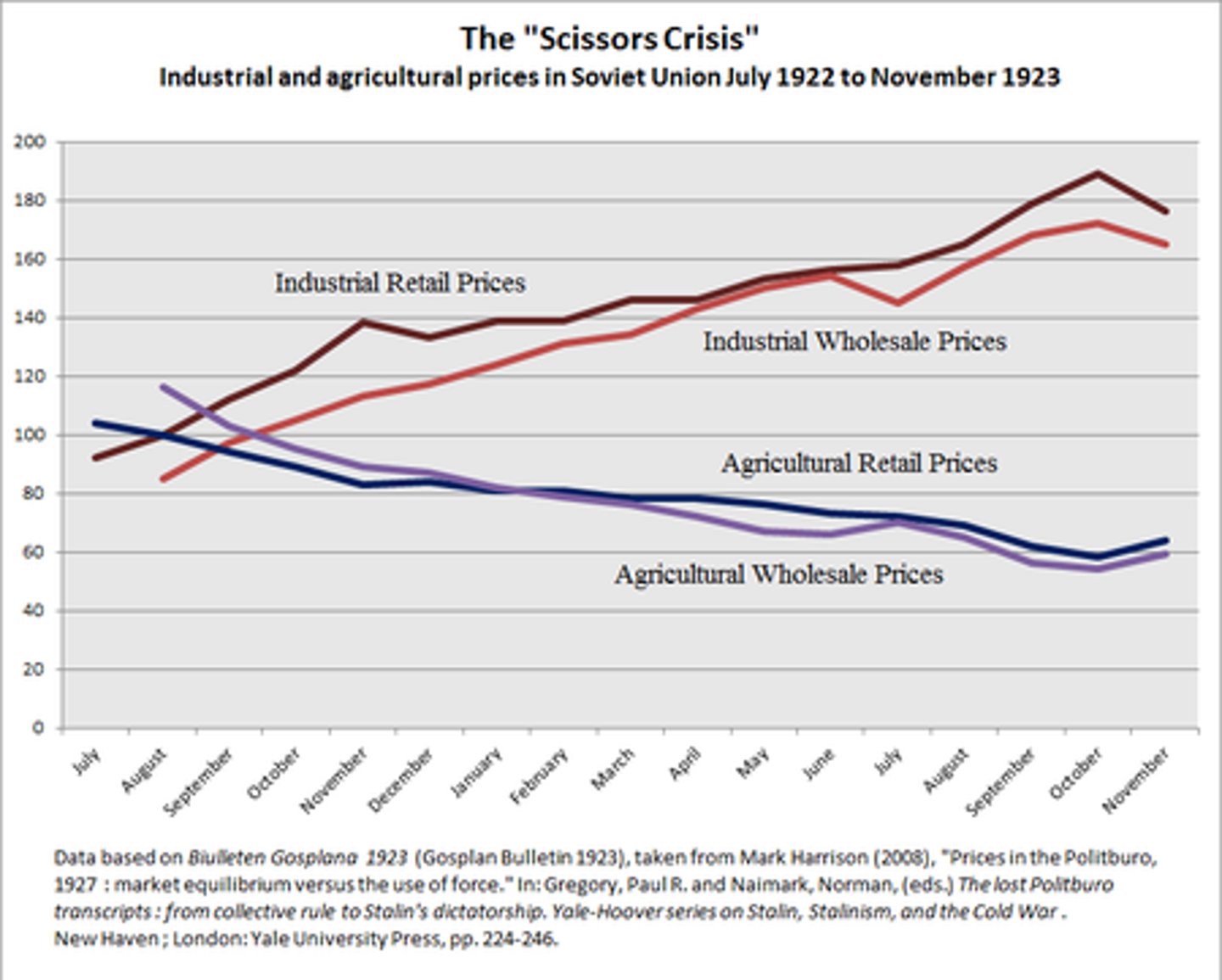
NEP consequences explained - scissor crisis
Initially, greater food supplied causing agricultural prices to drop but industry recovering slower so industrial prices grew. Gap between farmers' income and industrial prices.
- by 1923, gap reached crisis point and farmers couldn't afford industrial goods so no incentives for farmers to produce grain
- government intervened and subsidised industrial products but this meant less money available to improve economy
NEP consequences explained - inequality and corruption
- Nepmen traders
- Gambling, prostitution, drug dealing, gangs grew
Positions within the party of state control over industry and agriculture
1. Left (Trotsky and followers) - radical socialist policy: the Dictatorship of Industry
2. Right (Bukharin and supporters) - continue NEP to ensure social peace
3. Middle (Stalin and followers) - back whichever policy worked
The Leftist view - Dictatoship of Industry
- forced agricultural collectivisation
- take all profit generated by farming and use money to industrialise quickly
- end all private property and capitalist market
- peasants would be discontented
The Rightist view - Building socialism with capitalist hands
- NEP best way to industrialise
- allowed economy to grow and industrialisation would happen eventually
- NEP allowed society to remain harmonious
Land Reform (Lenin's early reforms)
- Decree on Land (1917)
- Church/ aristocratic landowners' estates broken up and given to peasants
- popular with peasants
Decree on Workers' Control (Nov 1917)
All factories to be placed under control of elected committees of workers (soviets)
War Communism (1918-1921) - Aims
- ensure communist victory in civil war by supplying Red Army with food+resources
- high levels of industrial production of war goods
- efficient allocation of workers
- food production to feed soldier, workers and population
- ideologically communist
- solve economic collapse from WW1
War Communism (1918-21) - Causes
- Civil War (1917-22)
- economic collapse and food shortages
- ideological
New Economic Policy (1921) - Reasons for introduction
- Lenin to retain political power
- Revive economy - stimulate grain production, end famine, increase industrial production
- move away from War Communism
- build socialism without foreign aid
- use capitalist methods to achieve communist goals
New Economic Policy (1921) - successes
- agricultural output increased
- famine ended
- industrial production increases
- gained support of peasants
- political stability
- increased living standards
New Economic Policy (1921) - failures
- scissor crisis
- economy not modernised
- ideologically failure
- emergence of kulaks
- Nepmen and corruption
NEP consequences explained - political and economic stability
- Free trade and end to grain requisitioning encouraged peasants to grow more so famine ended however not ideologically communist
- Bolshevik relationship with peasantry improved
NEP consequences explained - industrial growth
- government invested tax money in reopening and modernising factories
- roads, bridges and existing factories put back into production
- better harvests in 1922 and 1923
- market stimulated production
- electrification campaign
- 'building socialism with capitalist hands'
- By 1926, industrial production recovered to 1913 levels
- taxing didn't provide enough money to build large-scale factories so from 1926-28, industrial economy plateaued
The Centre view - Whatever works
- economic policy not ideological issue but rather practical one
- Stalin supported NEP until 1927 when it was working
- pragmatic approach