introduction to disease
 Call Kai
 Learn
Learn Practice Test
 Spaced Repetition
 Match
Match Flashcards
 Knowt Play
1/67

There's no tags or description
Looks like no tags are added yet.
Name | Mastery | Learn | Test | Matching | Spaced | Call with Kai |
|---|
No analytics yet
Send a link to your students to track their progress
68 Terms
Health
state of complete physical, mental and social wellbeing, and not merely the absence of disease or infirmity.
Health requires
that all the systems of the human body are functioning normally and are in balance with each other.
Homeostasis refers to
the dynamic equilibrium of the internal environment of the body.
Homeostasis example
Sugar levels vary every minute depending on meal times, amounts, and types.
Dynamic equilibrium is maintained by
the ever changing processes of feedback and then regulation in response to external and internal feedback changes.
Signs
physical findings or objective manifestations such as swelling or redness (vitals)
Symptoms
subjective manifestations such as pain or weakness (headaches)
Pathology
study of disease
Pathologist
physician who specializes in diagnosing and classifying diseases by studying the morphology of cells and tissues
ex: biopsy examined by pathologist to view cell characteristics to confirm diagnosis
Clinician
physician/health care professional that cares for patients
Syndrome
A disorder is an abnormal condition of mind or body and is any combination of symptoms, physical finding or laboratory results linked together by a common factor.
Common factors of syndromes
Can be genetic, biochemical, physiologic or structural abnormality.
ex: chromosomally determined syndrome: Down syndrome (trisomy 21, extra chromosome)
Diagnosis includes
Physical Exam, Inspection, Palpation, Auscultation, Percussion, Vital signs
Palpation examples
Checking for mass by touching/tapping
ex: tapping back to evaluate lungs for fluid
Imaging Technologies
Electrocardiography, Radiography, Computed tomography (CT), Magnetic Resonance Imaging (MRI), Ultrasound, Nuclear Medicine
Chest X-rays
Denser tissue = white (brighter), it obstructs flow.
ex: Ribs appear white on the radiograph because the ribs are very dense and cause shadowing of the X-rays.
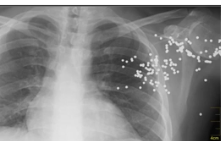
What is this? What side? When did it happen?
Buckshot L. Unknown. Cannot determine from x-ray.
Mammography
Mammography is a radiographic technology (X-ray) used to screen for breast cancer.
Mammography can frequently determine a breast cancer lump before it becomes palpable.
Incidents of mammography
1 out of 8 women will develop invasive breast cancer in their lifetime.
In 2021 it is estimated that 284,000 women were diagnosed with breast cancer.
Breast screening recommendations:
Screening every year for women 40+.
Self-examinations 1x a month.
Clinical breast exam by doc 1x a year for women 19+.
Oral Cholecystogram
Patient swallows contrast dye which is radiopaque. This dye is absorbed by the gall bladder and allowed visualization of the gallstones.
X-ray of gallbladder; gallstones appear as radiolucent (dark) within a radiopaque bile (white)
CT-Scan
Obtains multiple X-ray images at different angles into a three-dimensional picture by a computer.
Medical imaging is the primary use.
Used for diagnostic and therapeutic purposes.
CT-Scan can do what?
determine infarction (tissue death), tumors, hemorrhage and bone trauma.
scan of the abomen can be used for tumor masses and cancer staging.
Magnetic Resonance Imaging
Based on the principle: hydrogen atoms are placed in an external magnetic field they can emit radiofrequency energy.
This radiofrequency signal are integrated into scan.
Hydrogen atoms are most prevalent in water and fat, and not in bone.
MRIs are performed:
in a close cylinder like chamber.
may induce claustrophobia for the patient.
a mild sedative is recommended to reduce the claustrophobia.
Why are MRIs favored over CT-Scan?
MRI scans are very useful in studying the neuroanatomy of the brain.
Bony skull does not interfere with transmission because of the low water content.
MRI does not use ionizing radiation like CAT scans, so it is favored over.
MRI is noninvasive, more expensive, more time-consuming.
Ultrasound
High frequency sound waves produced by a transducer.
The transducer emits high frequency sound wave beams, then detects echoes reflected back.
The echoes are reflected back a change in tissue density/boundaries between tissues (e.g. the boundary between fluid and soft tissue or tissue and bone).
After echoes hit the transducer, they generate electrical signals that are sent to the scanner to produce an image on the screen.
Ultrasounds for pregnancy
The amniotic fluid (homogenous) is black and the fetal skeleton is white.
This white appearance of the skeleton is due to the density of the bone and the reflection back of the echoes from the bony surface.
Acoustic shadowing for ultrasounds
There is lack of penetration of the echoes through the (ex:) gallstone, unable to see the tissues behind it.
PET Scan
Biologically active molecule (allows for cell growth) is attached to a positron emitting radionuclide (tracer). The concentration of this active tracer is used as an indicator of metabolic activity.
PET Scan example
ex: cancer metastasis - cells have an increased level of activity due to increased cellular metabolism.
Due to the cellular needs, they take up the biologically active molecule in increased amounts. affixed to this molecule is the tracer.
result: the cancer cells can be detected by the concentration of the positron emitting tracer.
Cytology
is the study of cells.
Benign cells
more distinctive in appearance because they have retained their cellular characteristics.
Cancer cells
lose their cellular characteristics and become dedifferentiated. dark, enlarged active nucleus, have minimal cytoplasm, crowding and the cells appear stuck together.
Why are cancer cells grainy?
they are active metabolically.
Why do cancer cells have minimal cytoplasm?
they divide too quickly to make a sufficient amount.
What is a pap smear (diagnostic modality)?
when a sterile cotton swab is rubbed on the cervix to collect cells.
Normal cervical cells
small nuclei, benign.
Active cancer cells
larger the nuclei are and there is less cytoplasm.
Fine Needle Aspiration (FNA, diagnostic modality)
obtains cells from the suspicious lesion, send them to a lab for evaluation where they are microscopically examined to establish a diagnosis.
What does a benign nodule look like?
homogeneity of all the nuclei in the biopsy. small, round, and dark and look the same.
The Course of Disease
Prognosis, Acute, Terminal, Chronic, Remission
Exacerbation
Relapse
Complication
Sequela
Top 10 Leading Causes of Death in US
heart disease, cancer, chronic lower respiratory diseases, stroke, accidents, alzheimer’s disease, diabetes mellitus, nephritis, influenza/pneumonia, suicide
Top 10 Leading Causes of Death in WORLD
heart disease, stroke, lower respiratory infections, COPD, diarrheal disease, HIV/AIDs, lung cancers, TB, diabetes, road traffic accidents,
Mortality
is the number of deaths
Morbidity
is the incidence of disease
Incidence
is the number of newly diagnosed cases of a disease.
Prevalence
percentage of the population that is affected with a particular disease at a given time.
Epidemiology
occurrence, transmission, distribution, and control of disease.
Etiology
cause of a disease.
Pathogenesis
how the cause of a disease leads to the changes in the body that result in the disease.
Idiopathic
disease without recognizable cause. It may appear to be spontaneous in origin.
Chief Causes of Disease
Hereditary, Congenital, Degenerative, Inflammatory/Autoimmune/Allergic, Neoplastic, Metabolic, Traumatic, Nutritional
Hereditary
passed by genes from the parents to the offspring.
ex: sickle cell anemia
Congenital
a medical condition that is present at birth. also referred to as birth defects and can be acquired during the fetal stage of development or from the genetic makeup of the parents.
ex: cleft lip cleft palate
Degenerative
the result of a continuous process based on cell changes affecting tissues that increasingly deteriorate over time,due to bodily wear/lifestyle choices.
ex: knee and hip replacements are most often performed for this.
Inflammatory
arise when inflammation becomes uncontrolled, and causes destruction of healthy tissue.
there are many. occur when the immune system mistakenly triggers it in the absence of infection.
ex: chronic sinusitis, asthma, contact dermatitis.
Autoimmune/Allergic
occur when your immune system attacks healthy cells in your body by mistake.
ex: Systemic Lupus Erythematosus (SLE, lupus). antibodies attach to tissues. patients develop a facial butterfly rash. treatment = daily oral prednisone (steroid that reduces immune function)..
Neoplastic
meaning new growth in Greek, refers to any abnormal growth, whether malignant or benign.
refers to both malignant and benign growths.
all types of cancer fall into the category of malignant.
with cancer there will be crowding and loss of cellular characteristics as the cancer cells continue to divide and crowd out the healthy normal cells.
Metabolic
genetically determined or acquired.
process that the body uses to obtain or make energy from food.
ex: Type 1 diabetes mellitus (T1DM), a deficiency of insulin. insulin enables the entry of glucose into the cell. insulin deficiency causes blood sugar levels to rise. lack of insulin and the elevated levels of sugar cause complications to occur.
treatment of diabetes: diet control, blood sugar monitoring, and use of insulin.
Trauma
physical injury or wound caused by external force or violence.
ex: chronic traumatic encephalopathy (CTE), which is a progressive degenerative disease of the brain. common in athletes who have recurring concussions and traumatic brain injury.
triggers progressive degeneration of the brain tissue. associated with memory loss, confusion, impaired judgment, impulse control problems, aggression, depression and progressive dementia.
Risk Factors of Disease
Environmental, Chemical, Physiological, Psychological, Genetic
Health Promotion and Disease Prevention
Poor Nutrition, Lack of Physical Activity, Tobacco Use, Excessive Alcohol Consumption
How to prevent disease?
Be Physically Active, Eat Wisely, Maintain a Healthy Weight, Be Tobacco Free, Limit Alcohol, Get Recommended Screening Tests and Immunizations, Manage Stress