cre maybe?
 Call Kai
 Learn
Learn Practice Test
 Spaced Repetition
 Match
Match Flashcards
 Knowt Play
1/56

There's no tags or description
Looks like no tags are added yet.
Name | Mastery | Learn | Test | Matching | Spaced | Call with Kai |
|---|
No analytics yet
Send a link to your students to track their progress
57 Terms
Caseous necrosis is rich in
a. Lipid
b. Gly
a. Lipid
2. Seroid caused by lack of what vitamin
vit e
5. Oedema is:
Excess fluid is accumulated in the tissue
6. Edema is
Accumulation of fluid inside/outside of cell/accumulation of inflamed tissue
7. Amyloid is found
the spleen, liver and kidney are the organs with the most extensive formation of amyloid
8. Amyloid intra/extra cellular?
Extracellular
Pyogenic membrane is of infract/cyst/abcess:
Capillaries and venules in the connective tissue supply neutrophils that cross into the cavity of the abscess. The wall is called apyogenic membrane.
Regeneration is a new tissue with restoration of function and architecture (yes/no)
yes
Zenkers necrosis is a deficiency of:
it is essentially a coagulation of the proteins of the sarcoplasm a. Deficiency of vitamin E and Se
Fatty replacement is on (the same as fatty infiltration)
a. Liver and kidney
b. Myocardium and skeletal muscle
c. ..
b. Myocardium and skeletal muscle
. Fatty infiltration in common in liver/pancreas/kidneys?
a. Myocardial and skeletal muscles, and pancreas (but it is not common)
. Regeneration definition
. The formation of new cells like those, which were lost is in some cases. This is seen commonly on epithelial surfaces
Fatty replacement is occuring in which tissue
Skeletal muscle and heart
Gangrene
a. In reality does not represent a distinctive pattern of cell death. It is a necrotic tissue, which has undergone secondary influences
b. Two (three – líka gas) basic types of gangrene, dry and wet – the only difference being the availability of fluid for the rapid growth of bacteria
6. Wet gangrene description
a. Bloody/black/swollen/pulpy
Characterize jaundice (skrifleg) (or icterus)
a. Occurs when excess bilirubin (rauðbrúnt litarefni í galli) is present in the plasma and all tissues are stained yellowish-brown.
b. There are three types of jaundicee
i. Prehepatic
ii. Hepatic
iii. posthepatic
Coagulitive necrosis macroscopic appearance
Macroscopically: firm consistency, greyish – white to greyis – yellow color, dryness and cloudness
b. Microscopically: cytoplasm is homogenous and eosinophilic
. Antrachosis inhalation of what?
a. Carbon compounds
b. Found in city dogs and in animals exposed too much dust
c. The lung may be grey or motted in color. The bronchial nodes may be black
What is pus
a. A liquid of creamy color and consistancy and it is rich in leukicytes (mostly neutrophils) and parenchymal cells debris
Localized amylodosis
Caused by localized tumours of plasma cells in various tissues
35. What is hyaline droplet
a. Small eosinophilic structures in the cytoplasm of the cell
Russel bodies
a. Eosiniphilic globules that arise after the accumulation of immunoglobulin
37. Inclusion bodies
- In viral infections. These may be intranuclear, intracytoplasmic and either eosinophilic or basophilic, single or multiple
. Infarct myocardi caused by thromobo et eller anna caused by what necrosis
coagulation necrosis
Caseation (caseous necrosis)
Implies conversion of dead cels into a granular friable mass grossly resembling cottage cheese.
Most commonly is located in the centre of a tuberculosus lesion.
The appearance is due to a mixture of degenerative tissue protein and fat, the latter being derived from the lipid capsule of the organism
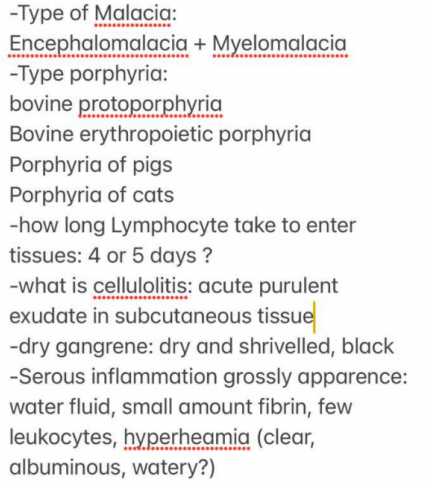
1. Types of malasia:
2. Types of porphyria:
1. Types of malasia: Encephalomalacia + Myelomalacia
2. Types of porphyria:
a. bovine protoporphyria
b. bovine erythropoietic porphyria
. porphyria of pigs
d. porphyria of cats
What is cellulitis
acute purulent exudate in subcutaneous tissue
Dry gangrene:
dry and shrivelled, black
Gout what is it?
disease that occurs when uric acid and urate crystals are deposited in tissue as a result of defects in purine metabolism. This tends to occur in joint spaces or on other serous membranes such as the pleura or peritoneum, or in the renal tubules.
Processus of stones in gallbladder
Cholelithiasis
Processus of stones in intestines
Enterolithiasis
Processus of stones anywhere in the urinary passage
Urilithiasis
Processus of stones in the pancreatic duc
Pancreatolithiasis
Gas bubble which bacteria?
Anaerobes
Sequestration part of:
necrosis
Prehepatic jaundice
haemolysis of erythrocytes
Hepatic jaudice:
occurs from direct damage to liver cells and the release of conjugated and unconjugated bilirubin into the blood
Posthepatic jaundice
bilirubin has passed through the liver cells but is unable to pass into the intestine
Lipofuscine in
aged animal
. hyorexis:
fragmentation of chromatin
. Autolysis means self-digestion by those tissue enzymes that are present in, or released into the cytoplasm of the cell after death:
true
2. During rigor mortis are muscles usually affected in a specific sequence, the trunk, the jaws, then the extremities:
false
. The loss of the cell outline, the loss of the differential staining, the absence of the cell are changes of the cell observed in cell degeneration
false
. Calcification, gangrene atrophy of the organ and regeneration – belongs to outputs of necrosis
true
5. Steatosis or fatty degeneration is the normal accumulation of triglycerides in the inerstitium of perenchymatous organs
False
o Steatosis or fatty degeneration is the abnormal accumulation of triglicerides in the cytoplasm of parenchymal cells
6. Anthracosis is seen mainly in the lung which may be grey or mottled in colour. The bronchial nodes may be black, particularly the medullary regions where particles are held in the sinusoidal macrophages
true
7. Haemorrage (i.e. bleeding) is the escape of blood from the vascular compartment
true
16. Hypoplasia means that the tissue or organ did not reach its normal size or structure
true
1. Hyaline occurs as a connective – tissue hyaline and intracellular hyaline
true
Inclusion bodies represents on of the possibilty for amyoid accumulation and it is seen in viral infect
false
The liver is the most common location of statosis or fatty degeneration because it is the major organ involved in fat metabolism
true
The amount of haemosiderin in the organism may be an indication of excess iron or blood breakdown
true
Haemorrhage by rhexin is the outward passage of blood cells through intact vessel walls
fasle brtoken ealls
Atelectasis means partial or complete collapse of the lung or failure to extend
true
Emphysema is a normal, permanent, enlargement of airspaces accompanied by destruction of alveolar walls
true
Lobular pneumonias are haemorrhagic, fibrinous, fibrino-purulent, or necrotizing and sometimes gangrenous
true