Permian
 Call Kai
 Learn
Learn Practice Test
 Spaced Repetition
 Match
Match Flashcards
 Knowt Play
1/9

There's no tags or description
Looks like no tags are added yet.
Name | Mastery | Learn | Test | Matching | Spaced | Call with Kai |
|---|
No analytics yet
Send a link to your students to track their progress
10 Terms
When was the Permian
~299–252 Ma
What key events occurred in the Permian
-Synapsids (e.g., Dimetrodon) dominate land ecosystems
-Expansion of conifer forests – Gymnosperms (seed plants) replace swamp forests as climates dry.
-Pangaea supercontinent forms, creating vast deserts and impacting global climate patterns
-Diversification of reptiles – Early archosaurs (dinosaur ancestors) and parareptiles begin to appear.
-End-Permian extinction wipes out ~90% of species
-Huge reduction in terrestrial biodiversity driven by massive volcanic eruptions leading to increased atmospheric carbon and ocean acidification
What were the Permian reefs like
-An enormous Texan reef complex, Delaware Basin with unusual biota
-Shallow water parts: platy calcareous sponges
-Deeper water parts: frond-like bryozoans, many cryptic species
What extinction event occurred right before the End Permian extinction
End-Guadalupian (~260 Ma) with severe marine extinction, warming, volcanism.
When did the End Permian extinction occur
~252 Ma
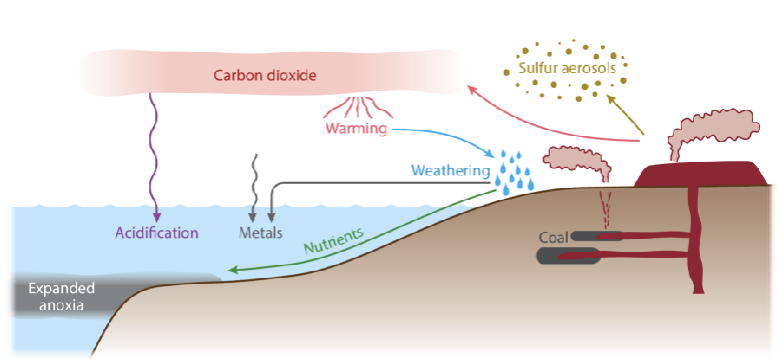
What caused the End Permian extinction (the Great Dying)
Trap volcanism in Siberia put massive amounts of carbon dioxide into the atmosphere. Bacteria that thrive on CO2 began producing methane, with large quantities of both gases warming the planet. Combined with Earth's water, the gas made the ocean and rain acidic, creating a highly toxic environment for life.
Volcanic CO2 emissions lead to global warming, ocean deoxygenation, anoxia and acidification.
We can see this event via the presence of uranium isotopes (shows expansion of anoxic bottom waters)
What are Siberian Traps
-Massive phase of volcanism
-4 million km2
-3.5 km thick pile of lavas= 3m thick across whole globe
-Eruptions persisted ~0.6 - 1 My
-Starting ~249 Ma
What are the general impacts of the extinction event
95% of all species lost, as well as 56% genera and 57% families extinct.
Groups lost include blastoid echinoderms, rugose and tabulate corals, acanthodian fish, trilobites and eurypterids (trilobites and eurypterids had both already dramatically declined before event)
Great decline in creatures including radiolaria, cephalopods, corals, bryozoa, foraminfera, brachiopods, crinoids (sea lilies), gastropods (snails) and bivalves
Marine impacts of the extinction event
-50% of marine families,
-~90% of species lost
Land impacts of extinction event
-~75% of families
-95% species lost
• ‘reef’ gap: ~7-8 My
• ‘chert’ gap: ~7-8 My
• ‘coal’ gap: ~10 My
-The only mass extinction to significantly affect insects
-Gymnosperm-dominated floras disappeared (Glossopteris)
-Two thirds of amphibians, reptiles and mammal-like reptiles were lost