3.1.3 - lipids
 Call Kai
 Learn
Learn Practice Test
 Spaced Repetition
 Match
Match Flashcards
 Knowt Play
1/36

There's no tags or description
Looks like no tags are added yet.
Name | Mastery | Learn | Test | Matching | Spaced | Call with Kai |
|---|
No analytics yet
Send a link to your students to track their progress
37 Terms
give the 2 groups of lipid
triglycerides
phospholipids
order alcohols, proteins, carbs and lipids from most energy to least energy
MOST
lipids
alcohol
protein
carbs
LEAST
what do all lipids contain
carbon, hydrogen, and oxygen (C, H, O)
are lipids soluble or insoluble in water
are lipids soluble or insoluble in organic solvents (e.g. alcohol or acetane)
insoluble
soluble
summarise role of lipids (WIPS)
waterproofing
insulation
protection
source of energy
what do lipids release (apart from energy) when oxidised that is useful?
water
why are lipids useful for waterproofing
examples of this in mammals and plants
they are insoluble in water
plants having waxy, lipid cuticles —→ these conserve water
mammals producing an oily secretion from the sebaceous glands in their skin
how do lipids help to retain body heat
(extra) when do fats act as electrical insulators
fats are slow conductors of heat
in the myelin sheath around nerve cells
why is it good that fats help with protection
they are often stored around delicate organs, e.g. the kidney
what are triglycerides
fats and oils
how are triglycerides formed
by the condensation of 3 molecules of fatty acid (tri) and 1 molecule of glycerol (glyceride).
what bond forms between each fatty acid and glycerol?
this bond is formed in a…(type of reaction?)
an ester bond
condensation reaction
therefore, what does hydrolysis of a triglyceride produce?
glycerol and 3 fatty acids
useful diagram of the formation of a triglyceride
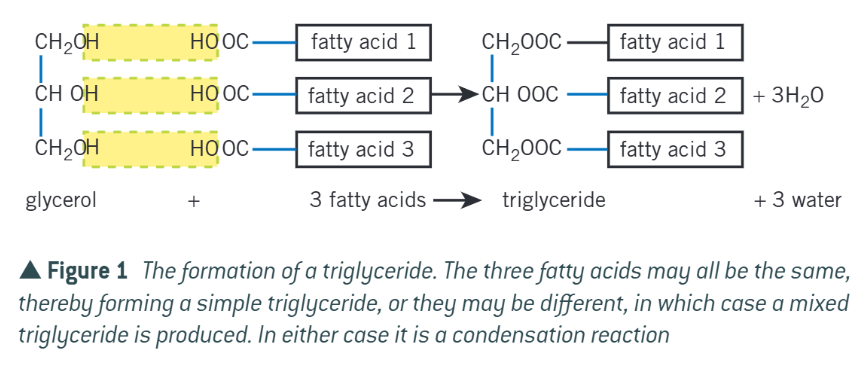
EXACT wording for describing the condensation reaction in this case (learn this!)
there is a reaction between the hydroxyl group (—OH) of the glycerol and the carboxyl groups (—COOH) of the fatty acids.
HOW are the properties of triglycerides different, even though the glycerol is the same?
different triglycerides can have different fatty acids. we’ll go into this now
general formula for a fatty acid (from spec)
hence, all fatty acids have a c__________ group (—COOH) with a h____________ c_____ attached.
RCOOH
hence, all fatty acids have a carboxyl group (—COOH) with a hydrocarbon chain attached
(the R represents the hydrocarbon chain, think of it as a variable - it can change)
when is the fatty acid described as saturated
why is this
if the chain has no C==C double bonds (all single C—C bonds)
bc all the C atoms are bonded to the maximum no. of H atoms possible (no bonds can be opened up, and therefore no atoms can be added)
when is the fatty acid described as unsaturated
what is a mono-unsaturated fatty acid
what is the fatty acid called when it has more than 1 double C==C bond
if a double C==C bond is present
when it has 1 double C==C bond
poly-unsaturated
diagram of diff. fatty acids
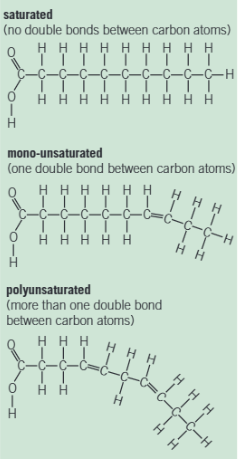
(we’ve already covered this, this is just the wording used in the spec) the R-group of a fatty acid may be…
unsaturated or saturated
apart from a fatty acid being saturated or unsaturated, what else may differ between them?
how many C atoms they have (and therefore, how long the hydrocarbon chain is)
why are unsaturated lipids liquid at room temperature (make ref. to structure)
the double bonds in the hydrocarbon chain cause kinks in the molecule’s structure (which cause it to bend)
so the fatty acid tails cannot pack together closely
which weakens the IMF between the unsaturated fatty acids
and weak IMF require less energy to overcome, so the lipids have lower MPs
why are triglycerides a good source of energy, in terms of structure
high ratio of energy-storing C—H bonds to C atoms
why are triglycerides good storage molecules, in terms of their structure
have a low mass to energy ratio
so more energy can be stored in a small vol. (useful in animals, as reduces mass they have to carry as they move around)
why are triglycerides insoluble
hence what 2 things does their storage not affect
they are large + non-polar
osmosis in cells, or the water potential of cells
role of phospholipids
contribute to the flexibility of membranes
contribute to transfer of lipid-soluble substances across membranes
what is different between a triglyceride and a phospholipid in terms of structure?
one of the fatty acids of a triglyceride = substituted by a phosphate molecule, and a phospholipid has no glycerol
what is different between a triglyceride and a phospholipid in terms of relationship with water?
fatty acids are hydrophobic (repel water)
phospholipids are hydrophilic (attract water)
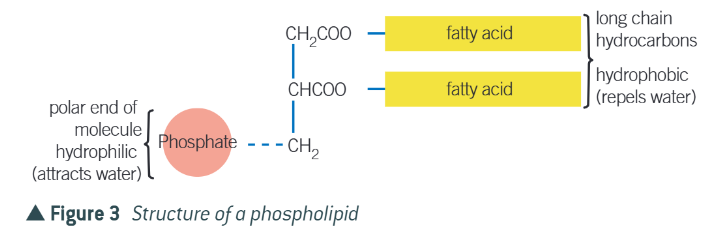
what 2 main parts is a phospholipid made up of
a hydrophilic phosphate head (interacts w/ water, but not fats)
2 hydrophobic tails (orients themselves away from water, but mixes readily w/ fat)
diagram of a structure of a phospholipid
what are the ends of a molecule called
what do you call molecules that have 2 poles that behave differently in this way?
poles
polar molecules
hence, when phospholipids are placed in water, how do they position themselves
so that the hydrophilic heads are as close to the water as possible
and the hydrophobic tails are as far away from the water as possible
why do phospholipids, when in aquaeous environments, form a bilayer within cell-surface membranes
phospholipids = polar molecules (hydrophilic phosphate head and hydrophobic fatty acid tails)
so a hydrophobic barrier is formed between the inside and outside of the cell
question: why is the barrier hydrophobic if the hydrophilic heads are facing outward
what does the phospholipid structure allow them to form
how
glycolipids (these are important in cell recognition)
by combining w/ carbohydrates within the cell-surface membrane
what is the test for lipids called
emulsion test
how to carry out emulsion test for a sample
crush / grind food and put in test tube
add ethanol
then add water (water MUST be added after ethanol, won’t get the mark otherwise)
shake tube thoroughly. if cloudy white emulsion forms, lipids are present
can make a control by repeating the procedures and using water instead of the sample. final solution should remain clear.