lipid metabolism
 Call Kai
 Learn
Learn Practice Test
 Spaced Repetition
 Match
Match Flashcards
 Knowt Play
1/12

There's no tags or description
Looks like no tags are added yet.
Name | Mastery | Learn | Test | Matching | Spaced | Call with Kai |
|---|
No analytics yet
Send a link to your students to track their progress
13 Terms
lipid metabolism
triglyceride is a molecule that is made up of a glycerol molecule and fatty acids
only triglycerides routinely oxidized for energy
two building blocks oxidized separately:
- glycerol —> glycolysis glycerol can go through glycolysis
- fatty acids —> B oxidation fatty acids go through process where they get broken down and energy is extracted by beta oxidation
Energy density of macronutrients
greater energy yield:
- fat= 9 kcal per gram (9000 calories per gram)
- CHO= 4kcal per gram (4000 calories per gram)
- protein= 4 kcal per gram (4000 calories per gram)lipids are energy dense relative to carbs and protein
Triglyceride formation
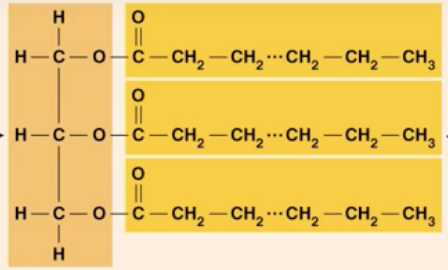
made up of a glycerol molecule plus the three fatty acids attached to each carbon of the glycerol
glycerol is a three carbon molecule and associated with each carbon there is a fatty acid
- three fatty acids give it the name triglycerideyou can get triglycerides through your diet or it can be made in your body
large molecule
how we store lipid inside cells
structure of cooking oil and lard
Similarities and differences between phospholipid and triglyceride
one of the fatty acids of the triglyceride is replaced with a phosphorus containing group or vice versa
- the phospholipid is produced at the border of the smooth and rough ER
- triglyceride is produced in the smooth ersimilarities: both synthesized inside cells within the endoplasmic reticulum
very similar to phospholipid where you have two fatty acids, each attached to a separate carbon and you have a phosphorus containing group attached to the third carbon
- phospholipid make up plasma membrane
How does a triglyceride get across the the plasma membrane
lipase: enzyme that breaks down the triglyceride into its components (a glycerol and its three fatty acids)
once this is done the glycerol and fatty acids can be transported across the plasma membrane
once they are in the interstitial fluids we can recombine them to form a triglyceride
cell uses triglyceride as energy source
glycerol ends up being broken down in glycolysis
but the fatty acids enter beta oxidation
Beta (B) Oxidation
glycerol is a three carbon molecule and can enter glycolysis as glyceraldehyde 3 phosphate
- the glyceraldhyde 3 phosphate is important because that is the molecule that we extract electrons from the synthesis of ATP via substrate level phosphorylation
- in the process we produce pyruvatethis is where we extract those electrons and hydrogens and synthesize ATP via substrate level phosphorylation
the pyruvate that was produced can be transported across the mitochondria, broken down, producing more NADH and synthesizing acetyl CoA
then acetyl CoA can then enter into the Krebs cycle which generate more high energy electron carriers and ATP via substrate level phosphorylation
Products in glycolysis from glycerol **KNOW THESE NUMBERS**
how many NADH are produced from a glycerol molecule?
- in glycolysis: 1How many ATP do we produce in glycolysis from this glycerol?
- 2How many pyruvate molecules do we produce from a glyceraldehyde three phosphate?
- 1
- glyceraldehyde 3 phosphate is a 3 carbon molecule and so is pyruvate, since we started with three carbons, we are ending with three carbons
Metabolism of fatty acids
enter into beta oxidation
can require energy for activation
CoA is involved
in beta oxidation we produce a lot of high energy electron cerriers and acytel CoA
differences between fatty acids and glycerol
fatty acids enter a different metabolic pathway
- beta oxidation
Similarities between glycerol and fatty acids
they both strip off hydrogens and electrons and produce NAD
aerobic metabolism of a glycerol molecule and metabolism of fatty acids can produce acetyl CoA
Fatty acid
long chain of carbons with a bunch of hydrogens
as the 18 carbon fatty acid makes its way through beta oxidation and we strip off hydrogens and electrons, this produces acetyl CoA
- Acetyl CoA has 2 carbons from one cyclethat produces Acetyl CoA
now down to a 16 carbon fatty acid and it passes through beta oxidation taking more hydrogens and electrons