Physio Oct. 10th
 Note
Note Call Kai
 Learn
Learn Practice Test
 Spaced Repetition
 Match
Match Flashcards
 Knowt Play
1/20

There's no tags or description
Looks like no tags are added yet.
Name | Mastery | Learn | Test | Matching | Spaced | Call with Kai | Chat |
|---|
No analytics yet
Send a link to your students to track their progress
21 Terms
What are the 2 common respiratory structures?
Gills, primarily in aquatic animals.
Lungs, primarily in terrestrial vertebrates.
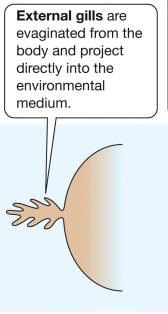
Explain the structure and function of external gills
Project into the environment for direct interaction with the medium (usually water), offering large surface area but are vulnerable to damage and desiccation in air.
Example: Land crabs utilize external gills kept moist for gas exchange with air, demonstrating a terrestrial adaptation of gills.
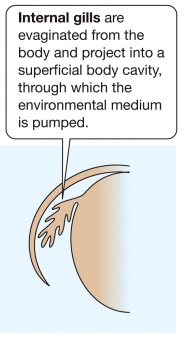
Explain the structure and function of internal gills
Protected structures that extend from the body and are covered by plates, reducing vulnerability.
Example: Fish possess internal gills under the operculum, allowing unidirectional flow of water over the gills, which is vital for efficient countercurrent exchange.
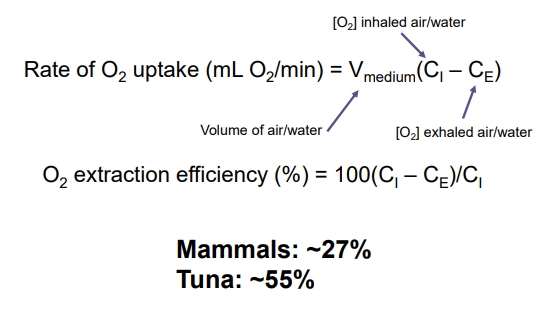
What is the Rate of O2 uptake and O2 extraction efficiency equations?
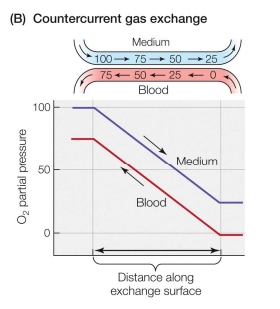
Fish, while having lower rates of oxygen consumption compared to mammals, are more efficient in extracting oxygen from water, largely due to countercurrent exchange, where blood flows in the opposite direction to water, maintaining a favorable partial pressure gradient across the entire respiratory surface.
What are the different types of ventilation?
Passive Ventilation: Without muscular control (e.g., in polychaete worms), relying on environmental currents.
Active Ventilation:
Non-Directional Active Ventilation: A form of ventilation in which muscles actively move the respiratory medium (e.g., water or air) to increase flow over the gas exchange surfaces (like gills), but without a consistent or defined flow path or direction.
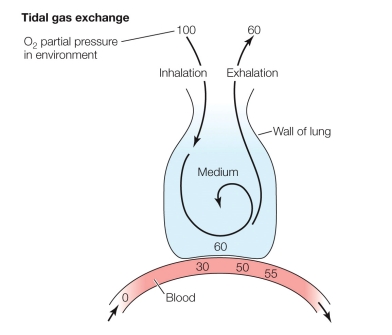
Tidal Exchange Ventilation: Involves inhalation (bringing fresh air in) and exhalation (expelling spent air), leading to the mixing of fresh and stale air (residual volume) after expiration; common in mammals. This reduces the maximum possible partial pressure gradient.
Unidirectional Flow Mechanisms:
the respiratory medium (air or water) moves continuously in a single direction across the gas exchange surface, enhancing gas exchange efficiency by maintaining a consistent partial pressure difference (e.g. fish gills; water enters through the mouth, passes over the gills, and exits through the gill slits. Is paired with countercurrent exchange)
Whats tidal gas exchange?
a type of respiration where the respiratory medium (air) moves in and out of the lungs along the same pathway, meaning fresh air and spent (used) air mix within the respiratory tract.
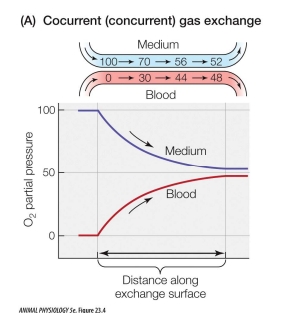
Whats co-current gas exchange?
Co-current gas exchange (also called concurrent gas exchange) is when the respiratory medium (like water or air) and the blood flow in the same direction across the gas exchange surface.
Whats countercurrent gas exchange?
Countercurrent gas exchange is a highly efficient respiratory system where the blood and the respiratory medium (usually water) flow in opposite directions across the gas exchange surface.
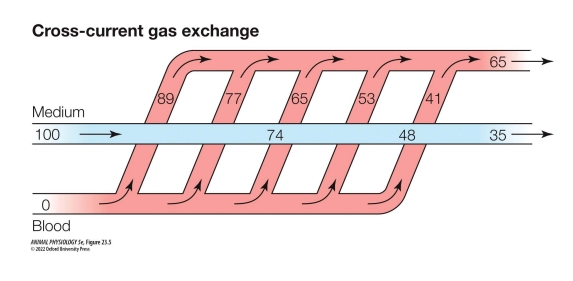
Whats cross-current gas exchange?
Cross-current gas exchange is a system where the air (or water) and the blood flow at right angles (perpendicular) to each other across the gas exchange surface.
Whats ranked gas exchanges by efficiency?
Countercurrent (most efficient due to continuous gradient maintenance) > Crosscurrent > Concurrent ≈ Tidal ventilation.
What are the factors that influence gas exchange?
Surface Area (A):
Large surface area of epithelia in gills/lungs facilitates gas exchange, directly proportional to diffusion rate, with body mass scaling allometrically.
Birds and mammals show larger surface areas adapted for higher metabolic rates, allowing for greater oxygen uptake.
Thickness of Epithelium (L):
Thinner epithelia (diffusion distance), particularly in birds, allow for more efficient diffusion. Diffusion rate is inversely proportional to thickness.
Partial Pressure Gradient (ΔP):
The difference in partial pressure of the gas between the medium and the blood. A larger gradient drives faster diffusion. This is a critical component of Fick’s Law of Diffusion, which states that the rate of diffusion (R) is proportional to (Diffusion Coefficient × Area × ΔP) / Length
(R∝LD⋅A⋅ΔP).
Whats the difference between vertebrate breathing?
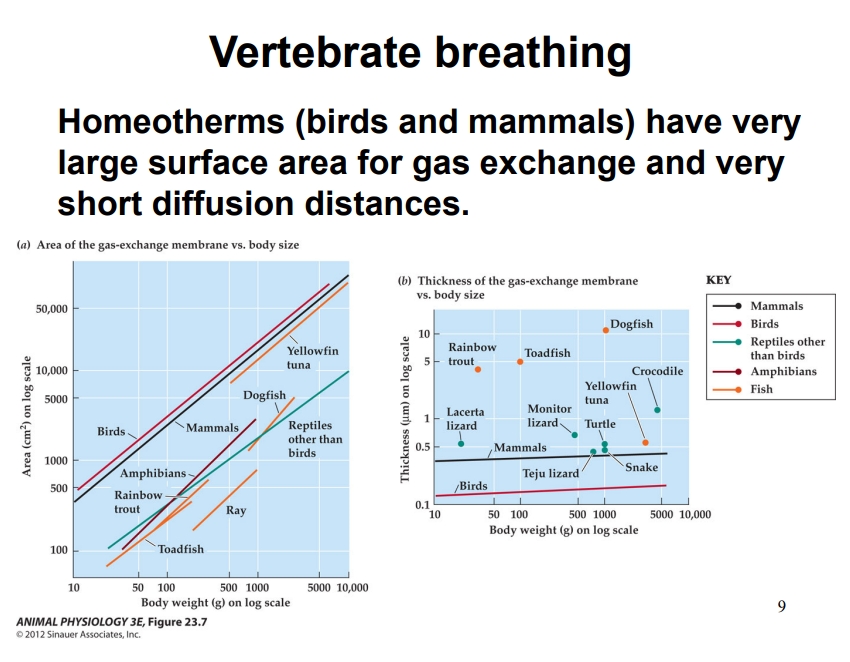
Homeotherms (birds and mammals) have evolved more efficient respiratory systems than ectotherms (fish, amphibians, reptiles) because they need to maintain a constant, high body temperature and therefore require more oxygen.
Birds and mammals have much larger gas exchange surface areas relative to body size than fish, amphibians, or reptiles.
A larger surface area = more space for oxygen and carbon dioxide to diffuse, which supports higher metabolic rates.
Birds and mammals have very thin gas exchange membranes, allowing faster diffusion of oxygen into the blood.
Fish, amphibians, and reptiles have thicker membranes, slowing diffusion.
Explain how fish breathe using their gills
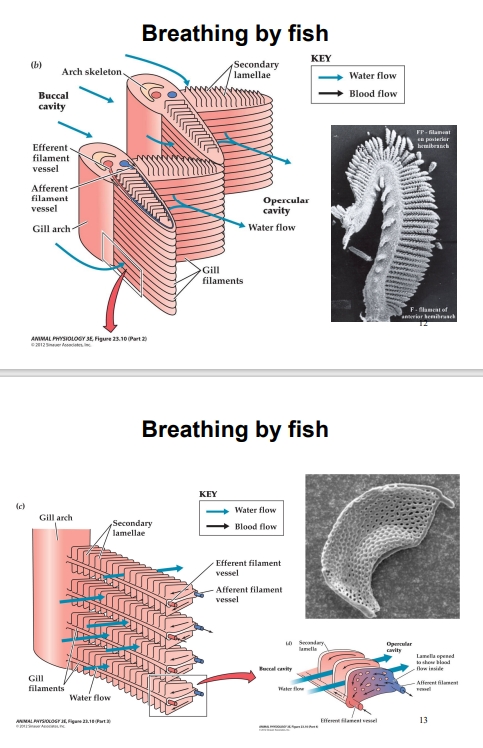
Water enters the buccal cavity (mouth), passes over the gill filaments, and exits through the opercular cavity (gill cover).
Blood flows through capillaries in the opposite direction (shown by red arrows).
This opposite (countercurrent) flow keeps a constant diffusion gradient — oxygen always moves from the water (which has higher O₂) into the blood (which has lower O₂).
This active pumping maintains a continuous water flow even when stationary.
Explain how Ram Ventilation works
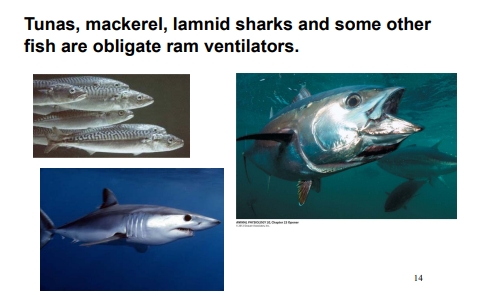
Ram ventilation is a method of breathing used by certain fast-swimming fish (like tuna, sharks, and mackerel) where they force water over their gills by swimming with their mouths open, instead of using buccal–opercular pumping.
The fish swims forward with its mouth open.
The forward motion pushes water into the mouth.
Water passes directly over the gills and exits through the opercular openings (or gill slits in sharks).
Oxygen diffuses from the flowing water into the blood in the secondary lamellae through countercurrent exchange, just like in other fish.
There’s no active pumping by mouth or opercular muscles — the swimming motion alone drives the water flow.
How do amphibians breathe?
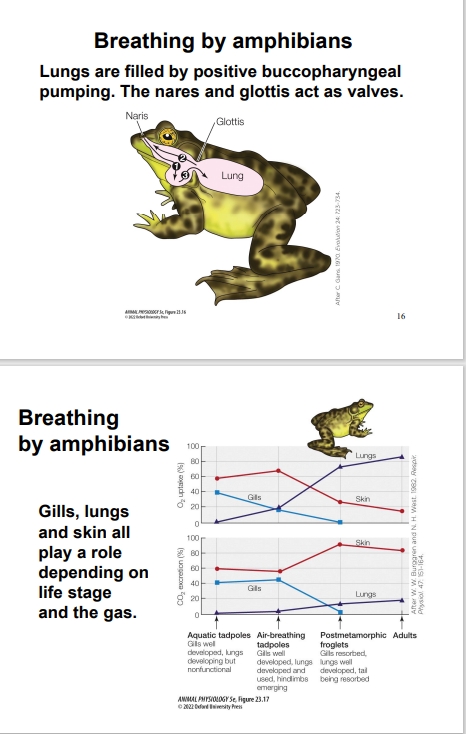
Amphibians utilize positive pressure breathing to fill lungs by swallowing air, contrasting mammals’ negative pressure method. Air is forced into the lungs by increasing pressure in the buccal cavity.
To move air in and out, they sue Buddha, pumping by lowering the floor of their mouth to draw air in and then closing their nostrils and raise the floor, pushing the air into the lungs.
Many are dual breathers, and depends on life stage. Paired unicameral lungs, surface may be honeycombed in frogs and toads
Gills are completely lost during adulthood in most species, yet skin remains a primary route for CO2 excretion (cutaneous respiration) which is highly permeable and moist.
Example: Bullfrogs rely significantly on skin for CO2 and lungs for oxygen uptake, demonstrating a bimodal respiratory strategy.
How do reptiles breathe?
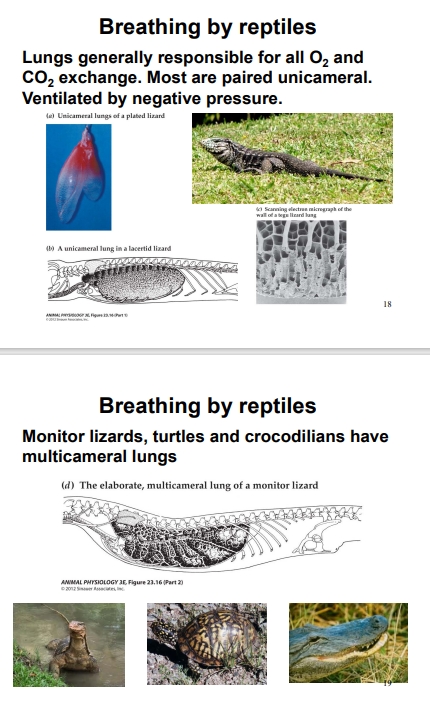
Most reptiles possess unicameral lungs (single chamber), while some (like monitor lizards) have multicameral lungs with internal septa, increasing surface area for improved efficiency.
How do insects breathe?
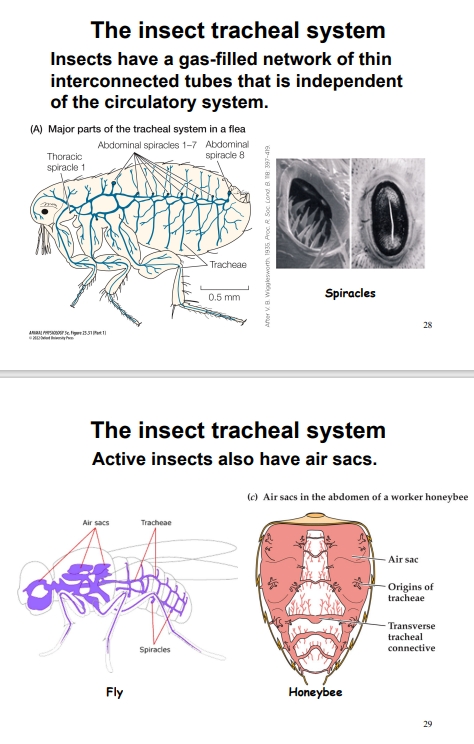
Unique to insects, respiratory gas exchange occurs via spiracles (external openings) leading to a highly branched tracheal system. The tracheae subdivide into tracheoles that penetrate directly into peripheral tissues and cells, allowing for direct diffusion of gases to cells, minimizing reliance on the circulatory system for oxygen transport.
Some larger insects can actively ventilate their tracheal system by muscular contractions to pump air.
How do mammals breathe?
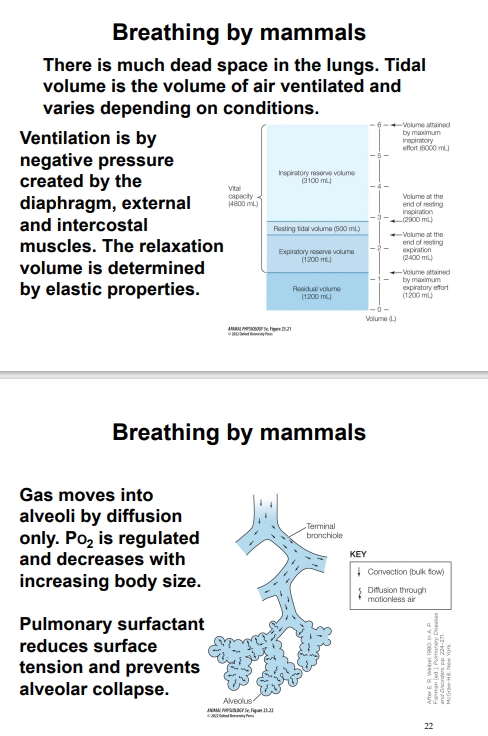
Mammals have highly branched respiratory airways leading to millions of alveolar sacs, which increase surface area extensively for gas exchange, creating a huge internal surface.
Ventilation via diaphragm creates negative pressure in the thoracic cavity, drawing air into the lungs. Mammals experience elastic recoil of the lungs and chest wall for passive exhalation after inhalation, aided by relaxation of the diaphragm and intercostal muscles.
How do birds breathe though?
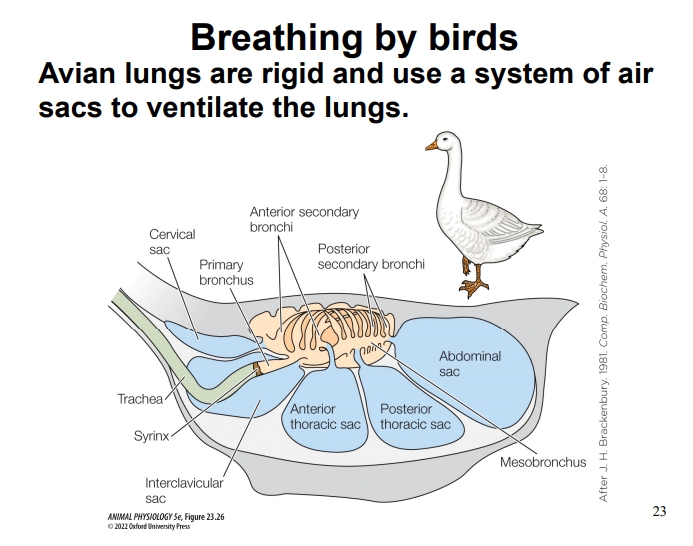
Birds have unique lung systems where air flows unidirectionally through rigid lungs and into a system of anterior and posterior air sacs.
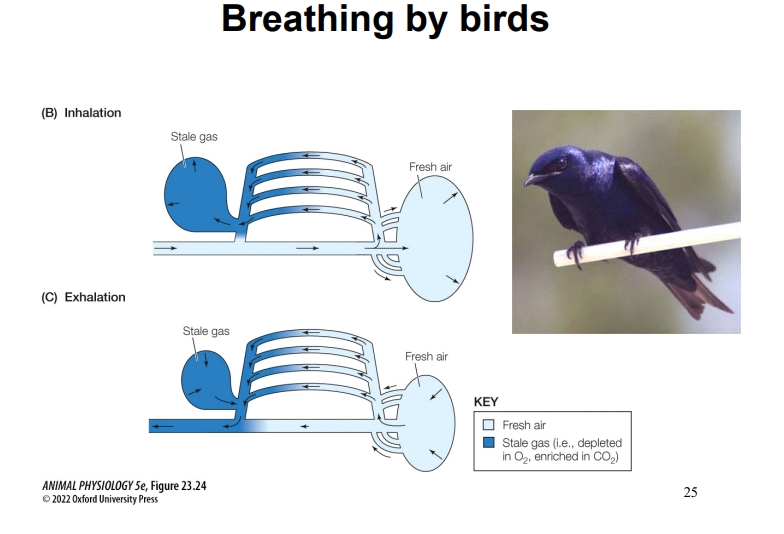
This intricate two-breath cycle ensures that fresh air constantly flows over the parabronchi (sites of gas exchange) without mixing with stale air, enhancing gas exchange efficiency, particularly important for high-altitude flight and high metabolic rates.
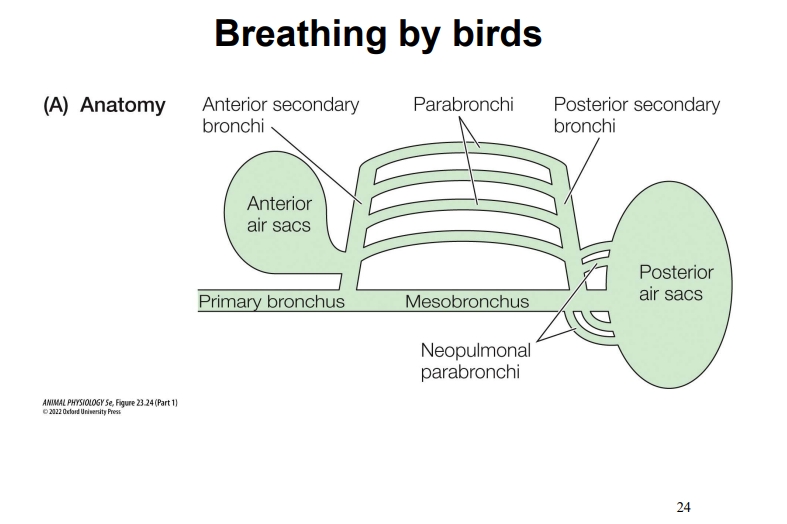
Hows the inhalation and exhalation work for birds?
Inhalation:
Fresh air enters through the trachea.
It bypasses the lungs and goes into the posterior air sacs (fresh air reservoir).
At the same time, stale air already in the lungs moves into the anterior air sacs (ready to be exhaled).
Exhalation:
The posterior sacs contract, pushing fresh air through the lungs, where gas exchange occurs (oxygen into blood, CO₂ out).
The anterior sacs also contract, pushing stale air out through the trachea and out of the bird’s body.
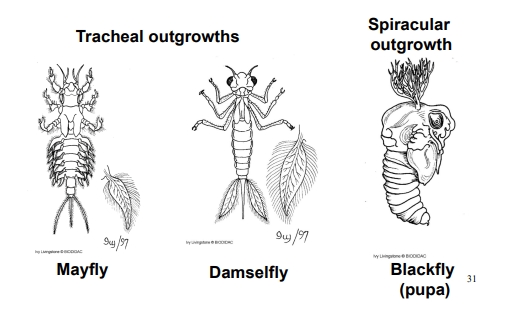
How do aquatic insects breathe?
Aquatic insects have evolved different gill adaptations depending on their environment and life stage.
Tracheal outgrowths (like in mayflies/damselflies) directly connect water-borne oxygen to the tracheal system.
Spiracular outgrowths (like in blackfly pupae) connect external spiracles to the water for efficient diffusion.