PPD
 Call Kai
 Learn
Learn Practice Test
 Spaced Repetition
 Match
Match Flashcards
 Knowt Play
1/161

There's no tags or description
Looks like no tags are added yet.
Name | Mastery | Learn | Test | Matching | Spaced | Call with Kai |
|---|
No analytics yet
Send a link to your students to track their progress
162 Terms
Where should large pieces of equipment go?
Dumpster: Out of view, far from noses, not near quiet room windows
Transformer: Between the municipal service and in-building switch gear. Could be on pole, on the ground near the building 4’ from the road, underground outside building or inside building. Out of view if possible. If inside building non-flammable coolant needed
Cooling tower: Large, out of view and need access to the atmosphere. Can’t be indoors often near the chillers they serve, can be remote if needed
Generator: Loud, but if it is a backup generator rarely be used and the noise will not be a problem. Must exhaust outside, typically outside a building. If inside must exhaust to outside.
When given a chance, how do you decide what is the least expensive construction technique?
What you see most often on construction sites is the least expensive.
OSB sheathing is more common and less expensive than plywood.
Plywood is more common as formwork, and less expensive than ICF
Vinyl siding is more common and less expoensive than wood siding
Asphalt roadway is more common and less expensive than concrete as pavement. Brick and cobblestons are more expensive than either … gravel is less expensive than either
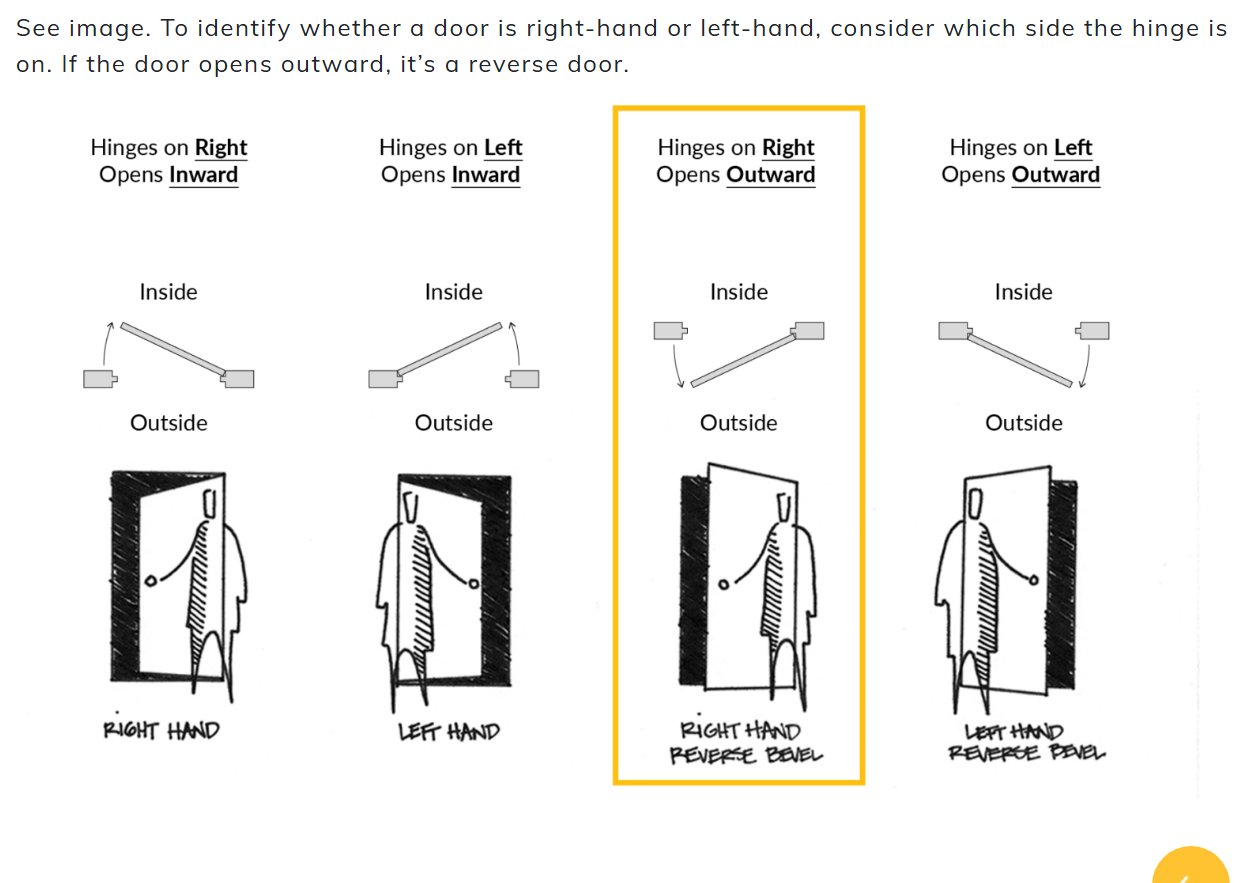
Right hand reverse door
How can we shade windows in the northern hemisphere?
South facing: Deciduous trees, horizontal louvers, light shelves, shade with other adjacent building masses
East and West: Deciduous trees, vertical louvers, light shelves
North facing: Shading not required
Shading lower southern sun requires ____ horizontal overhangs.
Longer!
Shading higher southern sun requires ____ horizontal overhangs.
Shorter!
Where should vertical fins be located?
Position vertical louvers on the east or west face so that the cut off angle of each fin shades direct sun.
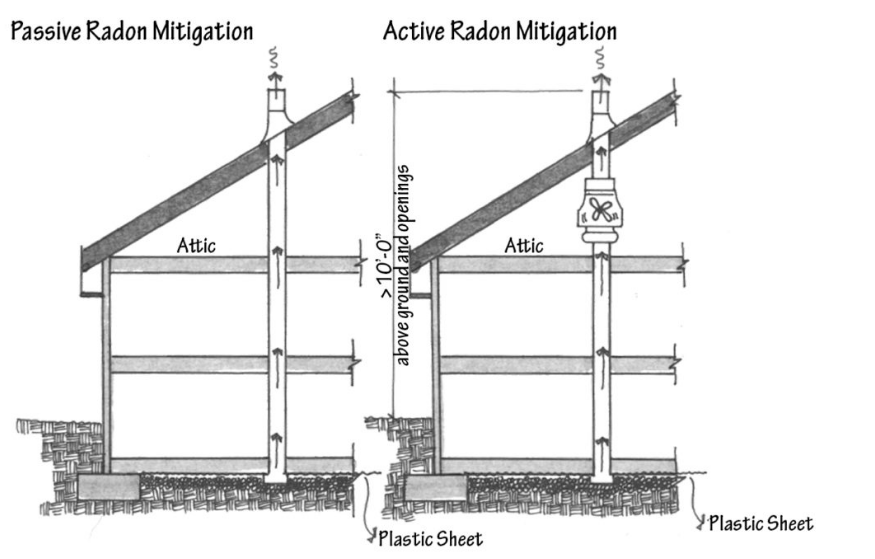
Passive vs active radon
Passive systems do not have a fan and use a plastic tube that extends from below slab up through roof.
Active systems use a fan that pulls air from below through a plastic pipe from below ground up through roof to air.
Why might it be problematic if a shear wall has too many holes or doesn’t run continuously from the roof to the foundation?
The discontinuities compromise its structural integrity and ability to resist lateral forces. It may not effectively function as a shear wall.
What is a “soft story”?
A floor (usually ground level) with significantly less lateral resistance than floors above due to large openings.
What is the problem with “soft story” buildings in seismic design?
Flexible lower floors that’s much weaker than upper floors, making them vulnerable to collapse during an earthquake due to concentrated lateral movements at that level.
There are urbanistic and programmatic reasons why you might want to design a tall or flexible or otherwise different first floor. What is the “soft story” solution?
Add columns to bottom floors, add bracing, add external buttresses.
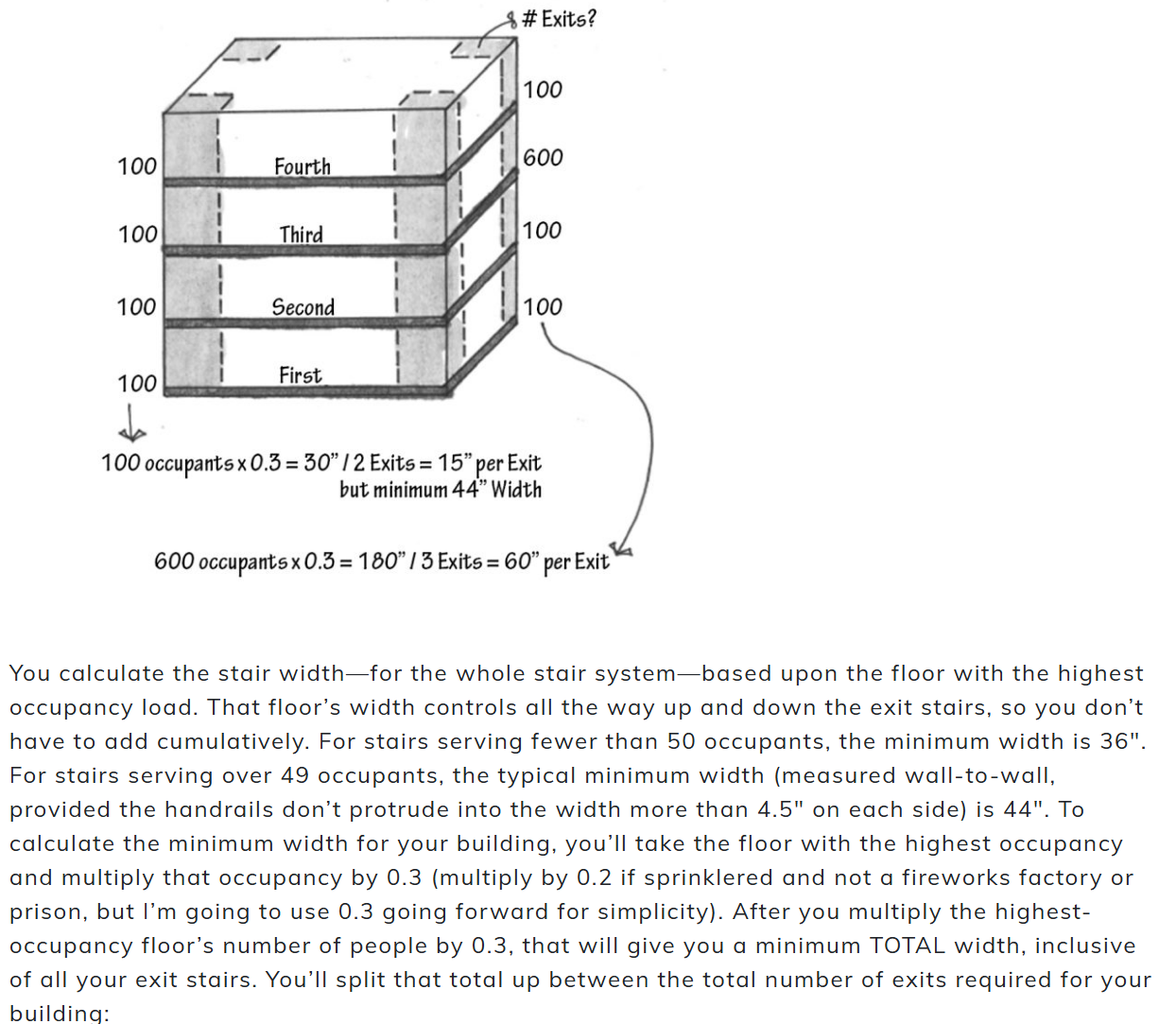
Calulating code stair width
Review Card 15
Shear (pin) vs Moment Connections
Shear connections don’t have flanges of beams bolted or welded to the columns they connect to, whereas moment connections do. They are more expensive though so it doesnt make sense to do a moment connection everyhwere and could be better just to use shear walls at stair towers as most life safety requires them to be concrete.
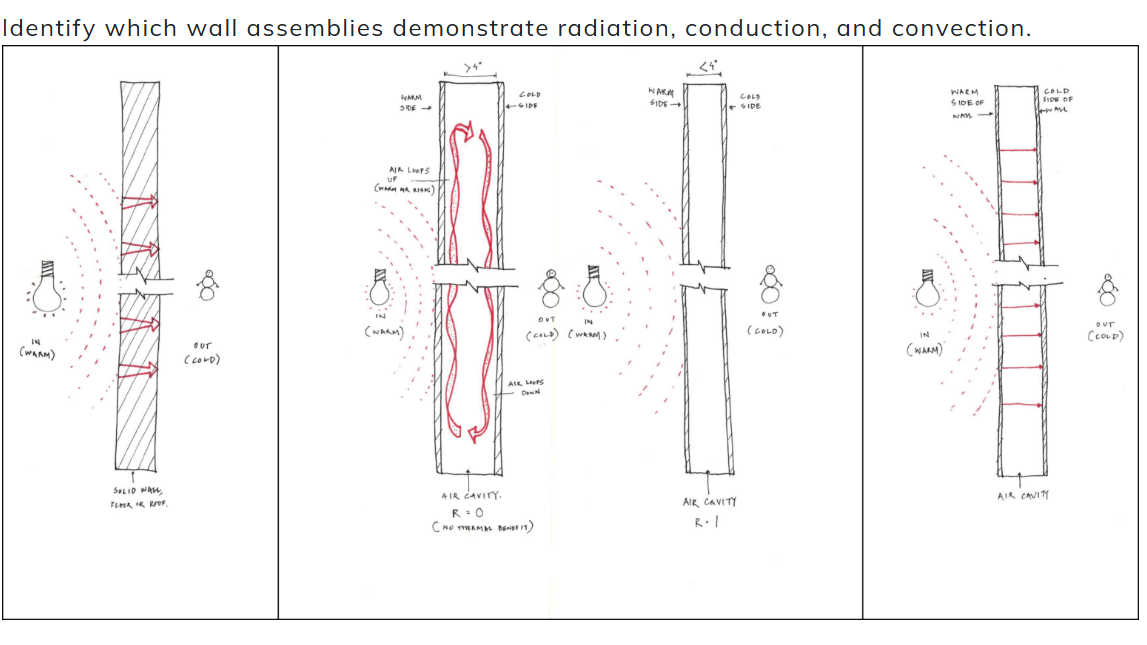
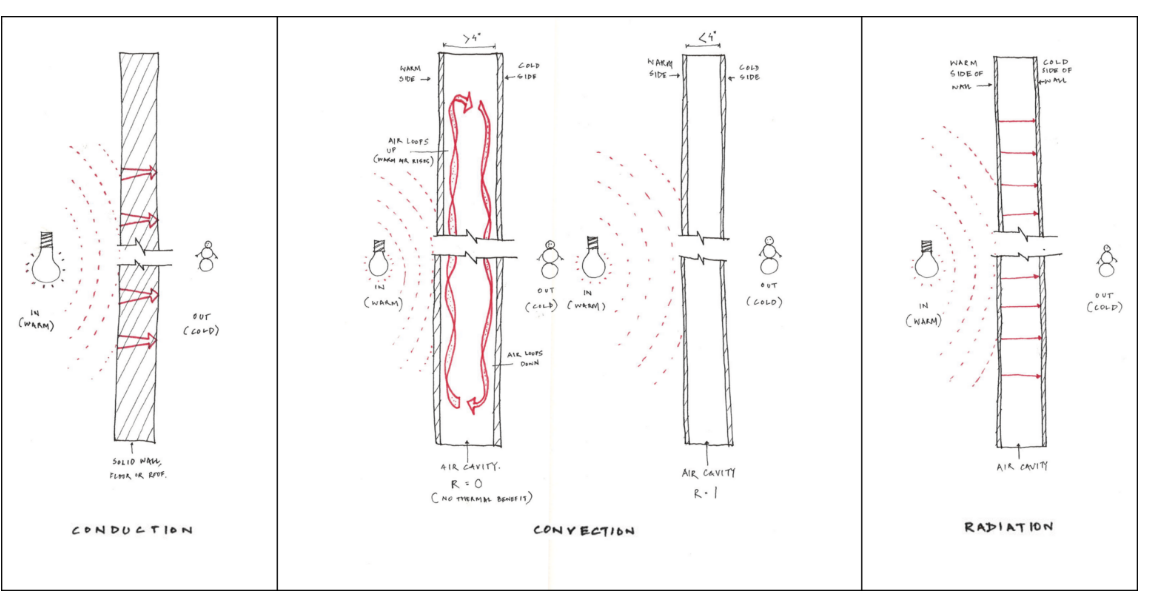
When the outside temperature is colder than the inside, can a convective loop develop in the cavity of a roof assembly? What about the floor assembly in contact with the ground?
For a roof assembly, yes because warm air rises and contacts the surface exposed to colder outside air. which cools it and causes it to sink, promoting convection.
For a floor, no the warm side of the assembly is on top and in contact with the warm interior air, so the warm air stays trapped.
Are wind loads higher at the top of tall buildings?
Yes, wind speeds increase with height above the ground (bust gustiness decreases with height).
To help with windward and leeward lateral pressure that can affect high floors, soften corners in plan, taper or set back the building plan as it rises, twist the building as it rises, provide larger apertures in the nuildings windward faces that allow the wind to pass through at some floors, or position a heavy damper in a top floor to counteract the natural vibratiosn of the building.
In which conditions does an exit stair need to be pressurized to keep smoke out?
Buildings made of combustible construction types (wood type V) Cosntruction?
Or
Underground Buildings
Underground buildings have stairs that must be pressurized
Egress path
Exit Access (corridor from room to stairs)
Exit (the stairs)
Exit Discharge (door from the stairs to the outside)
Pressurized stairs are required in the following building types to make sure smoke doesn’t fill the exit:
In tall buildings
In underground buildings
How do we best reduce the build-up of low-frequency sound in a room (rumble from a mechanical equipment)?
Specify materials with a low NRC or
Position sound absorbing materials near the corners and edges of walls
Position sound absorbing materials near the corners and edges of walls. Called a bass trap
Which type of soil is more stable to build on?
Clay
or
Sand
Sand
Clay behaves unpredictably when it gets wet. It swells.
Most soil boring reports detail a mix of sand and clay (and silt and gravel). It is then the proportion of clay that will determine stable soil
A good barrier for preventing sound from transmitting from one room to another is ___
Absorptive
or
Airtight
Airtight
Assemblies that are massive, air tight and structurally discontinuous do the best job at keeping out the neighbor’s tv noise. Sound absorption is used to reduce the sound buildup inside the same room.
A larger room has a __ reverberation time than a smaller room/
Longer
or
Shorter
Longer
Large rooms with fewer surfaces and rooms with harder, smoother less fuzzy surfaces are more reverberant (sound lingers longer).
Rooms with unamplified speech, amplified speech and amplified music generally want to be less reverberant: they want to be smaller with fuzzier surfaces.
Rooms for unamplified music, like concert halls generally want to be more reverberant: larger with harder and smoother surfaces.
A surface with an absorption coefficient of 1.00 is considered___
Sound-reflective
or
Sound-absorptive
Sound-absorptive
1 means fully sound absorptive where 0 is fully sound reflective. Most sound absorbing material has a value greater than .5 where sound reflective materials have values less than .2
What is an overturning moment?
Moment usually at retaining wall built from the average pressure of soil acting on the wall.
It’s wintertime, it’s been a rainy month, and there’s moisture inside the parapet structure. The building includes and arboretum. This can most likely be addressed with ___
Insulation
Rain Barrier
Vapor Barrier
Ventilation
Insulation
How many lavatories, water closets for boys, water closets for girls, and water fountains are required for a middle school with an occupancy load of 1000 people?
Based on California plumbing code 2025
1000/2 = 500 boys and 500 girls
Male, 1 per 40: 13 lavatories
Female, 1 per 40: 13 lavatories
Male: 1 per 50, 10 water closets
Female: 1 per 30, 17 water closets
Drinking Fountain: 1 per 150, 7 drinking fountains
How many amps for a 2160 watt bedroom circuit in a single-family detached house. Ignore power factor. Given P= I * V
Power = I(amps) * Volts, 2160=I*120, I= 2160/120 = 18 amps
The current calculation in the previous problem (P=I*V) can be used to __
Locate breaker box
Locate the underground power utility
Reduce the amount of power used (for energy conservation)
Size the wire
Size the wire
Horizontal footcandles is a measure of light arriving from ___
Above
or
the side
Above!
Horizontal footcandles is a measure of light impinging upon a horizontal surface, measures light coming from above
Vertical footcandles measures light impinging on a vertical surface so from the side
What is a Vierendeel Truss?
Truss without triangles, only right angles. Usually if you dont want truss components to interfere with windows, for its function as a truss, the connections at the top and bottom chords have to resist the moment forces and are often beefy and expensive.
How do we route power to desks that are far from a wall when the floor is concrete?
Raceways
How do we bury conduit into concrete structure?
We can run steel conduit inside concrete slabs. They are placed in the bottom half of the slab (in section) to help with tension the way that rebar runs in the bottom portion of spanning horizontal concrete. The top of the conduit sits below at least 3/4” inch of concrete covering and parallel conduit runs must be spaced O.C. a distance at least 3 times the larger conduit outside diameter. Conduits cross at right angles.
We can also pour a non-structural concrete topping over the structural slab and nestle the conduit into the topping.
What are underfloor raceway ducts?
Channels that carry electrical and data wires rather than air. They can sit beneath, or flush, to the floor. Expensive, disruptive and not very popular anymore in favor of moving power in the ceiling below, under carpet or cellular metal floor raceways.
Floor cellular raceway systems
Provide both the metal part of a concrete slab’s structure, the floor pan, formwork, and the wire management in a single proprietary product.
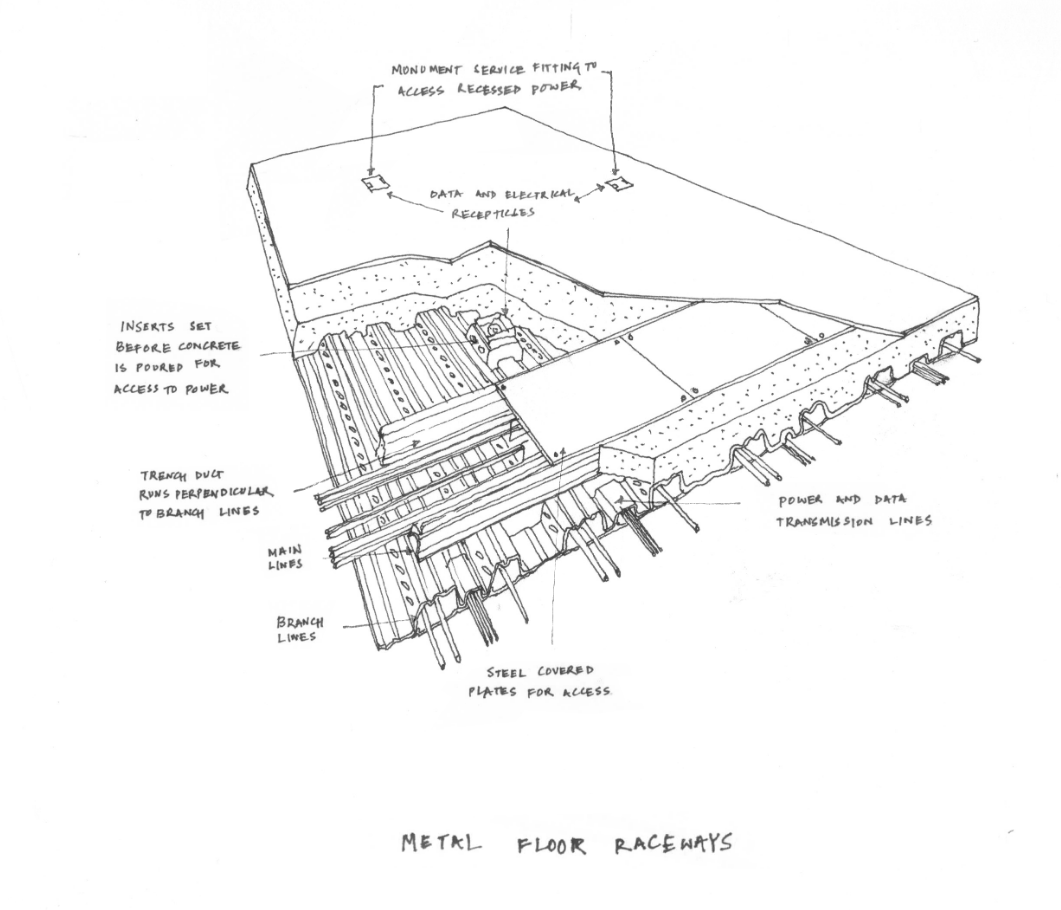
Poke-through floor boxes vs floor cellular raceways
Poke-through floor boxes: Best for retrofits and renovations because the floor slab is already poured.
Floor cellular raceways: Best for new construction. The fifth floor slab is poured with a floor cellular raceway system integrated into it.
Under-carpet wiring system
Flat insulated electrical conductors aligned edge to edge. Only .03 inches thick, so you can’t feel it under the carpet when you walk on it. Obviously least expensive and one with the least impact on floor-to-floor heights. Doesn’t work well with large, complicated floors because higher power needs require thick electrical boxes.
Surface metal raceways
Seen on walls, have plastic cover with metal back. Don’t specify these on floors unless you like to trip your occupants.
Ceiling raceways
Also called “manufactured wiring systems” run the power to the third floor open-plan desk through the ceiling of the second floor below it. Then install a poke through fixture. Expensive because of all the drilling through the floor, and in retrofits could inconvenience other tenants, but is a smart out of sight solution if a floor cellular raceway wasn’t installed when building was constructed.
Raised access flooring system
Float floor tiles on pedestals over a 12 by 24 hollow cavity. Conduits can then be flexibly run and later adjusted under the floated floor with relative ease. Raised access floors increase the required floor to floor height
Floor to ceiling raceway poles
Floor to ceiling poles with electrical and communication cables in it.
Thermal bridging
At overhangs for roofs or balconies
At window/door perimeters
Through slab if not insulated
Air infiltration
At overhangs for roofs or balconies
At window/door perimeters
Bracing
Single diagonal, cross bracing, k - bracing, v - bracing, inverted v - bracing (chevron bracing)
Minimal weight, ductility
Eccentrically braced best in seismic.
Cross bracing is really good at shear
Height to width no more than 3.5 to 1
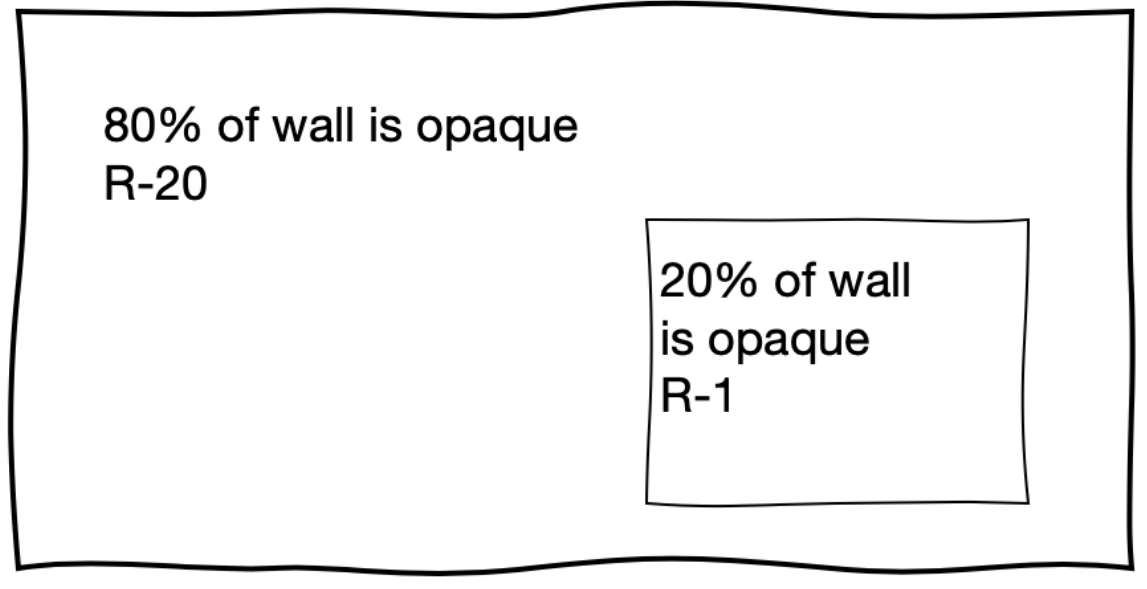
What is the area weighted U value of the wall
U is 1/20 = .05
U is 1/1 = 1
U total = .05*.8 (80%) + 1*.2(20%) = .24 BTU/(hr degree ft²)
How much heat loss through a single pane glass wall?
Given
Glass : R= .9
Set Point Temperature: 69 degrees
Use 19 degree design outside wintertime temperature
Wall is 375 sf
Q (heat loss in BTU/hr) = U (U value of assembly) * A (area) x delta T
U = 1/.9 = 1.111
delta T = 69 - 19 = 50
Q = 1.111(375 sf)(50) = 20,831.25
How much heat loss through the wall described below?
Given
Bubble Wrap: R=1.7 per layer
R-1 airspace
R-.9 glass
Wall is 4 layers of bubble wrap, 5 air spaces (1/2” each) and two 1/4” glass
Set Point temperature = 69 degress
Use 19 degrees design outside wintertime temp
wall is 375 sf
Q (heat loss in BTU/hr) = U (U value of assembly) * A (area) x delta T
1.7×4 =6.8
1×5 =5
.9 × 2 = 1.8
Total R = 13.6
U value total = 1/13.6 = .0735
Q = .0735×375×50 = 1,378.676
How can the A and delta T value be reduced in a building?
Given
Q=U X delta T
Q=U X delta T
Reduce the area of the building skin by designing a similar-sized building in a more compact form.
Reduce the wintertime inside outside temperature differential by lowering the thermostat. This can be done with a radiant heat source, or a conversation with the owner about wearing warmer
Put these CMU in order from most effective insulation to least effective insulation.
Grout in Cavity, Air in Cavity, Perlite/Vermiculite in Cavity
Perlite/Vermiculite in Cavity
Air in Cavity
Grout in Cavity
Put these CMU in order from highest sound transmission loss (TL and STC) to lowest sound transmission loss:
Grout in Cavity, Air in Cavity, Perlite/Vermiculite in Cavity
Grout in Cavity: robust sound barriers are massive. This barrier serves as an effective barrier to low-frequency sounds, separate a mechanical room from a conference room.
Perlite/Vermiculite in Cavity: A bit to absorb sound but not much
Air in Cavity
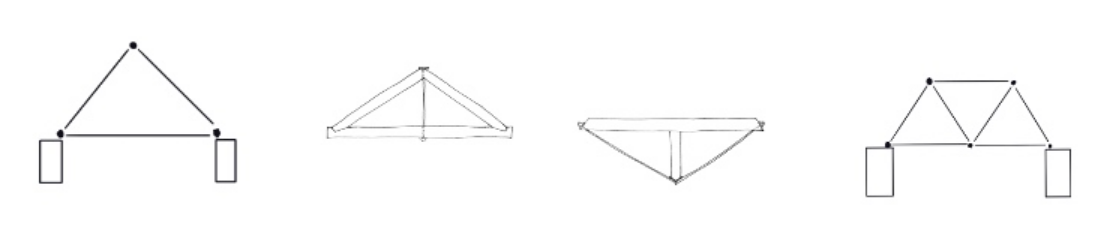
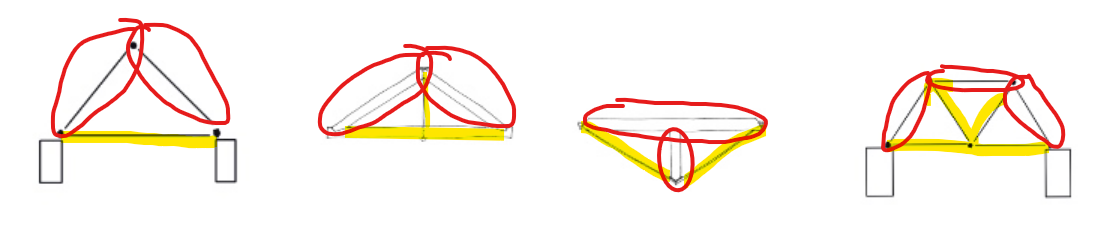
In each of these four trusses, Identify which members are in compression. Which ones are in tension?
Red is Compression, Yellow is tension
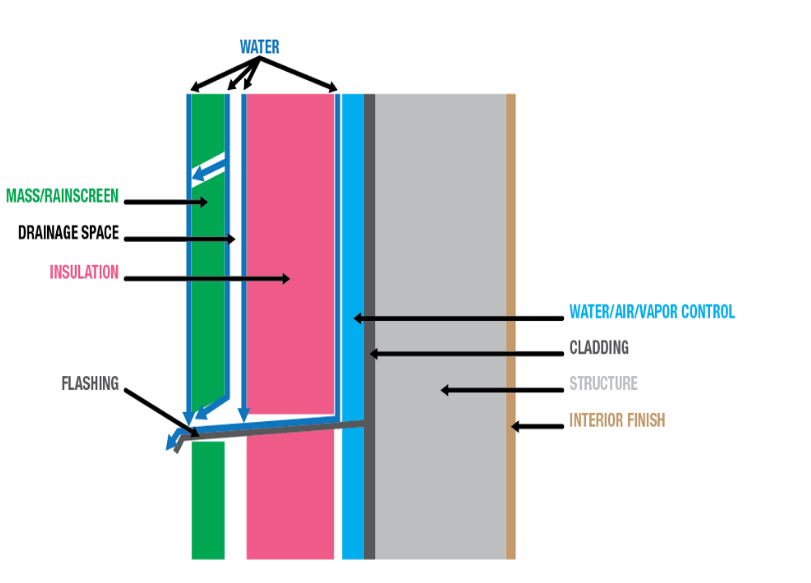
Where should I locate a vapor barrier?
On the warm side of the insulation, right up against the insulation.
For a warm climate that means placing the vapor barrier on the outside face of the insulation.
For a cold climate that means position the vapor barrier on the inside face of the insulation.
What does each term mean?
Condenser
Compressor
Evaporator
Air-to-air system
Air-to-water system
Water-to-air system
Water-to-water system
Split system
Minisplit
Swamp Cooler
Evaporative cool tower
Cooling tower
Chiller
Air-handling unit
Fan coil unit
Direct expansion
Variable vs Constant systems
Geothermal system
Chilled beams
Condenser: High pressure hot refrigerant
Compressor: pump that circulates refrigerant
Evaporator: low pressure cold refrigerant
Air-to-air system: fan over condenser and evaporator
Air-to-water system: fan over condenser, pumped water over evaporator
Water-to-air system: pumped water over condenser, air over the evaporator
Water-to-water system: pumped water over condenser and a different pumped water system over the evaporator
Split system: condenser outside, evaporator inside (residential)
Minisplit: refrigerant flows through units in rooms under high pressure for heating and low pressure for cooling: can heat and cool different rooms simultaneously
Swamp Cooler: Uses evaporation of water for cooling, with a fan, for very dry climates only
Evaporative cool tower: uses evaporation of water for cooling, no fan, for very dry climates only
Cooling tower: For cooling condenser water by blowing outside air over it.
Chiller: Refrigeration machine for cooling chilled water in large buildings. Includes refrigerant moving through the condenser, compressor, evaporator, and expansion valve and the water that interfaces with the evaporator (and condenser)
Air-handling unit: located down the hall, cools air for delivery to the room via ductwork
Fan coil unit: Located in the room, cools air by blowing it over pipes filled with chilled water from a chiller
Direct expansion (DX): like a window unit; with all cooling components including refrigeration machine and fan in one box
Variable vs Constant systems: how much control over the rate of flow, variable generally offers more comfort control and more energy-efficiency, but more complex equipment
Geothermal system: More efficient because it uses the moderate temperature of the earth to heat or cool water for the refrigeration machine
Chilled beams: like radiators for coolth, measure are required to prevent condensation.
Why are lab buildings big energy hogs?
Air quality concerns usually prohibit labs from recirculating room air back to the air handling unit. All indoor air is usually exhaust and then fresh new air has to be cooled or heated, not able to reuse the existing hot or warmed up indoor air.
What building type is most associated with chilled beam technology?
Labs are most associated with chilled beam technology.
Cold surfaces in the ceiling that circulate chilled water from the chiller. They cool air through convection and cool the occupants through radiation.
Why does the advantage of chilled beams overwhelm the inertia of the entrenched air systems in lab buildings?
For air quality reasons labs can’t recirculate air. Chilled beams allow for more cooling without the need to exhaust the perfectly good air and intake a bunch of fresh air that needs to be cooled.
We use plywood shear walls in wood construction to resist the lateral forces in the two vertical dimensions (X-Z and Y-Z planes). How do we resist lateral loads in the horizontal (X-Y) plane?
Wood diaphragms, OSB and Plywood can double up as resistor of lateral loads as well as using them for gravity loads over joists or rafters.
Types of security systems…
CCTV: Cameras record the premises for security, Types of cameras, conventional, thermal, Pan, Tilt and Zoom cameras, and domes
Access Control systems: Restrict entry by pin, fingerprint, or biometric pattern identification system.
Motion sensors: To detect movement with infrared rays… Active motion sensors send out radar and let the system know when something has moved. Passive motion sensors send out nothing but monitor with a thermal camera and wait for a change in heat.
Fiber-optic detection systems: a fiber optic cable is woven through a fence or wall. When the intruder climbs the cable shakes and the alarm sounds.
Some of these systems can only be applied to securing the property perimeter (fiber optic detection system). Others can only be applied to securing access at doors (fingerprint access control system). Some can be used for either securing the perimeter or securing access (CCTV).
Displacement Ventilation
Mechanical cooling supplied near the floor, with a little bit cold air brought in at not very fast duct velocities. Displaces warmer air near the floor and pushes it upward.
Benefits: Uses less energy, is quieter, and provides superior air quality.
Limitations: Only works in rooms with high ceilings, doesnt’t work with heating, doesnt do well in humid climates, Occupants can feel uncomfortable with cold feet and hands
Used for: High Occupancy rooms, theaters, cooler climates.
When do architects use a Faraday cage?
Architects use faraday cages as lightning protection. By creating a wire mesh on the roof, they can redirect lightning strikes around the building to the ground.
A gaming floor measures 24 feet by 20 feet, what is its occupant load?
44 occupants
Egress Widths: Select whichever width is greater
Stairways: Sprinklered = .2” x occupant load or 44” minimum (60 in. Max) Not Sprinklered = .3 “ x occupant load or 44” minimum (60” Max)
Corridors: Sprinklered = .15” x occupant load or 44” minimum, Not Sprinklered = .2“ x occupant load or 44” minimum
Doors: Sprinklered = .15” x occupant load or 32” minimum, Not Sprinklered = .2“ x occupant load or 32” minimum
Door width with hardware in practice is 36” usually
Fire wall vs Fire barrier vs fire partition
Fire Wall: Most stringent you essentially build two different buildings, structurally independent of one another. Separates two construction types or two different areas. Extends from foundation to roof
Fire barrier: More common - extends from floor to underside of structural ceiling and does not need to be structurally independent. Required for mechanical shaft walls, egress stair walls, separated uses, and incidental uses.
Fire partition: Least stringent - can be made of wood and can include a dropped ceiling. Required for corridors.
How deep should the bottom of a spread footing be in a climate with a frost depth of 60”
60”
If you dont go deep enoguh, freeze-thaw cycles will heave your foundation.
What do we use geotextiles for?
Buried to stegnthen soil
Stabilize soil
separate different strata of soil (fine grain aggregate from coarse aggregate)
Prevent erosion
Keep out weeds
Keep water out
allow water to filter through
seal soil to keep contaminants in or out
Describe how a Variable Refrigerant Flow (VRF) HVAC system works
Pumps and manifolds move refrigerant to spaces that need heating (high pressure refrigerant) : and pumps and manifolds move refrigerant from spaces that need cooling (low pressure refrigerant). An in-unit fan blows air over the refrigerant coil in each space. Because we can simultaneously heat the perimeter while cooling the core - just by moving refrigerant between the two - this type of system can be often your lowest-energy option.
Why is it difficult to simply drill a hole in the post-tensioned concrete floor to run a new vertical pipe?
Could inadvertently core through one of the post-tensioning cables
Should crawl spaces be ventilated or sealed?
Crawl spaces should be sealed: treat them like small basements and think of them as part of the building’s thermal enclosure. Underlay them with gravel, plastic sheathing, and a concrete slab to keep out groundwater, insulate the walls (but not the overhead plane) and heat/cool them just like the house.
What shape offers both the best resistance to torsion and the least resistance to wind?
The circle
Circular-cross section columns offer highest resistance torsion.
What is automatic dimming?
When the sun is out, photosensors in the ceiling automatically dim the electric lights, especially those near the window, to save energy.
Dimming is usually associated with offices because they are occupied during the daytime and have relatively constant light targets.
Will be asked which HVAC system to use for a specific building type or occupancy use.
When thermal control is prioritized, like if each hospital room, dorm room, hotel room, or apartment needs to set its own thermostat and some rooms need heating and some need cooling and some need neither… at the same time: which system should you use?
Fan coil units, ducted systems with VAV, and VRF systems like ductless minisplits.
Direct expansion (DX) systems (like window units or through the wall systems with a compressor in each room) allow for thermal control, but are unlikely to be used because they are inefficient, loud, facade-ugly and expensive to maintain.
When there’s no room for ducts… you’re renovating a historic building and there’s no dropped ceiling to hide the duct work or you’re building with low floor-to-floor heights so theres no room above or below for duct work, which HVAC system do you use?
When there’s no room for ducts can use either hydronic system pumping hot and cold water around the building in small pipes or a variable refrigerant system (VRF) pumping high and low pressure refrigerant around the building in small pipes
When energy-efficiency is a priority: which HVAC system should you use?
Energy efficient systems are:
Central chiller and AHU systems with fewer compressors and fans to run
Renewable systems like active solar where the sun heats up hot water that, in turn, moves through a thermosyphon piped loop
Wate-heat capturing systems like VRF (ductless mini split system of VRF) and systems that circulate leftover heat from hot water heater
Systems that leverage the temperature outside or underground like economizer cycles that allow us to use could outside air condition for free or geothermal systems that allow us to use underground mild temperature.
Dedicated Outdoor air systems
All electric heating systems
Radiant and displacement ventilation systems
When quiet is a priority: which HVAC system should you use?
Systems with far-away central compressors and far-away central fans … or radiant systems with no fans at all
Which systems are so clumsy or inefficient that you can eliminate them straight away in a problem?
Direct Expansion: Noise, expensive ugly
Multi-Duct: Use too much building volume for duct work
Dual Duct: Inefficient - heats and cools air then mixes the two to get the right temperature.
Swamp cooler: low energy, but brings unwanted humidity into the space.
HVAC system for each type:
Apartment
Offices
Retail
Apartment: Fan Coil Units
Offices: VAV with central AHU
Retail: Central single-zone AHU
You are designing a high school football stadium with an elevated drum major platform at 24” high. Do you need a railing?
No railing required for heights below 30”.
Exceptions that don’t need guard rails: The loading side of loading docks and the audience side of performance stages
When is tempered glass required? When is laminated glass required?
Tempered glass: 5x stronger than untempered annealed glass. Required at storefront door (or glass panel adjacent to a door) where the glass extends 18” above finished floor. Less likely to break if you back your rolling suitcase into it.
Laminated glass: Stronger still, required for skylights, and hurricane prone regions, as well as security sensitive rooms like prisons, mental hospitals, or casino cashiers. Can also be used instead of tempered glass in glass doors and adjacent panels.
What is an impact load?
Load of short duration, like a large tree limb falling on a roof
Noise control
Watch 40 min competence video
A new office building is being constructed in a seismically active locality. For greatest efficiency, where should the lateral steel bracing be inserted relative to the primary structure?
Outside of primary structure
In-line with primary structure
In board of primary structure
In-line with primary structure
The problem with lights recessed in the ceiling:
Unwanted path for infiltration potentially if unconditioned attic is above.
To quiet a mechanical system: put fibrous insulation inside the duct or outside the duct?
Inside the duct (1” thick)
Outside the duct does nothing for the acoustics but can keep air colder or warmer over long distances.
When given a choice on the exam, how do you decide the relative cost of design decision if you don’t have experience in this realm?
Labor is likely the deciding factor
Expensive labor:
HVAC Equipment installers
Steel erectors
Crane operators
Out of town specialists
Masons
Anyone building something they haven’t done before (unique build)
Anyone doing something more time consuming than it would otherwise be (disassembling or recycling vs demolishing)
Specialized trades associated with historic preservation
Finish Carpentry
Union labor
Labor sourced with competitive bidding
Generally Less expensive labor
Drywall
Light wood framing
Demolition
Roofing (unless very steep)
Foundations, Insulation
DIY stuff
Triangular trusses have fixed or hinged connections?
Hinged
Vierendeel truss has no triangles so that has fixed connections
Why is melted snow between the rafters on one roof and on the rafters for another roof?
Melted snow between rafters means that the attic is ventilated. The thermal envelope doesnt include the attic because the insulation sits on the attic floor. Baffles allow outside air to creep up the gap between the rafters, outside of the insulation, booling the lower part of the roof. A little heat from the house rises up through the insulation into the attic making it warmer than the outside air. Snow melts between the rafters as the rafters offer a tiny bit of extra insulation compared to the rest of the roof, so that area melts first.
Melted snow at the rafters is signs of an insulated attic. The thermal envelope includes the attic because the insulation sits on the attic ceiling between the rafters. There are no baffles letting cold air in, so the top plate, the ridge board at the peak of the roof, and the rafters at the gable ends all act as thermal bridges. So they melt before the insulated portions between the rafters melt.
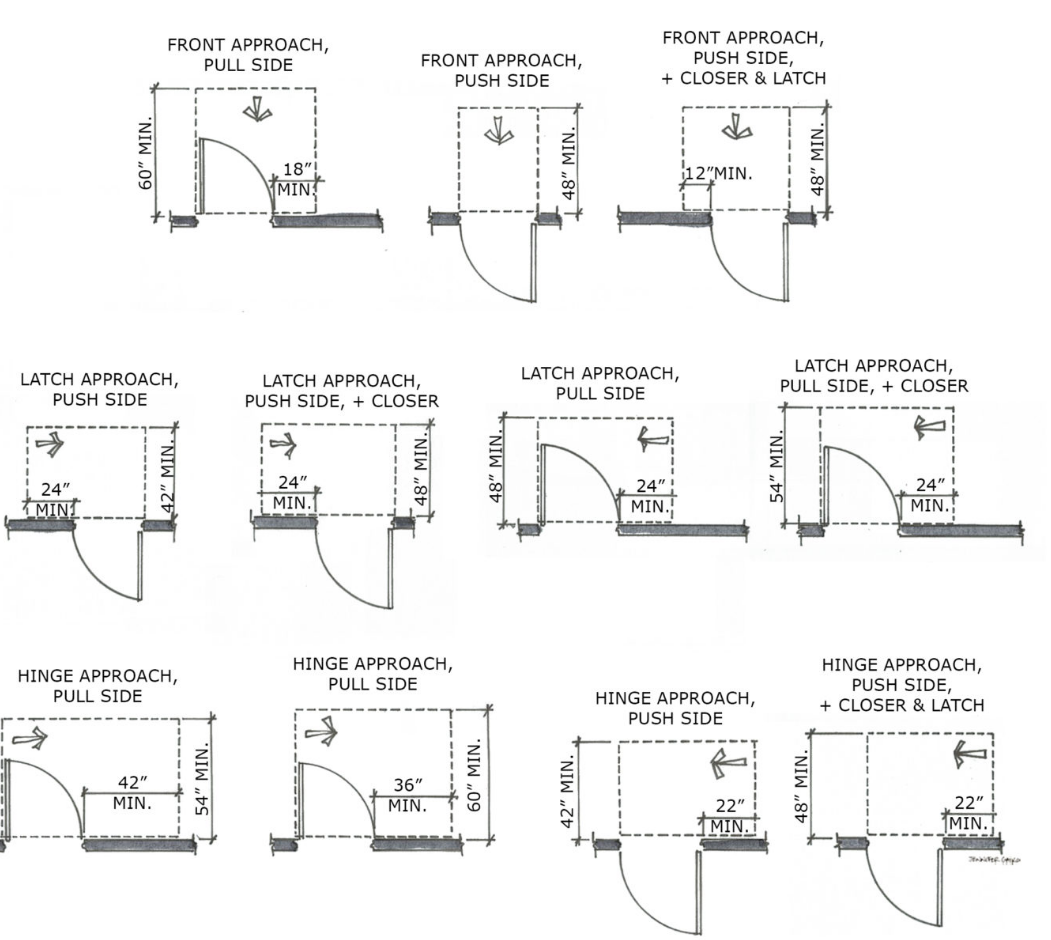
How much room do you need to allow around a door swing?
Dashed lines cannot have a wall pilaster, fire extinguisher cabinet jut-out, column, pinch point or anything else blocking the way.
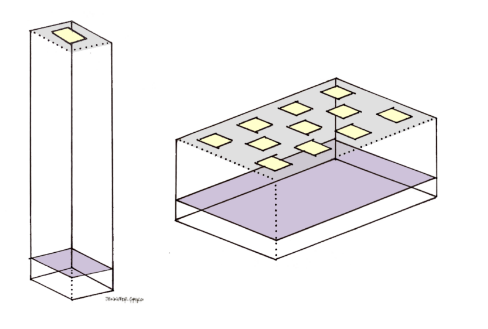
Given the same number of fixture per square feet, which room has more light at the desk plane?
The low ceiling large room (proportions of a tuna can) has more light reaching the desk than the high ceiling narrow room (proportions of a straw).
Tall skinny room has a HIGHER room cavity ratio: (2.5(luminaire height - workplane height) x room perimeter) / total floor area) and a LOWER coeficient of utilization (percent of light available in the room reaching the floor plane)
Low ceiling large room has a LOWER room cavity ratio: (2.5(luminaire height - workplane height) x room perimeter) / total floor area) and a HIGHER coeficient of utilization (percent of light available in the room reaching the floor plane)
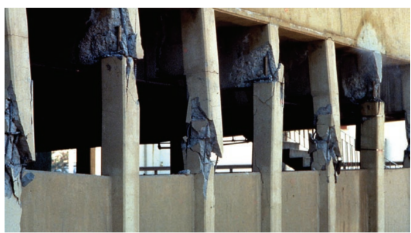
What causes this failure?
Strong beam, weak column.
We design buildings so the beam fails before the columns, as a column failing would result in collapse.
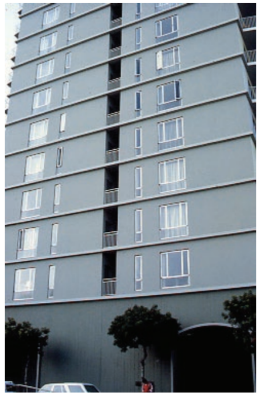
What’s the potential seismic problem?
Perforated shear wall on bottom right
Shear walls have to extend to foundation to roof to work correctly in an earthquake.
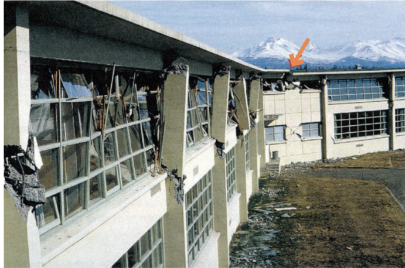
What caused this seismic failure?
Re-entrant corner/ irregularly shaped building. Simple forms perform best in earthquakes.
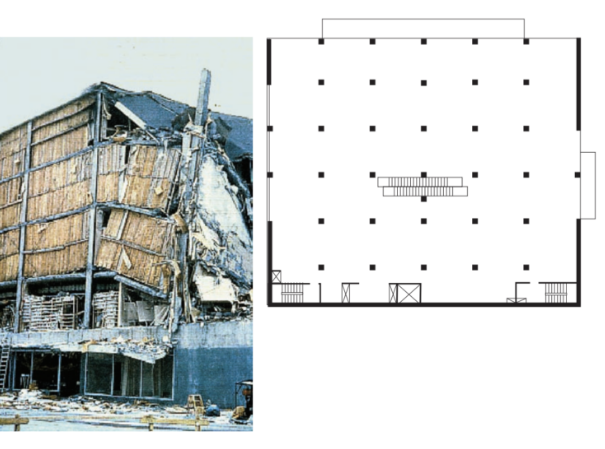
What caused this seismic failure?
Variations of perimeter strength and stiffness.
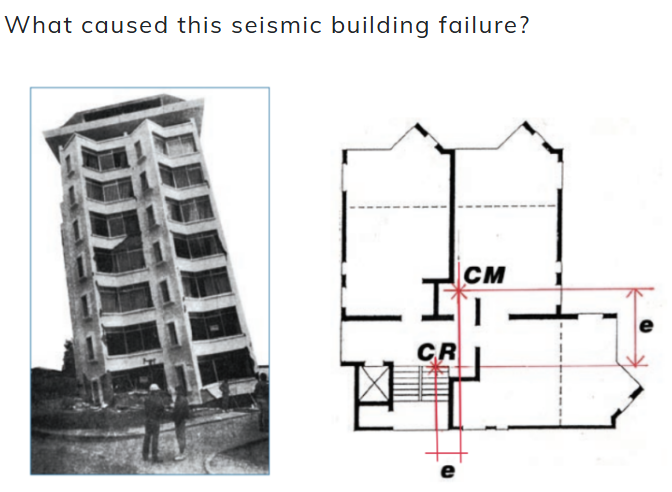
What caused this seismic building failure?
Variations in perimeter strength and stiffness.
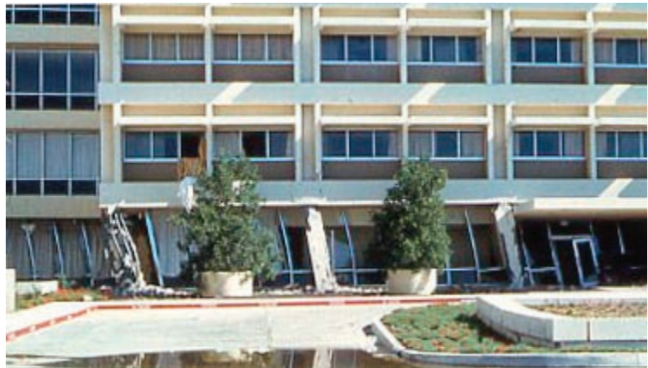
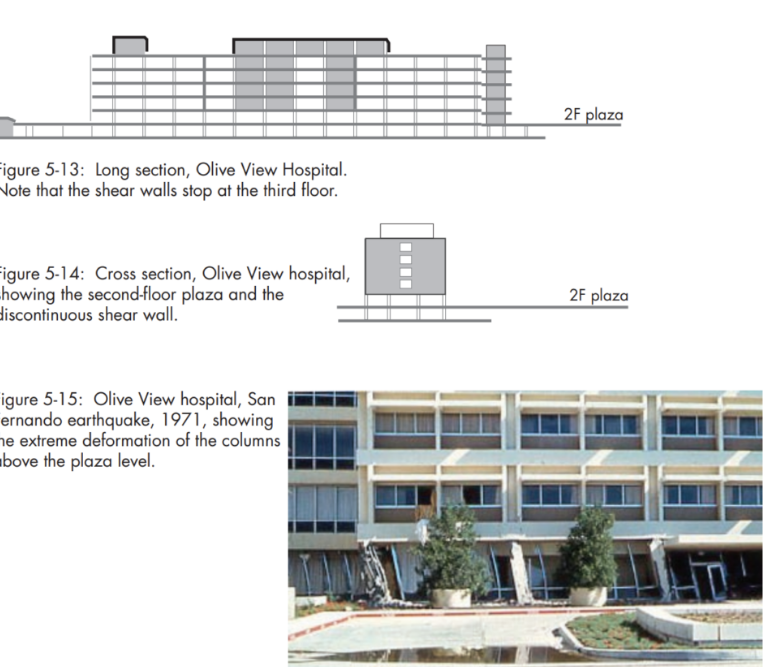
What caused this seismic failure?
It looks like a soft story, but its actually a discontinuous shear wall issue.
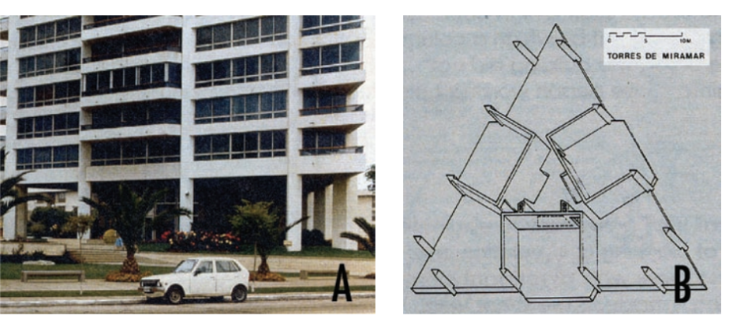
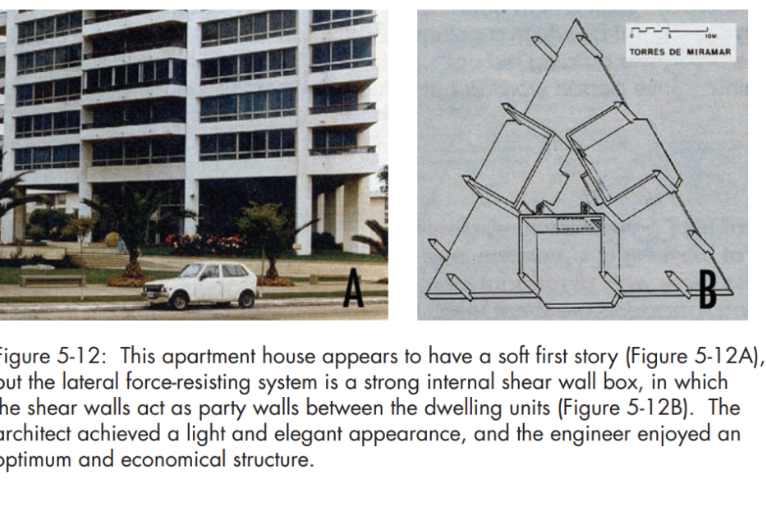
This building looks like it has a soft-story problem … but it doesn’t, why not?
The three shear wall boxes in plan on the first floor stiffen the structure on the bottom.
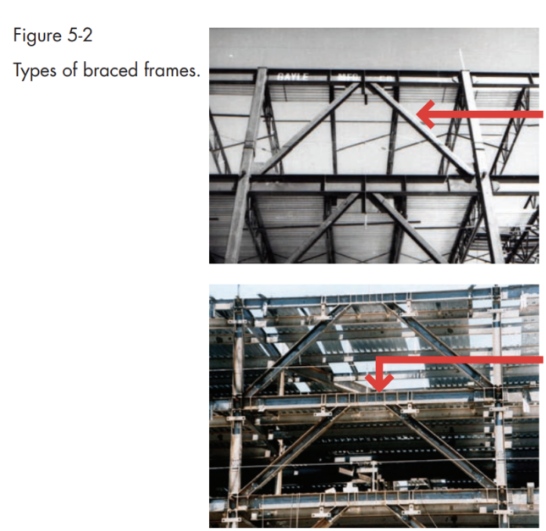
Concentrically vs eccentrically braced frames
Concentrically braced frames tend to be more economical than eccentrically braced frames. Both provide lateral stiffness, but the eccentrically braced frame better protects the building in an earthquake.
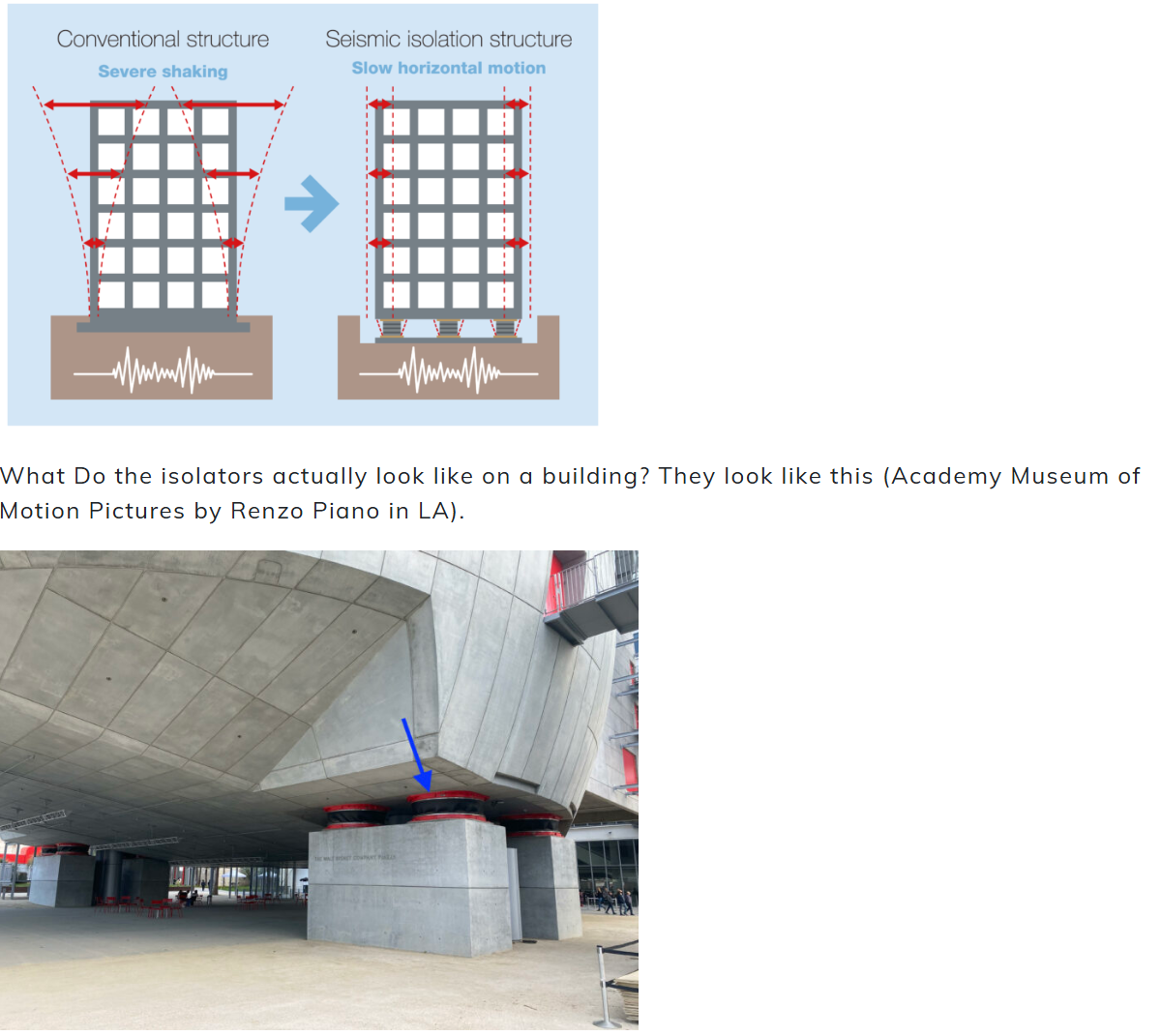
Why do we use seismic isolation?
Used to protect buildings and structures from earthquake damage by decoupling structure from ground motion. This system allows the building to move independently of the ground during seismic events, significantly reducing the transfer of seismic forces to the structure above.
SD cost estimating technique?
Unit rate cost estimating
We start at programming with a rough order of magnitude cost estimate, used for a napkin estimate before design to determine feasability. Used in predesign/programming.
We want our estimate to eventually be within 5%.
For later SD, DD and CD stages:
Unit rate cost estimating, early on in SD we know enough about the building size to use estimates based on cost per square foot or per cubic foot measurements. Then later, as we know more about the project (CD) our estimates will tally detailed units like number of pipe bends and linear feet of conduit and estimated cost of labor to install 50000 sf od EPDM roofing membrane.
Roof safety Railing: What height minimum?
42” minimum for rooftop safety railing.
Permanent and temporary railing systems available. Railings required anytime work happens on the roof. May penetrate the roof or parapet, or may sit on the roof, non-penetrating with weights.
Mechanical equipment screens in most cases are limited to no more than 18’ above the roof surface.
An architect is looking to reduce the cost of ductwork in an open-plan office. Which is a viable approach?
Economizer
Geothermal
Plenum
Dual-duct
Plenum
To reduce the cost and building volume associated with return air ductwork, in open-plan offices we often run a single large return air duct into the “plenum” space above the dropped ceiling and below the structural deck. The entirety of the plenum is then suctioned so that a return grilled can be placed anywhere in the grid and suck air back to the AHU through the plenum.
In displaced ventilation systems we also use a plenum for supply air.
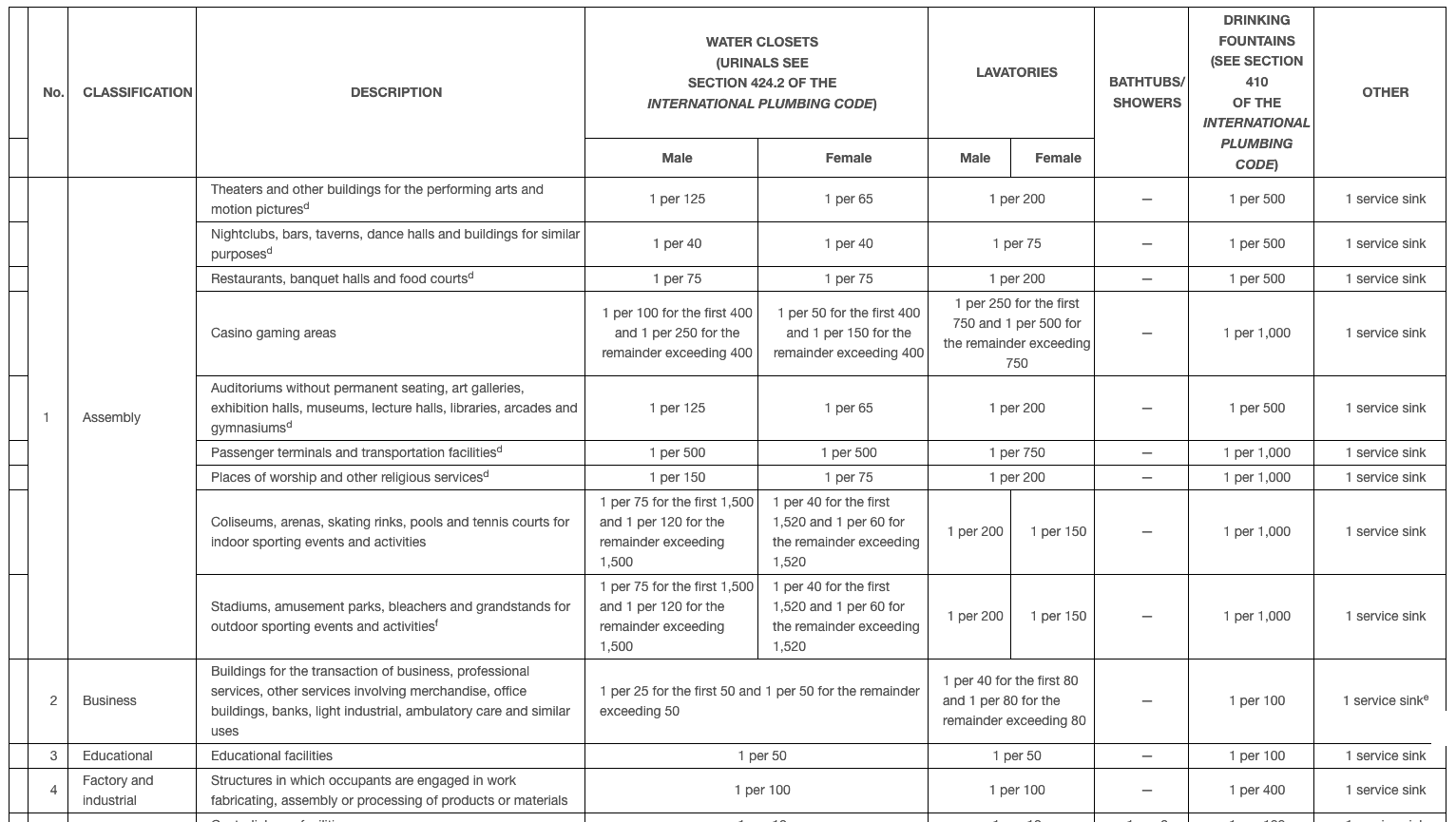
How many water closets are required for the women’s room of a 15,000 GSF one-floor office building with an occupancy load of person per 150 GSF?
15,000/150 = 100 people / 2 = 50 women
1 per 25 for first 50, so 2 water closets