AP Gov ALL vocab
 Call Kai
 Learn
Learn Practice Test
 Spaced Repetition
 Match
Match Flashcards
 Knowt Play
1/79

There's no tags or description
Looks like no tags are added yet.
Name | Mastery | Learn | Test | Matching | Spaced | Call with Kai |
|---|
No analytics yet
Send a link to your students to track their progress
80 Terms
Representative Democracy
People elect representatives to make laws and conduct government business
Direct Democracy
People govern themselves by voting individually as citizens
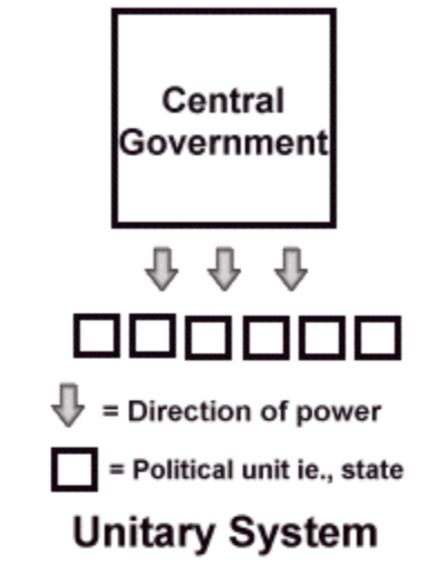
Unitary Government
Only one central government has authority over a nation
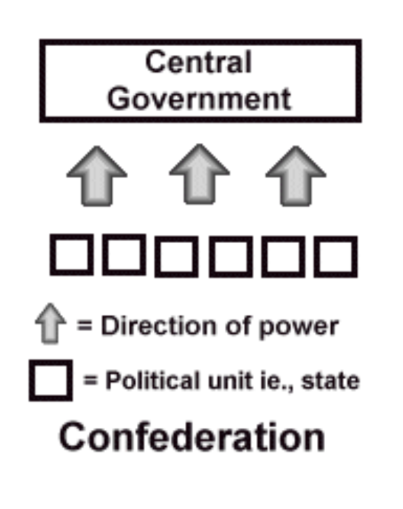
Confederation
An association of states with some authority delegated to a national government
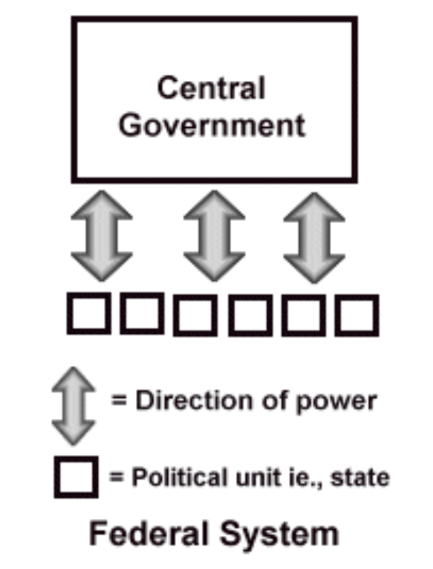
Federal Government
The federal system of government decentralizes power, power is shared between the states and the national government
Articles of Confederation
Established a government dominated by the states
Shay’s Rebellion
Daniel Shay led hundreds of angry farmers to threaten to attack Boston if the states didn’t pass laws to help them
Participatory Theory
Emphasizes the participation of constituents in the direction and operation of political systems of democracy
Pluralist Theory
People with common interests form organized groups to promote their causes and COMPETE to influence the government
Elite and Class Theory
Government favors only a narrow percentage of the public, primarily the wealthy
Hyperpluralism
Power is decentralized and policies become muddled and less effective because there are too many interests vying for political influence
Popular Sovereignty
The authority of the government comes from the people
Limited Government
The government can only do what the Constitution says it can
Judicial Review
The power of the courts to declare the constitutionality of a law or other government action
Checks and Balances
Gives each branch the authority to check the powers of the other two branches
Separation of Powers
Designed the Constitution to divide the duties of government among three branches
The Constitutional Convention
Meeting of high-class American men to revise the Articles of Confederation
Constitution
Nation’s basic law
Madisonian Model
Factions could pose a threat to the stability of a government
The Great Compromise
Established a bicameral legislature
Three-Fifths Compromise
3/5ths of slaves counted as population in determining representation to the House of Representatives AND in determining taxation
Interstate Commerce
Trade that crosses state lines, controlled by the federal government
Intrastate Commerce
Trade that occurs within the state, controlled by the states
Bill of Rights
The first ten amendments of the Constitution
Expressed (Enumerated) Powers
Powers directly expressed or stated in the Constitution by the Founders
Implied Powers
Powers not expressly defined in the Constitution
Reserved Powers
Powers that belong strictly to the states under the 10th amendment
Concurrent Powers
Powers that the national government and states have together
First Amendment
Freedom of religion, press, petition, speech and assembly
Second Amendment
Right to bear arms
Third Amendment
Prohibits government from forcing people to provide shelter for soldiers
Fourth Amendment
Protects the right to privacy by limiting searches
Fifth Amendment
A person cannot be tried for the same crime twice, Miranda rights
Sixth Amendment
Right to a speedy trial by an impartial jury
Seventh Amendment
Right to jury trial in federal court
Eighth Amendment
Prohibits excessive fines and bans “cruel and unusual punishment”
Ninth Amendment
Powers reserved to the people
Tenth Amendment
Powers reserved to the states
Thirteenth Amendment
Abolition of slavery
Fourteenth Amendment
Prohibits a state from depriving any person of life, liberty, or property without “due process of law”
Fifteenth Amendment
People of color cannot be denied the right to vote based on race
Sixteenth Amendment
Congress can levy an income tax
Seventeenth Amendment
People elect U.S. Senators
Nineteenth Amendment
Guaranteed women the right to vote
Twenty-Second Amendment
Limits President to two terms
Twenty-Fourth Amendment
Prohibits poll taxes in federal elections
Twenty-Fifth Amendment
Vice President takes over when President is disabled or dead
Twenty-Sixth Amendment
Lowered the voting age to 18
Federalist Paper #10
FACTIONS are inevitable but need to be controlled
Federalist Paper #51
CHECKS AND BALANCES, “If men were angels, no government would be necessary”, defends separate branches of government and concept of bicameral legislature
Federalist Paper #70
Argued for a unitary executive office (one president)
Brutus Papers
Three-fifths compromise, no term limits, addition of Bill of Rights to Constitution was critical
Devolution
Devolving grants to give power back to the states
Fiscal Federalism
The power of the national government to influence state policies through grants
Federal Grants
Federal funds allocated to states and local governments for state needs
Categorical Grants
Grants for specific programs and funds matched by states
Formula Grant
Awarded based on whether you fit into the formula (income, unemployment, FAFSA)
Project Grant
Awarded on the basis of competitive application
Block Grant
Large grant of money that can be used for a general purpose, such as public health or crime control
Mandates
Formal order given by a higher authority telling state and local governments what programs to implement
Pork-barrel spending
Using federal money for state and local projects
Dual Federalism
Each level of government has distinct responsibilities that do not overlap
Cooperative Federalism
Levels of government share responsibilities
Bicameral Legislature
Two houses: Senate and House of Representatives
House Rules Committee
Reviews most bills coming from a House committee before they go to Full House
Incumbent
Someone currently in office
Filibuster
Permits unlimited debate on a bill unless 60 members vote for cloture on debate
Delegate Representation
Representing their constituents by mirroring their personal, politically relevant characteristics
Trustee Representation
Representing the interests of groups
Congressional Caucus
Group of members of Congress that share some interest or characteristic
Casework
Social work directly concerned with individuals
Gerrymandering
Drawing district boundaries in such a way as to favor its own candidates
Party Influence
Parties are most cohesive when electing its official leaders
Legislative Branch
Makes the laws
Executive Branch
Carries out the laws
Judicial Branch
Interprets the law
Legislative Committees
Consider bills, maintain oversight of the executive, and conduct investigations
Subcommittees
Further study, research, hold hearings of a bill
Standing Committee
Permanent panel with full legislative functions
Select or Special Committees
Groups appointed for a limited purpose