PPFB 9 - Excipients and their roles
 Call Kai
 Learn
Learn Practice Test
 Spaced Repetition
 Match
Match Flashcards
 Knowt Play
1/31

There's no tags or description
Looks like no tags are added yet.
Name | Mastery | Learn | Test | Matching | Spaced | Call with Kai |
|---|
No analytics yet
Send a link to your students to track their progress
32 Terms
What is an excipient?
Inactive substances included in a tablet or capsule alongside the active pharmaceutical ingredient (API)
What is the main purpose of excipients in solid dosage forms?
can be manufactured effectively
Has the desired physical and chemical properties
performs correctly in the body
What is the main function of excipients in solid dosage forms?
Excipients do the following main functions:
1. Enable manufacturing
2. Control tablet structure
3. Improve patient acceptability
4. Control drug release
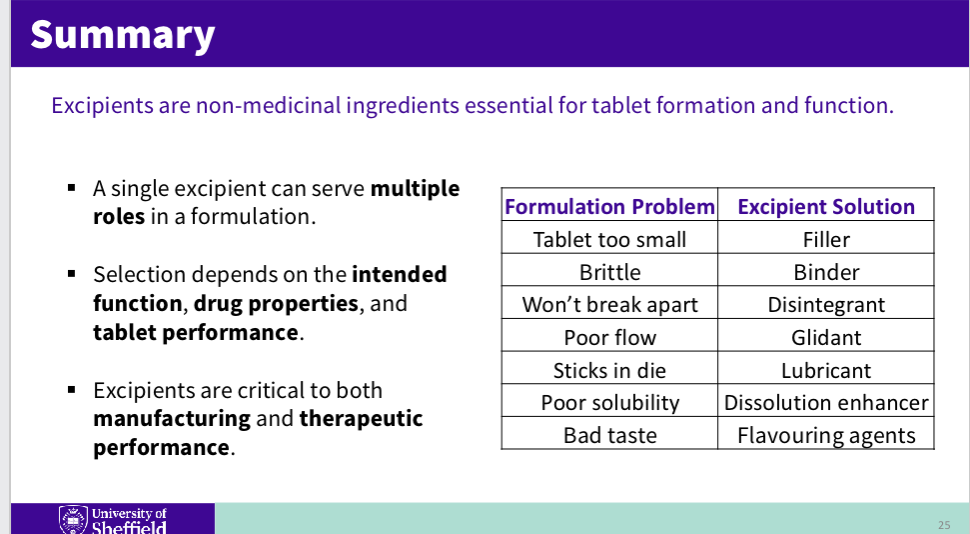
How do we build a tablet if it is too small ?
Add fillers ( diluents )
add bulk to tablets, especially important for low-dose drugs
not necessary if the dose of the drug per tablet is high
What properties should a pharmaceutical filler ( diluent ) have?
Inert, inexpensive, compressible, non-hygroscopic, biocompatible, water-soluble, or to aid drug release, acceptable taste.
What are the examples of commonly used fillers?
lactose, cellulose, dicalcium phosphate ( inorganic fillers), other sugar /sugar alcohols
Why do we use lactose, and what are its properties?
widely used in tablets
properties :
dissolves readily in water
pleasant taste
non-hygroscopic ( in its anhydrous crystalline form, but the amorphous form is hygroscopic)
fairly non-reactive
good compatibility
Main limitation - lactose intolerance in some individuals
Why do we use cellulose, and what are its properties?
Properties -
biocompatible, chemically inert, good tablet - forming and disintegrating properties
Versatile Excipient: Can function as a filler, binder, and disintegrating agent.Generally compatible with many drugs
limitation - due to hygroscopicity may be incompatible with drugs prone to chemical degradation in the solid state or moisture sensitive
Why do we use inorganic filler - dicalcium Phosphate?
Properties :
insoluble in water,non-hygroscopic, hydrophilic ( easily wetted by water )
Forms and uses:
Fine Particulate Form: Suited to granulation.
Aggregated Form: Excellent flow and compression properties, used in direct compaction tablet production.
Limitation - slightly alkaline nature, may make it incompatible with drugs sensitive to alkaline conditions
Why do we use other sugars/sugar alcohols?
Examples: Glucose, sucrose, sorbitol, mannitol.
Primary Use: Alternative fillers to lactose, especially in lozenges or chewable tablets
Due to their pleasant (sweet) taste.
Mannitol: Imparts a cooling sensation when sucked or chewed.
How do you solve friability problems?
Binders- promote cohesion between particles to form granules suitable for compression
Function - ensure that granules and tablets can be formed with the required mechanical strength. They help hold the tablet together
What is the difference between dry and solution binders?
Both included at relatively low concentrations,usually ( 2-10% w/w)
What are the ways binders can be added to a Powders?
As a DRY POWDER - ( mixed before wet granulation)
As a DRY POWDER - ( mixed before compaction) - mixed as a dry powder with other excipients directly before compaction (tabletting/slugging)
As a Solution ( solution Binders) added as a solution directly during the granulation process
What are some examples of binders?
Examples:
- Microcrystalline cellulose (MCC)
- Cross-linked polyvinylpyrrolidone (PVP)
Traditional: Starch, sucrose , gelatine
More common today ( polymers with improved adhesive properties) :
Polyvinylpyrrolidone (PVP),
Hydroxypropyl cellulose (HPC),
Hydroxypropyl methylcellulose (HPMC)
What happens if we add too many binders?
slower disintegration
slower dissolution
What happens if the tablet doesn’t disintegrate?
Add Disintegrants: Help tablets break apart after ingestion
Primary Goal:
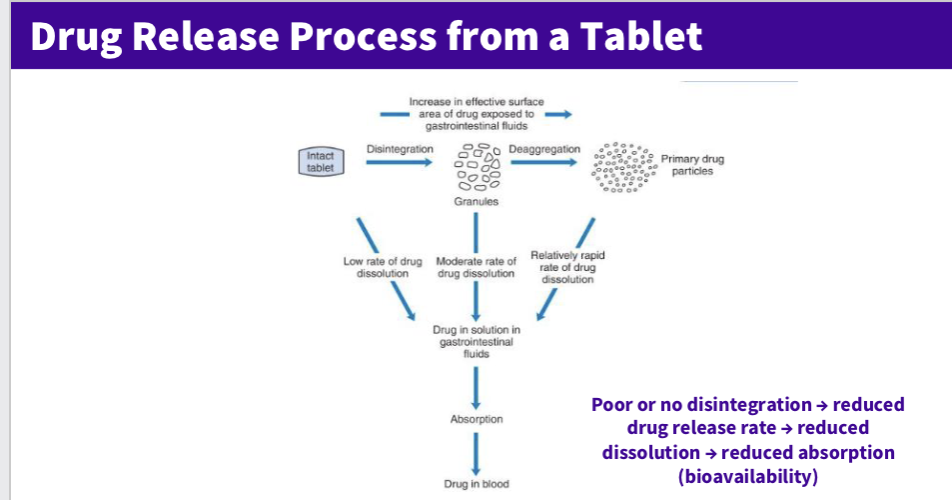
Increase drug surface area → promote rapid dissolution.
Disintegration Mechanism (2 Steps)
1. Wetting: Liquid penetrates tablet pores (critical in highly compressed tablets).
2. Breakup: Tablet → granules → primary drug particles.
What is the process of drug release for a tablet?
What are the mechanisms of disintegration in tablets?
Disintegrants that facilitate water uptake
Mechanism - increase porosity and wettability → allow rapid liquid penetration.
How they work:
•Improve wetting of drug particles
•Promote capillary action within the tablet pores
Example:
•Surface-active agents
Disintegrants that Rupture the Tablet (Swelling Type)
Mechanism - Absorb water → swell → generate internal pressure → tablet rupture.
Common Swelling Agents
•Starch (up to 10%)
•Sodium starch glycolate (high swelling)
•Pregelatinized starch (2–5%)
•Crosslinked PVP (2–5%)
Disintegrants for Effervescent Tablets
Different Mechanism:
Produce CO₂ in water → rapid matrix disruption.
Components:
•Bicarbonate/carbonate salt (CO₂ source)
•Weak acid (e.g., citric or tartaric acid)
Note: Not typically used for tablets meant to be swallowed as a solid
What are the methods of disintegrant addition?
Intragranular Addition: Mixed with other ingredients before granulation (within the granules).
Extra granulation: Mixed with dry granules before the complete powder mix is compacted (common and effective for disintegration into smaller fragments).
What do we do to combat poor flow ?
Glidants are excipients used to improve the flowability of powders or granules. especially during tablet manufacturing
Main Function: Improve powder flow, which is essential for consistent tablet weight.
Why are glidants needed?
During large-scale production, powders flow from hoppers into dies.
What can poor flow lead to?
Poor flow can lead to;
1. inconsistent tablet weights
2. machine stoppages
Glidants help reduce friction:
Between particles
Between powder and hopper walls
How do glidants work?
How They Work:
Glidants are hydrophobic and very small. They coat larger particles, reducing interparticle friction and enhancing flow.
Usually used at low concentrations (<1%), why?
Common Glidants:
Talc 1–2% w/w
Colloidal Silicon Dioxide 0.2%
Magnesium Stearate at low levels
What do you do when tabLets stick or caps?
What to add?
Lubricants / anti-adherent
Reduce friction between particles during compression and help eject the tablet from the die.
Why are lubricants important ?
Ensure smooth ejection of tablets from the die.
Prevent issues like capping, breaking, or scratching.
Enable high-speed manufacturing.
What are the two main issues of lubricants?
Two Main Issues:
• Hydrophobic lubricants can slow down disintegration and dissolution.
• Too much lubricant weakens tablet strength by interfering with particle bonding.
Mixing time and intensity, as well as the order of addition, affect performance
Avoid overmixing
What are the best practices with lubricants?
Use lubricants at low concentrations (<1%).
Consider hydrophilic alternatives or blends to reduce negative effects
What do you do when there is poor solubility ?
Dissolution Enhancers
Used for: Poorly water-soluble drugs.
Purpose: Increase dissolution rate (often the rate- limiting step in absorption).
Mechanism: Temporarily increase drug solubility during dissolution.
Example:
Salt formation (e.g., forming a more soluble salt).
What do you do when there is poor absorption?
Absorption Enhancers
Used for: Drugs with poor intestinal permeability.
Mechanism: Increase intestinal membrane permeability → Enhance drug transport into the bloodstream.
Both improve oral bioavailability:
❑ Dissolution enhancers → address solubility
❑ Absorption enhancers → address permeability
What do you do if the tablet is bitter /has a bad taste?
Flavouring agents
Function: Improve taste, especially for: Chewable tablets
Tablets with bitter drugs
Can be added:
As powders or granules
As alcohol-based solutions
Thermolabile, so NOT to be added before drying if needed
What do you do if the tablet is hard to identify ?
Colourants
Function: Aid in tablet identification,
appearance, and patient compliance.
Can be added:
Before compression (as powder or in
granulation liquid)
During film coating
Watch out for: Colour migration during drying (especially with soluble dyes).
Summary