Chapter 38: Plant Reproduction
 Call Kai
 Learn
Learn Practice Test
 Spaced Repetition
 Match
Match Flashcards
 Knowt Play
1/43

There's no tags or description
Looks like no tags are added yet.
Name | Mastery | Learn | Test | Matching | Spaced | Call with Kai |
|---|
No analytics yet
Send a link to your students to track their progress
44 Terms
What are the roles of sexual and asexual reproduction in flowering plants?
Sexual reproduction involves meiosis and fertilization, producing genetically diverse offspring that can adapt to changing environments
Promotes genetic diversity
Asexual reproduction produces genetically identical offspring (clones) w/o fertilization
Allows rapid population growth that doesn’t require pollinators/mates (efficiency/speed)
How do flowering plants reproduce asexually?
Flowering plants reproduce asexually through vegetative reproduction
Rhizomes: horizontal underground stems that can produce new shoots and roots
Corms: swollen underground stem bases that generate new corms capable of developing into independent plants
Some species produce plantlets along leaf margins that detach and grow into new plants
Other species use apomixis (seeds form without fertilization)
What are the advantages and disadvantages of sexual and asexual reproduction in flowering plants?
Asexual reproduction: efficient b/c it allows rapid population growth/preserves successful genetic combinations
However, genetically identical offspring may be vulnerable to the same diseases and environmental challenges
Sexual reproduction: generates genetic diversity that improves the ability of populations to adapt/ to conditions/resist pathogens
However, it requires pollination and is generally slower/more energy-intensive
What is alternation of generations?
The life cycle pattern in which plants alternate between a diploid sporophyte generation and a haploid gametophyte generation.
Sporophyte produces spores through meiosis; then those spores develop into gametophytes via mitosis
Gametophytes produce gametes by mitosis
Fertilization fuses gametes to form a diploid zygote, which develops into a new sporophyte
What are sporophytes and gametophytes?
Sporophyte is the diploid multicellular phase of the plant life cycle and is the dominant visible form in flowering plants. Produces spores through meiosis.
Gametophyte is the haploid multicellular phase that develops from spores and produces gametes through mitosis.
In flowering plants: pollen grains = male gametophytes and embryo sacs = female gametophytes
How do meiosis, mitosis, and fertilization fit into alternation of generations?
Meiosis occurs within the sporophyte and produces haploid spores. These spores undergo mitosis to form multicellular gametophytes.
Gametophytes produce gametes through mitosis because they are already haploid
During fertilization, sperm and egg fuse to restore the diploid chromosome number. The resulting zygote develops into a new sporophyte through mitosis
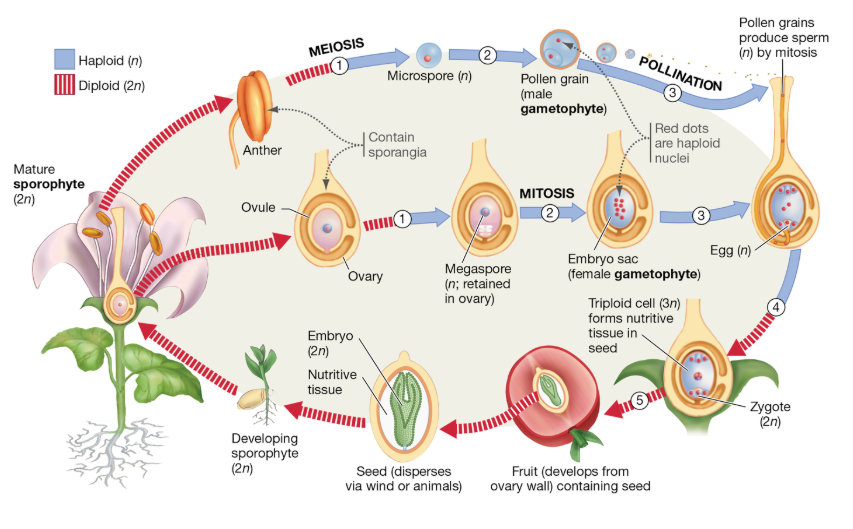
What is the step-by-step life cycle of a flowering plant?
Mature diploid sporophyte produces spores by meiosis.
Male route: meiosis produces microspores → develop into pollen grain (male gametophyte) → pollen grains produce sperm by mitosis
Female route: meiosis produces megaspores retained in the ovary → develops into the embryo sac with haploid cells (female gametophyte) → produces eggs
Pollination transfers pollen to a stigma
Fertilization occurs when sperm and egg unite. Triploid cell forms nutritive tissue in the seed, pollen grains create what becomes the zygote
Resulting diploid zygote develops in an embryo. First into a fruit w/ a seed → seed disperse via wind or animals
That embryo becomes a developing sporophyte → then grows into a mature sporophyte, completing the cycle
What are sepals and what is their function?
Leaf-like structures that form the outermost whorl of a flower (whorl is called a calyx)
Typically green and photosynthetic
Primarily protect the developing flower bud before it opens and help shield delicate reproductive structures from environmental damage
What are petals and what is their function?
Often brightly colored and scented structures that surround the reproductive organs of a flower
Primarily function to attract pollinators such as insects, birds, and bats
Can provide landing platforms and visual guides that direct pollinators toward nectar and pollen
Whorl of petals = the corolla
What is a stamen and what are its components?
Male reproductive structure of a flower consisting of the filament and the anther; primarily function in pollen production + dispersal
Filament is a slender stalk that supports the anther
Anther contains tissues where meiosis occurs and pollen is produced
Stamens generate the male gametophytes responsible for delivering sperm
What are the structures and functions of the carpel?
Female reproductive structure containing the stigma, style, and ovary that supports fertilization and seed development
Stigma is the sticky surface that receives pollen during pollination
Style is a stalk-like structure through which pollen tubes grow
Ovary contains ovules that house female gametophytes
What is the stigma and what role does it play in reproduction?
Uppermost portion of the carpel and serves as the pollen-receiving surface/entry point for male gametophytes
Sticky surface helps capture pollen grains delivered by wind, water, or pollinators
Pollen lands → stigma absorbs water and germinates initiating pollen tube growth towards the ovary
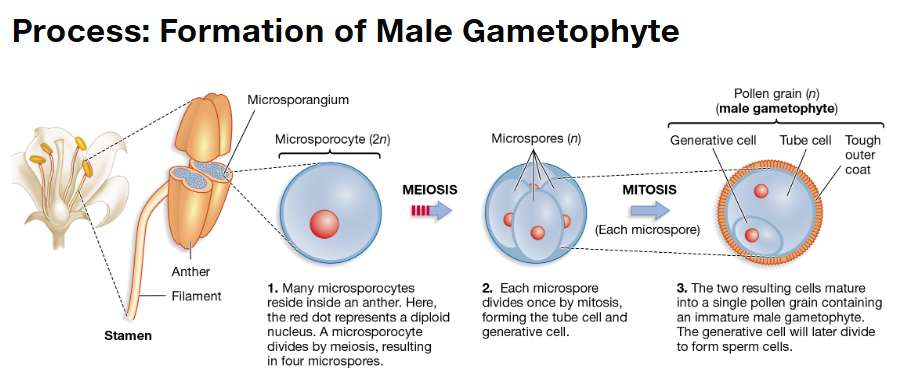
What is the step-by-step process of male gametophyte production?
1, Diploid microsporocytes within the anther undergo meiosis.
Meiosis produces four haploid microspores.
Each microspore undergoes mitosis once, forming the tube cell and generative cell
These two resulting cells mature into a pollen grain containing immature male gametophyte
The generative cell eventually divides to produce sperm cells
What is the style and what role does it play in reproduction?
Slender stalk located between the stigma and ovary
After pollination, pollen tubes grow through the style on their way to the ovules in the ovary
May also influence which pollen grains successfully achieve fertilization
What is the ovary and what role does it play in reproduction?
Enlarged basal portion of the carpel that contains one or more ovules and where female gametophytes develop
After fertilization, ovules develop into seeds and the ovary often develops into a fruit
Ovary houses the structures necessary for seed formation and protects developing ovules and embryos
Why is pollen considered a male gametophyte?
It’s a haploid multicellular structure that produces sperm and develops from a microspore produced through meiosis within the anther
The pollen grain contains a tube cell and a generative cell that eventually divides to produce sperm cells
It’s therefore the male gametophyte of flowering plants
What is an embryo sac and why is it important?
The mature female gametophyte of flowering plants
Develops within an ovule and contains the egg cell, synergids, and polar nuclei
Egg cell participates in fertilization and forms the zygote
Polar nuclei participate in double fertilization and contribute to endosperm formation
Embryo sac is essential for seed production b/c it houses the reproductive structures
What are synergids and what is their function?
Specialized cells located near the egg cell within the embryo sac.
Primarily function to help guide the pollen tube toward the egg
Release signals that help direct pollen tube growth into the ovule
What are polar nuclei and why are they important?
Haploid nuclei located within the central cell of the embryo sac
During double fertilization, one sperm fuses with the two polar nuclei which produces a triploid nucleus that develops into the endosperm.
That endosperm provides nourishment for the developing embryo
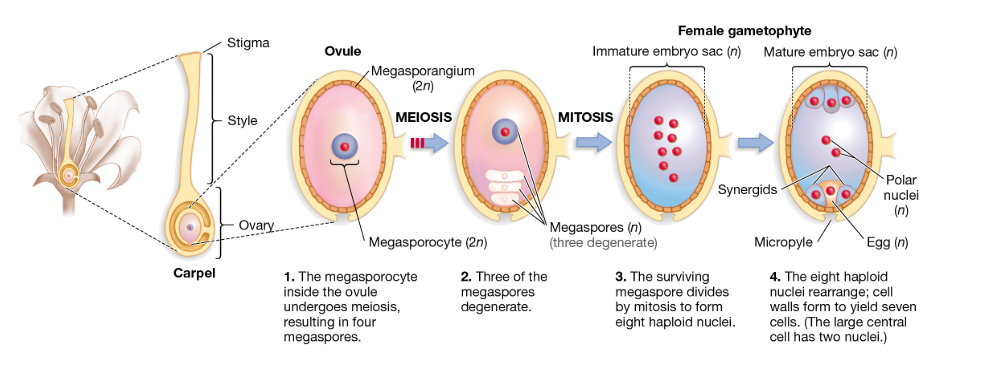
What is the step-by-step process of female gametophyte production?
A diploid megasporocyte within the ovule undergoes meiosis
Meiosis produces four haploid megaspores and three of them degenerate.
The surviving megaspore undergoes mitosis repeatedly to form 8 haploid nuclei within the developing embryo sac
Cellular organization/rearrangement of those eight nuclei produces the egg cell, synergids, and polar nuclei
That mature embryo sac functions as the female gametophyte.
What are advantages/disadvantages of self-pollination and outcrossing?
Self-pollination occurs when pollen fertilizes ovules on the same plant or flower
Guarantees that pollination can occur even when pollinators are scarce
However, it reduces genetic diversity and may increase inbreeding depression
Outcrossing occurs when pollen from one individual fertilizes ovules on a different individual
Generates greater genetic diversity and often improves disease resistance and adaptability
But successful pollination depends on external agents such as wind or animals
What are pollination syndromes?
Suites of flower traits associated with attracting particular pollinators (flower color, scent, shape, size, and nectar production)
Natural selection favors flower traits that improve pollination efficiency by the preferred pollinator
How do flowers attract different pollinators?
Bee-pollinated flowers are often brightly colored and may contain ultraviolet patterns that guide pollinators
Bird-pollinated flowers are frequently red and produce abundant nectar
Fly-pollinated flowers may emit odors resembling decaying material
Flowers often evolve to match those preferences and maximize pollination success
What are LURE molecules and what do they do?
Chemical attractants produced by cells near the egg within the female gametophyte
Primarily function to guide pollen tube growth toward the correct ovule
Growing pollen tube responds to these chemical signals and follows them through the ovule, ensuring accurate sperm delivery
What is double fertilization?
A unique reproductive process in which two sperm cells are delivered to the female gametophyte through a pollen tube
One sperm fertilizes the egg and produces a diploid zygote
The other sperm fuses with two polar nuclei to produce a triploid nucleus, which develops into the endosperm
How does double fertilization produce a diploid zygote?
One sperm cell fuses directly with the egg cell inside the embryo sac
Both the sperm and egg are haploid, each containing one set of chromosomes, so the fusion restores the diploid chromosome number
Resulting diploid zygote becomes the embryo of the next sporophyte generation
How does double fertilization produce a triploid endosperm?
The second sperm cell delivered by the pollen tube does not fuse with the egg, it fuses with two haploid polar nuclei located within the central cell of the embryo sac
Since the three haploid nuclei combine, the resulting nucleus is triploid (3n), which develops into the endosperm that functions as a nutrient-rich tissue that supports embryo development
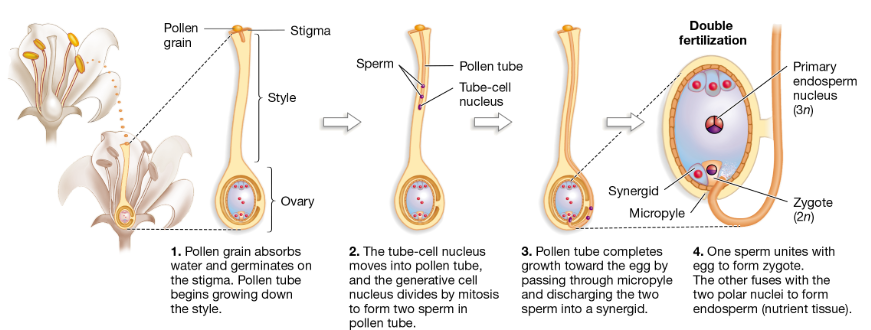
What is the complete step-by-step process of pollination and fertilization in flowering plants?
Pollen is transferred from an anther to a stigma
The pollen grain absorbs water and germinates
A pollen tube grows through the style toward an ovule
LURE molecules guide the pollen tube to the embryo sac
The generative cell produces two sperm cells
One sperm fertilizes the egg to form a diploid zygote
The second sperm fuses with two polar nuclei to form a triploid endosperm
Seed development begins.
What are seeds and what are their functions?
Structures produced after fertilization that contain a plant embryo, stored nutrients, and a protective seed coat
Their primary functions are protection, nourishment, and dispersal of the embryo
Allow offspring to survive unfavorable environmental conditions and germinate when conditions improve
Facilitate the spread of plants to new locations; contribute greatly to reproductive success.
What are fruits and what are their functions?
Mature ovaries that develop after fertilization and surround seeds
Primarily functions: protecting seeds and promoting seed dispersal
Many fruits are eaten by animals (transport), others are adapted for wind, water, or mechanical dispersal
Increase the likelihood that seeds reach suitable environments for germination
What are the major types of fruits and how do they differ?
Simple fruits develop from a single ovary within one flower
Aggregate fruits develop from multiple carpels within a single flower
Multiple fruits develop from clusters of flowers whose ovaries fuse together
Despite their differences, all fruits function in seed protection and dispersal
What is embryogenesis?
Developmental process through which a fertilized zygote becomes a multicellular plant embryo
Est the basic body plan of the plant and produces structures that will support future growth
Includes several developmental stages characterized by cell division and differentiation; meristematic tissues are established that become the ultimate source of cells in the mature plant
What happens during zygote division in flowering plants?
First division of the zygote is asymmetrical and produces two distinct cells
Smaller apical cell forms the embryo proper, while a larger basal cell contributes to the suspensor
This division establishes the apical-basal axis of the developing plant.
What are the apical cell and basal cell?
Apical cell: smaller daughter cell produced by the first zygotic division and gives rise to most of the embryo
Basal cell is the larger daughter cell and contributes primarily to the suspensor which helps transfer nutrients from the parent plant to the developing embryo
Formation creates the foundation for later embryo organization
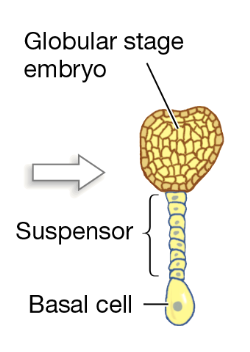
What is the globular stage?
The globular stage is an early embryonic stage where the embryo is a roughly spherical mass of cells.
Rapid mitotic divisions increase cell number and developmental complexity.
The embryo's radial organization is established during this stage.
It is one of the first clearly recognizable stages of embryogenesis and precedes the formation of more specialized structures.
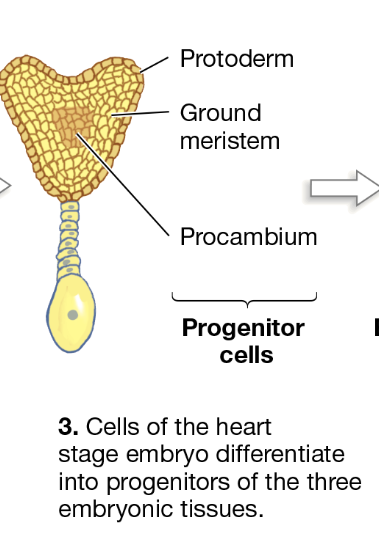
What is the heart stage?
Follows the globular stage and is characterized by two lobes that give the embryo a heart-like appearance.
During this stage, the three primary meristems are established: protoderm, ground meristem, and procambium.
These meristems begin differentiating into the plant's major tissue systems.
The heart stage is a critical transition that greatly increases developmental organization.
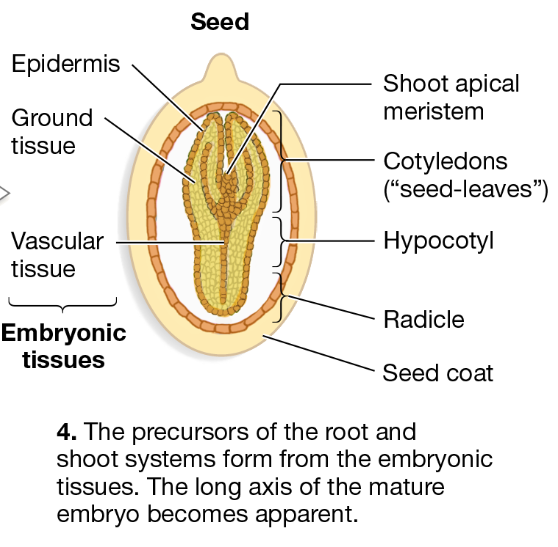
What structures are present in the mature embryo?
Cotyledons (seed leaves) store nutrients and assist in early development
Hypocotyl forms part of the embryonic stem
Radicle develops into the primary root system
All these structures are established before germination occurs and prepare the embryo for successful growth into a seedling.
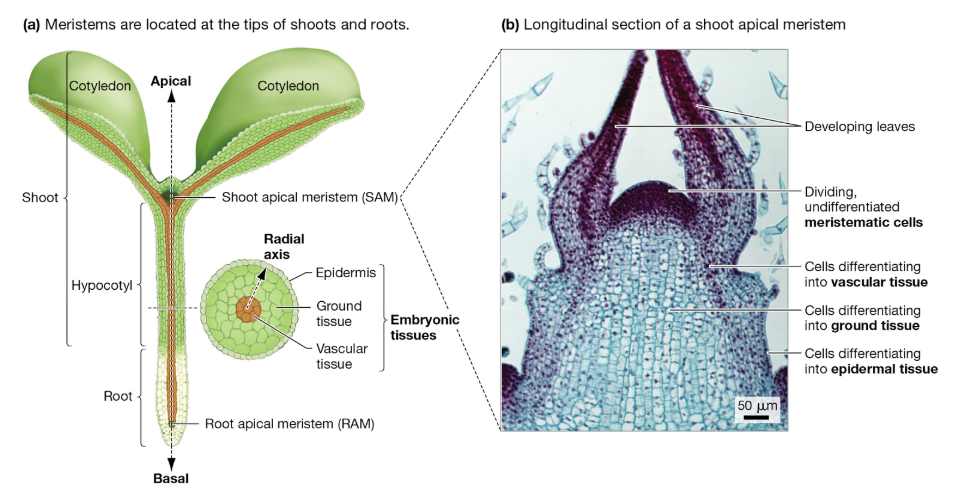
What are meristems?
Regions of undifferentiated cells capable of continuous cell division
Function as stem cell populations that produce new cells throughout the life of a plant, allowing the plant to continuously grow/generate new organs long after embryogenesis
How does embryogenesis establish meristems?
During embryogenesis, groups of cells become organized into meristematic tissues.
Meristem cells remain undifferentiated and retain the ability to divide repeatedly; serve as the plant's long-term source of new cells and are essential for continued growth
Meristems are positioned in locations that support future plant growth.
What are the three primary meristems?
Protoderm, ground meristem, and procambium; their formation begins during the heart stage of embryogenesis and are essential for tissue differentiation
Protoderm gives rise to dermal tissues
Ground meristem produces ground tissues
Procambium produces vascular tissues
What tissues develop from the protoderm?
The protoderm is the outermost primary meristem that develops into the dermal tissue system, including the epidermis
These tissues form the protective outer covering of the plant body, help reduce water loss, provide protection against environmental stress/pathogens
What tissues develop from the ground meristem?
The ground meristem develops into the ground tissue system that has numerous functions including photosynthesis, storage, and structural support
Ex’s Examples include parenchyma, collenchyma, and sclerenchyma cells
These tissues occupy much of the plant body between dermal and vascular tissues and produce a diverse array of important cell types.
What tissues develop from the procambium?
The procambium develops into the vascular tissue system including xylem and phloem that which transport water, minerals, and sugars throughout the plant
Form the transport network that connects roots, stems, and leaves; efficient transport is essential for plant survival and growth
What are root and shoot apical meristems and why are they important?
Regions of actively dividing cells located at the tips of roots and shoots
Drive primary growth (increases the length of the plant body)
Shoot apical meristem produces stems, leaves, and flowers; root generates root tissues
Support lifelong growth and development