Strategic Management Mid-Term
 Call Kai
 Learn
Learn Practice Test
 Spaced Repetition
 Match
Match Flashcards
 Knowt Play
1/38

Earn XP
Name | Mastery | Learn | Test | Matching | Spaced | Call with Kai |
|---|
No analytics yet
Send a link to your students to track their progress
39 Terms
PESTLE acronyms
Political, Economic, Social, Technological, Legal, Envirnomental
Golden Circle layer
why, how, what
Why (Golden Circle)
Where the organization is going, and for what reason (objectives)
How (Golden Circle)
How the organization is going to get there (Business Strategy/ Corporate Strategy)
What (Golden Circle)
What are we doing (everyday) to get there (Tactics/ Operations)
Macro Environment
Bigger factors. Use PESTLE
Micro Environment
Smaller factors, more local, Use Porters 5 forces
Porters five forces model
Framework for analyzing industry structure
Includes: threat of new entrants, bargaining power of buyers, bargaining power of suppliers, threat of substitute products, competitive rivalry
Helps assess competitive intensity and attractiveness of an industry
Threat of new entrants
Assesses the risk of new competitors entering an industry, potentially increasing competition, lowering prices, and reducing profits for existing firms.
Threat of subsittutes
Refers to products or services that can fulfill the same need as the original product. This can impact a company's competitiveness and market share. Companies must be aware of potential substitutes to stay relevant.
Buyer power
Refers to the influence customers have over a company in terms of negotiating prices, quality, and terms of sale. It is one of Porter's Five Forces that impact an industry's competitiveness.
Supplier power
Refers to the influence and control that suppliers have over the prices, quality, and availability of goods or services they provide to businesses. It is a key aspect of Porter's Five Forces framework in analyzing industry competitiveness.
Competition
Rivalry between individuals, groups, or entities for resources, recognition, or other goals. It can drive innovation, improve performance, and lead to better outcomes in various fields.
Value chain
Series of activities that a company performs to deliver a valuable product or service to the market. It includes primary activities (inbound logistics, operations, outbound logistics, marketing, sales, and service) and support activities (firm infrastructure, human resource management, technology development, and procurement).
Value chain support activities
Activities such as procurement, technology development, human resource management, and firm infrastructure.
Value chain primary activities
Directly involved in the creation and delivery of a product or service. They include inbound logistics, operations, outbound logistics, marketing and sales, and service.
VRIO framework
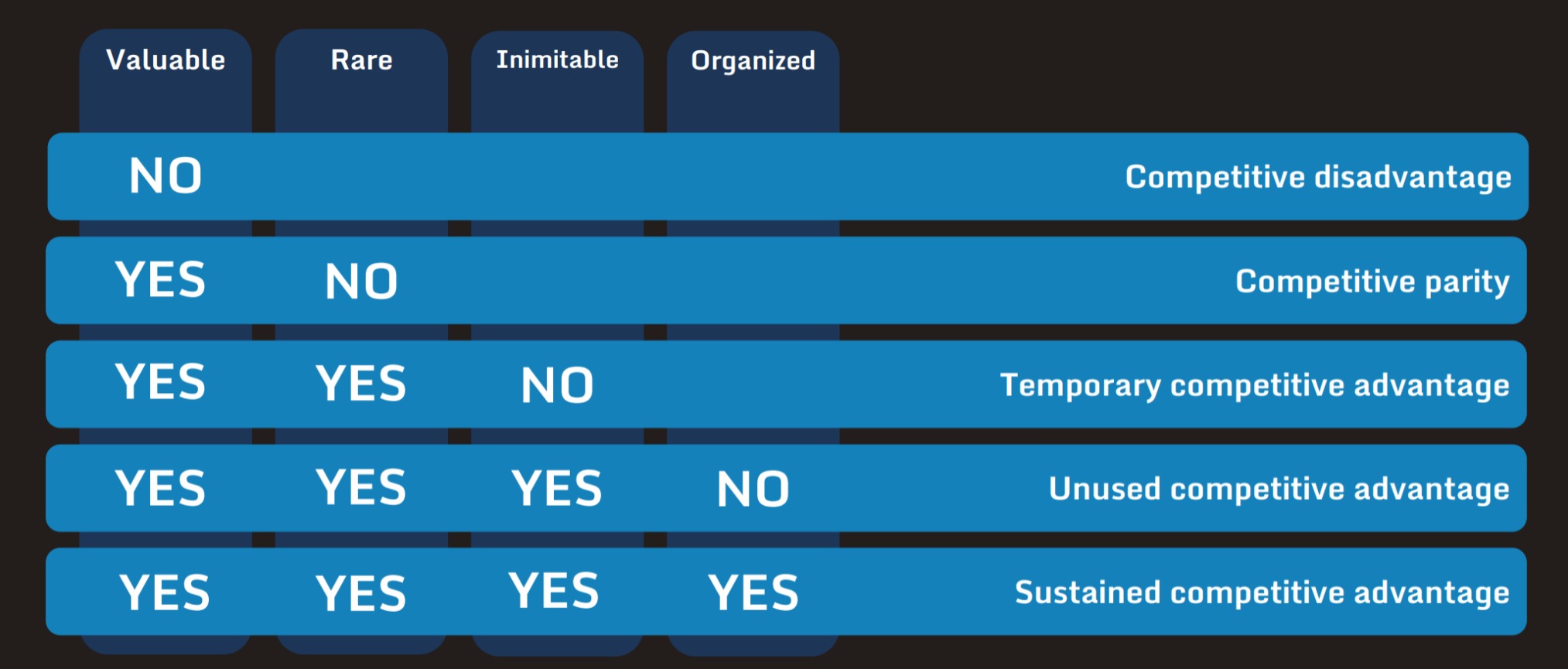
Tool used to analyze a firm's internal resources and capabilities. It assesses if resources are Valuable, Rare, Inimitable, and Organized to provide sustained competitive advantage.
Competitive advantage
Refers to a company's ability to outperform its rivals by offering unique products or services, lower costs, or superior value to customers. It allows a company to differentiate itself in the market and achieve higher profits.
VRIO model
Cost advantage
Refers to a firm's ability to produce goods or services at a lower cost than its competitors, giving it a competitive edge in the market.
Differentiation advantage
Stategy where a company seeks to distinguish its products or services from competitors to attract customers. This can be achieved through unique features, branding, quality, or customer service.
Corporate strategy
Set of actions taken by a company to achieve its long-term goals and objectives. It involves decisions on which businesses to enter, how to allocate resources, and how to create value for stakeholders.
Red ocean
Refers to existing market spaces where competition is fierce, leading to limited growth opportunities. Companies compete mainly on price and features, resulting in a bloody battle for market share.
Blue ocean
Theory that focuses on creating uncontested market space by innovating and offering unique value to customers, leading to high growth and profits. It involves moving away from competition to a new market space with less competition
Firm geographical level
Refers to the scope of operations of a company in terms of the geographic areas it serves or operates in. It involves decisions related to market expansion, distribution channels, and location of facilities.
Firm business level
Refers to the strategies and actions a company takes to compete within a specific industry or market segment. It involves decisions related to product differentiation, cost leadership, and focus strategies to gain a competitive advantage.
Horizontal integration
Strategy where a company acquires or merges with competitors at the same stage of the production process to expand its market share or reduce competition. Ex: Amazon acquiring MGM or other logistics companies.
Vertical integration
Strategy where a company controls multiple stages of the supply chain, from production to distribution, to gain more control over costs and quality. It can involve backward integration (towards suppliers) or forward integration (towards customers). Ex: Disney making their own movies without outside help.
Diversification integration
Refers to a strategy where a company expands its business into new markets or industries to reduce risk and increase profitability. This can involve related diversification (entering industries similar to current operations) or unrelated diversification (entering completely different industries) Ex: Virgin industries.
Question mark
High market attractiveness, low market share
electric city scooters
Star
High market attractiveness, high market share
YouTube
Cash Cow
High market share, low market attractiveness
iPhone
Dog
Low market attractiveness, low market strength
DVD’s
Multi-domestic integration
Tailors products to match local preferences in each market where it operates
Nestle
Transnational
Balances global brand consistency with localized offerings
McDonald’s
Global
Offers same products and brand imaging across all markets across the world
Apple
Market Amplification
Extending brand reach to a broader audience through increased engagement and prospective customer acquisition
Example: iPhone when it became popular
Market reduction
Situations where interference significantly affects prices or market behavior, often caused by government regulations or monopolies
Example: Government bans like cigarettes
Market Distortion
Occurs when external factors, like government interventions or monopolies, disrupt the regular functioning of a market, affecting prices and resource allocation
Example: US intervening with car companies