Social psych- Chapters 9, 10, 12, 13
 Call Kai
 Learn
Learn Practice Test
 Spaced Repetition
 Match
Match Flashcards
 Knowt Play
1/124

There's no tags or description
Looks like no tags are added yet.
Name | Mastery | Learn | Test | Matching | Spaced | Call with Kai |
|---|
No analytics yet
Send a link to your students to track their progress
125 Terms
What is a group?
A set of two or more people who interact and are interdependent (their needs and goals cause them to influence each other)
People in a group have :
-Direct interactions with each other over a period of time
People in a group have joint membership in a social category based on…
sex, race, or other attributes
People in a group have a shared…
common fate, identity, or set of goals
Social Brain Hypothesis
Humans are drawn to groups for survival and reproduction
Large brains among primates reflect this tendency
Social identity theory
People’s feelings of self-worth are derived from group membership
3 key features of a group: #1
Roles- individuals expected behaviors
3 key features of a group- #2
Norms- rules of conduct
3 key features of a group- #3
Cohesiveness- closeness
The two fundamental types of roles:
-Instrumental role
-Expressive role
Instrumental role
helps the group achieve its tasks
Expressive role
provides emotional support and maintains morale
group norms can be…
formal or informal
Groups exert pressure on members who…
deviate from the norms
Group cohesiveness
the extent to which members are attracted to each other and motivated to stay in the group
Cohesiveness and group performance are…
casually related, but the relationship is complex
-group cohesiveness can be affected in different ways as a function of cultural differences
Social Facilitation (Zanjonc, 1965)
Social facilitation: presence of other people → arousal → dominant response → performance improves on easy tasks, but performance declines on hard tasks
Easy task: A runner may run faster during a race because the crowd energizes them.
Hard task: A student may do worse solving a tough math problem while others watch because pressure increases mistakes.
Why does the presence of others cause arousal
-Makes us more alert as they may do something we need to respond to
-Evaluation apprehension (concerned about being judged)
-People are distracting (attentional conflict)
Evaluation apprehension
the concern about being judged by others, which can lead to increased arousal and influence performance.
Attentional Conflict
Divided attention
Social loafing
Social loafing is the tendency for people to put in less effort when working in a group than when working alone, especially when individual contributions are hard to identify.
Ex: group project
how does social loafing work
Presence of other people → NO AROUSAL → RELAXATION → performance declines on easy or unimportant tasks, but performance improves on hard or important tasks
People “loaf” less when…
Individually evaluated or rewarded
Task is important or meaningful
Individual effort necessary for success
The group expects to be evaluated on performance
The group is small and cohesive
Social dilemmas
-Conflicts, where if individuals choose an outcome that’s best for them, everyone suffers in the long run
-Selfish choices create the worst outcome for the group
What is the saying about social dilemmas
“What’s good for one is bad for all”
Prisoner’s Dilemma
-Involves two people who each have a decision to either be selfish or cooperate for a mutually beneficial outcome. If both cooperate, they achieve a better result than if both choose selfishly
Benefits/costs of the decision depend on partners decision
Selfish choices create the worst outcome for the group
Golden Balls Game Show- split or steal
A game where two contestants must decide to either split the prize money or steal it, where stealing leads to a higher reward for one but nothing for the other if both choose to steal.
Real world examples of prisoner’s dilemma
Cutting up while driving
Escaping a fire
Two types of resource dilemmas:
Common goods dilemma, public goods dilemma
Common goods dilemma
“Tragedy of the Commons”: scenario where individuals, acting in their own self-interest, deplete shared resources, causing long-term collective ruin
Modern examples of common goods dilemma
deforestation, overfishing, toilet paper during COVID
Public goods dilemma
Everyone is supposed to contribute to the common pool
If we don’t all contribute, then the public good in question disappears
Modern examples of the public goods dilemma
Blood drives, paying taxes, paying dues in frats/sororities
Solving dilemmas
More likely to cooperate when dealing with family and close others
Individuals are more cooperative than groups
Framing of the dilemma matters too
Framing of the dilemma example
“Wall Street” game versus “community” game
Participants played the same Prisoner’s Dilemma-style game, but it had different names:
Wall Street Game → sounded competitive, profit-focused, win-lose
Community Game → sounded cooperative, shared-interest, teamwork
Even though the rules were identical, people in the Wall Street Game acted more competitively, while people in the Community Game cooperated more.
In solving group dilemmas, conflict escalates when…
group distinctions (in-group versus out-group bias) are strong
One way to reduce group dilemmas is to appeal to a…
superordinate identity
superordinate identity
a shared identity that transcends individual group memberships, promoting cooperation and reducing intergroup conflict.
Ex: People from different states seeing themselves as Americans during a national crisis United States
Process loss
-Any aspect of group interaction that inhibits group performance
Ex: people don’t listen to each other, 1 person dominates the conversation, rely on shared knowledge vs unique
Process gain
-When a group performs better than expected because members help each other and combine strengths effectively.
Ex: Not changing mind for the sake of harmony, relies on a person with expertise, searches for good solutions rather than compromises
Group polarization
When individuals who have similar, though not identical, opinions participate in a group discussion, their opinions become more extreme
Ex: A jury initially thinks a defendant is somewhat guilty. After discussing the case together, members become much more convinced the defendant is guilty and recommend a harsher punishment.
What creates group polarization
Persuasive arguments, social comparisons
How do persuasive arguments lead to group polarization?
Exposure to a large number of persuasive arguments→ extreme views
How do social comparisons lead to group polarization?
Comparison to views of other group members → more extreme views
Ex: A group of friends talks about environmental issues. At first, most think recycling is important. During discussion, everyone hears others strongly supporting eco-friendly habits. Wanting to seem caring and responsible, members begin expressing stronger views than they originally held, such as banning all plastic or refusing to buy from certain companies. By the end, the group holds a more extreme environmental stance than any individual had at the start.
social comparison
The process by which individuals evaluate their own opinions or abilities by comparing them to those of others in their group, often leading to more extreme positions or beliefs.
Ex: A student thinks they studied enough, but after seeing classmates study for five hours, they feel unprepared.
Need for Affiliation
A pervasive drive to form and maintain lasting, positive, and significant interpersonal relationships
A fundamental human drive and motive
Schacter (1959)
Tested whether anxiety increases people’s desire to be with others by telling participants they would receive either painful or mild electric shocks.
Participants in the high-anxiety (painful shock) condition were much more likely to choose to wait with others, while low-anxiety participants preferred to wait alone.
Conclusion: Anxiety increases the need for affiliation, as people seek others for comfort and to compare their feelings in stressful situations.
Determinant of attractiveness
-Proximity
-Familiarity
-Similarity
-Physical attraction
-Reciprocal liking
Propinquity effect (related to proximity)
Propinquity effect: the tendency to form friendships or romantic relationships with those they encounter often
The single best predictor if two people will begin a relationship
Not just physical distance but functional distance as well
Mere exposure effect (related to familiarity)
the more exposure we have to a stimulus, the more likely we are to like it
Moreland and Beach (1992)
-Familiarity
Moreland & Beach (1992) had 4 women confederate sit in on a large lecture hall
All of the women attended the class for different amounts of time
The women who attended the class the most were viewed as the most attractive
Matching hypothesis (related to similarity)
people are more likely to become romantically involved with others who are equivalent in physical attractiveness
Similarity- experiences and interests
people who have similar experiences and interests (age, race, religion, education, politics) are more likely to be attracted to each other
How do men and women differ in importance of physical attractiveness?
Men weigh physical attractiveness more than women, but behaviorally, men and women behavior similar (equally important)
Objective perspective
symmetrical faces (indicator of good genes)
subjective perspective
ideal body type changes over different eras and times and times
reciprocal liking
Ex: someone liking you first, and then you start to like them more when you find out they like you
ender Differences in Mate Preferences: Evolutionary Perspective (Women)
Suggests that women need to be pickier than men
Limited by reproductive biology
Preference for men can provide resources/support
Economic and career achievements
Gender Differences in Mate Preferences: Evolutionary Perspective (Men)
Suggests that men may not be as picky as women
Less limited by reproductive biology
Preference for markers of fertility
Physical appearance: age and health
Gender Differences in Mate Preferences: Sociocultural Perspective
Society has different expectations and roles for men and women
Men approach women = women are more selective
Other gender roles
Different access to resources and power
The more economic power women have, the more they value physical attractiveness
Evolutionary perspective on mate selection
need to pass on our genes = influences mate selection preferences
Sociocultural perspective on mate selection
learned norms, social roles = influences mate selection preferences
Speed dating study (finale and Eastwick, 2009)
Two conditions: men rotating, women rotating
Regardless of gender, rotaters were less selective than sitters
Rotaters felt there was greater romantic chemistry than sitters
Types of jealousy
Sexual jealousy, emotional jealousy
sexual jealousy
based on suspected or imminent sexual infidelity
emotional jealousy
based on suspected or imminent emotional infidelity
Women typically are more upset by emotional infidelity
A woman is more likely to take a man back following sexual infidelity
Men are more sexually jealous because men face paternal uncertainty (Evolutionary)
Masculinity tied to sexual prowess = sexual infidelity threatens masculinity (Sociocultural)
Women risk the loss of resources and commitment if their partner finds another (evolutionary)
Women socialized to be nurturers and value relationships = emotional infidelity viewed as more threatening to the sense of self than sexual identity (sociocultural)
Types of love
companionate love, passionate love
Companionate love
intimacy and affection not accompanied by physiological arousal
passionate love
intense longing for someone accompanied by physiological arousal
Triangular Theory of Love
A framework proposed by Robert Sternberg that describes love in terms of three components: intimacy, passion, and commitment.
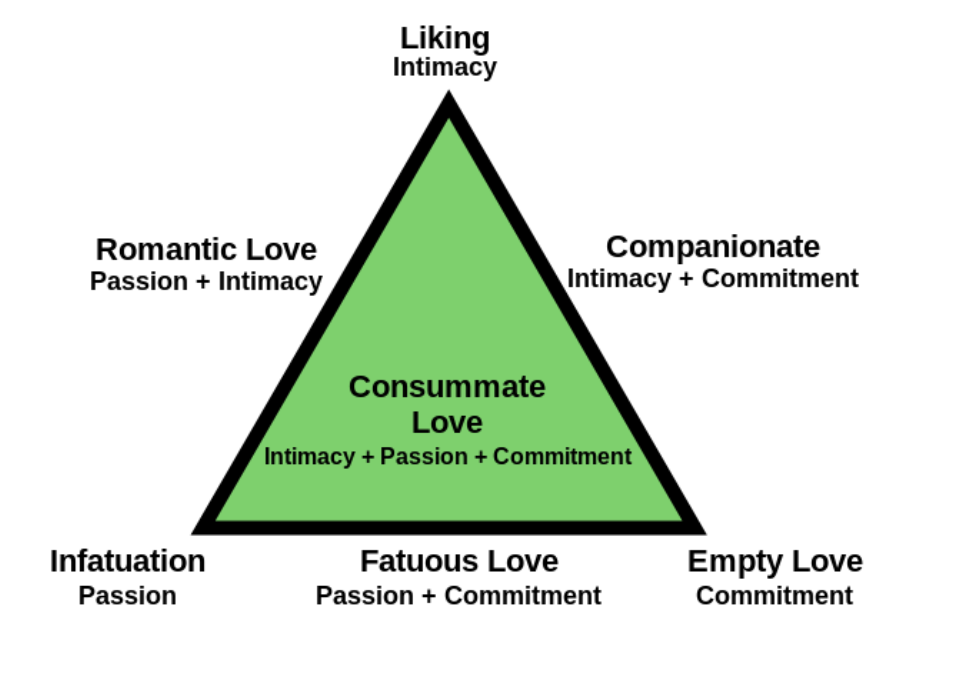
Relationship satisfaction: Social exchange theory
Benefit: traits, behaviors, status, money, network, activities
Cost: annoying traits, behaviors, etc.
Comparison level: expectation of the outcome of your relationship
High comparison or Low comparison
Comparison level for alternatives: satisfaction bsased on perception of relationship could be replaced with something better
Relationship Satisfaction: Equity Theory
Most satisfied when rewards/cost are fairly equal
Equitable relationships comfortable/satisfying
Overbenefited partner = guilty
Underbenefited partner = angry, resentful
Exchange relationships
need equity in relationships; more typical in new relationships
Communal relationships
primary response is other people’s needs; More typical in long-term, reciprocal relationships
What is aggression?
Behavior that is intended to harm another individual (even if they dont actually harm)
The harm may be _____ or _____
physical or psychological
Instrumental aggression
harm inflicted as a means to a desired end
Ex: football, self defense
Hostile aggression
Harm inflicted for its own sake, usually stemming from anger
Ex: a heated argument that escalates into a physical fight.
Origins of aggression through Evolutionary psychology
Aggression is innate, adaptive, and promotes genetic survival
Human warfare originated not only to obtain valuable resources but also to attract mates and forge intragroup bonds
Emphasis is placed on genetic survival rather than survival of the individual
Accounts for the inhibition of aggression against genetically related others
Predicts gender differences in aggressive tendencies
Men and women should use different tactics to ensure reproductive success
Why do men aggress
to display to women that they are high status mates
in response to sexual jealousy
Why do women aggress
To defend their offspring (due to high investment)
To protect themselves so they can protect their offspring
Indirect or relational (low risk) aggression is most likely
Are men more aggressive than women?
No, but boys are more overtly aggressive than girls. Girls display more relational aggression than boys
relational aggression
a form of indirect aggression that targets a person’s relationships and status
Gender Differences: Non-Evolutionary Perspectives
Males and females are rewarded differently for aggression
Overt aggression more acceptable for boys
Social learning theory
Behavior is learned through the observations of others, as well as through direct experience of rewards and punishments
Rewards and punishment through the lens of the social learning theory
Rewards increase aggression
Punishment decreases aggression
Learn specific aggressive behaviors
Develop more positive attitudes and beliefs about aggression in general
Positive reinforcement
Aggression produces desired outcomes
Ex: receiving cheers from friends for punching another person
Negative reinforcement
Aggression prevents or stops undesirable outcomes
Ex: Punching another person stops that person from intimidating or bullying you
“Bobo the Doll” Study (Bandura et al., 1961)
IV: Role model behavior
DV: number of aggressive acts
Constrict aggressive “scripts” – cycle of violence
Origins of aggression- culture
Cultures with cooperative and collectivist values have lower levels of aggression than European societies
Culture of honor
emphasizes honor and status, particularly for males, and the role of aggression in protecting that honor.
“A**hole Study” (Cohen et al., 1996)
Participants: U of Michigan students who grew up in the North or South
IV: insult or no insult
DV: perceptions of threatened masculinity, levels of testosterone, and aggressive behaviors displayed (Game of Chicken)
South had stronger results for aggression
Stereotypes (cognition)
beliefs that associate a whole group of people with certain traits
prejudice (affect/feeling)
negative feelings about others because of their connection to a social group
discrimination (behavior)
negative behaviors directed against persons because of their membership in a particular group
Social Categorization
The process by which we place people into meaningful social groups
What is the consequence of social categorization?
stereotypes
stereotypes are inevitable but social categorization isn’t because….
We overestimate the difference between groups
Underestimate the differences within groups
Focus on stereotype-consistent information
Don’t notice (rationalize way) inconsistent information
Study (labeling lines)
The lines that were labeled were remembered differently
Displayed underestimating differences within groups and overestimating the differences between groups
Outgroup homogeneity
belief that there is greater similarity among outgroups than ingroups